The One in One Hundred Child

The One in One Hundred Child

The One in One Hundred Child

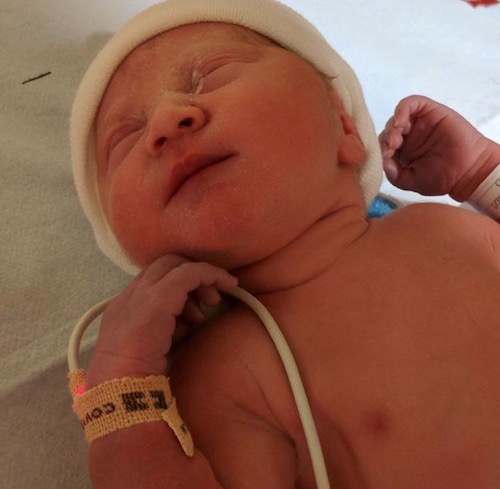
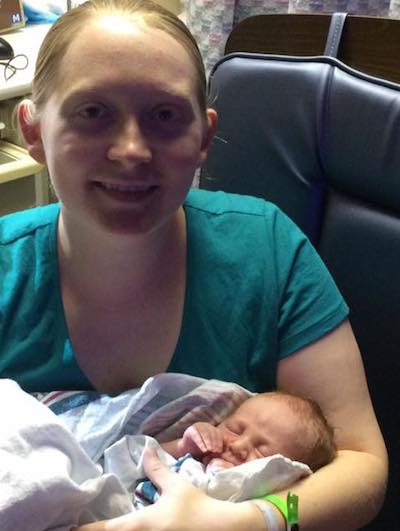
Valentine’s Day is an opportunity to remember the one in one hundred child born with a heart defect. In her heartfelt poem, guest blogger Stephanie Ballard profiles some of the one in one children born with heart disease and the families who are their advocates.

The One in One Hundred Child

You came home with a big red heart
That you had made at school
You wrote your own name in the middle
You asked me, “Mom isn’t it cool?”

“It’s beautiful,” I said to you
As pride swelled in my chest.
“When it comes to paper hearts
Yours really is the best.”

The glitter and lace
A mirrored reflection
So carefully placed
In sincere perfection.

I think about your real heart
On the inside, where others can’t see.
It won’t ever be perfect.
You have a CHD.

You are that one in one hundred–
We’ll never know what to expect.
Our lives have been forever changed
By the words heart defect.

A precious baby girl was born
In nineteen eighty-four
Her mother surely held her
Not knowing what was in store.

Her hopes and dreams were shattered
By the words that would be spoken.
Her tiny, brand new baby girl
Was born with a heart that was broken.

Things were different in that time.
Options weren’t as clear.
Although the baby did not live,
She is a pioneer.

Her mother named her Stephanie–
You can still read her story today.
She received the first baboon heart.
We call her “Baby Fae.”

She was the one in one hundred
Her family decided to give
So medical science could progress
And future heart children might live.

A mother and father get out of their car,
Taking their son’s tiny hand.
The little boy shifts restlessly,
Too young to understand.

Mommy has fresh flowers
Dad has a shiny new balloon
He doesn’t know they’re for his brother
Whose young life was taken too soon.

His small hands touch a well worn stone.
He says, “Wish you were here.”
His parents kneel beside him
Wiping away every tear.

Their child was one in one hundred,
And now they are living apart,
Countless children die each year,
Due to a broken heart.

The technician tells her to relax
The gel should still be warm
She rubs her pregnant belly
Discomfort is the norm.

Her husband smiles back at her
As she gives him a quick wink
Soon they will have their answer
Will it be blue? Or will it be pink?

The tech starts to look a bit nervous
In a flash there are doctors and chatter
She looks at her husband with tears in her eyes
Asking, “What do you think is the matter?”

They are the one in one hundred
How could they ever expect
The child they have been waiting for,
Would have a heart defect?

We are the one in one hundred,
We did not make this choice,
We share, reflect…remember,
We are our children’s voice.

Do you like what you see at DifferentDream.com? You can receive more great content by subscribing to the quarterly Different Dream newsletter and signing up for the daily RSS feed delivered to your email inbox. You can sign up for the first in the pop up box and the second at the bottom of this page.

By

Stephanie Ballard is the mother of two sons, her youngest son, Braeden, was born with Kabuki Syndrome and congenital heart defects. Her oldest son, Colin is in the military. She enjoys writing poetry and life lessons about her journey in life.

Author Jolene Philo

Archives

Categories

Subscribe for Updates from Jolene

Related Posts

How Will You Feel Loved this Valentine’s Day?

How Will You Feel Loved this Valentine’s Day?

How Will You Feel Loved this Valentine’s Day?

How will you feel loved this Valentine’s Day? That’s a question I’ve been asking myself often as I listen to couples raising kids with special needs talk about their relationships during interviews for Sharing Love Abundantly With Special Needs Families: The 5 Love Languages® for Parents Raising Children with Disabilities. The other question that comes to mind is equally important: How will my spouse feel loved this Valentine’s Day?

Dr. Gary Chapman, identifies the 5 love languages as gifts, acts of service, quality time, words of affirmation, and physical touch. Many years ago, Chapman’s 5 love languages quiz confirmed what I already knew. Acts of service and words of affirmation are the ways I receive love. Next comes quality time. But gifts and physical touch mean very little to me. Conversely, the best way to show love to my husband is through physical touch, followed closely by quality time. Acts of service weighs in at number 3. Words of affirmation and gifts mean next to nothing to him.

If only, my husband and I have often told one another, we had known about the 5 love languages early in our marriage. Those were the years when caring for our son with special needs comprised the bulk of every day. We had little time to work on our marriage as we fought to keep our baby alive.

When we did try to communicate love to each other, our efforts fell flat. He would hug me or try to hold my hand, which meant a great deal to him but very little to me. I tried to be helpful and praise him for what he did for our family, but my efforts barely penetrated his consciousness.

If we had known about the 5 love languages in those days when we were constantly exhausted and stressed, we could have used that information to energize one another. He could have garnered my undying love by clearing the table and doing the dishes or folding the laundry. I could have made him fee cherished and loved with a kiss and a hug before he went to work and a back rub while he held our baby in the evening.

Over the years, we’ve learned to speak each other’s love language. So this Valentine’s Day won’t involve exchanging expensive gifts because that language means little to either of us. Instead, he’ll speak my language by taking me out to dinner so I don’t have to cook that night. I’ll speak his language by holding his hand on the way to the restaurant and snuggling in bed before we drift off to sleep.

What we didn’t know then, I want you to know now while you’re in the thick of caring for your child. You are exhausted and stressed, and you need every available tool to safeguard your marriage this Valentine’s Day. So if you haven’t yet determined your love language or your spouse’s, I encourage you and your spouse to take this online quiz right away.

Once you know your love language and your spouse’s, you can find a creative way to express love to one another clearly and effectively. And once you do that, you will both feel loved in ways you never have before even while you’re engrossed in caregiving and parenting. What are you waiting for? Take the quiz and make this Valentine’s Day the best ever for you, for your spouse, and for your children.

Do you like what you see at DifferentDream.com? You can receive more great content by subscribing to the quarterly Different Dream newsletter and signing up for the daily RSS feed delivered to your email inbox. You can sign up for the first in the pop up box and the second at the bottom of this page.

By

Jolene Philo is the author of the Different Dream series for parents of kids with special needs. She speaks at parenting and special needs conferences around the country. She’s also the creator and host of the Different Dream website. Sharing Love Abundantly With Special Needs Families: The 5 Love Languages® for Parents Raising Children with Disabilities, which she co-authored with Dr. Gary Chapman, was released in August of 2019 and is available at local bookstores, their bookstore website, and at Amazon. The first book in her cozy mystery series, See Jane Run!, features people with disabilities and will be released in June of 2022.

Author Jolene Philo

Archives

Categories

Subscribe for Updates from Jolene

Related Posts

Sharing Special Needs Love this Valentine’s Day

Sharing Special Needs Love this Valentine’s Day

Sharing Special Needs Love this Valentine’s Day

Sharing special needs love is often a one way street where others support caregiving families by encouraging and giving to them. Trish Shaeffer, mom to sons with special needs, suggests ways families can reciprocate by showing appreciation and giving back this Valentine’s Day.

As Valentine’s Day approaches, we sometimes forget what the holiday is really about thanks to the big markets out there for candy and cards and more. It can be overwhelming, trying to decide what to get and who to get a box of candy or card for.

Yet Valentine’s Day should be a day when we slow down by sharing special needs love and appreciate all who are there for us. Whether your encourager is a friend, boyfriend, girlfriend, classmate, teacher, parent, husband, wife, or child–you don’t need to spend tons of money or buy a dozen roses to show that you appreciate what they do. All it takes is a hug, a shared day together, a handmade card, a homemade meal, or a thoughtful favor done for someone.

One small gesture is all you need. Showing people you care is contagious and will continue to spread the special needs love you’ve received. Even better, you are showing your children how to show love, acceptance and helping those in need.

I challenge you this Valentine’s Day to spread the love by doing something small that could make a huge impact on someone’s life. Here are some more simple ideas to spread the love:

  • Volunteer to help spread the special needs love through delivering Meals on Wheels or spending time at a senior center with those that may not have many visitors.
  • Pay for the coffee of someone behind you in line.
  • Volunteer at an animal shelter or donate some old towels or blankets for the animals to have something to sleep with.
  • Bake some cookies for your neighbor.
  • Hand make a card for your child or significant other.
  • Make dinner together as a family.
  • Donate items to a local homeless shelter.
  • Volunteer to cuddle NICU babies at the hospital.
  • Donate items to the Ronald McDonald Family Room. Coloring books, snacks, and  coffee are a few good suggestions.
  • Give someone a hug or high five.

If you have more ideas about sharing special needs love on Valentine’s Day or all year round, leave a comment below.


Do you like what you see at DifferentDream.com? You can receive more great content by subscribing to the quarterly Different Dream newsletter and signing up for the daily RSS feed delivered to your email inbox. You can sign up for the first in the pop up box and the second at the bottom of this page.

By

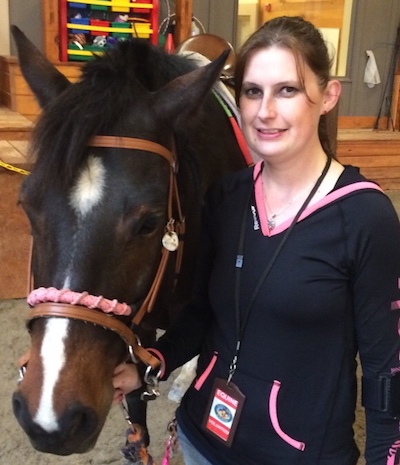
Trish Shaeffer mom of 3 active boys, a 9-year-old and 5-year-old twins who were born 2 months early and have special needs. She’s a peer supporter for Parent to Parent and volunteers with the United Cerebral Palsy Network, Special Olympics, and the United Way. She’s also an equine volunteer at Leg Up Farm. She’s married to her best friend and biggest supporter, Chris Shaeffer.

Author Jolene Philo

Archives

Categories

Subscribe for Updates from Jolene

Related Posts

Our Bittersweet EA/TEF Symphony

Our Bittersweet EA/TEF Symphony

Our Bittersweet EA/TEF Symphony

A bittersweet EA/TEF symphony. That’s how guest blogger Janae Copeland describes the life of her daughter who was born with EA/TEF in 2010. In today’s post, Janae explains how she learned to read the music of her daughter’s life. What a fitting and rousing finale to EA/TEF Awareness Month, 2018.

All my life, I trained for sound. Specifically, I was trained to make musical sounds and improve the musical sounds of others. Until that day in August, I never dreamed I would be thrust into a small pod of a room, surrounded by sounds that could no longer be shaped by my words or gestures, but that were completely at the command of my daughter’s tiny body and its ability to function despite the many EA/TEF challenges she faced, minute-by-minute.

The first time I saw her, about 48 hours after she had been rolled out of the NICU in our local hospital to take her first life-saving flight, she was fully sedated, a few hours out of surgery. My only instinct was to sing, standing on tiptoes to lean over the plastic bedside. Was it to comfort her or me? I’m still not sure. But the semi-tonal melodies produced by the monitors invaded the space and provided an accompaniment that mirrored the cacophony that would come to define the next few weeks.

As the hours passed in the pod, the lack of rhythmic synchronicity became my nemesis. I longed for a strong pulse that each bing and beep would willingly follow, but finally began to accept that the polyrhythms were reminiscent of the elite drumming ensembles of West Africa. They could be enjoyed, or at least appreciated, even if they never settled into my Western ear.

Perhaps the most humbling part was the realization that I, the teacher, had become student again, with an entirely new vocabulary to learn. I figured if I had once learned the meanings of sforzando and Sprechstimme, I could begin to understand tracheomalacia and brachycardia. Unfortunately, my teachers weren’t even aware of their roles, so the instruction was quick, mumbly, and often happened a little after 5 am, when my brain was barely even aware of its surroundings. Failure was not an option, so Google was my textbook, other parents led my online tutoring sessions. Using available resources meant standing close enough to the door during rounds to hear the “real talk” before the medical students came in to present their monologues, obviously intended more as an audition for the longer coats than as information for us.

Now, 6 ½ years later, I reflect and realize that every day in the hospital was a rehearsal of the bittersweet EA/TEF symphony that is our life. These days, we usually agree on a moderate tempo, plugging through each of our countermelodies with near-mastery. There are moments of difficulty, where a new challenge presents itself, and we go back into rehearsal mode. Sometimes it’s an all-night coughing sessions, or a few hours of wondering if there’s a stuckie causing her discomfort and difficulty breathing. Or, like this past weekend, we endure a 3-night stay in the PICU for pneumonia, after catching an illness that, to her classmates and sister, was just a cold.

Even so, we couldn’t be more grateful for this composition of ours. Each challenge simply serves to make this bittersweet EA/TEF symphony more beautiful and interesting. My daily prayer is that I will always remember to stop and listen to the beauty around me and never take one measure for granted!


Do you like what you see at DifferentDream.com? You can receive more great content by subscribing to the quarterly Different Dream newsletter and signing up for the daily RSS feed delivered to your email inbox. You can sign up for the first in the pop up box and the second at the bottom of this page

By

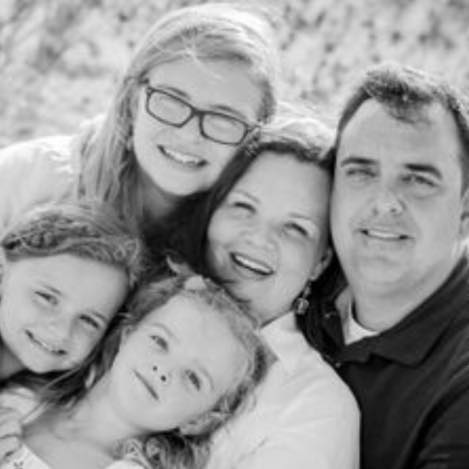
Janae Copeland is a wife and mother of 3 daughters. She lives in Jacksonville, NC where she is a K-5 music educator. She became a Different Dream mom when her oldest daughter, Jayda, was born in 2002 with hydrocephalus and cerebral palsy. Nine years later, her daughter Clark was born with EA/TEF and right microtia/atresia. Janae is grateful to have been entrusted with the care all 3 of her special daughters and seeks out opportunities to help other young mothers who may need support as they begin these same journeys with their own blessings from God.

Author Jolene Philo

Archives

Categories

Subscribe for Updates from Jolene

Related Posts

God’s Enabling Grace for Parents of Kids with Special Needs

God’s Enabling Grace for Parents of Kids with Special Needs

God’s Enabling Grace for Parents of Kids with Special Needs

God’s enabling grace wasn’t what my husband and I expected to see when we attended Dr. Paul Tripp’s marriage video series, What Did You Expect?,  at our church. After all, we reassured one another, we weren’t there to shore up our marriage. But as part of the research for my new book for special needs families that includes a marriage component.

As you might expect, the Holy Spirit used the series to reveal that realigning to His will certain attitudes within our marriage, rather than my book research, was the primary reason He’d prompted us to attend. It was a time of conviction and repentance for both of us, and our marriage benefited from it.

But, in what I have come to comprehend is the economy of God, He also used Dr. Tripp’s words in the final Sunday morning video to assure us and other couples of His constant presence and love. Dr. Tripp reminded us of a truth that brought me to tears because I immediately saw that it applied not only to the tough spots in our marriage, but to the hard places we’d experienced while parenting our son with special needs.

Dr. Tripp called this truth God’s enabling grace.

I was too busy hunting for a tissue as the words soothed my weary, convicted soul to scribble down Tripp’s exact definition. But an excerpt from his post about 6 kinds of grace explains it well:

“…grace reaches us where we are and takes us where God wants us to be. You see, God’s not simply content to give us salvation and then leave us alone until eternity. Rather, He wants us to become more like His Son and work for the furtherance of His Kingdom right here, right now.

But remaining sin leaves us lame and weak and unable. God’s grace intervenes to give us power and strength. It’s gives us the ability to do what we’re called to do but what we could never do on our own.”

To ready the rest of this post, go to the Key Ministry’s blog for special needs parents.

Do you like what you see at DifferentDream.com? You can receive more great content by subscribing to the quarterly Different Dream newsletter and signing up for the daily RSS feed delivered to your email inbox. You can sign up for the first in the pop up box and the second at the bottom of this page.

By

Jolene Philo is a published author, speaker, wife, and mother of a son with special needs.

Author Jolene Philo

Archives

Categories

Subscribe for Updates from Jolene

Related Posts

Our Unexpected but Blessed EA/TEF Journey

Our Unexpected but Blessed EA/TEF Journey

Our Unexpected but Blessed EA/TEF Journey

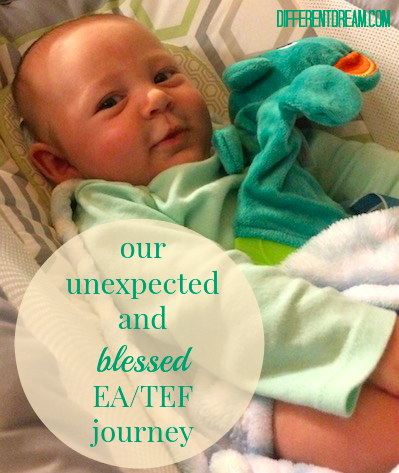
A blessed EA/TEF journey? Who could possibly say such a thing? Guest blogger and new EA/TEF mom, Kristen Horton, that’s who.  She’s participating in EA/TEF Awareness Month by sharing her story with Different Dream readers today. Enjoy! 

Our Unexpected but Blessed EA/TEF Journey

The Anticipation

In mid-February of 2017, I took a pregnancy test. It said “pregnant,” and our lives forever changed. Over the next 8 months, the prenatal appointments went perfectly: the harmony test revealed no chromosomal abnormalities and the sex (a boy), no hypertension, or gestational diabetes.

However all that changed when I was at 33 weeks, 6 days into our “babymoon.” We were vacationing in Florida, and all was fine when unexpectedly my water broke five hours from home. We decided to drive as far as possible to be home for a premature labor. Thankfully, God’s plan was to delay my labor just long enough for us to be admitted to our home labor/delivery ward prior to our son’s arrival. I spent 24 hours in labor. Our son came out perfect, weighing 5 pounds, 9 ounces. He was 19.25 inches long, and born at 34 weeks and 2 days gestational age.


The Shock of Diagnosis

In the span of a day, I experienced the best and worst moments of my life. One minute my baby was in the nursery, and the next he was transported in an incubator to a Level IV NICU at a hospital 30 minutes away, while I remained where I was for 2 more days. The diagnosis was esophageal atresia with tracheoesophageal fistula (EA/TEF). My perfect baby boy’s esophagus had formed improperly, and he could not eat without surgery. At 3 days old, he had an EA surgical repair. Thank God he had Type C EA/TEF, the most common and simplest to repair. Prayers were answered on surgery day, as well as a week later during the swallow test. After 18 days in the NICU, we were home!


The Stricture

All appeared to be going well, until he turned 6 weeks old. He was fine on Friday, but by Tuesday he couldn’t eat anything without choking. Then I experienced the most terrifying day of my life; my newborn son stopped breathing. I started CPR in my living room, praying to God that he would breathe again.  Again, prayers were answered, and God brought my baby back to me! This convinced me that every parent must know how to do CPR on an infant.

Later in the emergency room, a severe stricture at the repair site was discovered. The surgeon performed a balloon dilation to widen the site. The surgeon said the first dilation was “gnarly,” but also successful in widening the site. Four additional dilations later, the surgical procedure only takes 10 minutes total. Our son will probably need to visit the hospital at least 3 or 4 more times. Therefore as his parent, I will do whatever it takes to give my son a mostly normal life so he can eat “real” food in the future.

Even now, while I sit typing at the Children’s Hospital during our latest overnight stay, I am thankful that our baby has come this far. He’s now able to eat 4 ounces at a feeding, and we are blessed.


Do you like what you see at DifferentDream.com? You can receive more great content by subscribing to the quarterly Different Dream newsletter and signing up for the daily RSS feed delivered to your email inbox. You can sign up for the first in the pop up box and the second at the bottom of this page.

By

Kristen Horton lives in Georgia with her husband, Nathaniel, son, Christopher and dog, Winston. In 2010, she received her Bachelor of Science in Electrical Engineering from Clemson University in 2010 where she participated in the ROTC program and was commissioned as a Second Lieutenant. She holds a 2012 Master of Science in Electrical Engineering from the Air Force Institute of Technology. Since her son’s birth, she’s made it her mission to ensure that he receives the best care possible while she becomes as educated about EA/TEF as she can.

Author Jolene Philo

Archives

Categories

Subscribe for Updates from Jolene

Related Posts