Experiencing Post-Traumatic Growth while Raising a Child with Disabilities

Experiencing Post-Traumatic Growth while Raising a Child with Disabilities

Experiencing Post-Traumatic Growth while Raising a Child with Disabilities

Experiencing post-traumatic growth (PTG) while raising a child with disabilities may not be on your radar screen when you’re drowning in the stress associated with caregiving. The only growth that concerned me during our son’s medically fragile years was increasing his strength as he fought for his life. Paying attention to the stress I was experiencing while he struggled, and possible growth coming from it, never crossed my mind.

Now, as I reflect on the hot mess I was in 1982 after our son’s birth, I barely recognize the young and very stressed person I was then. The credit for my present lack of hot messiness goes to post-traumatic growth.

By now you may be asking yourself, ā€œWhat is post traumatic growth, how do I sign up for the class, and how do I know it’s happening in me?ā€

Let’s start with the first question.

In a research study conducted by Taylor Elam and Kanako Taku, they define PTG as ā€œthe positive psychological changes as a result of a struggle with a major life crisis or traumatic event.ā€ The crisis or event is the kind that rocks a person to the core and forces a re-evaluation of beliefs about the world. That sounds a lot like what many parents experience after a child’s diagnosis, doesn’t it?

Now, on to the second question.

The bad news is that I don’t know of classes about PTG. But according to Richard Tedeschi, who has worked extensively with traumatized veterans, you can facilitate and encourage your own growth in 5 powerful ways.

To learn more about experiencing post-traumatic growth while raising a child with disabilities, go to this link at the Key Ministry blog for special needs parents.

Do you like what you see at DifferentDream.com? You can receive more great content by subscribing to the monthly Different Dream newsletter and signing up for the daily RSS feed delivered to your email.

Photo byĀ Elijah HiettĀ onĀ Unsplash

By

Jolene Philo is the author of several books for the caregiving community. She speaks at parenting and special needs conferences around the country. Sharing Love Abundantly with Special Needs Families: The 5 Love LanguagesĀ® for Parents Raising Children with Disabilities, which she co-authored with Dr. Gary Chapman, was released in August of 2019 and is available at local bookstores, their bookstore website, and Amazon. See Jane Dance!, the third book in the West River cozy mystery series, which features characters affected by disability, was released in October of 2023.

Author Jolene Philo
Archives

Categories

Subscribe for Updates from Jolene

Related Posts

Deciding to Have More Kids after the Birth of a Child with Disabilities

Deciding to Have More Kids after the Birth of a Child with Disabilities

Deciding to Have More Kids after the Birth of a Child with Disabilities

Deciding to have more kids after the birth of a child with disabilities requires careful thought and advice from trustworthy friends and professionals. Today, guest blogger Kelly Simpson describes how those factors and faith played a part in their decision.

Oliver, our EA/TEF baby just turned 5! For years we lived taking extra precautions knowing what would help keep him healthy, out of a hospital and an Intensive Care Unit (ICU). The number of daily tasks needed to accomplish that could be overwhelming to some, but it was all that we knew and felt normal since he is our first child.

The odds of being born with EA/TEF are 1 in 5,000 births according to Children’s National Hospital. The fear of it happening again was a heavy burden that held us back from trying for more children. Oliver’s specialists and surgeons have been very happy with his growth and current condition. (Check the Different Dream article Update on Oliver for more details.) His progress has been a blessing from God.

Having several children was a desire for us, and as Oliver began to get older, we questioned ourselves. ā€œWill we try again?ā€ We consulted with Oliver’s specialists and doctors on the odds of having a second baby with the same or similar conditions. They were very low, as the condition is considered rare. I still wasn’t convinced.

We (mostly I) wrestled with the ā€œwhat ifs.ā€ Our fears that we (I) gripped so tightly began to show our (my) biggest doubts:

Did we trust God’s goodness?
Did we trust that he would again make a way for us, even if it looked different than what we wanted?
Did we trust that He really has our best interests in mind?

Eventually, I had to hand my fears over to God. I could not trust Him with everything except my children. I had to trust that He would again make a way regardless of what was to happen. We already knew we had some of the best doctors and surgeons on our side. They had already walked through our hardest times with us, and they would do it again.

So we tried and are blessed to say that we are pregnant with our second child due later this year! As I look back over the past several months and year, I identified several things that made deciding to have more kids after the birth of a child with disabilities easier for us. Though I don’t want you to view me as an expert, I want to share some truths that I try to practice (and have failed to do many, many times) with you.

  • Pray and pray some more.
  • Know that you serve a loving and powerful God. He made a way for Moses to part the Red Sea (Exodus 14) and Daniel to survive the Lion’s den (Daniel 6). He will make a way for you too!
  • Remember that God is your creator. He knows your deepest needs and desires. You don’t have to explain anything to Him. He already knows. Surrender can consist of very few words or a long list of concerns. He is okay with either. He can handle all of it.
  • Trust by handing over control on a daily, even hourly, basis.
  • Consult a doctor if you want more children after giving birth to a child with a disability. The ones you are already familiar with and know very well are a good place to start.
  • Seek support from trusted friends and family.
  • Pray some more.

I hope these truths help you make the best decision for you and your family.

Do you like what you see at DifferentDream.com? You can receive more great content by subscribing to the monthly Different Dream newsletter and signing up for the daily RSS feed delivered to your email.

Photo byĀ Andrew ItagaĀ onĀ Unsplash

By

Kelly has lived her whole life in Kentucky. She and her husband, Jeremy, have a five-year-old son, who, born during one of Jeremy’s deployments, was diagnosed with EA/TEF. Kelly has always felt a calling to serve others and is living the dream as an Army wife, middle school teacher, and now, as an encourager to those who are living a dream different than they had planned.

Author Jolene Philo

Archives

Categories

Subscribe for Updates from Jolene

Related Posts

Gratitude and Lent

Gratitude and Lent

Gratitude and Lent

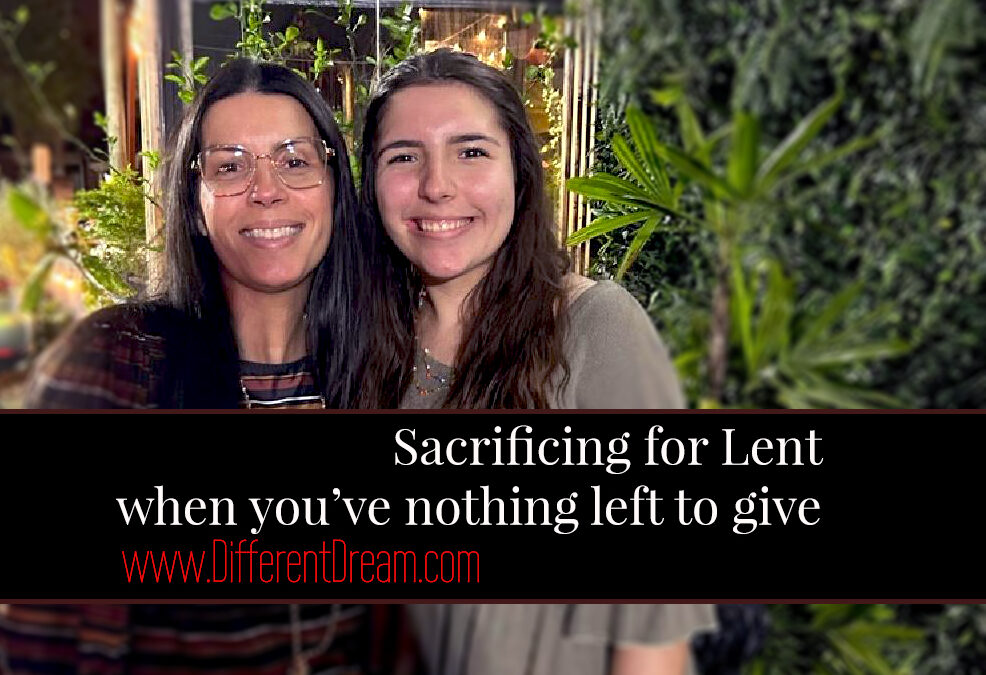
Gratitude and Lent became paired in the mind of guest blogger Valeria Conshafter. In this post she explains how being the mom of a daughter with special needs led her to a powerful practice she implements every year.

Lent has always been a time of reflection and contemplation for me. It’s a time of confession and repentance, sacrifice and fasting. But I must be honest, I have had too many times where I forgot to follow through with this very important Christian practice.

Some years ago, my husband and I went through a very difficult and traumatic experience with our special needs baby. Struggles and challenges were right in front of my face. Christ felt so far away and my capabilities to commit to Lent and take in another form of sacrifice were nearly impossible.

For many years, I had only focused on my day-to-day life, mothering my child and trying to survive hospital stays and a multitude of diagnoses my baby girl had. All too complex to understand. Too stressful to even mention. Our lives had turned upside down so fast from the moment we got the news.

Your daughter was born with a rare birth defect and needs immediate surgery.

Trying to make sense of anything else was the hardest experience we had ever faced. Taking on any additional tasks besides caring for my child, such as engaging in a particular spiritual practice like figuring out what to give up for Lent, was a major undertaking for me.

I felt bad about this for a long while, comparing myself to other moms who appeared to have everything together. They had plenty of time in hand to figure out what they were giving up for Lent and what their families would do together during this very-important-in-your-kids’-life season. I was barely able to keep my nose above water. Jealousy, hatred, and feelings of inadequacy—not to mention depression and anxiety—flooded my being each time I compared myself with everyone else.

Thankfully, I soon realized that my attitude wasn’t serving me or the God in whom I believed. However, the struggles and challenges, the sleepless nights and tense weeks spent in that cold hospital room, Lenten season in and Lenten season out, God became evident to me in every procedure my baby had and in each complication she faced.

Even when my brain could not focus on anything else, God showed up.

Whether I sought him or not, he was there all along. The same God who had blessed me with this very special little baby girl to love and care for, birth defects and all, who had trusted me to be her mommy and caretaker, never left our side.

It was then, during what I call a Holy Spirit awakening, I decided to follow what worked for me.

I knew the medical hardships and trials with my daughter would surely continue. But I also knew that God would not abandon us. I felt an immense gratitude in my heart—gratitude that filled my soul with hope and peace. I integrated myself into my own gratitude and Lent discipline. Gratitude would become my day-to-day commitment as an act of repentance and sacrifice—my way of staying connected with Christ.

Gratitude and Lent. That is what I needed. Come as you are, with all that you have, with a grateful heart.

  • I am grateful to be her mom.
  • I am grateful for my daughter’s health and her good spirits despite the ups and downs.
  • I am grateful for a husband who supports me and cares for me.
  • I am grateful for the doctors and nurses who provide the best treatment for our girl.
  • I am grateful for moments of quiet and calm after the storms have passed.
  • I am grateful for the laughter and play after pain and tears are gone.
  • I am grateful for answered prayers and the peace within that surpasses my own understanding.
  • I am grateful for our merciful God and his never-ending grace.
  • I am grateful for what has passed, for today, and for the future. For God’s love never fails.

What are you grateful for during this season of Lent?

Do you like what you see at DifferentDream.com? You can receive more great content by subscribing to the monthly Different Dream newsletter and signing up for the daily RSS feed delivered to your email.

Photo courtesy of Valeria Conshafter

By

Valeria Conshafter is a native of Brazil. She has a background in Counseling Psychology and currently works for a women’s organization providing emotional and spiritual support to women all over the country. She loves writing, cooking, and praying for her family and friends. Valeria lives in Houston, Texas, with her husband Todd, their 15-year-old daughter, Sofia, and their two Standard Poodles, Chocolate and Oreo. You can find Valeria onĀ Instagram,Ā Twitter, andĀ Facebook.

Author Jolene Philo

Archives

Categories

Subscribe for Updates from Jolene

Related Posts

Lessons from First Year EA/TEF Parents

Lessons from First Year EA/TEF Parents

Lessons from First Year EA/TEF Parents

Today’s lessons from first yearĀ EA/TEF parents come from guest bloggers Katharine and Jake. As is often the case, their advice will benefit more than the EA/TEFĀ crowd. It will resonate with parents of children with a wide variety of disabilities. Perhaps it will resonate with you.

Our family’s story began at our son’s 20-week anatomy ultrasound when our son Mason was diagnosed with congenital hydrocephalus. This condition causes an abnormal buildup of cerebrospinal fluid in the brain causing a wide range of developmental delays. At birth, he was unexpectedly diagnosed with another birth defect where the esophagus and stomach are not properly connected, called tracheoesophageal fistula and esophageal atresia (TEF/EA). He spent 6 weeks in the NICU, as he needed multiple surgeries to repair and manage these diagnoses.

It is hard to believe that we are approaching Mason’s first birthday. We have adjusted to a busy schedule over the past year. We attend regular developmental therapy appointments and see many medical specialists, both in our local area and over 2 hours away. Our son is delayed in meeting most developmental milestones. However, he is resilient and makes progress each day. There have been some bumps along the road, including unexpected hospital stays and new challenges, but seeing his bright smile every morning is our greatest motivation.

These are four lessons our son has taught us in his first year:

#1: Celebrate the ā€œinchstones.ā€

It can feel discouraging to focus on big milestones, like head control, sitting independently, and walking. It is difficult to do other things in our life, like housework or hobbies we enjoy, because it feels like he needs our attention all the time if he’s going to make progress. We remind ourselves that he is developing at his own pace. Instead of the milestones, we celebrate each small incremental stride our son makes while working on those bigger goals.

#2: We are his greatest advocates.

While we are surrounded by a great medical team, we know our son best. At each appointment, we learn all that we can about his condition and how each provider can help our son. We constantly ask questions and give our opinions. Ultimately, we come to a collective decision with our son’s providers to make the best medical decisions for him.

#3: Try it again, try it differently.

Our son came home feeding mostly from a gastrostomy tube (G tube). We tried changing so many things and thinking outside the box to improve his ability to drink from a bottle. Eventually, with the right combination at the right time, he succeeded with the bottle at four months old and now enjoys purees. Mason is always changing. We constantly reevaluate what he needs to succeed and are not afraid to return to things that previously failed.

#4: Remember all the good.

This is hard. Some days can be very hard. The stress and the difficulty of this experience can be overwhelming, especially when you are comparing it to what other parents experience or your own expectations. But no matter the added challenges, the smiles, laughs, and love are still there, perhaps even more so. Embrace it all, most of all your lessons as first year EA/TEF parents.

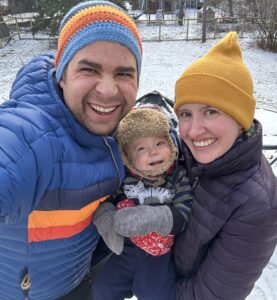
Jake, Mason, and Katharine Kaczmarowski

Do you like what you see at DifferentDream.com? You can receive more great content by subscribing to the monthly Different Dream newsletter and signing up for the daily RSS feed delivered to your email.

Image courtesy of Katharine and Jake

By

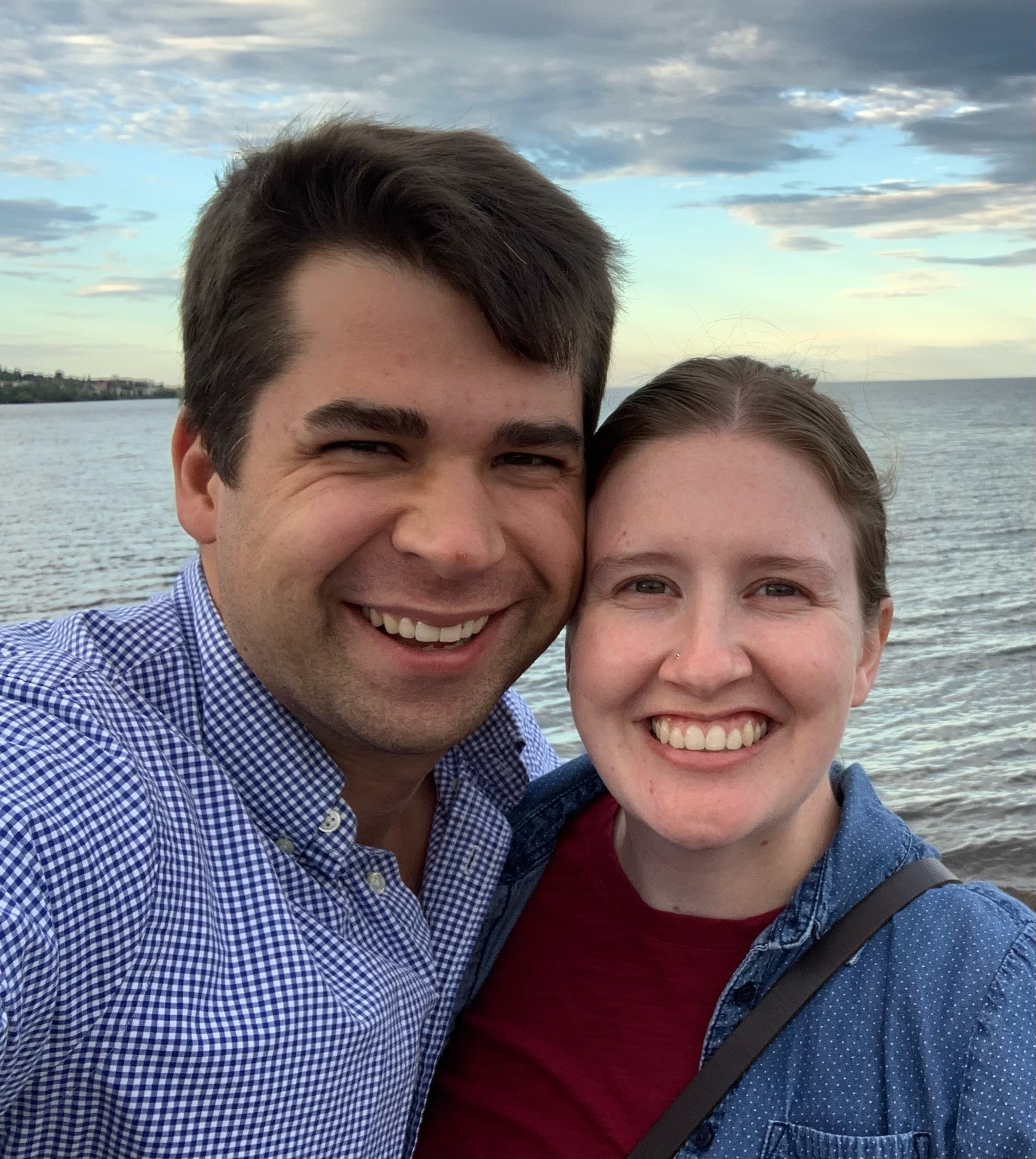
Katharine and Jake are young professionals living in Minnesota with their son, Mason. He was born in early 2023 with congenital hydrocephalus and TEF/EA (associated with VACTERL). He also has a chromosome 6q26-q27 deletion. They have been married for two and a half years and each day strive to parent as a team. As a family, they enjoy strolling along Lake Superior’s shore with their dog.

Author Jolene Philo

Archives

Categories

Subscribe for Updates from Jolene

Related Posts

An Unexpected Christmas Gift

An Unexpected Christmas Gift

An Unexpected Christmas Gift

An unexpected Christmas gift was given to guest blogger Sandy Ramsey-Trayvick and her family more than 2 decades ago. Today she shares her reaction to the gift shortly after it was given and how she views it now.

My son Myles got sick on December 10, 1999. My family had attended a Christmas party four days before. I have memories and pictures from that party of my son giggling with excitement as he raced back and forth across the room, practicing his newly developing walking skills. He was healthy and happy. Our family was excited and looking forward to enjoying the holiday season. But our little boy suddenly became very ill. Instead of planning for Christmas, my husband and I found ourselves in the emergency room receiving the news that our 13-month-old had contracted strep pneumococcal meningitis and was in a coma.

I remember sitting next to his hospital bed in the pediatric intensive care unit signing the photo Christmas cards that featured my three little ones all dressed up in their holiday best. Sending photo cards of my kids to family and friends had become one of my holiday traditions. This particular year, as I signed each card, I prayed for God to awaken my baby boy in time for Christmas. I pleaded with the Lord but His answer was no. The Christmas of 1999 was the saddest I’ve experienced.

I asked the Lord for just one gift and didn’t receive it.

There have been a lot of Christmases since then and, thankfully, my son has been awake and at home for all of them. Through that long illness and the special needs journey that has followed, the Lord has blessed our family with gifts I hadn’t thought to ask for as I sat in that hospital room all those years ago.

God began revealing His first gift to us shortly after Myles was hospitalized.

Prior to that long hospital stay, my husband and I held inaccurate ideas about God and His ways. In the midst of some of our most difficult circumstances with Myles, God gave us the gift of truly getting to know Him. We experienced Him as Teacher, Comforter, Protector, Advocate, and Waymaker. Prior to that hospital experience, we had heard about God and His ways, but He gave us the gift of knowing and seeing Him for ourselves. In the almost 25 years since my son’s initial illness, we’ve continued to know God more intimately as we’ve walked with Him through both joyful and painful experiences.

Through this special needs journey, the Lord has also given me the gift of knowing my true identity.

Becoming a special needs mom challenged all the ways I saw myself. My old chosen identity had been tied primarily to my performance and accomplishments—but it didn’t fit with my new life as a special needs mom. As I struggled for a sense of significance in this role, the Lord walked me through His Word to teach me who He says I am. He taught me that my significance—my worth and value—have always been in Christ. I didn’t need to choose an identity because He had already chosen one for me, one that would remain unchanged by new roles or unforeseen circumstances.

As I reflect back over the past two decades and more, I’m relishing an unexpected Christmas gift of remembrance—the ability to look back and recall all that God has done in and through my family’s special needs life. He has continued to give.

Do you like what you see atĀ DifferentDream.com? You can receive more great content by subscribing to the monthly Different Dream newsletter and signing up for the daily RSS feed delivered to your email.

Photo byĀ Igor OmilaevĀ onĀ Unsplash

By

Sandy and her husband are parents to three young adult children. Their son was diagnosed with multiple disabilities 24 years ago after a devastating illness as a toddler. Following her son’s diagnosis, Sandy quit her job to become his full-time caregiver and advocate.

Sandy is currently a Certified Professional Coach. Her focus is to empower special needs parents who are feeling weary by helping them to renew their hope and strength and reactivate their joy.

You can learn more about Sandy and her work at www.UNDisabledLIVES.org. You can also reach her at Sandy@UNDisabledLIVES.org.

Author Jolene Philo

Archives

Categories

Subscribe for Updates from Jolene

Related Posts

4 Ways Disability Families Can Heal after Being Hurt by a Church

4 Ways Disability Families Can Heal after Being Hurt by a Church

4 Ways Disability Families Can Heal after Being Hurt by a Church

4 ways disability families can heal after being hurt by a church? What? you may be thinking, only 4? Our family could use at least a gazillion! Trust me when I say that guest blogger Kristin Faith Evans knows where you’re coming from. In this post, she shares 4 effective strategies she and her family have used to heal after being hurt by a church and hold tight to their faith.

Many families have difficulty finding a church home or continuing to attend their home congregation due to their child’s special needs. They may have felt misunderstood, unsupported, or rejected. Some were even asked to leave because of their child’s behaviors or needs. In fact, almost 1/3 of special needs families have reported that they have left at least one church because their child was not included or welcomed. If you’ve been hurt by the church, consider taking these steps toward healing.

#1:Ā Tell the Leadership How You Feel

In some cases, speaking to the leaders may cause you further emotional harm. If you believe this might be true, skip this step. But if you haven’t already and you feel comfortable, share how the situation has hurt your family. It’s possible they didn’t realize, understand, or know how to respond. Bringing it to their attention might also help prevent another family from feeling the same way in the future. Perhaps the situation can even be resolved, and the church can support your family in staying. Or it may be the healthiest decision for your family to find a new congregation. But you can leave knowing that you have communicated and attempted to reconcile.

#2:Ā Talk to Someone You Trust

When we’ve been hurt, our natural instinct is to isolate. Being emotionally harmed by a church can be traumatic and keep us from forming new relationships. It may be hard, but reach out and talk to someone you know will be objective and supportive. It can be a family member, friend, another Christian outside that church, a support group member, or a counselor. A critical piece of your healing will be processing your experience with others.

#3:Ā Forgive Those Who Hurt You

Anger and resentment can be toxic and keep you from healing and moving forward. Forgiving may not be easy and can take time. Talk to God in prayer about your emotions and desire to forgive those who hurt you. Receive his comfort, healing, and counsel. Forgiving does not mean that you agree with what they did or that it was right. It means that you are no longer going to hold bitterness in your heart and that you are giving your pain to God so you can move on and heal. Scripture teaches us to: ā€œMake allowance for each other’s faults, and forgive anyone who offends you. Remember, the Lord forgave you, so you must forgive othersā€ (ColossiansĀ 3:13, NLT).

#4:Ā Don’t Give Up on Church

Visiting a new church as a special needs family can be scary, especially after a bad experience. But remember—how that church treated your family doesn’t represent all Christians or how Jesus feels about your child and your family. Belonging to a healthy church will bring you strength, hope, spiritual growth, connection, and joy. Ask around and visit churches that have disability ministries, respite programs, or support groups. And take your time. Pray that God will lead you to the right church where your family can flourish.

What do you think of these 4 ways disability families can heal after being hurt by a church? What would you add to the list? Leave your suggestions below.

Do you like what you see atĀ DifferentDream.com? You can receive more great content by subscribing to the monthly Different Dream newsletter and signing up for the daily RSS feed delivered to your email.

Photo byĀ Josh ApplegateĀ onĀ Unsplash

By

Kristin lives with her husband, Todd, and their two children in the Nashville, TN area. She is an author, speaker, mental health counselor, and a mom of two children with rare genetic disorders and complex needs. Her greatest passion is teaming up with her husband to empower other parents of children with disabilities, mental health disorders, and medical complications. She hopes that you may find encouragement and support on their websiteĀ www.DisabilityParenting.com

Author Jolene Philo

Archives

Categories

Subscribe for Updates from Jolene

Related Posts