Middle-Grade Fiction about Kids with Special Needs

Middle-Grade Fiction about Kids with Special Needs

Middle-Grade Fiction about Kids with Special Needs

Middle-grade fiction about kids with special needs is gaining traction in the writing world, though the stories tend to focus on conditions that can be seen and easily identified. In this post, guest blogger and book writer Lisa Pelissier introduces readers to characters in her middle-grade fiction who have invisible special needs. Be prepared to fall in love with Millie and Stasia and Andie like I did!

I never thought I would find myself occupying the niche of writing middle-grade fiction about kids with special needs. But then, I never thought I’d be parenting kids with special needs. But here I am. They say you write what you know, and I certainly know the struggles and triumphs my kids have had.

All my books feature characters with (mostly) invisible special needs. In some books, it’s more prominent than in other books. There’s always a hint of neurodivergence, anxiety, or mental illness. And sometimes, there’s more than a hint.

One of the things I want to come across to those who read my middle-grade fiction about kids with special needs, is that no one has to be perfect before they can do good, before they can become a hero, before they can be the main character in the narrative. And when the ā€œgood guysā€ win in the end, the disabilities don’t go away. That’s not the battle they’re fighting.

My first book to prominently feature a main character with a disability was MilliM, a wacky dystopian middle-grade novel published in 2020. The main character, Millie, has extreme OCD and has to have everything in her world be symmetrical. When Millie and her best friend Silas (who is autistic, though I never say so in the book) find a baby on her front porch—a baby with a very asymmetrical face—Millie loses it. She knows her mom will want to keep the infant, but she also knows if she has to look at that distorted baby face every day, she’s going to lose her mind. She and Silas get on their bikes and ride to the city center, to the Council of Benevolence (remember—this is a dystopian book), to see if they can trade the baby in on another grandmother. It goes on from there. But one of my favorite things about MilliM is that Millie doesn’t overcome her disability. She is who she is. Sometimes her OCD drives her to do the wrong thing—and sometimes it’s the reason things turn out okay. But it doesn’t go away. And she’s still a hero—albeit a broken one. Like any of us—with or without a disability—would be.

A huge chunk of the goal of not making the disability the central focus and issue to be solved is smashed to smithereens in my upcoming book, Speechless. The main character, Stasia, has been diagnosed with selective mutism, a disability preventing her from speaking aloud with anyone but her best friend, Andie, who has non-verbal autism and a bunch of other diagnoses. Stasia finds out that the reason she can’t speak isn’t actually her neurology, but a fairy curse, laid on her when she was only three years old. Together, she and Andie puzzle out the riddles the fairy gives her in order to break the curse and free her voice. In the process, both she and Andie learn some valuable lessons about what it means to be a friend.

This book was my daughter’s idea—the one with selective mutism. I’ve been working on the book for four years now, and in that time, my daughter has made big strides. She’s never told me why she dreamed up the backstory behind this novel. Sometimes I wonder if pretending her disability was the result of something outside of herself could be helping her cope with it. I mean, believing you’re inherently broken is devastating. But if it’s just a fairy curse, then what? It’s not your fault. It takes the burden away. Not that any of my kids’ disabilities are their fault, but I know from my own life that it’s easy to absorb responsibility—and blame—for things that are not yours to bear. But other times, I just think she has a really good imagination.

Having Stasia’s disability be a curse was uncomfortable for me. I didn’t want to send the message that disabilities are something that will magically go away. I fought with myself about whether to write this novel. I pressed on because I love my daughter and wanted to follow through with her idea. And I think, in the end, I’ve succeeded in what I wanted the book to say. The presence of non-verbal, autistic, really messy Andie redeems the story. She’s broken in ways that won’t be fixed. But she is who she is. She’s valuable. She’s one of the heroines of the story. She’s real. I hope the sweet friendship between these two girls who were born inside my mind and eventually became middle-grade fiction about kids with special needs will inspire children to look for friendship in places they would never have expected to find it.

Do you like what you see at DifferentDream.com? You can receive more great content by subscribing to the monthly Different Dream newsletter and signing up for the daily RSS feed delivered to your email.
Lisa Pelissier

By

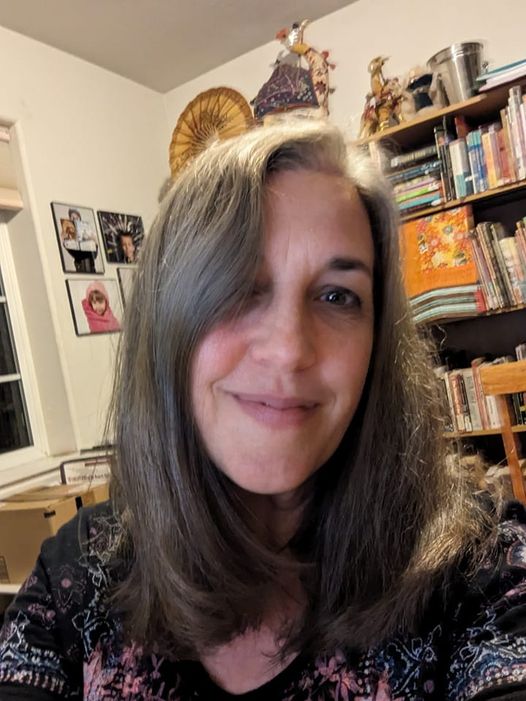
Lisa Pelissier lives in Oregon where she is a homeschool mom and author ofĀ five middle-grade fiction novels, the second-gradeĀ MonstersĀ series, and aĀ YA fantasy novel. Lisa ownsĀ SneakerBlossom Books, offering Christian, classical homeschool Study Guides and curriculum. She blogs atĀ Eleventh Willow, offering encouragement for Christians parenting the mentally ill. She also works as a freelance copy editor, copy writer, and a marketing editor. In her spare time Lisa enjoys playing the piano and writing books.

Author Jolene Philo
Archives

Categories

Subscribe for Updates from Jolene

Related Posts

How to Build a Thriving Marriage as You Care for Children with Special Needs

How to Build a Thriving Marriage as You Care for Children with Special Needs

How to Build a Thriving Marriage as You Care for Children with Special Needs

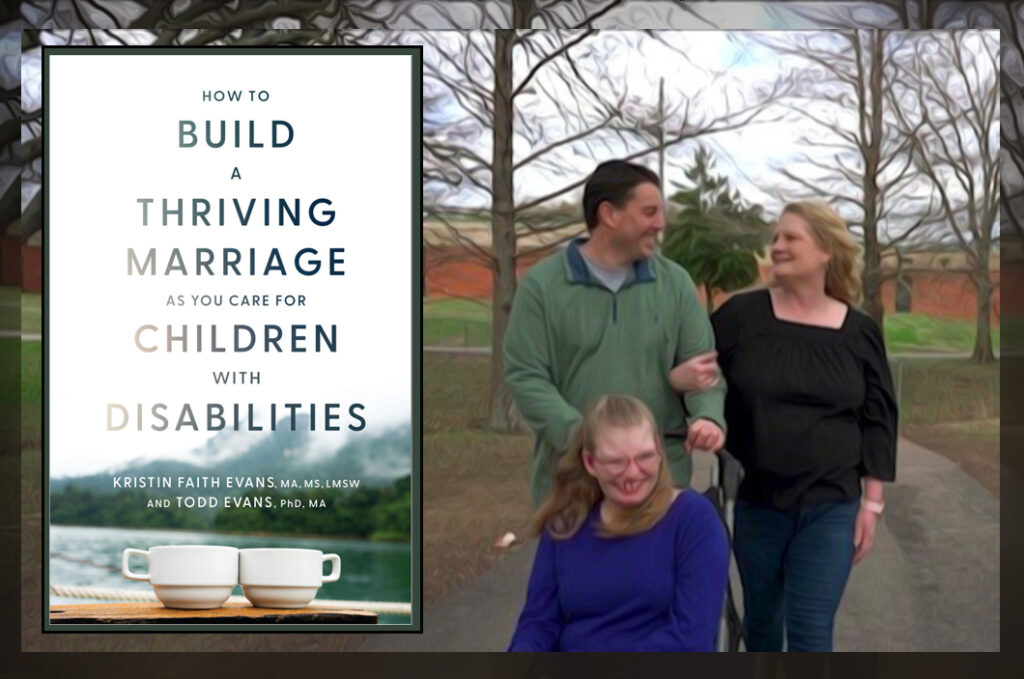
Todd and Kristin Evans know that tending to marriage while raising a child with disabilities can be challenging. About 12 years ago after their medically fragile daughter arrived, they decided to give their marriage one more shot before admitting defeat. In their new book How to Build a Thriving Marriage as You Care for Children with Disabilities, they invite parents to join them on a journey toward wholeness in marriage, parenting, and faith.

Early in our marriage, we discovered building a strong marriage can be difficult. But when our medically complex daughter was born, we began to face even more obstacles to staying connected. We learned the hard way that when special needs parents are not intentional, their marriage may be headed toward disaster. We’re sharing three challenges you may also be experiencing and simple ways you can grow a thriving marriage while parenting your child with special needs.

  1. Commit to a check-in time every day.

As special needs parents, you likely have more to discuss and more serious decisions to make than the average couple. Intense conversations about your child’s needs can easily push out time to engage in more intimate conversations.

Research shows when special needs parents set a consistent ten-minute check-in time every day, their marriages grow stronger. To ensure you have time to connect on a deeper level, agree on a specific time each day that you can set aside all distractions to focus one another. This might be talking on the phone or video chatting over lunch or after the kids are in bed. When you both commit to honoring this time, you will begin to feel more cared for and look forward to those moments. Guard this time and make it a priority.

  1. Regularly manage stress individually and as a couple.

As special needs parents, you likely experience intense daily stress. When your bodies remain in a chronic state of stress, your emotional and mental health can suffer, you can begin to experience physical symptoms, your marriage relationship can become strained, and your physical intimacy may drastically decrease.

In writing our new book, How to Build a Thriving Marriage as You Care for Children with Disabilities (Baker Books), we learned that regularly managing your own stress in healthy ways and supporting your spouse in coping with their stress can greatly improve your marriage. Individually practicing deep breathing, progressive muscle relaxation exercises, and physical activity are very effective ways to reduce your stress levels.

These are some simple ways we destress together that might help you as well:

  • Find a quiet place outdoors to hold hands listening to your surroundings, even if for just five minutes.
  • Go for a walk.
  • Watch a funny show, tickle one another, or swing on a playground.
  • Give your spouse a neck or foot massage.
  • Take a hot, scented bath or shower.
  1. Intentionally build an outside support network.

Caring for your child can easily isolate you and make it difficult to find support and respite. It may feel impossible to find time alone or get out of the house together. Yet, receiving both emotional and practical support can greatly decrease your stress levels and strengthen your marriage. We encourage you to keep searching for different resources. Here are some ideas for finding support:

  • Find local churches with a disability ministry, caregiver support group, or respite program.
  • Contact yourĀ state respite coalition
  • Call local college nursing or special education departments for potential caregivers.
  • Talk with other special needs parents about swapping child care

We encourage you to take the first step to strengthening your marriage by choosing one of these ideas and trying it with your spouse today. You’ll find many more ideas in our new book How to Build a Thriving Marriage as You Care for Children with Disabilities, which we hope will help you as well.

Do you like what you see at DifferentDream.com? You can receive more great content by subscribing to the monthly Different Dream newsletter and signing up for the daily RSS feed delivered to your email.

References

Jake Johnson and Fred P. Piercy, “Exploring Partner Intimacy Among Couples Raising Children on the Autism Spectrum: A Grounded Theory Investigation,” Journal of Marital and Family TherapyĀ 43, no.Ā 4 (October 2017): 644-61, https://doi.org/10.1111/jmft.12247.

Linda M. Raffaele Mendez, Karen Berkman, Gary Y. H. Lam, and Charisse Dawkins, “Fostering Resilience Among Couples Coparenting a Young Child with Autism: An Evaluation of Together We are Stronger,”Ā The American Journal of Family TherapyĀ 47, no.Ā 3 (2019):Ā 165-82, doi:https://doi.org/10.1080/01926187.2019.1624225.

By

Kristin Faith Evans, MA, MS, LMSW and Todd Evans, PhD, MA

Dr. Todd and Kristin Evans are award-winning authors, speakers, and parents of two children with complex needs. Their new book, How to Build a Thriving Marriage as You Care for Children with Disabilities releases in May 2024 by Baker Books. They both earned their MA in Christian Formation and Ministries at Wheaton College in Illinois and have served together in full-time ministry in church, camping, and retreat settings. Todd received his PhD from Vanderbilt University’s School of Engineering and currently manages his own business, and Kristin earned her MSW from the University of Tennessee and is a Licensed Master Social Worker experienced in couples, child and family, substance abuse, and crisis counseling. Connect with Todd and Kristin and learn more about their ministry and free resources at www.DisabilityParenting.com.

Author Jolene Philo

Archives

Categories

Subscribe for Updates from Jolene

Related Posts

New Blog for Christians Parenting the Mentally Ill

New Blog for Christians Parenting the Mentally Ill

New Blog for Christians Parenting the Mentally Ill

Christians parenting the mentally ill need other believers to support them. Today Lisa Pelissier is here to introduce Different Dream readers to a new blog designed to support Christian families impacted by mental illness and to equip extended family and friends to encourage them.

Statistics show that one in five adults in the United States suffer from mental illness. The numbers are even more sobering among young adults. Almost ten percent of people aged 18-25 find their life limited by mental health conditions. Sadly, these conditions tend to be hereditary, and many of us find ourselves dealing with more than one family member who is suffering.

Often, the church is unprepared for families suffering from these harrowing, invisible disorders. Because Christianity deals with the invisible facets of people’s lives, the lines between spiritual matters and mental health issues can become blurred. Misunderstandings abound, even amid good intentions.

As a wife, daughter, sister, and mother of people with mental illness, I know first-hand that it can be difficult to find support from other believers. Most of the time people are sympathetic, but to a great degree, they have no idea what it’s like to live in a world where you must walk on eggshells, fight for medical care, or figure how to discipline someone who can’t respond appropriately.

With this thought in mind, Amber Healy, Georgia Mathison, and I have started a blog, Eleventh Willow, to support Christians parenting the mentally ill. We hope to eventually cover a broad range of topics stemming from our own experiences in parenting our mentally ill children. A private Facebook group is also available to those who would like to connect on a more personal level.

Why ā€œEleventh Willowā€? The willow is one of the most resilient trees. It symbolizes flexibility and adaptability, qualities necessary to parenting in general and to parenting in light of mental illness specifically. The willow tree is a survivor, but is also associated with grief and mourning—the weeping willow. In the Bible, the willow tree symbolizes rebirth (Ezekiel 17:5), loss and hope (Psalm 137), and celebration (Leviticus 23:40).

ā€œEleventhā€ comes from the eleventh hour—the last opportunity before it is too late. As parents of children with mental illness, we all feel that urgent desire for our child’s healing. Any hour could be the eleventh one—the moment our children are destroyed by their disease.

Our first five blog posts went live this month and deal with issues we have experienced in parenting our children with mental illness.

Amber, Georgia, and I—the Eleventh Willow bloggers—don’t have all the answers, but we are all seasoned mothers of mentally ill children and young adults. We hope to encourage, to inform, to love others on their similar journeys, and most of all, to provide that very needed support to those whose experiences with the church or with Christians have been less than ideal.

Image byĀ Annette MeyerĀ fromĀ PixabayĀ 

By

Lisa Pelissier lives in Oregon where she is a homeschooling mother of four (three with disabilities) and author ofĀ three middle-grade fiction novelsĀ as well as aĀ YA fantasy novel. Lisa ownsĀ SneakerBlossom Books, offering Christian, classical homeschool Study Guides and curriculum. She blogs at Eleventh Willow, offering encouragement for Christians parenting the mentally ill. She also works as a freelance copy editor, an artist, a substitute teacher, and a tutor. In her spare time Lisa enjoys playing the piano and fretting about things over which she has no control.Ā 

Author Jolene Philo

Archives

Categories

Subscribe for Updates from Jolene

Related Posts

Communication Is a Gift

Communication Is a Gift

Communication Is a Gift

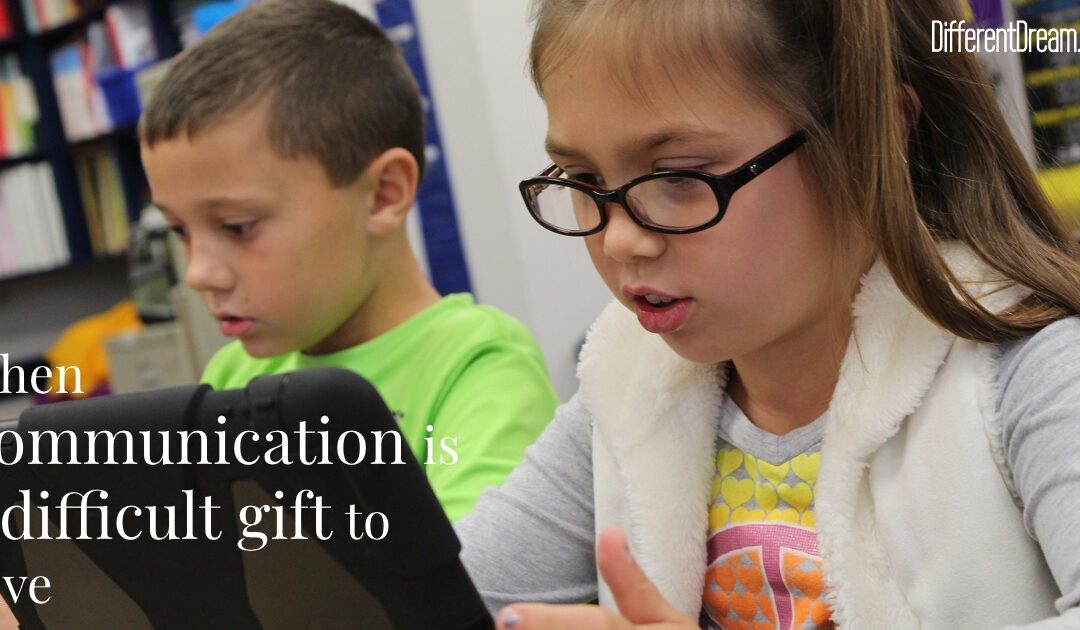
Communication is a gift for a child who is non-verbal or has delayed speech. Our youngest daughter, Ellie, recently started using a communication device at school. We felt a sense of dread as the words ā€œcommunication boardā€ and ā€œiPadā€ came home.

You see, our family, including extended family, took sign language classes when our oldest daughter, Abbey, was 3. I also taught myself using signing videos and other things to give her a mode of communication.Ā 

She loved to attempt to sign. Ā 

She attended our local preschool disabled program, and it was clear that her verbal skills would not progress. She needed to be immersed in the world of sign language if it was going to sink in. When she was 5, she moved to a school for the hearing impaired. When she was 9, that school decided it was no longer the right fit for her given her extensive physical needs. She transitioned to a school for the severely or multiply handicapped. That school decided sign language was not appropriate for her because her cerebral palsy made it hard for her to properly sign.Ā 

They suggested an iPad.Ā 

The iPad went back and forth from home to school for years.Ā  While Abbey was somewhat interested in games and matching, she refused to use it to communicate. Sometimes she would push the iPad at me and shake her head ā€œnoā€ or put it down on the floor! It was heartbreaking, discouraging, and a lot of money was wasted. Then during her high school transition, the team saw her eagerness to sign She is using sign language in her high school and thriving.Ā 

The iPad is sitting in a box.Ā  Ā 

Ā Now Ellie is at the starting line. I burst into tears while watching a video her teacher sent about the importance of being ā€œall inā€ with the device. ā€œWe’ve already done this!ā€ I thought. ā€œIt was so discouraging! I can’t do it again. Maybe we need to accept that she can’t communicate.ā€Ā 

Her team would not give up.Ā 

Despite COVID and all the transitions since 2019, they evaluate her and are working diligently to get her to use her iPad.Ā  We brought it out to try when she asked for a toy.Ā  To my surprise and delight, she needed only one verbal cue to point to the correct icons.Ā  When I couldn’t remember how to make the iPad ā€œtalk,ā€ she laughed and clicked the proper place.Ā 

She loved it.Ā 

If you are struggling with finding a way to communicate with your disabled child, I want you to know that we’ve been there. It feels hopelessness and exhausting to try something over and over to no avail. But sometimes the breakthrough is around the corner. Or it comes in an unexpected way.Ā 

Not every child will achieve the level of communication you hoped for, but keep trying!Ā  Their ability to communicate may be hindered, but ours is not. Keep communicating with your child no matter what their ability to communicate with you is. Keep talking, keep explaining, keep including them in the conversation. We cannot truly know what our non-verbal children understand. Communication is a gift we can give to them.Ā 

Do you like what you see at DifferentDream.com? You can receive more great content by subscribing to the Different Dream newsletter and signing up for the daily RSS feed delivered to your email inbox. You can sign up for the first in the pop up box and the second at the bottom of this page.

By

Kimberly grew up and went to college in the small town of Upland, IN. She graduated from Taylor University with a degree in Elementary Education in 2002. While at TU, she married her college sweetheart and so began their adventure! Ryan and Kimberly have four amazing kids on earth (Abigail, Jayden, Ellie, and Cooper), and a baby boy waiting for them in heaven. Their daughter Abigail (Abbey) has multiple disabilities including cerebral palsy, a seizure disorder, hearing loss, microcephaly, and oral dysphagia. She is the inspiration behind Kimberly’s desire to write. In addition to being a stay-at-home mom, Kimberly has been serving alongside her husband in full time youth ministry for almost fourteen years. She enjoys working with the senior high girls, scrapbooking, reading, and music. You can visit Kimberly at her website,Ā Promises and Perspective.

Author Jolene Philo

Archives

Categories

Subscribe for Updates from Jolene

Related Posts

The Little Lion that Listened: Author Interview

The Little Lion that Listened: Author Interview

The Little Lion that Listened: Author Interview

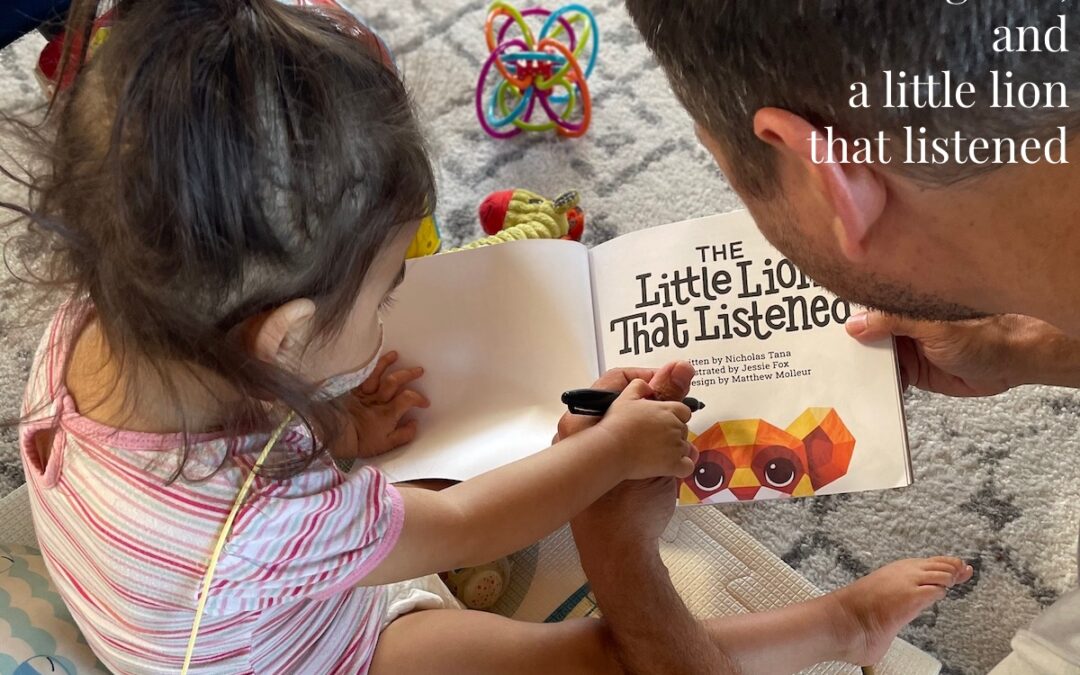
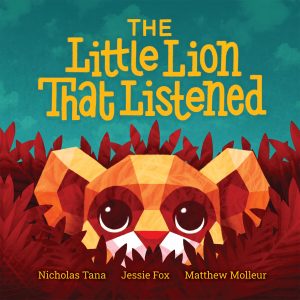
The Little Lion that Listened was written by Nicholas Tana, whose daughter lives with a rare disease. Today he shares what he’s learned from his daughter and why he wrote this children’s book.

As a parent of a child with special needs, I often draw parallels between the questions I ask myself while navigating the troubled waters of caring for a child with a disability and those I ask myself as an author. As a writer, you boldly make sense of the world through the stories you tell. As a parent of a special needs child, you often try to make sense of the world through the stories you tell yourself.

What’s the point?

My daughter Catalina lives with a disease similar to Dravet Syndrome. Her condition is so rare, there is not yet a name for it. It severely impacts her development. At two years old, she doesn’t walk, talk, or crawl. Faced with this struggle, I have to find a way to give meaning to what can often feel meaningless. I do this by finding ways to alleviate her pain and learning about things I can do to help others on similar journeys. In a way, purpose comes from how we rise heroically to alleviate others’ suffering, despite it being an inevitable part of life. But how do I accomplish this if I don’t know what she wants?

What do the characters want?

Understanding what a child wants is not always easy for parents of disabled children, especially if a child is non-verbal. In our case, the wants and needs of Catalina often come first. She has a complex medicine schedule and requires tons of physical therapy and doctor visits. But I can’t neglect the needs of my partner (her mom) or myself. By paying attention to what we all want, we stay tuned into how our characters will change, and we can do our best to plan for that change and care for each other along the way as our story unfolds.

How will the characters change?

Change is always happening. Parents of children with disabilities have to plan ahead to run through the scenarios of what could happen, in order to anticipate what might go wrong so as to be prepared. This is similar to how a writer has to imagine the future in order to plan their tale. How will the characters evolve with time and what does that mean for the story? Though change can feel scary, character arcs are what drive the plot and give rise to those conflicts that keep the story interesting.Ā  If one views such life alterations as a mystery to be experienced, one which creates a page turning life, it can help to put a positive spin on what can often feel intimidating, frustrating, and overwhelming.

What are the conflicts?

As things change, we face new conflicts. Depending on the disability, the types of struggles we face can vary greatly. Whether it be a life-threatening seizure, falling while going down the stairs, or an increased risk of infection due to hospital visits. Sometimes it’s the emotional struggles that arise from anxiety and depression. These challenges are what gives the hero something to battle and surmount. However, too much strife can feel impossible. But as a parent of a child with special needs, if you focus on the little wins, you can marshal your will to keep going until the end, much like an author who must overcome writer’s block and fear to get to the end of the story. And this leads us to the ultimate question.

How will the story end?

Like any good author, parents of a child with special needs must imagine the future and try to control how the story unfolds; perhaps even guide it toward a favorable outcome. But the truth is we don’t know how the story will end when we are in the middle of writing it. Still, we must approach the blank page with a sense of mystery. Despite our fears, we would do well to have faith that the story will unfold as it should. And we should try not to rush the ending. Instead, it is better to take things one page at a time. If we do this, the story will have a way of writing itself.

Information about how to order The Little Lion that Listened can be found at the publisher’s website, www.newclassicsbooks.com.Ā 

Do you like what you see at DifferentDream.com? You can receive more great content by subscribing to the monthly Different Dream newsletter and signing up for the daily RSS feed delivered to your email.

By

Nicholas Tana is an award-winning writer, director, and musician. He is the writer of the comic books Hell’s Kitty and Lost Angel in Los Angeles, which became an award winning web-series before being adapted as a feature film and musical. Tana is the author of the children’s books,Ā Monsters Are Afraid of Babies,Ā The Kitten, The Cat, and The Apple,Ā The Kingdom of Glee, and The Little Lion That Listened. Tana’sĀ original Snow White story,Ā Snow White and The Wishing WellĀ appears in Disney’sĀ 5 Minute Easter Stories.

Author Jolene Philo

Archives

Categories

Subscribe for Updates from Jolene

Related Posts

Friend in Me for Kids with Disabilities

Friend in Me for Kids with Disabilities

Friend in Me for Kids with Disabilities

Friend in Me is a website that encourages friendships between kids with disabilities and neurotypical peers. It’s the brainchild of Julia and her brother Troy. In this guest post, Julia explains how Friend in Me came into being and how kids can join the fun.

My brother Troy is one of my best friends. He keeps me company when I am stressing over homework and tells me a cow knock-knock joke whenever I seem sad. Even though he is so funny and sweet, it’s been challenging for him to find friends at school. Troy has a diagnosis of autism, so he has a hard time making conversation and socializing with his peers.

Inspired by my brother, I started Friend in Me, a free online social group that connects kids with disabilities between the ages of 8 and 18 with neurotypical student volunteers through fun online games and conversation. Three Zooms are offered on a weekly basis. On these Zooms, buddies, who are paired up in advance, go into individual breakout rooms where they have one-one-one conversations and play games like Minecraft, Connect 4, Roblox, hangman, tic tac toe, and checkers. We try to pair the same buddies together every week if they are a good fit, so individuals have a chance to develop lasting friendships. The program now includes around 200 participants and volunteers and is expanding to other parts of the country, including cities like Chicago and Boston.

Many parents have told me that Friend in Me has given their children a new source of friendship and a chance to practice their social and communication skills. One of the first participants who joined Friend in Me has found many friends through the program. He and one of his buddies have become super close, and they now facetime and text each other all the time even outside of Friend in Me sessions. Friend in Me has also been a positive and eye-opening experience for student volunteers. When my close friend first joined Friend in Me, she was nervous that the conversation would be awkward and not flow well, but she soon realized how much she and her buddy had in common. My friend now insists on doing every Zoom. My favorite part about Friend in Me, however, is the lasting friendships that have developed because of it. I have been with my buddy since the very beginning, and she and I are really good friends now. We will just talk and laugh about the most random things.

Even though we do not all live near each other, Friend in Me gives kids an opportunity to connect with people they would not have otherwise met and develop friendships with them through similar interests or fun activities.

If anyone is interested in joining Friend in Me, either as a participant or a volunteer, please contact info@friendinmegroup.org. For more information about Friend in Me, feel free to visit our website located at friendinmegroup.org.

Do you like what you see at DifferentDream.com? You can receive more great content by subscribing to the monthly Different Dream newsletter and signing up for the daily RSS feed delivered to your email.

Ā 

By

Julia Sansing is a junior in high school living in Santa Monica, California. She founded Friend in Me during the pandemic in the summer of 2020 to help her brother and other kids like him find social connections with neurotypical peers. Julia is currently focused on expanding Friend in Me nationwide. Julia truly believes that if she can reach enough kids that she can begin to change the way that kids with disabilities are viewed by other kids and even by themselves.

Author Jolene Philo

Archives

Categories

Related Posts