The Importance of Community for Parents of Kids with Complex Medical Needs, Pt. 1

The Importance of Community for Parents of Kids with Complex Medical Needs, Pt. 1

The Importance of Community for Parents of Kids with Complex Medical Needs, Pt. 1

Guest blogger Jill Seaney is back with advice for new parents of kids with complex needs. The advice comes from her personal experience since her son was born three years ago. She’ll be back with ideas of how to find the best community for you in the near future.

When my son was born with complex medical problems, I faced a set of challenges I never expected. I immediately turned to my husband who was a pediatric nurse at the time and to the surgeons, physicians and nurses caring for my son with my questions and concerns.

In the beginning, these resources were a wealth of knowledge. But what I didn’t realize is that medical professionals are great resources, but that what moms really need long term is a support group of other parents walking the same path. Moms and Dads of kids with complex medical needs live in the trenches all day, every day, and have a vast knowledge of what its like to raise a kid similar to mine. Most medical professionals or friends/family don’t have that same knowledge simply because most of them don’t live and breath it 24 hours a day.

Medical professionals can teach me about anatomy and symptoms, fixes and long term side effects. But they cannot give me the practical advice and tools needed to fight our every day battles. The same goes for friends and family. I can rely on them for advice about potty training or sleep training their children. But they cannot offer the advice of what it’s like to do those things with a kid with complex medical needs that is so different from their own.

After we brought my son home from the NICU, I felt isolated because I wasn’t experiencing newborn life the way I had imagined. My caregiving duties became more and more overwhelming. I spent a lot of time online reading other parents blogs, joining Facebook groups for parents and individuals with the same birth anomalies as my son, and scouring the web for resources. I was searching for anyone who was walking a road similar to mine as a mom with a 3-week-old newborn who had already faced major surgery, was facing more surgeries and had a multitude of life long medical complexities. I can’t describe the feeling of chatting with moms who were or had been in my shoes. They understood the worries, the medical terminology and had advice to give.

I’m so thankful I figured out the importance of community for parents raising kids with complex medical needs. I am in at least 15 different groups currently and have gained so much knowledge from other parents. I can get on these groups 24 hours a day and ask questions that doctors or friends and family aren’t able to answer. Within minutes I typically have answers from more than one parent.

These groups have a wealth of knowledge and a camaraderie of parents with a mutual trust and respect. It’s a breath of fresh air to communicate with other moms who understand my fears. Its been a beautiful ride to go from being the new parent with all the questions to now being one of the veteran parents who answer them. I feel fortunate and thankful for the friendships made along the way. I can’t imagine momming without them!

My advice for new parents  is to seek out a community of other moms and dads raising kids with complex medical needs similar to your child’s. You will find solace, peace of heart and mind, and many incredible parents and kids to cheer you on.

Part 2

Do you like what you see at DifferentDream.com? You can receive more great content by subscribing to the quarterly Different Dream newsletter and signing up for the daily RSS feed delivered to your email inbox. You can sign up for the first in the pop up box and the second at the bottom of this page.

By

Jill lives in Tucson, AZ with her husband Jeff and their son Blake. She worked in Human Resources up until 2014 when her son was born with VACTERL Syndrome which included EA/TEF. Jill resigned to care for her son full time. Later he was also diagnosed with a Congenital Diaphragmatic Hernia and Eosinophilic Esophagitis. Jill’s personal blog (Beloved Blake) documents his surgeries and health challenges, their family struggles, and Blake’s milestones. Jill loves writing and teaching others about what it’s like raising a child with complex medical needs. She wants to be a blessing to other parents just starting on this journey.

Author Jolene Philo

Archives

Categories

Subscribe for Updates from Jolene

Related Posts

Sometimes Caregiving Is Like Dominoes

Sometimes Caregiving Is Like Dominoes

Sometimes Caregiving Is Like Dominoes

Sometimes caregiving is like dominoes. Touch even the smallest thing and everything begins to fall apart. Our lives were constantly falling apart when our baby was a bundle of complex medical needs. But once his health stabilized and we tacked life back together, I forgot about the chaos of caregiving.

But the little changes suggested by the nurse who conducted Mom’s recent annual placement assessment set the caregiving chaos in motion again. Before I knew it, a week of my life had been consumed by the changes wrought by the purchase and installation of 3 things: an electric lift chair, a toilet safety rail, and the worst offender of all, a bed safety handle.

I spent one morning calling the long term insurance company. Twice. Because the news related in the first call was so good (“Yes,” the nice lady said, “those items are covered by her policy and 100% of the purchase price will be reimbursed once you send the receipts.”) that I called a second time to hear and document the information again. I was a half day behind on my writing, but the news was so good, I didn’t much mind.

But then, I spent another morning visiting the nearest medical supply store where they said all chair sales were final. Therefore, Mom should come in to determine the right chair for her. Which meant another half day getting her there and back again. Along with an eight week wait while the factory built the chair and shipped it.

Now I was a day and a half behind, but I had eight weeks to catch up before the chair arrived and the time came to haul it to where Mom lives. Plus, my brother said he would install the toilet safety rail and the bed safety handle. So really, the task was almost done, and I would soon be able to concentrate on writing.

Except that as much as Mom loved the toilet safety rail, she disliked the bed safety handle. Because as she said and continues to say every time I visit, “It’s in the way of the night stand, so I can’t turn the light off and on. I hate it.”

Which led to a half day of fruitless research about remote control lamps that led to more fruitful research about remote control outlets. Which led to a half day trip in driving rain shopping for remote control outlets at Walmart and sales clerks who said those have to be ordered online.

Which led to me coming home soaked and discouraged and complaining to my husband who said, “Oh, I have one of those in the shop. Let me get it.” He demonstrated how it worked and said, “The remote buttons will be hard to see in the dark, so you should mark them with paint or fingernail polish or something for your mom.”

“Caregiving is like dominoes,” I complained. “Change one thing, and my schedule falls apart. Do you know how far behind I am on my writing?”

He took pity on me. “I have colored tape in my shop. I’ll fix the remote.”

His kindness freed up just enough time for two things. First, I was able to rearrange Mom’s caregivng dominoes into brief semblance of order until there’s another shift in her circumstances. Second, my appreciation grew for the caregiving parents who keep going as the dominoes fall down around them. Third, I realized that caregiving is most like dominoes, not when everything stands straight and tall, but when we train our eyes to see the beauty in the clamor, humor in the chaos, the goodness of life within the ruins of caregiving.

Do you like what you see at DifferentDream.com? You can receive more great content by subscribing to the quarterly Different Dream newsletter and signing up for the daily RSS feed delivered to your email inbox. You can sign up for the first in the pop up box and the second at the bottom of this page.

By

Jolene Philo is a published author, speaker, wife, and mother of a son with special needs.

Author Jolene Philo

Archives

Categories

Subscribe for Updates from Jolene

Related Posts

How to Talk to Children About Their Disabilities

How to Talk to Children About Their Disabilities

How to Talk to Children About Their Disabilities

Guest blogger Trish Shaeffer is at Different Dream to explain how to talk to children about their disabilities. Her ideas have been field tested on her own boys with whom she says she’s “100% honest so it’s not a shock to them in later life.

We’ve all been there as parents. When our little ones with disabilities realize what is going on in their world and how different they are from others, the questions will come pouring out. Why? When? How? What’s that?

No matter what age our children are, we have to answer their questions regarding the giant elephant in the room. If they have siblings, we have to answer their questions depending on a child’s chronological or development age. The talk about a child’s disability doesn’t have to be a formal, one-time-only, high-pressure sit-down event. Instead, make it part of everyday conversations and share information on your child’s timetable.

As a mom of three boys, with twins who have unique and different medical conditions and disabilities, I have answered their questions. I simplify things and change the way I answer  depending on their ages and developmental delays. For instance, my neuro-typical 9-year-old will understand more than the one twin who is 5. And his twin with the developmental delay of a 2-year-old, will understand less. Changing the way I answer the same question depending on their circumstances helps so much.

For example, the developmental delayed twin will get the answer, “Your legs do not work right.” His twin and older brother may get the response, “Your brother was born with a condition that makes it hard for his legs to work.” With the 9-year-old, I go into more detail about cerebral palsy and how it effects people differently. When my one 5-year-old asks what autism is I may say, “People with autism look and feel the world differently, but they like the same things as you.”

In addition to these examples. these guidelines can help you educate your children about these issues regardless of age or disability.

  • Start small. Don’t share information in one big dump. From the very start, give your child a name for the condition that makes some stuff harder and some stuff special. For very young kids, you can introduce a storybook element or a stuffed animal with a name like that diagnosis that your child must tame or battle.
  • Tell stories. Find children’s books about your child’s disability. Books can provide  good language to explain a complicated disorder and to show that others have the same issues.
  • Find role models. Knowing other people with the same disability makes the diagnosis much less spooky and isolating. It can be valuable for your child to spend time with other kids with special needs. And other special needs children can provide more answers.
  • Work as a team. All family members should work as a team and provide the same information so as not to confuse your child. Mixed signals are worse than no signals at all.
  • Accentuate the positive. Though you may wish your child didn’t have to deal with disability. But do not describe it as a tragedy. Children living with disabilities know what’s hard and need parents to shine a light on the brighter side. But be sure to discuss strengths and weaknesses, abilities and disabilities.
  • Follow your child’s lead. Some kids may have questions earlier than others. Some may seek only a simple definition and others may want more in depth answers. Every child and every family is different, and there’s no one right way to do this. Keeping lines of communication open and the topic out in the light will make sure that whatever your child wants to talk, you’ll be ready.
  • Watch shows with characters who have disabilities. Shows that feature characters with special needs can be a good way to get a conversation started with your child.
  • Locate helpful websites. Forums for parents of kids with your child’s disability are a good place to see how others have handled the telling and to locate resources. Sites for children with specific disabilities can also be helpful. Older kids might appreciate forums and email lists where they can communicate with kids with similar issues.

Best wishes as you talk to your child. Remember, let the light and positivity in as you share a great moment with your children. Bond with them over the conversation about their disability and find strength in each other.


Do you like what you see at DifferentDream.com? You can receive more great content by subscribing to the quarterly Different Dream newsletter and signing up for the daily RSS feed delivered to your email inbox. You can sign up for the first in the pop up box and the second at the bottom of this page.

By

Trish Shaeffer mom of 3 active boys, a 9-year-old and 5-year-old twins who were born 2 months early and have special needs. She’s a peer supporter for Parent to Parent and volunteers with the United Cerebral Palsy Network, Special Olympics, and the United Way. She’s also an equine volunteer at Leg Up Farm. She’s married to her best friend and biggest supporter, Chris Shaeffer.

Author Jolene Philo

Archives

Categories

Subscribe for Updates from Jolene

Related Posts

10 Reason to Celebrate My Husband’s Special Needs Parenting Skills

10 Reason to Celebrate My Husband’s Special Needs Parenting Skills

10 Reason to Celebrate My Husband’s Special Needs Parenting Skills

My husband’s special needs parenting skills have been a gift to our children and me. So today, our family is celebrating the gift of him on his 62nd birthday. Here are 10 special needs parenting skills he’s perfected since our first child was born in 1982.

  1. Bodily fluids don’t bother him. From pee to poop, from projectile vomiting to fountains of blood, from oozing wounds to regurgitated bile–he took it all in stride from the day our son entered the world. Which was good because even perfectly normal poopy diapers made me gag, and I may have been the one doing the projectile vomiting on occasion.
  2. Calm is his middle name. Seriously, emergency situations do not rile him. At least not when they are happening. Time after time when the crisis ended and his calmness dissolved into worry, my long term planning skills kicked into action.
  3. He is patient beyond patient. With his kids. With his wife. With whiny kids. With an impatient wife. You get the picture.
  4. He compliments the cook. Even when the exhausted cook, who spent all night nursing a fussy baby, burns frozen pizza. Or slams a box of macaroni and cheese on the table and runs crying to the bedroom. Even then, he compliments the cook for planning supper so he didn’t have to.
  5. Sleepability is his forte. As in, he can sleep in the recliner. While jiggling a fussy baby in his lap. Night after night. For months on end.
  6. Forgiveness comes easily to him. That was good news for a new mom caring for a child with a life-threatening condition. I often said things that should not have been said, and he forgave me. Every. Single. Time.
  7. Hard work doesn’t bother him. Often when our children were young, he said he wished I could stay home with the kids. But the insurance coverage and other benefits provided through my teaching job meant I taught for 25 years until our son was an adult and on his own. Furthermore, though he could retire at 62, he’s chosen to work 3 more years because of the insurance coverage and other benefits provided by his nursing job.
  8. Faith and faithfulness define him. Because he is a man of faith who wants to please God, he chooses to be faithful day in and day out. Not just to me, but to his family, his friends, and his church. To never have to doubt his faithfulness has been an immense gift while raising a child with special needs.
  9. He encourages me and our kids to follow our dreams. He has more faith in our abilities than we do. He listened to our kids dream big and always believed in them, whether or not their dreams were realized. He encouraged me to leave teaching to write and speak even though doing so meant a much lower income. “It’s not about money,” he once told me. “It’s about ministering to other parents raising kids like ours.”
  10.  When our son was born and immediately whisked away for surgery at a hospital 750 miles away, I was a basket case. When I asked my husband what we were going to do, he looked at me quizzically. “We’re going to love him,” he said, “for as long as we have him. Just as he is.” His love for his son, and for his daughter born 6 years later, has never wavered.

My husband turns 62 today, and I am keenly aware of the gift he has been to our family. We’ll celebrate the day with presents and his favorite meal, but whatever we do can’t compare with what he’s done for us. Happy birthday, dear husband. And happy birthday to us!

Do you like what you see at DifferentDream.com? You can receive more great content by subscribing to the quarterly Different Dream newsletter and signing up for the daily RSS feed delivered to your email inbox. You can sign up for the first in the pop up box and the second at the bottom of this page.

By

Jolene Philo is a published author, speaker, wife, and mother of a son with special needs.

Author Jolene Philo

Archives

Categories

Subscribe for Updates from Jolene

Related Posts

Empathy and Autism

Empathy and Autism

Empathy and Autism

Parents are often told that empathy and autism don’t go together. Guest blogger, Amy Felix, is here with quite a different story, one that’s sure to warm your heart and give you hope.

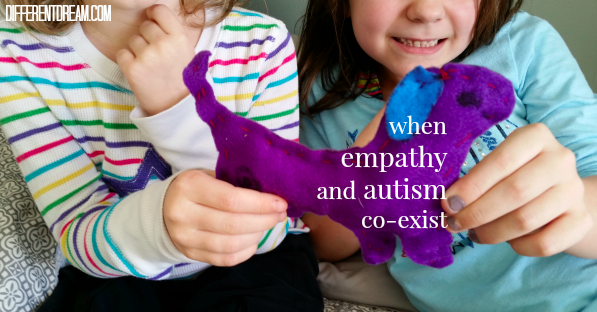
The dog ate one of my six-year-old’s, favorite stuffed animals. Not just any stuffed animal, but one that can’t be replaced; one she handmade herself. A little, red and purple puppy that had been so well-loved it was barely recognizable. She rarely went anywhere without it so, of course, the dog ate it.

There were a lot of tears.

When the sobbing started, I instantly transformed into two mothers: A typical mother, who wanted to make her second born feel better…and an atypical mother who cringed and braced for impact as her first born who lives with autism emerged from her room to react.

Emotional outbursts from her siblings tend to set my oldest off on one of two paths: anxiety or indifference. Autism can make it hard for her to understand why others may be upset, which either intensifies her anxiety or causes her to walk away, seemingly having no emotional reaction at all to someone else’s feelings. When she goes down the more common path of anxiety, it combines with her inability to tolerate sudden, loud noises and easily pushes her to her breaking point. The mix of both kids’ emotions usually causes a ripple effect. Soon, the whole family is on edge. I suddenly find myself overwhelmed and scrambling to find many solutions for what started out as only one problem. It’s in these stressful moments when I hear the whispers in the back of my mind; the temptation to buy into a common myth about individuals with autism…a myth about my child:

She isn’t capable of empathy.

Here’s where God stopped me in my tracks, before my mind could fully toy with the idea of believing the lie. This time, my daughter’s response to her sister’s sadness wasn’t one of anxiety or indifference…

She sat down next to her sister. She asked her why she was upset. She paused for a moment and, as she was considering her own reaction, I was already in a state of awe. Then, she did it! She stepped into her sister’s pain and out of her mouth came words that brought me to tears, “I could make you a new puppy with the sewing kit in my room to make you feel better.”

Not only can autism and empathy co-exist, my child feels empathy.

She displays it. And, through the gift that is being a part of a special needs family, we never take it for granted. Which is why my second born’s response to her big sister’s offer was so perfectly precious: “Yes, I would love that so much! That’s one of the nicest things you’ve ever done for me!”

Everything within me wishes that I could lift the fog of myths and labels surrounding autism, revealing the endless gifts and possibilities of those who, although different, are definitely not less. I may not be able to change the whole world in this way, but I can start with simply changing myself. I can break free of any doubt in the back of my mind that empathy and autism are incompatible. I can also stand in the truth that, through hard work and God’s grace,

There’s nothing my child can’t do.


Do you like what you see at DifferentDream.com? You can receive more great content by subscribing to the quarterly Different Dream newsletter and signing up for the daily RSS feed delivered to your email inbox. You can sign up for the first in the pop up box and the second at the bottom of this page.

By

My name is Amy Felix. I’ve been married for 10 years to a guy who’s totally out of my league. I’m a homeschooling mom to 4 kids, ranging in age from 9 to 2 years. That’s really enough work on it’s own but, because I love it, I’m a photographer as well. And, in my spare time, I write. My faith is the driving force behind my special needs blog: Appointed To Hope. I’m a firm believer in being real, transparent, and using the gifts of this journey as a way to relate to others in their joy as well as their sorrow. To read more about my adventures in special needs parenting, visit my website at www.appointedtohope.com.

Author Jolene Philo

Archives

Categories

Subscribe for Updates from Jolene

Related Posts

When Is Private Testing Right for a Child Struggling Academically?

When Is Private Testing Right for a Child Struggling Academically?

When Is Private Testing Right for a Child Struggling Academically?

When is private testing right for a child struggling academically? Liz Matheis, clinical child psychologist and today’s guest blogger, offers answers by walking readers through 6 questions to determine what’s best for their child’s specific needs. 

When Is Private Testing Right for a Child Struggling Academically?

#1: When your child is struggling academically and your teacher agrees with you, what do you do?

The natural next step is to reach out to the Child Study Team. Lately, I have been finding that parents are receiving much resistance regarding this step and are being sent back to the general education classroom for an intervention plan with accommodations to be implemented for 4-6 weeks. In essence, teachers are being asked to offer more differentiated instruction and try more strategies before the child can be referred for a Child Study Team evaluation.

So where does this leave our struggling child? Waiting. Waiting for intervention while more of the school year passes by. This means that both you and your child are frustrated and flailing. Speaking from experience, waiting is not good for a child who is already struggling academically.

#2: What are your options?

As a parent, you have a few options. You can wait until the 4-6 week intervention period is over and try again. You can also hire a private tutor for your child. Or, you can seek private psycho-educational testing. The last two options involve waiting and often, out of pocket expense.

If you decide to wait and your Child Study Team agrees to test at the end of the 4-6 week intervention period, you will meet again in 90 days to review the test data and determine your child’s eligibility for a special education program and related services.

#3: What are the tests involved in a psycho-educational evaluation done either through the schools or privately?

A psychological evaluation consists of an intelligence quotient (IQ) test, usually a Wechsler-based test that looks at intellectual functioning (WPPSI, WISC-V or WAIS-IV). A full scale IQ is the sum of four index scores while an educational evaluation is a measure of achievement or the different areas of academic functioning such as spelling, writing, reading and math. The Woodcock Johnson Test or the Wechsler Individual Achievement Test is used to assess achievement. The social evaluation is a review of developmental and family history of the student.

#4: What are the advantages of gaining a psycho-educational evaluation privately?

A private psycho-educational evaluation can offer you more information than an evaluation provided by your Child Study Team. A privately based evaluation can also offer you a diagnosis, such as a learning disability or attention deficit hyperactivity disorder (ADHD), where one exists. A private evaluation often consists of executive functioning testing that looks at attention, learning and memory, impulse control, and cognitive flexibility. Another piece of information that is available through private testing is the learning profile. That is, your child’s learning style–visual spatial or auditory sequential.

The examiner can integrate all of the test findings in order to understand your child as a student and learner instead of looking at discrete test scores without looking at how they are related to each other. The other major advantage to private testing is that it will be completed in less than 90 days, which means that you do not need to wait 3 months in order to gain an understanding of how your child is functioning, based on standardized test scores.

#5: When should I accept a Child Study Team evaluation?

That’s easy – if everyone on the Child Study Team is in agreement, then let them proceed with the testing. If you are looking to make the most of the data generated, you may want to consult with a psychologist, learning specialist or educational consultant in order to help you integrate the data that has been provided to you.

#6: How is eligibility determined by the Child Study Team?

Traditionally, the Child Study Team is going to look for a 23 point discrepancy (please note that this can vary from state to state and district to district) between the full scale IQ and an index score on the educational testing. This discrepancy suggests that there is a difference between your child’s cognitive ability and how they are actually performing; thus, a learning disability exists, and your child can be eligible for special education and related services under the category of specific learning disability. Your child can also gain eligibility under several other categories that vary from state to state. So you will want to refer your state’s special education law for the most accurate information.

I hope this clarifies some of the process for you when you are trying to determine when private testing is right for a child struggling academically. If you have more questions, leave them in the comment box.

Do you like what you see at DifferentDream.com? You can receive more great content by subscribing to the quarterly Different Dream newsletter and signing up for the daily RSS feed delivered to your email inbox. You can sign up for the first in the pop up box and the second at the bottom of this page.

By

Dr. Liz Matheis is a clinical psychologist and school psychologist in Parsippany, NJ. She offers support, assessments, and advocacy for children who are managing Autism Spectrum Disorders, ADHD, learning disabilities, and behavioral difficulties, as well as their families. She is also a contributor to several popular magazines. Visit www.psychedconsult.com for more information.

Author Jolene Philo

Archives

Categories

Subscribe for Updates from Jolene

Related Posts