How the Christmas Story is a Special Needs Story

How the Christmas Story is a Special Needs Story

How the Christmas Story is a Special Needs Story

How the Christmas story is a special needs story is something guest blogger Mark Arnold is thinking about this time of year. What he has to say will help you see how Emmanuel, God with us, is with caregiving families in a deep and meaningful way.

Every year we hear the Christmas story of Mary and Joseph heading to Bethlehem, of the innkeeper, angels, shepherds, wise men, and of course the baby Jesus. Have you ever looked at it as a metaphor for special needs families? Here’s a look at how this story parallels the story of parents of children with special needs or disabilities.

Unexpected news

Mary is visited by the angel Gabriel who tells her that she will have a very special child. This surprised Mary. She was ‘greatly troubled at his words’ before she accepted his message and said, May it be to me as you have said.” (Luke 1:26-38)

For the families of children with special needs, unexpected news can arrive during a pre-natal scan. It can be troubling, devastating even. Not every parent accepts the news as Mary did. For some who learn their child will not survive or will be significantly disabled, parents grieve all that their child might have been.

A different location

Mary and Joseph traveled to Bethlehem for the census. Joseph, belonging to the house and line of David, had to register with Mary in Bethlehem, the town of David. (Luke 2:1-5)

Places where a baby with pre-birth concerns can be delivered may be limited. This might require a journey to an unfamiliar town. Though the trip won’t involve a ride on a donkey, it may still be a difficult journey.

Unexpected kindness

Mary needed somewhere safe to give birth to her baby in Bethlehem. Although there are no rooms available for them to stay in the inn, the innkeeper allowed them to use the stable, and the newborn baby was placed in the animals’ manger. (Luke 2:6-7)

Families of children born with special needs or a disability often mention one person who brought a cup of tea and a kind word during an overwhelming medical crisis. A simple act of kindness transformed their profoundly challenging situation into something a little more bearable.

Strangers

A bunch of shepherds turned up shortly after Mary gave birth. Goodness knows what she thought about this, exhausted as she was. Still Luke’s Gospel says that “Mary treasured up all these things and pondered them in her heart.” (Luke 2:8-20) Later, wise men or Magi from the East brought gifts and wanted to see the baby. (Matthew 2:1-12)

Families like ours get used to the arrival of strangers with impressive lists of medical and social care credentials, professionals involved in the care and support of the child and their family. We also ponder the support and care the professionals provide and wonder what the future holds for our child.

Hateful people

Mary and Joseph were warned that Jesus was in danger and fled to Egypt. King Herod ordered the death of all boys under two years old in the Bethlehem area, but was too late to catch Jesus and his family. (Matthew 2:13-18)

There are people today who do not understand or accept children with special needs or disabilities. They do and say hateful things. Some believe babies with special needs or disabilities should be euthanized. Families who encounter these views find them hurtful.

Home

Mary, Joseph, and Jesus eventually returned and set up a home in Nazareth near Galilee. It was Jesus’ earthly home during most of his life. (Matthew 2:19-23)

Many families of children born with special needs or disabilities wait a long time to bring their child home. Some never make it. Those who do come home to a different future than originally envisaged. Still it is a future that can be wonderful.

Seeing how the Christmas story is a special needs story can help us live more fully knowing that Jesus, God with us, and his parents experienced the challenges, and struggles we and other families face each day.

Do you like what you see at DifferentDream.com? You can receive more great content by subscribing to the monthly Different Dream newsletter and signing up for the daily RSS feed delivered to your email.

Photo by Gareth Harper on Unsplash

By

Mark Arnold is the Additional Needs Ministry Director at Urban Saints, a leading national Christian children’s and youth organization. He is co-founder of the Additional Needs Alliance, a national and international advocate for children and young people with additional needs or disabilities. Mark is a Churches for All and Living Fully Network partner, a member of the Council for Disabled Children and the European Disability Network. He writes an additional needs column for Premier Youth and Children’s Work (YCW) magazine and blogs at The Additional Needs Blogfather. He is father to James, who has autism spectrum condition, associated learning disability, and epilepsy. To find out more about how Mark’s work can help you, contact him at: marnold@urbansaints.org or @Mark_J_Arnold

Author Jolene Philo
Archives

Categories

Subscribe for Updates from Jolene

Related Posts

What a Difference a Decade Makes!

What a Difference a Decade Makes!

What a Difference a Decade Makes!

“What a difference a decade makes!” is the joyful cry of guest blogger Janae Copeland as her daughter, born with EA/TEF, turns eleven. Janae shares both the joys and challenges her family experienced when their daughter was born and invites readers to join in this birthday celebration.

“The first two years will be the hardest,” my daughter’s pediatrician said quietly, while looking out the window of my hospital room on the labor and delivery floor. He was watching the helicopter ascend above the trees and head west, as it carried our daughter to the place that could save her. I don’t remember much for several hours after that, mostly due to the combination of drugs I was given to relieve that physical pain of an emergency c-section, and I’m sure, others to ward off any emotional responses to the events of the past few hours.

On August 3, 2022 we reach the eleventh anniversary of that painful day.

Several moments from those first two years––and the several after––are seared in my mind as clearly as the moment they occurred. Countless others have faded with the passing of time. Memories become sewn together in swaths, quilt-like in nature, blurring timelines and sequences, but covering that whole time period with a shadow of fear, uncertainty and single-minded anxieties. Plans made and events held to preserve “normalcy” for our other two kids and ourselves continued to the greatest degree we could muster, although many of those memories seem to have gotten sucked into the mental abyss along with the others. Perhaps I was too tired to monitor my psyche for precise sorting?

Now, when my thoughts of these early years come, they generally fall into one of two camps:

How in the world did we make it through that?

or

Did all that really happen?

Recently, while spending some time with our closest friends, they asked about that day, filling in gaps of the events of the time between getting the phone call that she had been born and their arrival at the hospital. It occurred to me about ten minutes into the conversation that my daughter was looking at me with wide-eyed wonder. Sometimes I forget that she doesn’t have a consciousness of her early days. Much like the huge scar just below her shoulder blade, hidden to her due to its location, and even (unintentionally) to everyone else beyond the bathing suit days of summer, she has an underlying understanding without a fully developed context.

So, what is our reality, a decade later?

In a literal sense, she’s sitting across the room from me, foil in her hair, allowing her chosen blue highlights process on her “curtain bangs”. She just finished a bag of popcorn––I repeat, popcorn–without a drink in hand and without her dad and me holding our breath, watching for the inevitable chaos to ensue. She’s sending Amazon links via text, making sure we know some of her birthday wishes. Her first year of middle school lurks around the corner, with all the newness that brings. In other words, normal stuff! Stuff that I probably never would have been able to believe would one day be her reality.

As her mom, I am filled with gratitude, humility, and hope.

Gratitude that she continues to thrive and maintain her health. I am equally humbled as I relish in God’s grace on our family. I’m all too aware of the parents who are sitting in hospitals right now, with kids of all ages facing what seem to be insurmountable challenges. Even more humbling, some parents are looking at empty cushions where their child should be. Lastly, I have lasting hope, rooted in faith, that any challenges coming our way will be surmounted and that strength and wisdom will be provided when we need it.

He has never forsaken us and His plans for her are more perfect than we could even dream. If you are at the beginning of your journey, please know that prayers are being prayed on your behalf, prayers that you will find yourself down the road living the most beautiful, ordinary life possible. Prayers that in ten years or so, you too will be saying, “What a difference a decade makes!”

Do you like what you see at DifferentDream.com? You can receive more great content by subscribing to the monthly Different Dream newsletter and signing up for the daily RSS feed delivered to your email.

Image by Jackie Matthews from Pixabay

By

Janae Copeland is a wife and mother of 3 daughters. She lives in Jacksonville, NC where she is a K-5 music educator. She became a Different Dream mom when her oldest daughter, Jayda, was born in 2002 with hydrocephalus and cerebral palsy. Nine years later, her daughter Clark was born with EA/TEF and right microtia/atresia. Janae is grateful to have been entrusted with the care all 3 of her special daughters and seeks out opportunities to help other young mothers who may need support as they begin these same journeys with their own blessings from God.

Author Jolene Philo

Archives

Categories

Subscribe for Updates from Jolene

Related Posts

Parenting a Child with Disabilities Isn’t the Grief Olympics

Parenting a Child with Disabilities Isn’t the Grief Olympics

Parenting a Child with Disabilities Isn’t the Grief Olympics

Parenting a child with disabilities isn’t the grief Olympics as guest blogger Laura Spiegel knows. However, as is true for many other caregiving parents, she struggles to find a balance between validating her own grief and cultivating a healthy perspective.

It’s Saturday morning, and I’m at a cafe devouring a giant sandwich and eavesdropping on a conversation at a nearby table. Egg and cheese drip down my hands. As I contemplate grabbing a truckload of napkins or maybe just a fork, I overhear the bad news.

Someone walked into a fellow diner’s open garage and stole a high-end power washer. Her table mates tut with sympathy and promise prayers.

I roll my eyes. Don’t these people have real problems?

I wish my judgement was limited to strangers, but alas. There are times when a family member or a friend will describe a piece of personal news while I silently pass judgment.

A tournament lost,
a D+ earned,
the foundation of a house detached by a deranged mole,
a promotion foregone,
a pet husky passed,
a root canal performed with questionable accuracy.

These are setbacks for sure, and some of them are real doozies. But if devastation is on display when casual disappointment would suffice, I reach for my robe and gavel.

My penchant for judgment kicked into high gear after my daughter was diagnosed with cystic fibrosis. One day, I was freaking out about work along with everyone else. The next, a physician was citing statistics that would change the entire way our family thought, felt, and operated.

Any other moms out there relate?

Your kid has to wear a mask to school? Get over it. My kid has cancer.

Drop the mic.

If my inner comparisons have taught me anything, it’s that somebody else has it worse.

I hate that COVID is still floating about, but my kids have good teachers who are trying their best.
What about those girls in Afghanistan whose dreams of education have crumbled?

My mom has cancer and time is finite, but she has lived 80 years of laughter and love.
What about the local teens killed by a drunk driver?

My daughter lives with cystic fibrosis, but she reads like a boss and flies down the track with glee.
What about the friend who lost her child? Or the friend who would give anything to have one?

Thinking in this way can cultivate perspective. But here’s the thing. When taken too far, it can also rob us of the opportunity to sit with our own emotions.

Frustration
Rage
Devastation.
Grief

All are valid feelings, and all have a place in our lives. If we can’t acknowledge and accept these emotions when they arise, how can we begin to process them?  

This kind of thinking can also distance us emotionally from others. When I silently weigh a loved one’s troubles against my own, I’m dismissing the common humanity associated with suffering and failing to listen with compassion and empathy. I’m robbing myself—and my loved one—of the opportunity to connect authentically with another human being.

There is no established standard for sadness. What knocks me down may be a bump in the road for you. My hiccups may burn you alive.

But who cares? Sometimes, we just need to hear, “That sounds hard, and I’m here for you.”

I’m working on retiring my scale, on remembering that parenting a child with disabilities isn’t the grief Olympics. When someone shares a hardship with me, I’m trying to take a moment to acknowledge the thoughts that immediately flit into my brain. Some are reasonable; some aren’t. There’s usually an It-could-be-worse in there somewhere.

That’s okay. The more I recognize my rush to judge and compare, the more I can begin to loosen their hold over me, and the faster I can get back to doing what matters most:

loving myself,
loving others,
and accepting love in return.

Do you like what you see at DifferentDream.com? You can receive more great content by subscribing to the monthly Different Dream newsletter and signing up for the daily RSS feed delivered to your email.

By

Laura Spiegel spent 12 years at the world’s largest biotech company, partnering with professionals and care teams to help people with special needs and disabilities lead full and happy lives. In 2013 her daughter was diagnosed with cystic fibrosis. Laura now hosts Paint Her in Color, a website that offers emotional support to parents of children with special medical, developmental, or behavioral health care needs. When she isn’t reading, writing, or soaking up time with her husband and kids, Laura can be reached at Paint Her in Color, by email at laura@paintherincolor.com, and on Facebook and Twitter.

Author Jolene Philo

Archives

Categories

Subscribe for Updates from Jolene

Related Posts

Transitioning Kids with Disabilities to Adulthood

Transitioning Kids with Disabilities to Adulthood

Transitioning Kids with Disabilities to Adulthood

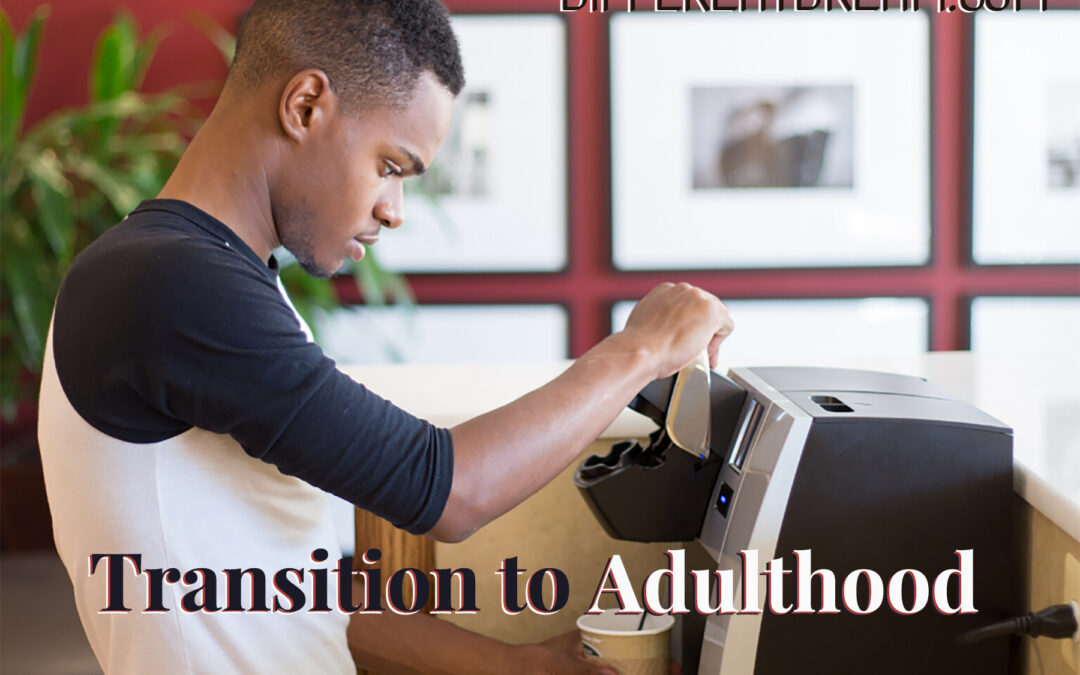
Transitioning kids with disabilities to adulthood is a process that often begins before parents are ready for it. That’s how Sandy Ramsey-Trayvick felt when transitioning became part of her son’s IEP while in middle school. Today she shares 5 tips that made the process easier for her family. She hopes they can do the same for you too.

When the focus of my son’s IEP became about transitioning him to adulthood, it seemed premature. He was in middle school. It seemed too soon to be working on things like vocational skill development, potential job placement, and independent living skills. But as premature as it seemed at 14, as he was nearing 21, it seemed like there hadn’t been enough time to prepare him—or me.

My son is 23 now. Looking back, here are some things I learned that may help in your child’s transition process.

1. Think and pray about your childs future.

    • What are your dreams for your child’s next chapter? What interests do they have that you want to build on?
    • Where will they live? Where will they find community as an adult?
    • Will they work? Go to college? What skills do they need to develop or strengthen?
    • How will siblings be involved in their lives?
    • What kind of support will they need?

2. Do your homework.

    • What is your school district’s process for transitioning students to adulthood?
    • What is the timeline for making the transition so that your child is set up for success?
    • What resources do your district and local agencies provide to help in the transition?
    • What resources will you need to find on your own? In my case, I had to find a transition coordinator for my son because the school district didn’t willingly provide that resource to children with profound special needs.
    • How is funding determined? For my son, the NJCAT assessment was used to determine government funding levels. Based on responses to questions about my son’s needs, level of independence in different settings, communication skills, behavioral issues, medical issues, etc., a funding tier was assigned.

3. Do your own research.

    • What post-school options exist in your area (e.g. day habilitation, college/trade school, employment, group homes, community based supports, etc.)?
    • Which are best suited to your child’s needs and abilities?
    • Prepare to visit a lot of programs. If possible, take your child’s teacher and case manager with you. Don’t rely on brochures for this. Nothing is as good as it seems on paper.
    • You’ll also need to research and interview support coordination agencies to replace the case manager. Speak with other parents about their experiences.

4. Review medical needs.

    • Have you found adult specialists to replace pediatric providers?
    • If you haven’t already, now is the time to organize your child’s medical history and current medical needs: conditions, doctors, medications, etc.

5. Think through changes to be made at home.

    • How can you help your child to become more independent? How can you help generalize skills from school to home? In what ways can you pull back to give your child a chance to grow his/her skills?
    • Will you need additional support at home?

Theres a lot to think about and do when transitioning kids with disabilities to adulthood. It can feel intimidating, but creating a plan with your childs teacher and case manager can make the process much smoother.

Do you like what you see at DifferentDream.com? You can receive more great content by subscribing to the monthly Different Dream newsletter and signing up for the daily RSS feed delivered to your email.

By

Sandy and her husband are parents to three young adult children. Their son was diagnosed with multiple disabilities 21 years ago after a devastating illness as a toddler. Following her son’s diagnosis, Sandy quit her job to become his full-time caregiver and advocate.

Sandy is currently a Certified Professional Coach. Her focus is to come alongside other special needs parents, helping them to recognize choices that will enable them to reclaim freedom, renew purpose, and reactivate joy.

You can learn more about Sandy, her work and her blog at www.UNDisabledLIVES.org. You can also reach her at Sandy@UNDisabledLIVES.org.

Author Jolene Philo

Archives

Categories

Subscribe for Updates from Jolene

Related Posts

EA/TEF Awareness Day 2022 is Here!

EA/TEF Awareness Day 2022 is Here!

EA/TEF Awareness Day 2022 is Here!

EA/TEF Awareness Day 2022 has arrived. Usually Different Dream devotes all of January to EA/TEF Awareness Month. For over ten years, I have issued invitations on Facebook for parents and survivors to share their stories. In the past, responses came so thick and fast, the monthly calendar filled up quickly.

This year there was plenty of initial interest after the invitations were sent. Follow-through was a different matter. I don’t know if sick kids or pandemic burnout or bad timing or holiday demands was the culprit. Whatever the reason, my Plan A resulted in a January blogging calendar that is as bare as Old Mother Hubbard’s cupboard.

Moving on to Plan B, I hereby declare that EA/TEF Awareness Day for 2022 is here! In honor of this special day, this post features some of my favorite EA/TEF posts from past years. I hope you enjoy them and pass them along to raise awareness about a condition that affects 1 in every 3,000 babies born around the world.

#1

My First EA/TEF Memories: Mary Monahan wrote this post as a 61-year-old EA/TEF survivor. In it she shares her earliest hospital memories and what she calls the “dark ages of this condition’s treatment.” This post will make new parents grateful for treatment advances since then!

#2

My Special Needs Mom Worries Never End: I wrote this post a few years back when my EA/TEF survivor son was in his mid-30s. He is not a fan of me obsessing about his health, so I wrote this post to quit doing so. Maybe it will help you, too.

#3

Our Bittersweet EA/TEF Symphony: Not many people consider EA/TEF to be music to their ears, but mom and musician Janae Copeland does. In this post she shares what she’s learned while conducting the symphony of her daughter’s life.

#4

So You’re a NICU Parent: If you’re the parent of an EA/TEF baby, you are also a NICU parent. Brianna Lennon was a NICU parent in 2015 after the birth of her son Ryan. With humor and grace, she explains several parenting skills unique to our particular breed of NICU kids.

#5

When a Kid with EA/TEF Finds Courage…: We know that our EA/TEF kids are among the bravest people in the world. Our kids have to discover that truth for themselves. In this article, Lori McGahan tells readers how her son Brandon discovered how courageous he is.

#6

6 EA TEF Warnings Hidden from New Parents: Nanette Lerner relates 6 warning signs she watches for while raising her son. These warnings allow parents to be proactive rather than reactive as they care for their kids.

#7

EA/TEF Repair Is One Chapter in Your Child’s Life: This post by Cori Welch puts EA/TEF repair surgeries into perspective. Cori also shares 5 things she wishes she’d known before her baby was born in 2018.

#9

Why EA/TEF Awareness Month Is Grace Awareness Month: When our son was born in 1982, I could only see the pain and the worry and the challenges surrounding his condition. As he grew, I began to see the grace surrounding it too.

This list is just a smattering of the Different Dream guest posts about EA/TEF. You can make EA/TEF Awareness Day last a little longer by typing “EA/TEF” in the search bar to find more great stories.

Do you like what you see at DifferentDream.com? You can receive more great content by subscribing to the monthly Different Dream newsletter and signing up for the daily RSS feed delivered to your email.

By

Jolene Philo is the author of the Different Dream series for parents of kids with special needs. She speaks at parenting and special needs conferences around the country. She’s also the creator and host of the Different Dream website. Sharing Love Abundantly With Special Needs Families: The 5 Love Languages® for Parents Raising Children with Disabilities, which she co-authored with Dr. Gary Chapman, was released in August of 2019 and is available at local bookstores, their bookstore website, and at Amazon.

Author Jolene Philo

Archives

Categories

Subscribe for Updates from Jolene

Related Posts

Non-Verbal Kids Can Communicate Clearly if We Learn their Language

Non-Verbal Kids Can Communicate Clearly if We Learn their Language

Non-Verbal Kids Can Communicate Clearly if We Learn their Language

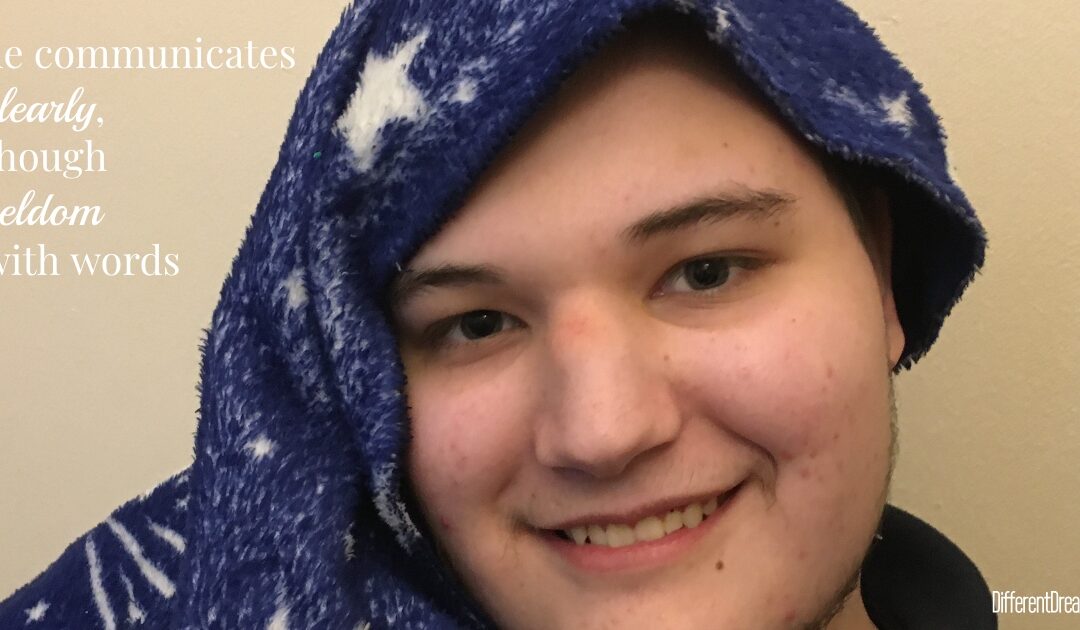
Non-verbal kids can communicate. In fact, they communicate all the time. Guest blogger Mark Arnold continues to learn more about how non-verbal kids can communicate from his son James. Today, Mark shares what James has been teaching him lately.

There is a perception that children who are labelled or identified as nonverbal are unable to communicate. Many believe that kids who have less speech than other children (or no perceived speech at all) can’t share how their feelings, needs, or desires that humans communicate with each other every day.

This perception creates anxiety both for children and their families. Speaking like everyone else becomes a mountain to climb at all costs. This goal overlooks and diminishes the other wonderful ways children subtly and clearly communicate with us.

Those who study non-verbal communication say that perhaps 60-70% of communication doesn’t rely on words. This means that non-verbal kids can communicate using eye contact, facial expressions, gestures, posture and other body language, their mood, sounds, loudness, pitch, rhythm, and tone to communicate. So why do we put so much energy into trying to force non-verbal children to communicate through words instead of focusing on their communication skills? It’s like teaching Japanese to a child without understanding or using their first language.

My son, James, has a limited range of verbal communication, maybe 20 words (one of them is “beerbut that’s another story!), but he communicates fluently. He makes it abundantly clear how he is feeling, what he wants or needs, and what he wants to do. We need to tune in to his communication and understand it. It takes time to learn his form of communication. Sometimes we don’t pick up on something straight away. This can cause frustration, but patience and practice helps!

One of James’ words is “appy!(happy). He often uses it to communicate how he is feeling, whether he is happy or not. If James uses “appywhile he’s frowning, his eyes are downcast, his tone is abrupt and low, he’s is scrunched on the sofa with his legs pulled up, he is telling us how he is feeling in many ways. The word “appy!is his general catch-all phrase for feelings.

Similarly, if James is enjoying his food at the dinner table and wants another portion he might say “more.” He might also say “p-ease(please) and point at what he wants. He will look at it, then us, then back at what he wants again.

If he is feeling unwell, he will lie on his sofa and look suitably miserable. He will also place our hands on whatever hurts–his stomach or head. His communication gives us a better understanding of what might be happening so we can help him.

Non-verbal communication is complex. It can take more decoding than verbal communication, but if we are willing to learn it, it is rich, expressive, and as beautiful as speech. If your child is labelled or identified as non-verbal, remember that non-verbal kids can communicate. Your job is to learn that language and explore ways to develop their speech. It’s just as beautiful!

Do you like what you see at DifferentDream.com? You can receive more great content by subscribing to the monthly Different Dream newsletter and signing up for the daily RSS feed delivered to your email.

By

Mark Arnold is the Additional Needs Ministry Director at Urban Saints, a leading national Christian children’s and youth organization. He is co-founder of the Additional Needs Alliance, a national and international advocate for children and young people with additional needs or disabilities. Mark is a Churches for All and Living Fully Network partner, a member of the Council for Disabled Children and the European Disability Network. He writes an additional needs column for Premier Youth and Children’s Work (YCW) magazine and blogs at The Additional Needs Blogfather. He is father to James, who has autism spectrum condition, associated learning disability, and epilepsy. To find out more about how Mark’s work can help you, contact him at: marnold@urbansaints.org or @Mark_J_Arnold

Author Jolene Philo

Archives

Categories

Subscribe for Updates from Jolene

Related Posts