When the Caregiver Needs Care: How To Admit You Need Tangible Help

When the Caregiver Needs Care: How To Admit You Need Tangible Help

When the Caregiver Needs Care: How To Admit You Need Tangible Help

What happens when the caregiver needs care? Guest blogger Kimberly Drew asks and answers that question in a post that’s hitting close to home as she and her husband care for two daughters with special needs.

When the Caregiver Needs Care:
How To Admit You Need Tangible Help

Our church family and friends often ask if there is anything that they can do to help us. When I’m doing well physically, emotionally, and spiritually, I usually ask friends to pray for the current physical needs of our girls. For Ellie, that she will eat better, be able to sit up, and for a full brain healing. For Abbey that we can make progress on communication, and for specific deformities on her toes and hands that she’s dealing with right now.

Easy right? Everyone can pray!

Let us storm the gates of heaven with our prayers for these girls. I do believe in the power of unceasing prayer.

But right now, I am suffering with a sciatica problem. I’m struggling physically and am realizing how difficult taking care of things is becoming for me. Please know that for me to ask for help is extremely difficult…and doesn’t feel right. While I would do anything for a friend in need, that doesn’t make it easier to be the friend in need. Most parents of children with special needs don’t want to bother others with their problems because they feel they will be a burden or scare away friends.

So I’ve being thinking of ways to ask for help more specifically. These ideas for when the caregivers need care are somewhat specific to our family. But they are tangible things that can really make a difference, and can be adapted for anyone.

  1. I would love to have a small, personally chosen team of four families who are trained to do everything the girls need in an average day. This requires some planning on my part, reaching out to the circle of people I trust the most, and praying they are willing to be “on call” anytime we need help.
  2. Sometimes I need need help around the house, inside or out. It hurts to bend, twist, push, or lift right now…which makes deep cleaning or weeding a struggle. Caregivers not struggling physically have times when the schedule of doctors and medical things overtakes life, and the house starts to fall apart. Friends and family can offer to clean. Or they can pay someone who is in need of extra money to clean. Let the caregiver know this is an open offer for when they need it. Maybe provide a homemade coupon book to use for the number of cleanings you are offering.
  3. Meals are always welcome. Appointments go haywire, a child has an off day and requires constant attention, or exhaustion finally catches up with a person. Having a frozen meal available on a busy day is such a relief! Don’t wait for caregivers to ask for a meal. Just show up with a frozen one once in a while. Make it simple by doubling easy recipes, or plan regular meals for a family with serious needs.
  4. Point people to medical or therapy equipment that would be helpful. Our family is going on sabbatical this summer, and I can’t take our therapist. So some of the therapy tools we use regularly would be helpful. I’ve started a wish list on Amazon, and you could do the same thing.
  5. Ask for diaper or formula donations. We spend about $120 a month on diapers–not covered through insurance–so I could ask for a pack of diapers. One can of Ellie’s special formula is about $18 and lasts 3.5 days. Not an exciting way to support us, but very helpful!
  6. Give money. Asking for money feels very wrong, so I suggest this with a cringing of my spirit. However, lots of families in situations like ours have financial need. Medical bills are generally in the thousands out of pocket expenses every year. When we had just Abbey, we spent between $5,000 to $10,000 a year out of pocket. Sometimes I skip specialist visits and dental work because the co-pay isn’t in the budget. If you want to give anonymously to a family, contact a mutual friend or church office to arrange it.
  7. Send an encouraging note. I love these and read them over and over. I stick them in books as bookmarks, on mirrors, and by my kitchen sink. Sometimes a kind word can get me through a rough day.
  8. Dream big when asking for help. If I’m dreaming big, a handicapped bathroom addition to our downstairs would be amazing. If we asked, perhaps a friend would open a donation account, and when the funds are there we could start. If your family were dreaming big, what would you ask for? A vacation? Respite care so you could go away with your spouse? A home repair? A service pet for your child? Anything works– it’s your dream!

I adamantly detest asking for help. Even so, these eight tangible ways can help when the caregiver needs care in our family or in a family you know. Such acts of love will not go unnoticed by the families you help wherever you live.

Do you like what you see at DifferentDream.com? You can receive more great content by subscribing to the quarterly Different Dream newsletter and signing up for the daily RSS feed delivered to your email inbox. You can sign up for the first in the pop up box and the second at the bottom of this page.

By

Kimberly grew up and went to college in the small town of Upland, IN. She graduated from Taylor University with a degree in Elementary Education in 2002. While at TU, she married her college sweetheart and so began their adventure! Ryan and Kimberly have four amazing kids on earth (Abigail, Jayden, Ellie, and Cooper), and a baby boy waiting for them in heaven. Their daughter Abigail (Abbey) has multiple disabilities including cerebral palsy, a seizure disorder, hearing loss, microcephaly, and oral dysphagia. She is the inspiration behind Kimberly’s  desire to write. In addition to being a stay at home mom, Kimberly has been serving alongside her husband in full time youth ministry for almost fourteen years. She enjoys working with the senior high girls, scrapbooking, reading, and music. You can visit Kimberly at her website, Promises and Perspective.

Author Jolene Philo

Archives

Categories

Subscribe for Updates from Jolene

Related Posts

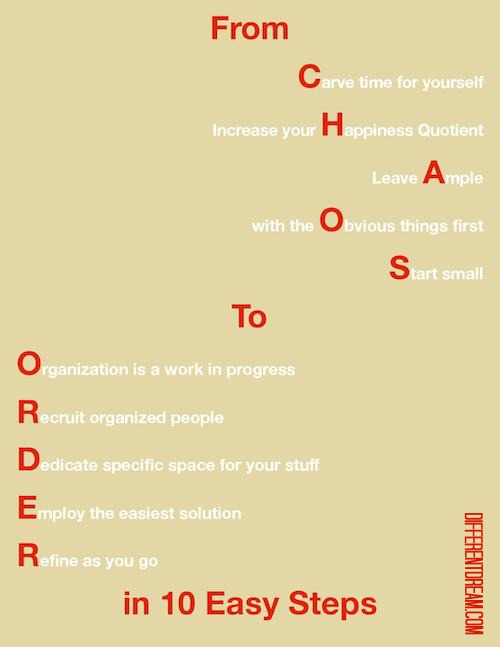
From Chaos to Order in Ten Easy Steps, Part 2

From Chaos to Order in Ten Easy Steps, Part 2

From Chaos to Order in Ten Easy Steps, Part 2

Moving from chaos to order is no easy feat for parents raising kids with special needs. I know that from experience. That experience is what I drew upon for the first post in the series that shared five tips to implement in to move from chaos to order. Today’s post completes the series with 5 more steps I’ve learned about taming chaos over the years. recently when asked to speak to special needs parents about how to bring order from chaos.

From Chaos to Order in Ten Easy Steps, Part 2

The 5 steps explained in Part 1 of this series can go a long way in controlling chaos. But they aren’t enough. To maintain control, a mindset of order must replace the chaos. The next 5 steps can equip you do this.

From Chaos to Order: Step 6

The sixth step is remember that organization is a work in progress. Accept the fact that organization is not an end point but a lifelong journey, especially with kids in the house. My mom gave me a plaque when my kids were young. It said, “Cleaning with children in the house is like shoveling snow in a blizzard.” I put it on a shelf in my kitchen, and it encouraged me when my children’s messes were a source of frustration. It also reminded me to delight in their presence and their messes because one day they would no longer be at home.

From Chaos to Order: Step 7

Step 7 is to recruit organized people to help you because staying organized is much easier when you’re surrounded by people who value what you do. During my teaching years, I learned to find the teachers who were always on top of things. I asked them how they set up their grade books, handled correcting papers, and filling out report cards. It’s a win-win situation. You validate them by seeking their expertise, and you don’t have to reinvent the wheel. So look for parents of kids with special needs who seem to be on top of things and ask them how they do it.

From Chaos to Order: Step 8

The next thing to do is to dedicate specific spaces for important stuff. Put your purse, wallet, and car keys in the same place each day. The same with your kids’ meds, your phone, your tablet, planner, calendar, grocery list–anything crucial to organization. Have a place for it and always put it in that place.

From Chaos to Order: Step 9

Step 9 is to employ the easiest solution possible in every situation. What’s easier than making a bed in the morning? Or getting rid of extra doo-dads on the dresser? The easiest solution could be to fix the same breakfast every morning or assign each person in the house a certain color of socks to facilitate laundry sorting. Stick with easy solutions because they are, well, easy.

From Chaos to Order: Step 10

The final step in moving from chaos to order is to refine as you go. Look for little ways to tweak the systems you put in place so they become more streamlined, simpler, and easier to maintain. And when circumstances change in either big or small ways–a new therapy is added, a new child arrives, you move to a new house–keep refining and tweaking so order is maintained.

Very early in my parenting career I learned a very important key to implementing these 10 steps. I learned to select just one thing at a time–to shine the sink, make the bed, color code the socks, clean off the dresser–and wait until it’s a habit I moved on to the next thing. That was manageable. I could develop one organized habit at a time. I could do it. And you can too.

What are your tips for moving from chaos to order? Leave them in the comment box if you like!

Part 1

Do you like what you see at DifferentDream.com? You can receive more great content by subscribing to the quarterly Different Dream newsletter and signing up for the daily RSS feed delivered to your email inbox. You can sign up for the first in the pop up box and the second at the bottom of this page.

By

Jolene Philo is the author of the Different Dream series for parents of kids with special needs. She speaks at parenting and special needs conferences around the country. She’s also the creator and host of the Different Dream website. Sharing Love Abundantly With Special Needs Families: The 5 Love Languages® for Parents Raising Children with Disabilities, which she co-authored with Dr. Gary Chapman, was released in August of 2019 and is available at local bookstores, their bookstore website, and at Amazon.

Author Jolene Philo

Archives

Categories

Subscribe for Updates from Jolene

Related Posts

From Chaos to Order in Ten Easy Steps, Part 1

From Chaos to Order in Ten Easy Steps, Part 1

From Chaos to Order in Ten Easy Steps, Part 1

Moving from chaos to order is no easy feat for parents raising kids with special needs. I know that from experience. That experience is what I drew upon recently when asked to speak to special needs parents about how to bring order from chaos. Today’s post is the first in a 2 part series about what I’ve learned about taming chaos over the years.

From Chaos to Order in Ten Easy Steps, Part 1

When my sister and I were kids, we shared a bedroom. We zealously guarded our respective sides of our bed, chest of drawers and vanity dresser. Her sides of each were neat. Mine…not so much. I remember the day when my sister said, “Jolene, if you put just a few things on your side of the dresser, it will look better.” Lo and behold, she was right. Then she added, “And if we make our bed in the morning, our room will look a lot cleaner.” Again, my sister was right. Her wisdom brought much needed order to my natural bent toward chaos. And that little bit of order her suggestions injected into my disorder felt very, very good.

What I learned instilled in me a desire that remains to this day–a desire to transform chaos into order with as little effort as possible. That desire ramped way up after the arrival of our first child who was born with a life threatening birth anomaly that required years of corrective surgery. The problem was that, as I mentioned before, I was not a naturally organized person. I don’t have an innate ability to create order. But I am very good at recognizing and adopting proven organizational techniques and tweaking them to meet my needs. So throughout the early years of our son’s life and after our second child was born 6 years later, I collected organizational strategies and eventually implemented 10 strategies that brought order to our home. Now that my kids are grown and gone, I have time to share those 10 simple steps with you.

 From Chaos to Order: Step 1

The first step is to carve out time for yourself. Even if its 5 minutes a day, find some time to do something that gives you energy and rejuvenates your soul. It could be reading a book, watching the sunrise, a short walk or exercise, or listening to music. It could even be locking yourself in the bathroom and enjoying the quiet.

From Chaos to Order: Step 2

Step 2 is to increase your happiness quotient. Shawn Anchor, who researches happiness at Harvard–this is a job I seriously want–suggests 5 research-proven methods for increasing happiness: write down 3 things you’re grateful for each day, journal about positive things, meditate, exercise, and practice random acts of kindness. I know time is at a premium for parents, so choose just one of those ideas and try to do it just once a week.

From Chaos to Order: Step 3

The third step is to create ample margins. Refuse to squeeze too much into your day. Instead identify your priorities and stick to them by saying “no” to other activities and events. Say no without feeling guilty. Remember that this season of life will pass. When it does and the margins in your life are more than ample, start saying “yes” to those activities again.

From Chaos to Order: Step 4

Step number 4 is to deal with the obvious first. Like my sister and me making our bed–the biggest thing in our room and the easiest to do. So find the biggest source of chaos in your life that can easily be tamed and deal with it first. You’ll be amazed at what a difference it makes, and you’ll be motivated to find the next biggest source of chaos that can be easily tamed, too.

From Chaos to Order: Step 5

Step 5 is to start small. The Fly Lady is an online coach who helps people develop house cleaning habits. She recommends starting with just a 15 minute routine that always includes “shine your sink!” Starting small, with just 15 minutes every day, can make a big dent in your family’s chaos.

There you go. The first 5 steps in moving from order to chaos. I’ll be back in 2 weeks with 5 more steps designed to bring order into your special needs parenting life. In the meantime, feel free to share your ideas in the comment box below. Thanks!

Part 2

Do you like what you see at DifferentDream.com? You can receive more great content by subscribing to the quarterly Different Dream newsletter and signing up for the daily RSS feed delivered to your email inbox. You can sign up for the first in the pop up box and the second at the bottom of this page.

By

Jolene Philo is the author of the Different Dream series for parents of kids with special needs. She speaks at parenting and special needs conferences around the country. She’s also the creator and host of the Different Dream website. Sharing Love Abundantly With Special Needs Families: The 5 Love Languages® for Parents Raising Children with Disabilities, which she co-authored with Dr. Gary Chapman, was released in August of 2019 and is available at local bookstores, their bookstore website, and at Amazon.

Author Jolene Philo

Archives

Categories

Subscribe for Updates from Jolene

Related Posts

The Emotional Toll of IEP Meetings

The Emotional Toll of IEP Meetings

The Emotional Toll of IEP Meetings

The emotional toll of IEP meetings is real to parents. Educator Kimberly Drew learned that after her daughter with special needs began school. Over the years she’s learned several strategies to deal with the emotional toll of IEP meetings, and she shares them in this post.

Having been in an IEP meeting as an educator before I had our daughter with special needs, I can tell you that I cared deeply about my student. I went into that meeting prepared and ready to collaborate with the team and parents on how we could best help our student with special needs. I left feeling fantastic about the plan we had in place. It never occurred to me that the parents might have felt differently, that they left feeling exhausted, concerned, and maybe even sad.

I understand now what it feels like to sit on the other side of the table. As a parent, I have left IEP meetings feeling all those emotions at one time or another. I would like to give you some tips on how to handle the emotional toll of IEP meetings.

  1. Most teachers do not get into the field of special education for the money. (What money!?) They do it because they care about these kids and because they want to make a difference in their lives. Go into your meeting knowing that teachers are for your child, not against them or you.
  2. It is the responsibility of each team member to come to the table with a report. They’ve spent a lot of time observing your child in an educational setting very different than a home or family environment. While your child might be able to hold it together at home, school challenges their minds both educationally and socially. The report makes it feel like your child has been under a microscope, and to some extent this is true. However, its details are meant to form a complete picture of your child’s strengths and weaknesses to gauge where they need the most help and what the team can do about it. Try not to listen on the defensive, but remember that you are part of the team. Come with your own notes and thoughts to present, and embrace that you are all working toward the same goal.
  3. As the meeting goes on, it is normal to feel discouraged and tired. It is very taxing to listen to four or more people (six at our last meeting) talk about your child in detail. Try to plan ahead for the fatigue that comes after these meetings. I usually have a plan for dinner that includes either a crock pot or eating out! I also try to come home with nothing else on the planner. It’s important to be able to crash and recover.
  4. Understand that it’s okay to be sad. It’s very hard to hear how your child is struggling. At our last meeting, our daughter was transitioning to a new school. I had to answer the questions about whether or not our daughter could read. The answer was no. Can she recognize letters? A few. Can she count? No. Does she now any numbers? Only one to three. Then we all sat there staring at each other for a few awkward moments. I felt my heart sink. I was sad. It was okay to be sad. I kept the tears in until I got home and then gave myself a moment to let them out.
  5. If you leave the meeting feeling unsure if everything was covered or if you forgot things, you can e-mail the team afterwards. You have time to review the IEP once it’s printed and nothing is set in stone without your signature.

Always remember that you are all doing your best to help your child reach their fullest potential. Be grateful for a team who wants to help your child, let yourself grieve if you feel the sadness rising up again, and look for the positives in the meeting and try to focus on those.

How do you deal with the emotional toll of IEP meetings? Leave your comments below!

Do you like what you see at DifferentDream.com? You can receive more great content by subscribing to the quarterly Different Dream newsletter and signing up for the daily RSS feed delivered to your email inbox. You can sign up for the first in the pop up box and the second at the bottom of this page.

By

Kimberly grew up and went to college in the small town of Upland, IN. She graduated from Taylor University with a degree in Elementary Education in 2002. While at TU, she married her college sweetheart and so began their adventure! Ryan and Kimberly have four amazing kids on earth (Abigail, Jayden, Ellie, and Cooper), and a baby boy waiting for them in heaven. Their daughter Abigail (Abbey) has multiple disabilities including cerebral palsy, a seizure disorder, hearing loss, microcephaly, and oral dysphagia. She is the inspiration behind Kimberly’s  desire to write. In addition to being a stay at home mom, Kimberly has been serving alongside her husband in full time youth ministry for almost fourteen years. She enjoys working with the senior high girls, scrapbooking, reading, and music. You can visit Kimberly at her website, Promises and Perspective.

Author Jolene Philo

Archives

Categories

Subscribe for Updates from Jolene

Related Posts

Mother’s Day Top Ten at Different Dream

Mother’s Day Top Ten at Different Dream

Mother’s Day Top Ten at Different Dream

Check out the Mother’s Day top ten Different Dream posts written for moms of kids with special needs by moms of kids with special needs. Grab a tissue and be ready for your heart to swell with the fierce love peculiar to moms like you and me.

#10: How to Breathe When You Can’t Let Go

Guest blogger Sarah Broady (who is also Different Dream’s virtual assistant and tech wizard) shares lessons she learned about how to breathe when you can’t let go while enjoying the Mother’s Day gift her husband gave her in 2016.

#9: To Grandma from Your Grandchild with Special Needs

Kathy Guzzo wrote her post for grandmothers of kids with special needs from personal experience and deep gratitude. If you and your child have been blessed with the support of a great grammy, you’ll want to pass this post along to that remarkable woman this week!

#8: Top 20 Reasons Moms of Kids with Special Needs Rock

This links to a favorite post by Ellen Seidman’s Love That Max blog. Her 20 reasons create the perfect Mother’s Day tribute to moms of kids with special needs.

#7: This Is for the Special Needs Mothers Who…

Guest blogger Stephanie Ballard published her first Mother’s Day poem for moms of kids with special needs in May of 2013, and it was an instant hit. For your reading pleasure, here’s the link to This Is for the Special Needs Mothers Who…

#6: How Can 31 Years Ago Seem Like Yesterday?

This post was written on the 31st anniversary of the birth of Jolene Philo’s son. It recalls the events of a day that became increasingly dire as his health challenges were diagnosed. All moms who’ve lived through similar circumstances, whether 3 years or 13 or 30, know that the anniversary of that day brings back memories that feel like they happened yesterday.

#5: Happy Mother’s Day, Special Needs Moms

A year after her first Mother’s Day poem appeared on Different Dream, she again recognized the day with a Happy Mother’s Day wish for special needs moms. In case you haven’t yet realized it, all Steph’s poems come with tissue warnings!

#4: The Place Where Joy and Grief Meet

Moms of kids with special needs know that Mother’s Day is one of those days where the joy and grief of parenting meet. Jolene wrote about that intersection in this reflection about becoming a mom.

#3: A Special Needs Mother’s Day Poem

Yup, you guessed it. Steph Ballard joined the Different Dream May fun with a third special needs Mother’s Day poem in 2015. Here it is…do you have your tissue ready?

#2: Mother’s Day Grace for Moms of Kids with Special Needs

The more Jolene travels, the more often she meets moms who feel like they don’t do enough and aren’t enough for their kids with special needs. This post is a reminder of the grace that makes moms of special needs enough and more than enough to care for their kids.

#1: The Heart of a Special Needs Mother

The ongoing needs of Steph Ballard’s son didn’t leave her time to write a Mother’s Day poem this year, so Different Dream’s rounding out the this Mother’s Day top ten with her post about the heart of a special needs mother which appeared in May of 2016.

Your Favorite Mother’s Day Top Ten Post?

Which is your fave Mother’s Day top ten post? Leave a comment about it below if you’d like. Happy Mother’s Day!

Do you like what you see at DifferentDream.com? You can receive more great content by subscribing to the quarterly Different Dream newsletter and signing up for the daily RSS feed delivered to your email inbox. You can sign up for the first in the pop up box and the second at the bottom of this page.

By

Jolene Philo is the author of the Different Dream series for parents of kids with special needs. She speaks at parenting and special needs conferences around the country. She’s also the creator and host of the Different Dream website. Sharing Love Abundantly With Special Needs Families: The 5 Love Languages® for Parents Raising Children with Disabilities, which she co-authored with Dr. Gary Chapman, was released in August of 2019 and is available at local bookstores, their bookstore website, and at Amazon.

Author Jolene Philo

Archives

Categories

Subscribe for Updates from Jolene

Related Posts

How to Create a Sensory Garden for Kids with Special Needs

How to Create a Sensory Garden for Kids with Special Needs

How to Create a Sensory Garden for Kids with Special Needs

Want to create a sensory garden for and with your kids this summer? Guest blogger Trish Shaeffer is here with step-by-step directions to get your summer off to a green thumb start!

How To Create a Sensory Garden for Kids with Special Needs

Now that the weather is getting nicer and winter is behind us, it’s a great time to start thinking about outdoor activities for the whole family.

One of those activities is gardening. Gardening is for the whole family and any age group, and is great for kids with special needs. It teaches children a lot of lessons as well–from the circle of life, to patience and responsibility, and even colors and time. For a child that is learning to read or spell, the labels you make for you garden provide another opportunity to practice those skills. My son who has CP loves to plant the seeds in the small pots and water them. It gives him a sense of accomplishment because he can actually do something on his own. Gardening is also great for my twins who have sensory issues. The dirt in their hands gives them tactile input and the plants also provide their own input with touch and sight. Even the creepy crawlers in your garden provide a teaching opportunity and sensory feedback.

So why not create a sensory garden the whole family can enjoy together?  A sensory garden can include everything from bright, colorful and fuzzy flowers to vegetables and fragrant herbs. Each plant in the garden should have unique features.

I don’t claim to have a green thumb at all and it makes for a challenge to get our garden started. We have lot of trial and error, but it’s a great sense of accomplishment for the whole family when hard work pays off and our garden grows.

A vegetable garden is a great way to also save money. Seeds are very cheap and you get a lot of plants out of one seed packet. The seeds themselves provide a learning experience and feedback. Have you child touch and observe each seed and try to have them guess which vegetable the seed came from.

If you want to save money on pots for your seedlings, just look around the house. An old box lid, egg carton, old jars, empty yogurt containers, and the like are all great containers for sprouting seeds. Just make sure to punch a drainage hole in the container.

To make a greenhouse for your new plants, place plastic wrap over jars and cups, and secure with a rubber band. This will not only help your plants stay warm, but will also keep moisture in from the soil which means less watering.

Place your seedlings in a place where your kids can check on the plants everyday and note the progress of their garden, watching it grow and transform. I can honestly say that, in spite of my lack of a green thumb, one week after we planted seeds, our garden started to sprout. My kids are excited to watch their garden grow and I hope your children will be, too! Have a happy and healthy garden experience.

Have you tried to create a sensory garden with your children? Leave your favorite tips in the comment box if you like!


Do you like what you see at DifferentDream.com? You can receive more great content by subscribing to the quarterly Different Dream newsletter and signing up for the daily RSS feed delivered to your email inbox. You can sign up for the first in the pop up box and the second at the bottom of this page

By

Trish Shaeffer mom of 3 active boys, a 9-year-old and 5-year-old twins who were born 2 months early and have special needs. She’s a peer supporter for Parent to Parent and volunteers with the United Cerebral Palsy Network, Special Olympics, and the United Way. She’s also an equine volunteer at Leg Up Farm. She’s married to her best friend and biggest supporter, Chris Shaeffer.

Author Jolene Philo

Archives

Categories

Subscribe for Updates from Jolene

Related Posts