Useful Holiday Tips for Special Needs Families

Useful Holiday Tips for Special Needs Families

Useful Holiday Tips for Special Needs Families

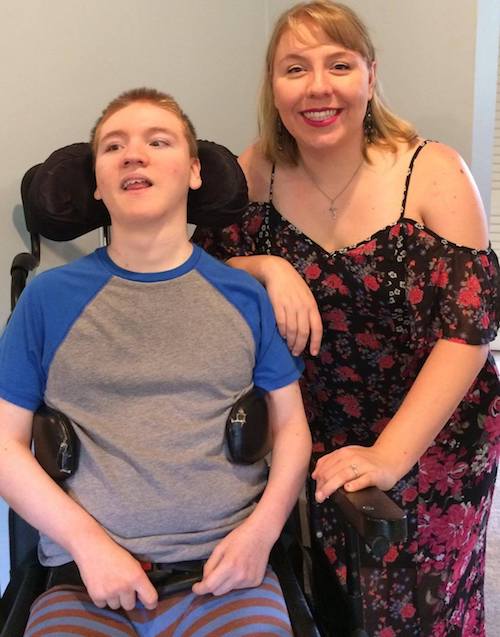
This the season for holiday tips for special needs families. Today’s tips from guest blogger, Trish Shaeffer, who is mom to 3 very cute, very active boys with special needs have been field tested and declared both useful and successful.

Useful Holiday Tips for Special Needs Families

The holidays are a joyous time to spend with loved ones being thankful, giving to others, exchanging gifts and wishing for peace. I look forward to all of the wonderful things that come with the holiday season — but, having said that, I admit, it can be a difficult time for my special needs family. Routines and school programs change. Vacation, travel, visiting family and friends, and functions all have accompanying difficulties. There’s too much downtime, too much noise, and way too much food. To make the best of the season, I have come up with some useful holiday tips for families for special needs families:

  1. Leave some buffering time in your schedule. It is tempting to plan numerous visits, weigh your schedule down with gatherings and get involved in as many seasonal activities as possible to capitalize on the too-brief season. But this can be too much for your special family. Instead, plan for one or two special experiences (aim for quality over quantity) and make sure your child has plenty of restful time before and after an event.
  2. Bring your own food and supplies to gatherings. If your loved one is a picky eater or on a special diet, come prepared to holiday gatherings with your own food to maintain consistency. This is also a good idea for kids who have food allergies or are on tube feeds. Bring along favorite items that help calm your child, too, like iPads, books, stuffed animals, and weighted vests.
  3. Build in as much routine as possible. This is hard, but I try to keep consistent wake-up time, bedtime, and routines over the holiday break. I also try to maintain rules enforced during the school year. For instance TV and screen time remains limited. Also, meals are served around the same time.
  4. Plan activities for the holiday break. Ask your child’s teacher for activity ideas to reinforce what your child is working on at school. This can preserve continuity and reinforce lessons. You can also ask your child’s therapist if there are any activities to benefit your child between sessions.
  5. Schedule ample help. Take advantage of family togetherness and reach out for a little help during the holiday season! Your “mother’s helper” could be a grandmother, babysitter, local college student, paid nurse or other family member, or friend. Ask for help with your child’s routine or care, Christmas shopping, decorating, baking, cooking, cleaning or all the above. It’s a way to let others and give people who love you a chance to help in what can be a hectic time.
  6. Avoid crowds. Loud, frantic crowds can be too much for many of us and even more so for our special needs children. Shop during the hours or days that are less busy, or do your shopping online. If a huge crowd cannot be avoided, make sure to allow time for your child to decompress and relax before and after the hustle and bustle. This may help cut down on sensory issues as well as shopping headaches and heartaches.
  7. Keep calm. Keeping calm during chaos and resisting meltdowns helps children cope with the holiday sights and noises they absorb. Keeping calm is also good for your heart rate and your mind. So count to 10, go to your quiet place, or just have that second glass of wine. Taking mom time for yourself may be just what you and your child needs.
  8. Say no. You need to say “no” to anything that does not ultimately contribute to your own or your child’s well-being. Figure out which events and activities you must do, and let go of the rest.Simply explain that it will not work for your child or your family. If you decline an invitation, people who care about you will not be offended. Then, opt for a quite night at home instead.
  9. Take time for yourself. Maintaining a healthy state of mind helps you be a better parent. If you happen to come across me around town, kid-free and deep in a good book at a coffee shop, you’ll know I take my own advice seriously.
  10. Keep expectations reasonable. We want the holidays to be perfect for our family. Just cherish the time you do have and make the best of it instead of getting frustrated.
  11. Count your blessings. Raising a loved one with special needs is hard, and we may wish for a normal holiday season. Let the holidays be a time to realize the gifts we have been given — especially those we receive from our children. I am a better person because of my sons. This makes me feel very blessed indeed.


Do you like what you see at DifferentDream.com? You can receive more great content by subscribing to the quarterly Different Dream newsletter and signing up for the daily RSS feed delivered to your email inbox. You can sign up for the first in the pop up box and the second at the bottom of this page.
By

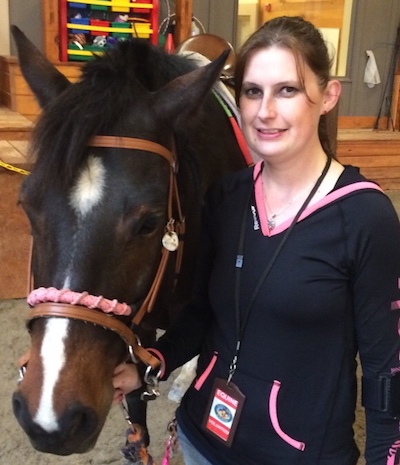
Trish Shaeffer mom of 3 active boys, a 9-year-old and 5-year-old twins who were born 2 months early and have special needs. She’s a peer supporter for Parent to Parent and volunteers with the United Cerebral Palsy Network, Special Olympics, and the United Way. She’s also an equine volunteer at Leg Up Farm. She’s married to her best friend and biggest supporter, Chris Shaeffer.

Author Jolene Philo
Archives

Categories

Subscribe for Updates from Jolene

Related Posts

The Final IEP Meeting: Advice to the Mom I Once Was

The Final IEP Meeting: Advice to the Mom I Once Was

The Final IEP Meeting: Advice to the Mom I Once Was

After her daughter’s final IEP meeting, guest blogger Karen Jackson, marked the day by penning a letter to the mother she was in the early days of their children’s education. Her advice is valuable beyond measure and may require a tissue.

The Final IEP Meeting:
Advice to the Mom I Once Was

Today I attended my 17th and final IEP meeting for my daughter, Samantha. I remember the first one when she was just four years old. I was new to the lingo, new to the procedures and still grieving and trying to figure out what autism was and how it would affect my sweet daughter.

Samantha’s public schooling comes to an end this year, and the last IEP begins the official process of transition to the post-high school world. I feel like something should mark this day. Celebration does not seem completely appropriate but the idea of a letter to that mom from 17 years ago might work. So here goes…

Dear Young(er) Mom,

As you begin this new, unknown path of education for your child who was just diagnosed with autism, let me share a few things you will learn during the next 17 years- things that may set your mind at ease:

  1. You aren’t going to do this alone. There will be many, many professionals who will come alongside and help educate your daughter. They will not all be excellent teachers, but some will be. Most will be caring and skilled, doing their best to help your daughter reach new goals.
  2. It’s not a battle. Despite how you feel right now, the best strategy is to support and encourage the IEP team. Be a positive advocate when at all possible. Sometimes, you will need to use strong words or even bring in other advocates, but you will be most affective by staying positive.
  3. Do not feel guilty. You try your best for your daughter, so do not feel guilty when you miss something–when she doesn’t make the expected progress or when you can’t be at every event for all three of your children. (Oh, by the way, you will have a third child in a couple of years…Surprise!)
  4. Enjoy the everyday moments. The schedule in the school years will always be busy: activities, work, meetings, therapy will be on-going. So savor the small, seemingly insignificant moments; a walk to the water, the first day she wanted to help in the kitchen, watching her interact with her brothers. These precious moments will make up for some of the daily challenges so take time to recognize and enjoy them.
  5. You are stronger than you think. The task ahead appears daunting. You need to educate a child who can’t speak a word, keep her safe, help her to grow into the woman she is meant to be. You will become strong enough because, as you gain parenting and life experience on this unexpected journey, your faith will also mature. One day, you will look back and realize your strength is not just from yourself. It is from the Lord. You were never meant to be strong enough by yourself, or even with all the support of professionals, family and friends. God will be on every step of the journey with you and He will give you the strength to carry on.

Blessings to you as you begin this exciting and very special parenting journey. Hang in there. The years are going to go quickly!

Love,
Karen, a slightly older and more experienced me


Do you like what you see at DifferentDream.com? You can receive more great content by subscribing to the quarterly Different Dream newsletter and signing up for the daily RSS feed delivered to your email inbox. You can sign up for the first in the pop up box and the second at the bottom of this page.

By

Karen Jackson is the Executive Director of Faith Inclusion Network (FIN) of Hampton Roads where she lives with her husband and three children in Norfolk, VA. She is also the author of Loving Samantha. You can connect with Karen on Facebook at the FIN page.


Author Jolene Philo

Archives

Categories

Subscribe for Updates from Jolene

Related Posts

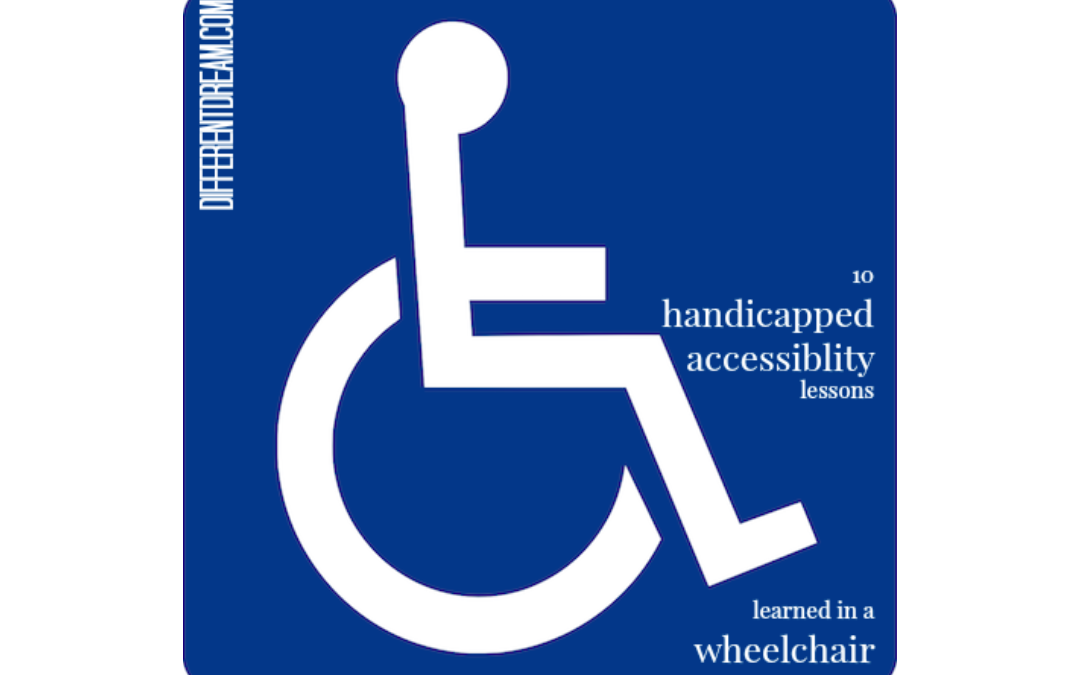
Ten Handicapped Accessibility Lessons Learned in a Wheelchair

Ten Handicapped Accessibility Lessons Learned in a Wheelchair

Ten Handicapped Accessibility Lessons Learned in a Wheelchair

I’ve been in a wheelchair for six weeks now, compliments of the malicious purse strap that wrapped itself around my leg, causing me to fall and break my foot. The doctor issued strict non-weight bearing until the foot heals, which is taking longer than expected. Since the fall (and yes, I still use the purse), I’ve made the acquaintance of a pair of crutches and become good friends with a black boot and a wheelchair.

While the wheelchair has resulted in a slower paced life for the time being, I get out as often as possible. (Translation: whenever busy and thoughtful family members can serve as drivers.) These forays have allowed me to experience the challenges people in wheelchairs deal with day after day, from building to building, and from one encounter to another. It’s been an eye-opening experience, and I’d like to share some observations with you today.

10 Lessons Learned in a Wheelchair

10.  Those signs near hotel elevators that say “In case of fire, use the stairs” are less than reassuring to people in wheelchairs assigned handicapped rooms located anywhere other than on the first floor.

9. Have you ever tried to open a heavy door while sitting in a wheelchair? If you have, you know that any bathroom that claims to be be “handicapped accessible” and doesn’t have an automatic door is not truly handicapped accessible.

8. The pitches of many ramps are so steep that they inaccessible to people operating manual wheelchairs by themselves. So in reality, those “handicapped accessible” ramps force dependence upon people in manual wheelchairs.

7. Most handicapped bathroom stalls are too small for wheelchairs to turn around in so the stall door can be closed and locked. Therefore, they are “handicapped accessible” only for exhibitionists.

6. Flagstone walkways, while quaint and charming, are dangerous for anyone using crutches, a walker, or a wheelchair. Therefore, our flagstone sidewalk to the front door is being replaced with a mildly pitched cement ramp as soon as possible.

5. If the front of a wheelchair can’t roll far enough under the sink in a “handicapped accessible” bathroom so a person can reach the faucet and soap, the bathroom is not handicapped accessible. It’s a germ factory.

4. By the same token, if a person has to use wet hands to wheel to the hand dryer in a “handicapped accessible” bathroom, the bathroom is not handicapped accessible. It’s gross.

3. When you’re out and about in a wheelchair, half the people will ignore you, a third of the people will call you “hon”  or “honey” and try to do everything for you, and the rest will ask you what you need, listen carefully, and be truly helpful.

2. Most grab bars in “handicapped accessible” bathrooms aren’t close enough to the toilet to be useful. Which once again means the bathroom is mislabeled.

1. Anyone who is temporarily confined to a wheelchair will likely become a disability advocate. They will also be grateful for those who go beyond the minimum “handicapped accessible” guidelines to make the world truly handicapped accessible to all.

Do you have mobility issues? What lessons have you learned in a wheelchair, a walker, or crutches? Share them in the comment box.


Do you like what you see at DifferentDream.com? You can receive more great content by subscribing to the monthly Different Dream newsletter and signing up for the daily RSS feed delivered to your email.

By

Jolene Philo is a published author, speaker, wife, and mother of a son with special needs.

Author Jolene Philo

Archives

Categories

Subscribe for Updates from Jolene

Related Posts

Cerebral Palsy: A Message for You

Cerebral Palsy: A Message for You

Cerebral Palsy: A Message for You

Cerebral palsy (CP) is part of life for many Different Dream readers and their families. One of those readers. Today’s guest blogger, Lindsey Pasieka, is raising awareness about the condition as part of her advocacy efforts on behalf of her brother.

Cerebral Palsy: A Message for You

For those of you who may have missed it, October 6th was World Cerebral Palsy Day. World CP Day is a day to spread awareness about the #1 childhood motor function issue in the world. Cerebral palsy affects nearly 1 in 300 children.

People make a lot of assumptions about kids with CP. They assume that people with CP can’t think or learn. That they can’t grow up, or won’t grow up, because of their disease. And that even if they do reach adulthood, they will never be independent.

Over the past few months, I’ve been able to connect with a huge community of CP families online and it’s clear that those assumptions are often wrong. So here are a few things you might have never known about cerebral palsy.

CP doesn’t always imply intellectual impairment.

While some people with CP do have mental delays or deficiencies, there is a huge number of folks with normal cognition. Actually, many people with CP are intellectually gifted– I’ve connected with college grads, business owners, and even doctors who have a form of CP.

Cerebral palsy isn’t all the same.

There are 4 large groupings to distinguish the different types of CP: spastic, athetoid, ataxic and mixed. Each of those groups contains a myriad of symptoms and severities. Some people with CP may have multiple issues -added complications on top of their motor function deficits. The range is truly astounding, as is the range of capabilities. Yes, there are CP patients that are wheelchair bound and have almost no motor function control. There are also CP patients who wear high heels, drive cars or go jogging.

Lots of people with cerebral palsy live happy, independent lives.

That’s right. They don’t all stay with their parents forever or end up in long-term care facilities. Some may use assistive technology, which has come such a long way in recent years. Others won’t need it and are able to use medications or physical therapy to manage motor function issues. With some people, you might not realize that they even have CP.

But for some people, cerebral palsy is devastating.

I’ve spent a lot of time around World CP Day talking about the amazing accomplishments of people with CP. But those stereotypes, those assumptions you make, they are also someone’s reality.

Someone prays that their child lives past 10.
Someone sits by a hospital bed and refuses to go home.
Someone knows their kid won’t walk, or talk, or graduate.

When you meet someone with CP, the best thing you can do is enter the conversation with no assumptions. Let that person or their family tell you their story their way.  Be supportive, and respectful. Pray by their side if they need it. Cheer them on as they accomplish things they never expected. And never let your preconceptions get in the way of connecting with another person. Thank you, and Happy (belated) World CP Day.

Do you like what you see at DifferentDream.com? You can receive more great content by subscribing to the monthly Different Dream newsletter and signing up for the daily RSS feed delivered to your email.


By

Lindsey Pasieka is a writer and consumer advocate working with ConsumerSafety.org. When not working, she enjoys spending time with family and volunteering for animal rescue. She writes for Different Dream on behalf of her brother, who has cerebral palsy.

Author Jolene Philo

Archives

Categories

Subscribe for Updates from Jolene

Related Posts

How to Press On as a Caregiver

How to Press On as a Caregiver

How to Press On as a Caregiver

Guest blogger Kimberly Drew is learning to press on as caring for a beloved baby daughter with special needs takes a toll on mamma’s body and mind.  Today, she explains where she looks for help and encouragement.

Press On

I pulled out of the doctor’s office and geared up for the almost 2 hour drive home. By the time I got home it had been a 6 hour day. Our youngest daughter Ellie was adopted with the knowledge that she would have special needs. Her recent cerebral palsy diagnosis was a big disappointment, but it was also expected. What I didn’t anticipate was the toll that her care was going to take on my mind and body, how hard it would be to Press On.

It’s not that I had forgotten how hard the early years were with our older daughter who has special needs, I had just forgotten what “hard” felt like.

Ellie is 22 months and only 15 pounds and 6 ounces, and she has oral feeding difficulties. Her feeding therapist wants us to wean her off the pacifier–the same pacifier that the NICU team told us required a critical skill she needed to develop before weaning her off the feeding tube. So of course we encouraged her to use the pacifier all the time!

We have had pacifiers in every room of the house, 3 in the crib, many lost, and multiples in the diaper bag at any given time.

But at this stage, the pacifier can become a problem for her feeding issues and speech delays. Despite all the hours of effort, all the frustration, all the labored and intense therapy sessions to develop her reflexes in place for drinking from a bottle, the pacifier now has to go. It’s simply time to move on toward our next goal.

This lesson couldn’t be more appropriate for the difficulty I am currently facing.

Sometimes, not matter how hard you’ve worked at something it’s time to move on. A pastor at a teaching conference spoke about the hardships that Paul went through in his journey as a devoted follower of Jesus.

2 Corinthians 11:23b-27 reads, “I am talking like a madman—with far greater labors, far more imprisonments, with countless beatings, and often near death.  Five times I received at the hands of the Jews the forty lashes less one.  Three times I was beaten with rods. Once I was stoned. Three times I was shipwrecked; a night and a day I was adrift at sea;  on frequent journeys, in danger from rivers, danger from robbers, danger from my own people, danger from Gentiles, danger in the city, danger in the wilderness, danger at sea, danger from false brothers;  in toil and hardship, through many a sleepless night, in hunger and thirst, often without food, in cold and exposure.”

Despite those obstacles, Paul continued to serve, follow, and give his life up for the sake of God’s glory and the Gospel even still. In Ephesians 3:8 he says,  “ Indeed, I count everything as loss because of the surpassing worth of knowing Christ Jesus my Lord. For his sake I have suffered the loss of all things and count them as rubbish, in order that I may gain Christ.”

With the backdrop of his imprisonments, beatings, shipwrecks, hunger, and public shame Paul looks to Christ for the strength to press on. In Phillipians 3:13-14 he writes, “Brothers, I do not consider that I have made it my own. But one thing I do: forgetting what lies behind and straining forward to what lies ahead, I press on toward the goal for the prize of the upward call of God in Christ Jesus.”

If you, like me, are struggling through the difficulties of raising a child with special needs and find yourself discouraged and weary, I encourage you to let go of what is behind, strain forward, and press on. Let’s read and meditate upon Paul’s words until they take root in our hearts.

I love the song, Press On, by the group Selah. I need to hear it today and imagine I’m not alone in that. If you have a few minutes to listen to it, you won’t regret it.

How do you press on when the caregiving burden takes a toll on you? Share what you’ve learned in the comment box below.

Do you like what you see at DifferentDream.com? You can receive more great content by subscribing to the quarterly Different Dream newsletter and signing up for the daily RSS feed delivered to your email inbox. You can sign up for the first in the pop up box and the second at the bottom of this page.

By

Kimberly grew up and went to college in the small town of Upland, IN. She graduated from Taylor University with a degree in Elementary Education in 2002. While at TU, she married her college sweetheart and so began their adventure! Ryan and Kimberly have four amazing kids on earth (Ellie, Abigail, Jayden, and Cooper), and a baby boy waiting for them in heaven. Their daughter Abigail (Abbey) has multiple disabilities including cerebral palsy, a seizure disorder, hearing loss, microcephaly, and oral dysphagia. She is the inspiration behind Kimberly’s  desire to write. In addition to being a stay at home mom, Kimberly has been serving alongside her husband in full time youth ministry for almost fourteen years. She enjoys working with the senior high girls, scrapbooking, reading, and music. You can visit Kimberly at her website, Promises and Perspective.

Author Jolene Philo

Archives

Categories

Subscribe for Updates from Jolene

Related Posts

The Amazing Shrine School for Children with Special Needs

The Amazing Shrine School for Children with Special Needs

The Amazing Shrine School for Children with Special Needs

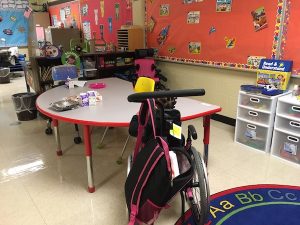
The Shrine School in Memphis, Tennessee is one of a kind. I visited it in late September of 2017 and was blown away by the building, the teachers, the staff, the parents, and most of all, by the 150 students served there.

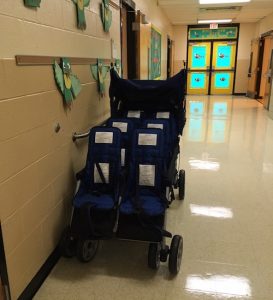
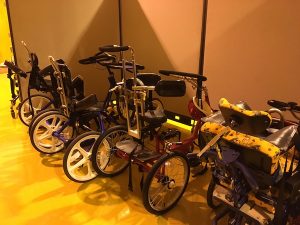
I knew this school was something special after spying this multiple child carrier in the preschool hallway.

The school, part of Shelby County Schools, has a unique history and collaboration with the Shriner Organization. The Shrine Board of Control provides funding for special services that benefit the students who attend the school. To be eligible to attend, students (who range from age 3 to 21) must have an IEP, and the need for nursing services must be written into their IEPs. The services offered are amazing. Here are pictures of a few.

Breakfast and lunch for all students. The little girl in the chair is eating breakfast. The cafeteria provides special meals for students who require pureed food, thickened liquids, gluten-free and the like.

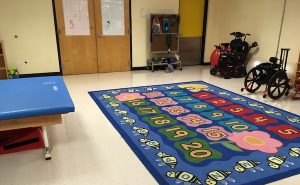
Full time, on site physical, occupational, and speech therapists who do some work in the therapy room above or in the classroom.

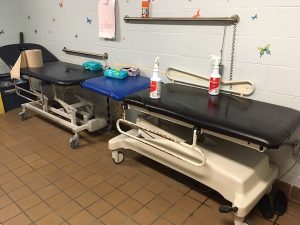
Special changing tables in the locker rooms for students whose IEPs include water therapy in the pool shown at the top of the page.

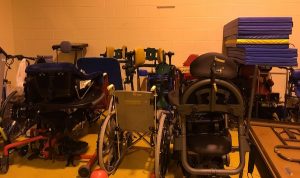
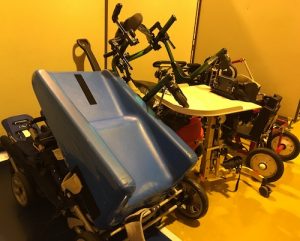
Adaptive PE equipment for tots,

tweens,

teens, and young adults.

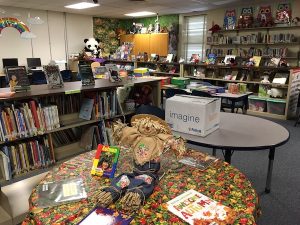
A fully stocked library run by Ms. Posey, which I think is the best possible name for a children’s librarian.

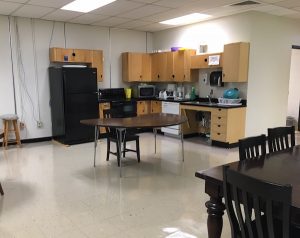
A life skills area where students learn cooking and housekeeping skills.

The Shrine School also has a full time RN who works with students and oversees numerous LPNs that serve each wing of the school (preschool, elementary, middle school, and high school). Class sizes range from 8–13 students. Each classroom has a full time teacher and at least 2 teaching assistants. The principal has been there 18 years and is passionate about the students. The full time guidance counselor, who first contacted me about speaking at their fall parent resource fair, knows every student by name and is constantly searching for resources for children and families.

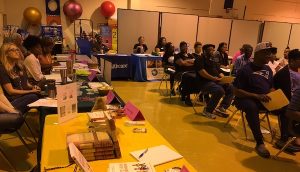
Here are a few of the Shelby County resources at  the Resource Fair.

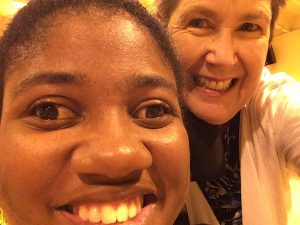
Meet Brittany, a Shrine School Alum, who now works for The Arc in the Memphis area and represented the organization at their booth.

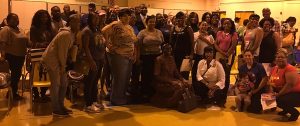
Speaking of families, the Shrine School parents are dedicated and involved. Here are a few of the over 100 who attended the Fall Resource Fair.

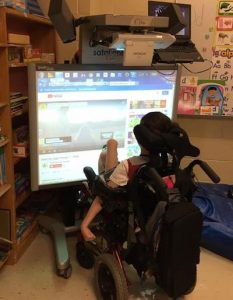
The work being done by and with the students dropped my jaw more than once. In 1 classroom, a little boy operated the smart screen with his foot.

He knew exactly how to get to the channel he wanted.

At the end of the day, I visited a middle school classroom. The speech therapist wheeled one of the students into the room and announced that the young girl had “found her voice” that day. “Say hello to everyone,” she instructed a girl with dancing eyes and a radiant smile who was unable to use her limbs or speak because of cerebral palsy.

Then, for the first time in her life, the young girl used her gaze-activated communication board to say, “Hi, how are you?”

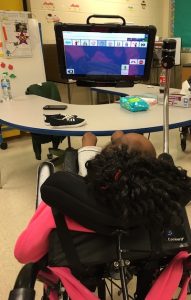
Gaze-activated communication board in use!

I watched the teachers and associates lovingly gather around her chair to chat with the student and listen to what she had to say. They kept their cool, but I was in tears.

“This school is amazing,” I told the guidance counselor later as I recounted the story.

“Miracles like that happen here all the time,” she said. “Children take their first steps, start talking, and learn to use the bathroom.”

At the end of the day, I went back to my hotel room grateful to the Shriners for their commitment to children with special needs. But my gratitude pales in comparison to that of the parents.

One after another said, “My child loves it here, and so do we. This is the best school ever.”

And do you know what I think?

They’re right.

Do you like what you see at DifferentDream.com? You can receive more great content by subscribing to the quarterly Different Dream newsletter and signing up for the daily RSS feed delivered to your email inbox. You can sign up for the first in the pop up box and the second at the bottom of this page.

By

Jolene Philo is a published author, speaker, wife, and mother of a son with special needs.

Author Jolene Philo

Archives

Categories

Subscribe for Updates from Jolene

Related Posts