We’re Having Some Christmas

We’re Having Some Christmas

We’re Having Some Christmas

“Grammy Jo, are we having some Christmas today?”

The three and a half-year-old who lives at our house first asked this question about a week after Halloween. None of the adults in the household fully understood what he was asking until the Sunday after Thanksgiving when he helped us set up the tree and decorate.

“Grammy! Papoo!” Tad exclaimed with delight. “We’re having some Christmas!”

Three Christmas decorations captivated him. The first was a giant Hallmark pop up card that folds out into a snowy scene of carolers outside a Victorian home. In order to preserve its fragile beauty, I moved the paper house to the top of the china hutch where Tad can see but not touch it.

The second was the nativity set consisting of only Joseph, Mary, and the Baby Jesus. Thankfully they are sturdily made and unbreakable, so Tad has full access to them. He moves them around the living room and kitchen throughout the day and returns them to the kitchen desk before bedtime each night.

The third captivating decoration was the Christmas tree. When we turned on its lights and Christmas music, Tad crawled into an armchair with his bowl of popcorn and gazed at the tree for almost forty-five minutes–the longest our active grandson has sat still since, well, since ever.

The next morning, he stood in front of the Christmas tree and told his dad he didn’t want to go Auntie Rachel’s. Odd because he usually can’t wait to go to her house for day care.

“Are you worried there won’t be any Christmas when you get home later?” I asked.

“Yes,” he said with little boy solemnity.

To read the rest of this post, visit the special needs parenting blog at Key Ministry.

Do you like what you see at DifferentDream.com? You can receive more great content by subscribing to the quarterly Different Dream newsletter and signing up for the daily RSS feed delivered to your email inbox. You can sign up for the first in the pop up box and the second at the bottom of this page.

By

Jolene Philo is a published author, speaker, wife, and mother of a son with special needs.

Author Jolene Philo

Archives

Categories

Subscribe for Updates from Jolene

Related Posts

Laughter and How It Heals Us

Laughter and How It Heals Us

Laughter and How It Heals Us

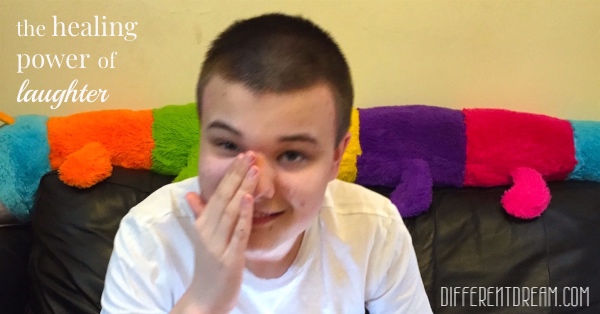
Laughter is a gift frequently given to Mark Arnold by his son James. Though he is mostly non-verbal, James’ laughter is healing balm for his parents, something Mark has come to appreciate more with each passing year.

Laughter and How It Heals Us

James has an infectious laugh; it starts as a chuckle and build into a raucous belly laugh that barely gives him opportunity to take breath. All sorts of things can set him off, like the other day when James was enjoying being with the rest of the family. A look of pure joy spread across his face and, as his laugh emerged, our almost non-verbal autistic son said, “Appy!! Appy!!” Indeed he was!

It reminded me of the words spoken to Job by his friend Bildad the Shuhite: “He will fill your mouth with laughter. Shouts of joy will come from your lips.” Job 8:21 (NiRV) Life was hard for Job, and yet here was the promise of joy and laughter to cut through the hard times. Things can be hard for James too, and seeing him truly happy, filled with joy and laughter was such a precious moment for us, one that we treasure.

When James laughs it takes over his whole body. He rocks with laughter, and his arms often wave in the air. He’ll almost stop, and then whatever it started him laughing passes across his mind again, and off he goes a second time. By then, whatever the initial trigger for James’ laughter was, we’re lost in the moment of collective joy and delight.

It’s good for us to laugh. There is something wonderfully therapeutic about it. The poet Byron said, “Always laugh when you can. It is cheap medicine.” There is something about it that can sooth even the deepest of pain.

In his old age Solomon, one of Israel’s great kings, wrote the book of Ecclesiastes. Reflecting on his own life’s experience, he wrote “There is a time to weep, and a time to laugh. There is a time to be sad, and there is a time to dance.” Ecclesiastes 3:4 (NiRV)

For parents of children with special needs, there are many times to weep and be sad. But there is more to life than tears and hard times. Let us celebrate the happier times, the times to laugh, the times to dance, and cherish these times–remembering them, treasuring them, when harder times return.

Allowing the better days, the fun moments, the times of laughter–and goodness knows even dancing–to heal our souls gets noticed by others. If they only see our tears, if they only hear  our woes, if they only understand our sadness–and there is nothing wrong in sharing those feelings–then they don’t get to see and experience the delights of special needs parenting. Those delights might be rare and fleeting, but the treasure is still there. Therefore, we join with Ezra, who wrote in Psalm 126:2:

 “Our mouths were filled with laughter. Our tongues sang with joy. Then the people of other nations said, ‘The Lord has done great things for them’.”

Amen!


Do you like what you see at DifferentDream.com? You can receive more great content by subscribing to the Different Dream newsletter and signing up for the daily RSS feed delivered to your email inbox. You can sign up for the first in the pop up box and the second at the bottom of this page


By

Mark Arnold is the Additional Needs Ministry Director at Urban Saints, a leading national Christian children’s and youth organization. He is co-founder of the Additional Needs Alliance, a national and international advocate for children and young people with additional (special) needs or disabilities and is passionate about enabling everyone engaging with them to be inspired, trained and well-resourced. Mark is a Churches for All and Living Fully Network partner, a member of the Council for Disabled Children and the European Disability Networ. He writes an additional needs column for Premier Youth and Children’s Work (YCW) magazine and blogs at The Additional Needs Blogfather, He is father to James, who has autism spectrum condition, associated learning disability, and epilepsy. To find out more about how Mark’s work can help you, contact him at: marnold@urbansaints.org or @Mark_J_Arnold.

Author Jolene Philo

Archives

Categories

Subscribe for Updates from Jolene

Related Posts

When You Don’t Have Anything Good to Say

When You Don’t Have Anything Good to Say

When You Don’t Have Anything Good to Say

Whenever I got snarky as a kid, my mother had this habit of staring straight at me and saying, “If you don’t have anything good to say, don’t say anything at all.”

Her words came to mind as I read the Exodus 14 account of Moses and the Israelites after they fled from Egypt and were trapped between the Red Sea and the Egyptian army. The Israelites were freaking out and blaming Moses, reviling him with snarky comments like these.

“Is it because there are no graves in Egypt that you have taken us away to die in the wilderness?”
“What have you done to us in bringing us out of Egypt?”
“Is not this what we said to you in Egypt: ‘Leave us alone that we may serve the Egyptians.'”
“It would have been better for us to serve the Egyptians than to die in the wilderness.” (ESV, Exodus 14: 11–12)

Do you know what my mother would have said if she’d been in Moses’ sandals? Yup. You guessed it. She would have nailed them with an unsympathetic, “If you don’t have anything good to say, don’t say anything at all.”

Moses’ response in verses 13–14 was a little different. “Fear not, stand firm, and see the salvation of the LORD, which He will work for you today. For the Egyptians whom you see today, you shall never see again. The LORD will fight for you, and you have only to be silent.”

Moses and Mom both advised people without anything good to say to say nothing at all. But Moses, who was caught between the devil and the deep Red Sea at the time, responded with great compassion and uncompromising assurance in the ability of the God who had brought them safe thus far to complete His good work in them. This account offers advocates in the special needs community a model of how to respond when our efforts fall on deaf ears and our accessibility initiatives fail.

First, remain silent. Assume that whenever you can’t think of anything good to say or if you can’t think of anything to say, God is calling you to say nothing at all. He’s not shutting your mouth forever, but He is shutting it until you cool off and can speak constructively rather than destructively. You may need to ask to reschedule the meeting for another time. Other than that, remain silent.

Second, pray. Ask God to show you what to say and to empower you to show compassion even though you may be in a tight spot and a person’s present and future well-being is on the line.

Third, listen. Listen to God by reading His Word. Seek wise counsel from faith leaders and from special needs and disability advocates. Compare the counsel given to Scripture again.

Fourth, ask questions. Ask others how they advocated in similar situations. Ask what worked and what didn’t work. Ask disability and special education liaisons for advice. Ask what laws and legal precedents can be cited or employed.

Fifth, draft a solution. Based on what you have learned, draft a reasonable solution to the issue. The solution should ensure the well-being of those with disabilities and, if possible, establish a foundation for collaborative problem-solving in the future. Also, determine how you will respond to objections and what your next steps will be if an acceptable solution can’t be reached.

Sixth, craft a response. Think of how to best present your solution during the meeting scheduled during the first step. Write it down. Trouble shoot it. And practice, practice, practice what you will say.

Seventh, pray for compassion and courage. The compassion that comes from knowing that everyone involved is dearly loved by the Creator. The courage that comes from the Lord who began this good work of advocacy in you will be faithful to complete it.

Eighth, speak. Speak calmly. Speak courageously. Speak firmly. Speak objectively. Speak truth. Speak in hope, doing all you can to make good and right changes for those with disabilities and special needs. If your solution isn’t accepted, and you are speechless or you can’t think of anything good to say, don’t give up. Don’t lose your cool. If you feel God has called you to be His change agent in the disability arena, go back to the first step and begin again.

It took ten plagues, the parting of the Red Sea, two attempts at recording God’s commandments, and forty years in the wilderness before Moses completed what God had called him to accomplish. Why do we think our work should require anything less?

Do you like what you see at DifferentDream.com? You can receive more great content by subscribing to the quarterly Different Dream newsletter and signing up for the daily RSS feed delivered to your email inbox. You can sign up for the first in the pop up box and the second at the bottom of this page.

By

Jolene Philo is a published author, speaker, wife, and mother of a son with special needs.

Author Jolene Philo

Archives

Categories

Subscribe for Updates from Jolene

Related Posts

4 Tips for Smoother School Transitions for Kids with Special Needs

4 Tips for Smoother School Transitions for Kids with Special Needs

4 Tips for Smoother School Transitions for Kids with Special Needs

Transitions can be tough for kids with special needs. This fall Marnie Witters devised 4 tips for smoother school transitions when their family moved to a new house and her son who is on the autism spectrum started a new school. Join Different Dream in welcoming Marnie as she describes how preparation beforehand made the move easier for her son and her family.

4 Tips for Smoother School Transitions for Kids with Special Needs

Imagine a toddler who screams when he’s upset, hungry, angry. Ear-piercing screams that cleared out stores and emptied pools. Transitions were physically painful for our son between the ages of 2 and 4. So, he screamed, shut down, and we would leave. Over time, we learned to prep with social stories, introductions, videos, pictures, stories, whatever would help calm him down.

Fast forward a few years and he progresses in his speech therapy, learning conversation, inferences, how to communicate, and how to express himself better. He still struggles with transitions, but has learned to retreat, shut down, or use his headphones.

Fast forward about 6 more years–that screaming toddler, our son, turns 13 years old in December of 2018. And wow, what progress he’s made! He still attends speech therapy and occupational therapy, but the focus is now more self-regulation, socializing skills, self-advocating, and communication skills, all on a higher level. Working with friends, recognizing when someone is being rude, determining cause and effect, laughing at appropriate times, and more.

In November, we made a big move from his childhood home of 8 years. Our family prayed and decided to downsize. We wanted to move closer to our church and to schools that were smaller, more personable, and more inclusive. We were a homeschool/private school family, transitioning to public school. Huge change! Change for anyone is tough, but for a child on the autism spectrum, it can be downright debilitating.

However, over the past few years, we purposefully threw changes at him. As mean as that sounds, it worked. Giving him planned out changes helps him get used to and accept change and transitions. It’s shown him it’s not the end of his world when things veer from his expectations. It’s taught him how to be flexible. Presenting him with “change” situations has prepared him for this huge move, helped him understand what to expect, and familiarized him with his new school and its surroundings.

Tips for Smoother School Transitions

I want to share a few ideas of what we did over the past few months to help prepare. I pray it helps another family facing big life changes!

Research the New School

I sat with my son and visited his new school’s website and Facebook page. I showed him how it was similar to his elementary school. We drove by the school and looked at all the pictures and events going on so he physically could relate the events and pictures to the actual school. These visuals really helped his anxiety about attending a new school.

Prepare the Teachers

A couple of years ago, I started researching the county and schools we wanted to move closer to. Last summer, I began researching the exact school and made connections with the county autism coordinator who really has played an important role in our son’s transition. A few weeks before we moved, I provided his recent individualized education plan (IEP), evaluation, therapy notes, and grades to the new school. Administration and his IEP team thanked me numerous times for being so proactive and providing as much information as possible.

Shadow at School

One of the best things my son’s ever done in a new situation is had a “shadow day” at his new school. The school offered this to us right before Thanksgiving break so Jadon and his brother had an opportunity to follow another student during a school day. My sons were allowed to sit in classes, ask questions, get a school tour, eat lunch in the cafeteria, and then be picked up with the car riders so they would know what to expect the first real day, which was this week.

Use Comparisons as a Bridge

As best I could, I compared my son’s elementary school with this new middle school. I explained there is a cafeteria, media center, hallways where his teachers’ classrooms would be, speech therapy, and occupational therapy. He was able to recall his own experiences and see the similarities in his new school, which eased his anxiety.

If you and your family are facing big life changes, try these ideas. Change is scary, but can be the biggest, most unexpected blessing from God!

You’re off to Great Places!
Today is your day!
Your mountain is waiting,
So… get on your way!”
Dr. Seuss

Do you like what you see at DifferentDream.com? You can receive more great content by subscribing to the quarterly Different Dream newsletter and signing up for the daily RSS feed delivered to your email inbox. You can sign up for the first in the pop up box and the second at the bottom of this page.

By

Marnie Witters was a technical writer and editor for more than 20 years until she resigned to homeschool her sons for 8 years. Recently, they went back to public school and she now writes and substitute teaches. She’s been married for 17 years, serves in our amazing church, loves to garden, and enjoys spending time with her family. 

Author Jolene Philo

Archives

Categories

Subscribe for Updates from Jolene

Related Posts

Confessions of an Autism Dad

Confessions of an Autism Dad

Confessions of an Autism Dad

Kevin O’Brien shares his confessions as an autism dad in today’s post…something he was reticent to do until he became a contributor to a new book, Life on the Spectrum, and discovered the importance and worth of the work he’s been given to do.

Confessions of an Autism Dad

Can I be honest for a moment? For over a decade, I have resisted being an autism dad. I have written a few pieces about having a son with autism, but I have done so reluctantly. Really reluctantly.

There are lots of reasons. Privacy–mine and my son’s. Concern that I have no idea what I’m talking about. But to be honest–brass tacks, bottom line, no more obfuscating–the resistance is about me. Because as soon as I take that step my identity changes. My goals, my interests, and yes, my dreams change. To name a thing is to make it real.

I have a master’s degree in theology and wrote my master’s thesis on Generation X and Truth. Won an award for it. I dream of being a writer when I grow up. But I want to write about faith and culture. About theology and the Church. About things that matter.

My dream. How many time did I say “I” in the previous paragraphs? 12? (not including “mine”, “me” and “my”) That’s the problem. Too much I, me, my, mine. Not enough recognition of the fact that “I” am not the center. God is. Everything I claim to believe says so. It is he who calls me to himself, who crafts me to his use and his purpose. Who seeks my ultimate good even when I cannot see it.

This is the story of Scripture. It practically drips off of every page. God pursues his people. Relentlessly. He seeks their good at all times in all places and all situations, even when–especially when–they resist him.

Pick a person, pick a time, pick a place.
Adam, Moses, David, Jeremiah, John.
Eve and Tamar and Rahab and Ruth and Abigail and Gomer and Mary.

So many others whose names we forget and the details of whose stories are fuzzy. God pursues. God shapes and molds and takes the good and the bad, the victories and the defeats, the moments of righteousness and yes even the sins to bring us to himself. There is absolutely nothing that God cannot redeem. For his glory and our good.

Even my son’s autism.
Even my own arrogant dreams.

A few years ago, I was invited to be a part of a book by the parents of autistic kids. It took far longer to complete than we expected. Bumps along the road and unanticipated detours but Life on the Spectrum is now a real  book. It speaks to the messy realities of parenting a child with autism through the eyes of faith. It’s also about expectations and asking why. It’s about parties and comparisons and family and church and . . . life. But mostly, it’s about seeing God at work in and through those things.

Because there is nothing that God cannot redeem. There is nothing that God cannot redeem. Over and over again in Scripture we see that God is a god who cares for those who cannot care for themselves.

The widow and the orphan.
The alien and the exile.
The poor and the disabled.

“Then the King will say to those on his right, ‘Come, you who are blessed by my Father, inherit the Kingdom prepared for you from the creation of the world. For I was hungry, and you fed me. I was thirsty, and you gave me a drink. I was a stranger, and you invited me into your home. I was naked, and you gave me clothing. I was sick, and you cared for me. I was in prison, and you visited me.’
“Then these righteous ones will reply, ‘Lord, when did we ever see you hungry and feed you? Or thirsty and give you something to drink? Or a stranger and show you hospitality? Or naked and give you clothing? When did we ever see you sick or in prison and visit you?’
“And the King will say, ‘I tell you the truth, when you did it to one of the least of these my brothers and sisters, you were doing it to me!’ Matthew 25:34-40, NLT

God cares and so should we. My son has shown me firsthand how God cares for those who cannot care for themselves. How God uses us to do so. How in so doing we become more and more like him and he surprises us in astounding ways. I have delayed and hemmed and hawed, not using my gift because I wanted to write something more important, because I second guessed myself and what I had been given. Yet in the middle of that ,something became increasingly clear. In and through my son’s autism I have the opportunity to speak to serious issues of faith and culture and theology and the church. My dream looks decidedly different than what I expected or planned, but it turned out not to be so different.

Do you like what you see at DifferentDream.com? You can receive more great content by subscribing to the quarterly Different Dream newsletter and signing up for the daily RSS feed delivered to your email inbox. You can sign up for the first in the pop up box and the second at the bottom of this page

By

Kevin O’Brien is a husband, father, ordained minister, writer and volunteer theologian. He holds a Master of Divinity and Master of Theology from Liberty Baptist Theological Seminary and has done graduate work at the Institute for Christian Studies in Toronto. He is currently the study Bible and reference brand manager at Tyndale House Publishers where he has helped to develop several Bibles and has written articles which have appeared in The Way, the iShine Bible, and the Illustrated Study Bible. He is one of the authors of the recently released Life on the Spectrum. Kevin lives in the far western suburbs of Chicago with his wife, three children, a dog, and a cat. He would prefer to spend his time reading, writing, woodworking and watching the Chicago Blackhawks.

Author Jolene Philo

Archives

Categories

Subscribe for Updates from Jolene

Related Posts

How To Demystify Special Needs at School

How To Demystify Special Needs at School

How To Demystify Special Needs at School

I am grateful to my colleagues who taught me how to demystify special needs at school. A special education teacher in our building and the guidance counselor wanted to mainstream a child with developmental delays into my third classroom for subjects like handwriting and music. I was game, but unsure of how to start.

“Tell your students what’s going on,” the special education teacher advised. “Help them get to know Kendra. I’ll talk to her parents after school about how much you can say.”

After the phone call, she reported back. “Her parents are willing to talk to your class and answer their questions. They said kids will make up their own answers if they aren’t given any information. And that’s not good.”

Kendra’s parents spent a half hour telling my students about Kendra’s diagnosis and answering the children’s questions. They wanted to know about her favorite things, how to talk and play with her, and what to do when she behaved in ways they didn’t understand. The foundation laid that day made my students more caring and friendly toward Kendra, a valuable lesson for all of them.

I learned a valuable lesson about how to demystify special needs at school that day, too. I used what I learned repeatedly during my teaching career to clear up misconceptions children had about their classmates with special needs–from juvenile diabetes to developmental delays, from cerebral palsy to autism and more. The suggestions below can help you do the same.

  1. Enlist a colleague’s support. Ask a special education teacher, the guidance counselor, or building principal to assist you. They can help approach parents or do one on one activities with a child with special needs who doesn’t want to be part of the discussion.
  2. Ask parents for permission and information. Parents may offer to be directly involved in the discussion as Kendra’s parents did. Others may want you to lead it. In that case, ask what they want to be shared about the child’s disability. If you are just getting to know the child, gather information to acquaint classmates with the whole person, not just the disability.
  3. Give children the opportunity to ask questions. Doing so makes kids part of the discussion and provides you with insight from their perspective. They may bring up worries or past history you don’t know. Their questions can be a valuable source of information for you.
  4. Provide practical suggestions. Give children ideas of how to strike up a conversation, how to include children in wheelchairs on the playground, what to say to students from other classrooms who ask questions, what to do in an emergency, and when to report behaviors of children with or without special needs. Do some role play if you have time. The better equipped children are, the more likely they are to empathize and be compassionate friends.
  5. Follow up and provide feedback. A month or so after the initial discussion, check back with all your students. Ask how things are going for typical kids and those with special needs. You can also ask other building faculty and staff for their observations to get a well-rounded perspective. Praise children for what they’re doing well and problem-solve challenges as a group. When children know they are accountable, appreciated, and supported by the adults in their world, they will rise to the occasion.

The more we do to demystify special needs at school when children are young, the more likely they are to embrace all their peers wherever they meet—in the community, at church, and eventually in the workplace and the wider world.

Do you like what you see at DifferentDream.com? You can receive more great content by subscribing to the quarterly Different Dream newsletter and signing up for the daily RSS feed delivered to your email inbox. You can sign up for the first in the pop up box and the second at the bottom of this page.

By

Jolene Philo is a published author, speaker, wife, and mother of a son with special needs.

Author Jolene Philo

Archives

Categories

Subscribe for Updates from Jolene

Related Posts