Middle School IEP Meeting Survival Tips

Middle School IEP Meeting Survival Tips

Middle School IEP Meeting Survival Tips

A recent middle school IEP meeting led to guest blogger Marnie Witters’ post for today. In it she shares her top middle school IEP meeting survival tips, which every parent of elementary students should read in order to be prepared for what is yet to come.

Middle school. Isn’t there a book titled How I Survived Middle School or I Despise Middle School?

Oh boy, I get it. Middle school is tough!

This has been one of the hardest years of my sons’ life in school. My husband and I recently endured a 2 hour IEP meeting that felt more like 100 Years of Solitude. In the wake of our meeting, I thought I’d share with you what I’ve learned over 10 years of IEP meetings and, specifically, how to survive a middle school IEP meeting.

Tip #1: Stay Positive

I’ve learned to remain positive, even in the midst of my child’s challenges highlighted on a large screen in front of a roomful of people I don’t know. I can’t pay more attention to my son’s challenges than to his supports and goals. I’ve learned that starting the meeting with a positive, prayerful attitude will most likely help the meeting end the same.

Tip #2: Engage in Prayer

In middle age I keep learning over and over how important quiet, still time with the Lord is. I always say I’ll commit daily 20-30 minutes to prayer, but in reality, it’s 10. Remember, though, that the small, quick one-sentence pleas to Him throughout our days count! There is no manual or set of rules as to how long or how eloquent our prayers should be; only that we go to Him daily. When I don’t go to Him, I go to my head, which always gets me in trouble.

James 4:8 says “Draw near to God and He will draw near to you.” This scripture resonates with me because I’m making the first step. I’m choosing Him. He longs for us to talk with Him and loves His time with us, too!

Tip #3: Do the Research

Over 10 years of advocating, researching, and protecting my son, I’ve done more research than I did in graduate school. However, the research helps me know the lingo, have an idea of middle school goals and supports, and understand middle school supports available to our children. The IEP team is very appreciative of my knowledge, and we work as a team instead of 2 teams going at it, competing. The more I know and can share, the more they understand I want to know and help my child at home.

Tip #4: Speak Up

Our recent meeting was challenging. Middle school supports are very different from elementary school supports.

Remember that.

For example, my son only receives 30 minutes/week of speech therapy. Pushing for 1 full hour/week of speech therapy was difficult because it cuts into his class time. When a therapy cuts into class time, it puts my son behind. This causes him much anxiety and requires extra support from his teachers or co-teachers. However, we decided in order for him to succeed in the higher-thinking, comprehension-driven classes, he desperately needs to work on his pragmatic and inferencing speech.

Be sure to speak up.

I had to reiterate that he still struggles with speech and was receiving one full hour/week before and he needed that again. The team agreed.

Tip #5: Remember that You Are Not Alone

You are never alone.

Out of the blue, I reconnected with a long-time high school acquaintance. We didn’t really know each other in high school and ran with different groups, but thanks to Facebook, we learned of each others’ autism journey, and a friendship kindled! We immediately began messaging, then calling, then texting. Now we check on each other! We pray for each other.

We’re like-minded moms walking through the muck and mire of autism together now. She’s been a huge blessing to me in helping me navigate the waters and I hope I can also be a blessing to her. One or two friends walking the same path will encourage, inspire, and keep you moving!

Tip #6: Your Child is Not an IEP Exceptionality

In the IEP, it listed my son’s exceptionalities as “autism” and “speech delay.” I used to have to come home, drink wine (I quit 7 years ago), and take a long, hot bath while recalling all of the negative things about my child. This year was good in the fact I didn’t have a full-fledged meltdown after the IEP meeting.

A friend who is walking his own challenge said to me just this week, “Your son’s disability does not control him; your son controls his disability and is amazing.” I thank God we have support, I have Him, I have a husband who gets our sons, and we are surrounded by people who care. I still get sad and down, but take it to the Lord a little quicker now.

My son isn’t a challenge, a result of an evaluation, a diagnosis, or a disability. He is our son who loves bridges, can tell me directions to California (highways and all), draws beautifully, laughs uncontrollably, and lays hands on and pray for us when we’re sick.

He’s not going to be identified by what’s in an IEP. 

Children are a gift from God.
They are.
And you are a gift to them.

Power on, parents. You got this!

Do you like what you see at DifferentDream.com? You can receive more great content by subscribing to the quarterly Different Dream newsletter and signing up for the daily RSS feed delivered to your email inbox. You can sign up for the first in the pop up box and the second at the bottom of this page.

By

Marnie Witters was a technical writer and editor for more than 20 years until she resigned to homeschool her sons for 8 years. Recently, they went back to public school and she now writes and substitute teaches. She’s been married for 17 years, serves in our amazing church, loves to garden, and enjoys spending time with her family. 

Author Jolene Philo

Archives

Categories

Subscribe for Updates from Jolene

Related Posts

Mother’s Day Joy Mingled with Sadness

Mother’s Day Joy Mingled with Sadness

Mother’s Day Joy Mingled with Sadness

Mother’s Day joy mingled with sadness is the reality I live with. Not just since my first child was born with medical special needs in 1982.

But for as long as I can remember.

The first sadness took place when my grandmother, Fern Stratton, died the year before I was born. Both my father and mother loved her dearly. Dad because his mom doted on him as the only child of older parents. Mom because she was treated as a daughter and basked in individual attention her own mother, who raised 8 children, couldn’t offer. My middle name is Fern, and every Mother’s Day I remember the stories my parents told of her and wish I had met her.

My dad was born during Mother’s Day weekend in 1928, and the convergence of his birthday and Mother’s Day led to a double sadness. The weekend always reminded us of the loss of Grandma Fern. Dad’s annual birthday celebration revealed his deteriorating physical and mental condition caused by multiple sclerosis.

The final sadness is related to Mother’s Day, 1982. My husband and I celebrated it with the joyful anticipation and wonderment of first-time parents—hopes and dreams, boy or girl, bringing our baby home from the hospital—like all expectant parents. 2 weeks later our picture of life with baby changed when he was flown to a hospital 750 miles away for immediate surgery.

Even so, joy has become the overriding reality of Mother’s Day for me.

My reality may not be the same as yours this Mother’s Day. Your sadness may be new and raw. Your child’s diagnosis may be going from bad to worse. You may not be able to ease your child’s physical pain or your personal, emotional hurt. You may recently have lost your child. If one of those describes your reality this Mother’s Day, I am so sorry. I wish I could reach through the screen to hug you and cry with you. I can’t do that, but I can offer some reassurance.

Though at this moment you can’t imagine experiencing joy on Mother’s Day ever again, you will. Trust me, these suggestions can help you reach a new, more joyful reality.

Acknowledge your sadness.

Admit it’s real. Admit it hurts. Admit you wish it wasn’t. Those are true and good feelings after the loss you’ve experienced. They must be acknowledged, experienced, and processed in order to move on with life.

Affirm life.

Our God counts every life as precious. His measure of human worth is not determined by length of days, contributions to society, personal accomplishments, or any other worldly measure. His measure of worth is being. Each life is His creation. Though your child’s life isn’t what you anticipated, it is a life. Your child’s life makes you a mother, so affirm your life and your child’s as a gift from God.

Seek small joys.

My father loved to eat. He told my sister, brother, and me why ice cream was his favorite dessert. “It fills in the cracks,” he explained more than once with a twinkle in his eye and a smacking of lips. Small joys are like ice cream. They are the little things that melt our sad hearts and repair its broken, jagged edges. Things like:


  • Remembering the twinkle in Dad’s eye as he savored ice cream
  • Seeing Grandma’s first name on my birth certificate
  • Recalling how it felt to hold my son after he was born
  • Having the same color eyes as my dad and my son
  • Hearing people remark on my resemblance to my grandmother

These small joys led to a lifetime of Mother’s Day joy mingled with sadness. My small joys connect me to the people who gave me the gift of life to pass on to others. I pray that as you seek for small joys, the same will be true for you.

Do you like what you see at DifferentDream.com? You can receive more great content by subscribing to the monthly Different Dream newsletter and signing up for the daily RSS feed delivered to your email inbox. You can sign up for the first in the pop up box and the second at the bottom of this page.

By

Jolene Philo is the author of several books for the caregiving community. She speaks at parenting and special needs conferences around the country. Sharing Love Abundantly with Special Needs Families: The 5 Love Languages® for Parents Raising Children with Disabilities, which she co-authored with Dr. Gary Chapman, was released in August of 2019 and is available at local bookstores, their bookstore website, and Amazon. See Jane Dance!, the third book in the West River cozy mystery series, which features characters affected by disability, was released in October of 2023.

Author Jolene Philo

Archives

Categories

Subscribe for Updates from Jolene

Related Posts

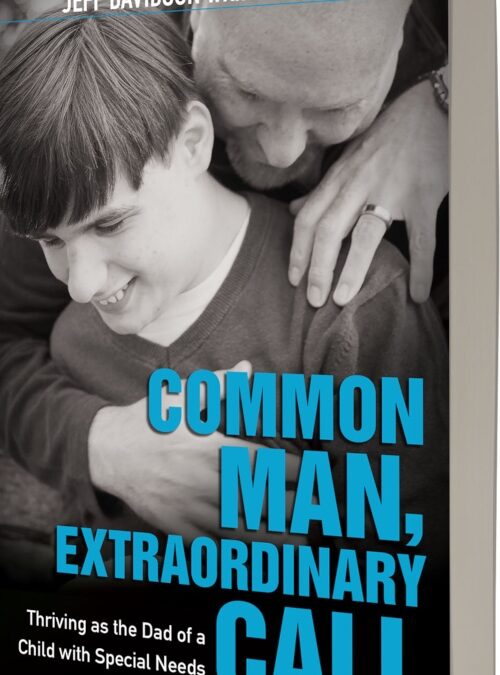
Common Man, Extraordinary Call: Thriving as the Dad of a Child with Special Needs

Common Man, Extraordinary Call: Thriving as the Dad of a Child with Special Needs

Common Man, Extraordinary Call: Thriving as the Dad of a Child with Special Needs

Common Man, Extraordinary Call: Thriving as the Dad of a Child with Special Needs is a book worthy of a place on the shelf of every family raising children with disabilities. Today, guest blogger Becky Davidson tells the story of the vision of the man behind the book.

When a family receives a special needs diagnosis or finds out that their child will face life with a disability, there is often a deep internal struggle to process what this means for the family. Mothers typically respond like I did, as caregivers. We throw ourselves into research, sign up for  support groups, and search for the best doctors available to treat our children. Fathers, who are often the “fixers,” find themselves in a difficult place. Facing an “unfixable” diagnosis, many men are tempted to go AWOL or emotionally abandon their family. Some even physically walk away.

My husband, Jeff Davidson, was a special needs father for twenty years and a mentor to fathers like himself. He knew firsthand what it was like to face the temptation to hide, to pull into his work and to leave his family without the emotional support we really needed. In his book, Common Man, Extraordinary Call, Jeff reaches out to other fathers of children with special needs. He shares in an authentic and candid way how he struggled to adjust to having a son with profound disabilities. He tells the hard truth about his own struggles in hopes of helping other dads.

It took Jeff several years to find his own way to connect with our son Jon Alex, but when he did, he gave himself fully to the process. Leaving a successful business career, Jeff eventually gave his life to serving and supporting the special needs community. Jeff was the president and co-founder of Rising Above Ministries which we established in 2005. Together we developed a multi-dimensional outreach to families impacted by disability. Sadly, he passed away unexpectedly in 2017, but before his death he wrote a field guide for fathers facing the same challenges he had faced.

In Common Man, Extraordinary Call, Jeff addresses the grief parents face when adjusting to the knowledge that they will not enjoy the typical life they had hoped for. He shares how he was overwhelmed with a sense of loss when he realized he would never shoot hoops with our son or teach him how to drive. Jeff was tempted to go AWOL himself and he provides 25 signs that you might be vulnerable to doing the same. In the heart of the book, Jeff addresses the deeper issue of how a special needs father can lead his family in these areas: as a protector and defender, as a provider, as a father who strengthens his family, and one who equips his family. Jeff makes the analogy of the special needs father as a soldier and this theme carries throughout the book. He teaches dads about common emotional landmines. He also addresses how to deal with “civilian assault” or the attacks that can come from people outside the special needs world who do not understand this life or its challenges.

I have had the privilege of leading Rising Above Ministries since Jeff’s death. I know Jeff would be so proud to see his book helping so many men. I hope you will take time to read it and benefit from his hard won lessons. I don’t think you will regret it. 

Do you like what you see at DifferentDream.com? You can receive more great content by subscribing to the monthly Different Dream newsletter and signing up for the daily RSS feed delivered to your email inbox. You can sign up for the first in the pop up box and the second at the bottom of this page.

By

Becky Davidson is the co-founder and president of Rising Above Ministries, a multi-dimensional outreach to families impacted by special needs. She took on her role at Rising Above after the death of her husband, Jeff Davidson. She is passionate about supporting and encouraging special needs families and encouraging women. Becky and Jon Alex, her adult son with special needs, live and thrive in Cookeville, Tennessee. To get to know Jeff through more of his writings, visit Good Night Superman.

Author Jolene Philo

Archives

Categories

Subscribe for Updates from Jolene

Related Posts

That Child Could Have Been Me or You

That Child Could Have Been Me or You

That Child Could Have Been Me or You

That child could have been me, I thought as I read through one of the responses to my survey about stress and compassion fatigue in caregivers. The respondent said her 60-year-old child lived with intellectual delays caused by an untreated Rh factor blood disorder. The mother also said that she is still her child’s primary caregiver. With a gasp, I realized the implication of what I had just read.

I am 62.
I was born with Rh factor blood disorder shortly after the disease was discovered.
My disease was detected too late for newly developed treatment methods.
The doctor said my parents would have to wait and see how the disease would affect my development.
Most certainly, that child could have been me.
A chill ran down my spine.

My eyes filled with tears as I imagined this elderly mother, who has to be in her late 70s at the youngest, taking care of her aging child. She’s been a caregiver for 60 years, and she must be wondering who will care for her child when she no longer can.

I contemplated how Rh factor affected my life. For years I struggled with low muscle tone and poor coordination. I shunned physical sports and became a voracious reader, a necessary first step in becoming a writer. The direct line between Rh factor and my present life renewed my determination to redeem the time God has given me. (Ephesians 5:16)

To read the rest of this post, visit Key Ministry’s blog for parents raising kids with special needs.

Do you like what you see at DifferentDream.com? You can receive more great content by subscribing to the quarterly Different Dream newsletter and signing up for the daily RSS feed delivered to your email inbox. You can sign up for the first in the pop up box and the second at the bottom of this page.

By

Jolene Philo is a published author, speaker, wife, and mother of a son with special needs.

Author Jolene Philo

Archives

Categories

Subscribe for Updates from Jolene

Related Posts

He’s My Dad, Not a Disability

He’s My Dad, Not a Disability

He’s My Dad, Not a Disability

He’s my dad, not a disability.

Those words have been rattling in my brain this March, the month in which my father died 22 years ago. My thoughts have moved beyond the deep, personal grief I felt in 1997. Now my wish is to describe Harlan Stratton who, along with Jesus, shaped my perception of who people truly are.

Harlan Stratton loved his wife. He picked out her birthday and Christmas gifts carefully. He looked through the newspaper ads and phoned the store to quiz the clerk for a long time about whatever gift he wanted to buy. Once he made his decision, he arranged to have the gift delivered when Mom was at work.

He loved his three children, and he understood how we thought and what made us happy. He gave us rabbit kisses. (There’s no way to describe them. You had to be there.) When I was home sick from school, laying on the couch, we would watch Captain Kangaroo together. He laughed as hard as I did when the ping pong balls came pouring down. His presence made me feel safe.

Dad loved people. He was always happy to see them. Always. He enjoyed playing cards with his friends after they got off work. He didn’t play to win. He played to talk, to tell stories, to make people laugh, and to laugh with them.

He had a terrific sense of humor and a thousand-watt smile. Mom remembers a time he and a friend decided to stay up until one of them ran out of jokes. They were still at it when Mom got up to make breakfast.

Dad never allowed discussions about politics to become cut throat. He listened respectfully to the views of others and never tore them down. Perhaps that’s why I was years into adulthood before I comprehended his personal political leanings. He only expressed them in a comment which referred to his right arm, severely weakened by illness–It’s my Republican arm. Not good for much of anything.

He loved his work as a cattle farmer and an extension agent. He was happiest in the show ring at the county fair when he was judging cattle. He lived for those hot, July days when young people led livestock in a circle around him and listened keenly to his advice about showmanship.

He was never, ever a picky eater. He ate with gusto whatever was served and always complimented the cook. That said, his favorite foods were a good steak, ice cream, and homemade baked goods.

Dad loved to go to church when he could. He listened intently to the sermons, but he came fully alive after the service when old friends and new acquaintances came over to say hello.

Are you getting a sense of who my father was?
His likes?
His passions?
His personality?

Can you picture him in the show ring at the fair?
Eating a good steak?
Playing cards?
Chatting after church?

How different would that picture of him be if description had begun with his disability?
If the first things you knew were that he had multiple sclerosis?
That he used a wheelchair?
That others had to cut his food and help him in the bathroom?

Because he’s my dad, not a disability, I led with who he was because I wanted you to know him.

As the church, we need to do the same.
We need to get to know people with disabilities for who they are.
We need to ask them about their interests, their work, and their families.
We need to introduce them to others with similar likes, passions, and personalities rather than with a similar disability.

Eventually, the disability will come up. But it should never come first. It should never be a person’s defining mark.
Because she’s a daughter, a mom, a sister, a niece, a cousin, an aunt, a grandma, a friend.
He’s a son, a dad, a brother, a nephew, a cousin, an uncle, a grandpa, a friend.
She’s a beloved creation of God, and so is he.

Would you say it with me now?
She’s my ____________, not a disability.
He’s my ____________, not a disability.

Do you like what you see at DifferentDream.com? You can receive more great content by subscribing to the monthly Different Dream newsletter and signing up for the daily RSS feed delivered to your email inbox. You can sign up for both at the bottom of this page.

By

Jolene Philo is a published author, speaker, wife, and mother of a son with special needs.

Author Jolene Philo

Archives

Categories

Subscribe for Updates from Jolene

Related Posts

To the Mother of Our Child with Special Needs, My Wife

To the Mother of Our Child with Special Needs, My Wife

To the Mother of Our Child with Special Needs, My Wife

To the mother of our child with special needs…with these words, guest blogger Mark Arnold begins the best kind of love letter to his wife. Grab a tissue and read on!

To the mother of our special needs child, my wife…

It’s not your fault. It’s not your fault that our child is autistic. It’s not your fault that he has learning difficulties. It’s not your fault that James has epilepsy. None of these things are your fault, or mine; they are no one’s fault. James is who he was born to be, who he was meant to be, with all of the challenges that brings–along with all of the joys that we experience with him. James has a mix of our genes, and those have formed him into who he is. To be blamed for any differences this blend has created is as absurd as finding fault in parents whose child has red hair, or is shorter, or can’t sing in tune, or is left handed.

James’ additional needs are not your fault, but they are what make you shine! We didn’t expect that our child would have additional needs, but the way you fight for him, care for him, and love him unconditionally does you great credit.

You fight for him. When things aren’t happening quickly enough to give James the support that he needs, you are filled with a strong will to champion his corner, to call out poor performance in professionals, to challenge why things are taking so long. You are better than me at asking the hard questions, putting people on the spot and forcing them to act, bringing about positive change for James and our family.

You care for him. James needs a lot of care, care that is much less for a typical 16-year-old. Whether it’s the whole range of personal care that needs doing, or just sitting with James when he’s had an epileptic seizure to make sure that he is safe and recovering, or just keeping him company when he wants it, you are there for him.

You love him unconditionally. Even when you are again clearing up what you would not expect to have to for a 16-year-old. Even when James refuses to cooperate, doing the exact opposite of what you have calmly asked him to do. Even when those rarest of rare things–a break from being carer to enjoy a treat, or a much-needed holiday–gets cancelled at the last minute because James cannot cope or is unwell. You love him because of who he is, not in spite of who he is.

You juggle like a circus performer. Caring for James, keeping the household going, managing to hold down your job, volunteering at church in the children’s team, being wife to me, Mum to Phoebe and James, daughter, sister, friend, and more. It’s amazing how you manage to keep everything going without dropping the ball, I’m very grateful for all that you do and very proud of you!

So, when things are tough, when it’s hard to see the future clearly, when that future looks difficult and there seems no end to the demands on you, please remember this. I’m fighting for our family alongside you, I care for you as much as you care for James, I love you unconditionally too, and when you are juggling and feel like you’re going to drop a ball, you can toss it to me and I’ll catch it. We’re in this together, for life and all that it can throw at us. There is no-one I would rather be facing life with than you.

Your loving husband and friend,
Mark

Do you like what you see at DifferentDream.com? You can receive more great content by subscribing to the quarterly Different Dream newsletter and signing up for the daily RSS feed delivered to your email inbox. You can sign up for the first in the pop up box and the second at the bottom of this page.

By

Mark Arnold is the Additional Needs Ministry Director at Urban Saints, a leading national Christian children’s and youth organization. He is co-founder of the Additional Needs Alliance, a national and international advocate for children and young people with additional (special) needs or disabilities and is passionate about enabling everyone engaging with them to be inspired, trained and well-resourced. Mark is a Churches for All and Living Fully Network partner, a member of the Council for Disabled Children and the European Disability Networ. He writes an additional needs column for Premier Youth and Children’s Work (YCW) magazine and blogs at The Additional Needs Blogfather, He is father to James, who has autism spectrum condition, associated learning disability, and epilepsy. To find out more about how Mark’s work can help you, contact him at: marnold@urbansaints.org or @Mark_J_Arnold.

Author Jolene Philo

Archives

Categories

Subscribe for Updates from Jolene

Related Posts