Special Needs Diagnosis: 4 Tips to Stay Positive

Special Needs Diagnosis: 4 Tips to Stay Positive

Special Needs Diagnosis: 4 Tips to Stay Positive

A special needs diagnosis often throws parents off kilter. No wonder so many DifferentDream.com posts deal with the issue. Here are just a few:

Special Needs Diagnosis Advice

Today, I’m pleased to point you to another article. This one, written by Carrie McLaren, made its debut at www.5minutesformom.com. Carrie is mom to Molly, her daughter who has Down syndrome. The initial news threw Carrie for a loop at first, but she says, “Not long after Molly came home from the hospital, I decided I could either live in fear of the unknown or provide a positive, loving environment for her. I chose to celebrate milestones instead of fear them.” Wise advice, don’t you think?

Special Needs Tips

McLaren offers parents these four tips to help them stay positive after receiving their child’s diagnosis:

  1. Talk, Talk, and Talk Some More: McLaren suggests you find someone you trust and let all your feelings out.
  2. Cry: “Don’t be afraid to cry…There are days when the only thing that makes me feel better is a good crying session,” McLaren says.
  3. Be Honest: She also says, “Down syndrome and the special needs world were so new to me in the beginning months…I’ve never been ashamed or afraid to admit when I don’t know something.”
  4. Write It Down: Carrie suggests writing things down and then looking back in a few years to see how far you’ve come.

To read the rest of McLaren’s post and see some adorable pictures of Molly, read the entire post at Staying Positive after a Special Needs Diagnosis.

How Did You Stay Positive?

Carrie’s tips are right on target. But my guess is that you have some tips, too. And since parents need plenty of positive reinforcement, leave your tips in the comment box for so others don’t have to beg, borrow, and steal ideas from strangers!

Do you like what you see at DifferentDream.com? You can receive more great content by subscribing to the quarterly Different Dream newsletter and signing up for the daily RSS feed delivered to your email inbox. You can sign up for the first in the pop-up box and the second at the bottom of this page.

By

Jolene Philo is the author of several books for the caregiving community. She speaks at parenting and special needs conferences around the country. Sharing Love Abundantly with Special Needs Families: The 5 Love Languages® for Parents Raising Children with Disabilities, which she co-authored with Dr. Gary Chapman, was released in August of 2019 and is available at local bookstores, their bookstore website, and Amazon. See Jane Dance!, the third book in the West River cozy mystery series, which features characters affected by disability, was released in October of 2023.

Author Jolene Philo

Archives

Categories

Subscribe for Updates from Jolene

Related Posts

Legal Documents Needed When Your Child Turns 18

Legal Documents Needed When Your Child Turns 18

Legal Documents Needed When Your Child Turns 18

Legal documents to be prepared by parents when their kids with special needs turn 18 were the subject of guest blogger Kathy Guzzo’s series earlier this year. (Part 1: The Importance of Attorney and Medical Authorizations and Part 2: The Importance of Power of Attorney for Property) But an article at the Chicago Daily Herald website that explained the importance of having similar legal documents for typical kids really opened my eyes.

Legal Documents Needed

The attorney interviewed for the article suggests preparing the following documents:

  • Durable Powers of Attorney for Health Care—with appropriate HIPPA provisions
  • Durable Powers of Attorney for Property—to ensure that you have the legal right to obtain information and make decisions for your child if their child becomes incapacitated
  • In Case of Emergency (ICE) Card—lists the names of all approved emergency contacts, health insurance information, and all known allergies

Legal Document Purpose

The attorney explains why legal documents are needed once our children reach legal adulthood. “Privacy laws can prevent parents from getting the necessary medical information or speaking with the doctor, let alone making medical decisions for their adult children…Without these documents in place, parents could be helpless spectators of the child’s care if they are incapacitated and unable to speak for themselves.”

The second half of the article explains what other documents should be in place for adult children with special needs. The list is very similar to what Kathy Guzzo listed in her series and in my book, Different Dream Parenting. You can read the entire Chicago Daily Herald article at this link: Your Teenager Is Now an Adult, but What Does That Really Mean?

What Do You Think?

I never thought about making sure those papers were in place when my kids turned 18. Thankfully we never needed them, but I shudder to think what would have happened in case of a medical emergency. How about you? What did you have in place for both your special needs and typical children when they turned 18? Please leave a comment.

Do you like what you see at DifferentDream.com? You can receive more great content by subscribing to the quarterly Different Dream newsletter and signing up for the daily RSS feed delivered to your email inbox. You can sign up for the first in the pop up-box and the second at the bottom of this page.

By

Jolene Philo is the author of several books for the caregiving community. She speaks at parenting and special needs conferences around the country. Sharing Love Abundantly with Special Needs Families: The 5 Love Languages® for Parents Raising Children with Disabilities, which she co-authored with Dr. Gary Chapman, was released in August of 2019 and is available at local bookstores, their bookstore website, and Amazon. See Jane Dance!, the third book in the West River cozy mystery series, which features characters affected by disability, was released in October of 2023.

Author Jolene Philo

Archives

Categories

Subscribe for Updates from Jolene

Related Posts

7 Recess Strategies to Help Kids with Special Needs

7 Recess Strategies to Help Kids with Special Needs

7 Recess Strategies to Help Kids with Special Needs

Recess can be a difficult time for kids with special needs. They may not have the physical abilities or social skills needed to participate in customary playground games. Their peers may not have skills or problem-solving skills to include kids with special needs. Today, guest blogger Esther Leung offers seven recess strategies parents can employ to help their children interact successfully.

7 Recess Strategies for Success

Recess and lunch breaks are a time that most students look forward to. It is the time of day when children get a break from all the academics and have time to play. However, this may be one of the more challenging times for your child with special needs because of the lack of structure and supervision that happens. There is increased stimulation and activity level in the recess playground. Teachers and support workers will rotate for their breaks, meaning that it may be there may be someone less familiar to your child.

Recess is a great opportunity for your children to develop deeper social relationships with their classmates. It is an opportunity to practice social skills. Facilitation from adults is often needed to support a child with special needs within these interactions. If children struggle with finding meaningful activities and peer interactions, this may impact on their behavior during class time and how they enjoy school overall.

Here are some suggestions to make the time more positive:

  1. Find out what activities are available. Is there playground equipment or games that are commonly played?  Are these activities that your child knows how to play? If not, you can practice with your child on the weekend or take your child to the schoolyard during evenings and weekends so they become more comfortable in this environment.
  2. Have the school create a visual choice board or mini-schedule about the different activities that a child can participate in. It may be difficult for them to jump into an activity with so many different things happening at once. This is something that can be shown to your child at the beginning of recess.
  3. Find out the supervision schedule for the recess breaks. If there are volunteers or lunchroom volunteers, ensure that they receive information about your child’s interests and needs. The more information they have, the more comfortable they will feel interacting with your child. This is also important for your child to learn, so he/she knows whom to seek if they require assistance.
  4. Learn about what the transition in and out of recess looks like for your child. This can be very noisy and busy as children are coming in and out of school, making it overwhelming for your child. Find out if your child uses a schedule or if staff can give additional warnings and cues to make the transition easier.
  5. Talk to the school about peer mentors or a buddy system on the playground. Children learn from each other and want to do what their friends are doing. Some children have difficulties approaching others if he/she wants to join an activity. Ask teachers to look out for students that your child gravitates towards or talks about at home. Partnering with a buddy can make playground time more enjoyable for your child and creates opportunities to deepen peer relationships.
  6. Talk to the school to see if there are any clubs or special interest groups that run at recess time. Some children have more success in a smaller group and quieter setting compared to the large, open schoolyard.
  7. If your child is taking any social skills classes outside of school, share this information with educators so they are aware of what concepts and skills to reinforce. Children may need some encouragement and practice in order generalize concepts across different environments. Recess is a great opportunity to have an educator or support staff model and reinforce some of these skills for your child.

Recess and breaks are an important part of the school day. They are not always included in your child’s Individualized Education Plan. If possible, try to set some time to discuss this with the school team can help to ensure that there are the necessary supports to increase your child’s success and confidence at school.

Your Strategies?

Thank you, Esther, for giving us ideas to help kids be successful on the playground. I’d love to hear what you do to help your kids improve their playtime interactions. Leave a comment!

Do you like what you see at DifferentDream.com? You can receive more great content by subscribing to the quarterly Different Dream newsletter and signing up for the daily RSS feed delivered to your email inbox. You can sign up for the first in the pop-up box and the second at the bottom of this page.

By

Author Jolene Philo

Archives

Categories

Subscribe for Updates from Jolene

Related Posts

Medical Bills Super Hero

Medical Bills Super Hero

Medical Bills Super Hero

Medical bills are a huge source of concern for parents of kids hospitalized because of their special needs. Sometimes, families sacrifice in very creative ways to pay for their kids’ treatment. A while back, my son-in-law Facebooked a link to an article about a dad who’s a medical bill superhero.

Who Is Our Superhero?

Our medical bill superhero is a Karl Kesel, the mild-mannered comic book writer who, according to an article at www.io9.com, “created the new Superboy character for DC in the 1990s.” Kesel and his wife Myrna adopted their son Isaac, who was addicted to heroin at birth. Little Isaac is now at home with his parents and doing well, but they have adoption bills and medical bills to pay.

How Is Our Superhero Paying the Medical Bills?

Kesel came up with a creative way to pay the medical bills. He’s put his valuable collection of comic books up for sale, hoping to raise $25,000 for adoption fees and $67,000 for medical bills, though insurance should cover most of that.

The article quotes Myrna, his wife. “It’s so touching to me that he’s willing to sacrifice something he loves so much to help us have a family. It’s a big deal, to let all those comics go.” The article goes on to say, “It’s a fair trade, Karl thinks. An investment in the miracle that continues to unfold, and the baby who screeches with delight each time his father sings to him.”

How Can We Help Our Superhero?

Even if you’re not a comic book geek (like my son-in-law who says the prices Kesel is asking are more than reasonable), you can still help our superhero. Please pass on Kesel’s story to the geeks you know and love. And be sure to send them to the link to the site where the comic books he’s selling to pay Isaac’s medical and adoption bills can be seen. (Link no longer active)

What Do You Think?

How does the story of Isaac’s superhero daddy make you feel? Leave a comment to share your thoughts.

Do you like what you see at DifferentDream.com? You can receive more great content by subscribing to the quarterly Different Dream newsletter and signing up for the daily RSS feed delivered to your email inbox. You can sign up for the first in the pop-up box and the second at the bottom of this page.

By

Jolene Philo is the author of several books for the caregiving community. She speaks at parenting and special needs conferences around the country. Sharing Love Abundantly with Special Needs Families: The 5 Love Languages® for Parents Raising Children with Disabilities, which she co-authored with Dr. Gary Chapman, was released in August of 2019 and is available at local bookstores, their bookstore website, and Amazon. See Jane Dance!, the third book in the West River cozy mystery series, which features characters affected by disability, was released in October of 2023.

Author Jolene Philo

Archives

Categories

Subscribe for Updates from Jolene

Related Posts

Special Needs Financial Planning: The Future Is Now

Special Needs Financial Planning: The Future Is Now

Special Needs Financial Planning: The Future Is Now

Special needs financial planning is a topic most parents would like to ignore. But my research before writing Different Dream Parenting helped demystify the topic and convinced me of its importance. So when Friendship Circle of Michigan requested I become one of their guest bloggers, special needs financial planning was the first topic I tackled.

Financial Planning Tips

The article includes eleven tips divided into three categories. Here’s a brief rundown of what’s in the story:

How to Begin

  1. Ask parents of older children.
  2. Attend a support group.
  3. Make an appointment with a lawyer to draw up a will.

What to Have in Place

  1. Medical Power of Attorney
  2. Property Power of Attorney
  3. Last Will and Testament
  4. A Special Needs Trust
  5. A Letter of Intent

Where to Find Resources

  1. DifferentDream.com guest blogger Kathy Guzzo’s series. She writes about medical and legal documents necessary for parents of adult children with medical conditions.
  2. Merrill Lynch’s website.
  3. Different Dream Parenting has an entire chapter about financial planning, including an extensive resource list at the end and advice from an attorney with extensive experience in the field.

You can read the entire article, The Special Needs Future is now! 11 Tips to Make Sure You Are Prepared at Friendship Circle of Michigan’s blog. It puts meat on the above bare bones list. Give yourself plenty of time to read the article and explore Friendship’s site. You’ll find one informative post after another about topics parents care about.

Have You Done Special Needs Financial Planning?

Have you done any financial planning for your child? If so, what did you learn? What advice do you have for parents who need to start the process? If not, what fears or lack of information are holding you back? What questions do you have? Leave your questions and comments below so we can learn from one another and start preparing for our kids’ financial futures.

Do you like what you see at DifferentDream.com? You can receive more great content by subscribing to the quarterly Different Dream newsletter and signing up for the daily RSS feed delivered to your email inbox. You can sign up for the first in the pop-up box and the second at the bottom of this page.

By

Jolene Philo is the author of several books for the caregiving community. She speaks at parenting and special needs conferences around the country. Sharing Love Abundantly with Special Needs Families: The 5 Love Languages® for Parents Raising Children with Disabilities, which she co-authored with Dr. Gary Chapman, was released in August of 2019 and is available at local bookstores, their bookstore website, and Amazon. See Jane Dance!, the third book in the West River cozy mystery series, which features characters affected by disability, was released in October of 2023.

Author Jolene Philo

Archives

Categories

Subscribe for Updates from Jolene

Related Posts

Teachers Who Loves Our Kids with Special Needs, We Thank You

Teachers Who Loves Our Kids with Special Needs, We Thank You

Teachers Who Loves Our Kids with Special Needs, We Thank You

Teachers play an important role in the lives of our children. Even so, it’s sometimes easy to take them for granted. However this story about how Stephanie Ballard thanked her son’s teachers shows how our acts of gratitude can touch the hearts of the professionals who love our kids at school.

Teachers in Room 16, Thank You!

by Stephanie Ballard

Sending your child off to school for the first time can be a daunting task for any parent. I can clearly remember walking my oldest son Colin through the elementary doors for the first time and thinking, “Is he really ready to start school?” “What if he needs me?” Colin adjusted by the end of the week and I questioned why I had even worried.

Teachers Rise to the Challenge

The real challenge for me would come seven years later when it was time to send my youngest son, Braeden to kindergarten. You see Braeden is my special needs child. He was born with a severe heart defect called hypoplastic left heart syndrome, and he has undergone three open heart surgeries. He was also diagnosed with Kabuki Syndrome, which leads to a laundry list of other medical and developmental challenges. I had learned through the years exactly what signs and symptoms might warrant concern when it came to Braeden’s fragile little heart, and now I would have to entrust someone else to be just as diligent.

Teachers Thank You

Braeden was nervous about starting school initially, but in no time he was bringing home artwork, progress reports, and a contagious smile. Not only did my precocious little boy adore going to school, he was making enormous gains in his development. Braeden was able to spend two unforgettable years in Ms. Megan’s classroom before graduating. I proudly watched him don a a tiny cap and gown last May as he received a certificate of achievement. As the end of the school year drew closer, I began searching for an appropriate gift that might show Braeden’s teacher and classroom aides know just how much I appreciated their love and dedication to my son.

A candle? No.
Flowers maybe? Not exactly what I had in mind.

It finally occurred to me that it has been the hand written cards of acknowledgment that have always meant the most to me. I decided to write a poem of gratitude for the wonderful people who made room 16 a place of love, encouragement and growth. We have been blessed to have the most wonderful teachers, therapists, aides and respite workers come into our lives in the last few years… and as the mother of a special needs child, it has made all the difference.

Room 16

One day you took my child’s hand,
And led him down the hall,
I watched him go uncertainly,
To me, he still seemed small.
The backpack seemed to weigh him down,
His feet moved…slow…unsteady.
I knew this would be good for him,
But wondered…”Is he ready?”
And then he brought a picture home,

Scribbles of yellow and gray,
He smiled as he whispered,
“I made this at my school today.”
One day he cut with scissors,
And stacked four blocks with care,
He walked up the steps unassisted,
He remembered to share.
One day he kicked the ball himself,
Despite endless commotions,
He ate his snack without your help,
And learned about emotions.
One day he smiled back at you,
As if to say, “I’m known,”
And it became apparent,
Just how much he has grown.
You have made a difference…
By planting countless seeds,
Your gentle words remind me,
To embrace my child’s needs.
One day you saw my child’s strengths,
Through every struggle and strife,
One day you grasped my child’s hand,
And then…you changed a life.

Teachers, We Thank You!

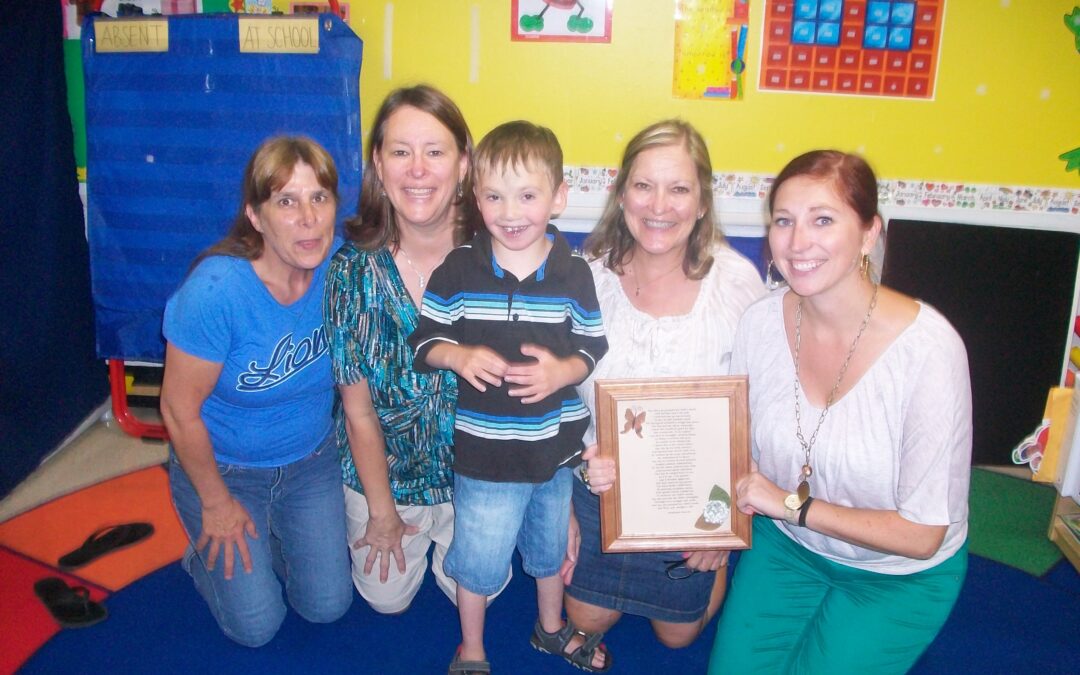
Okay, sorry about neglecting to issue a tissue warning! Now you can understand why Braeden’s teacher had the poem framed and hung it in Room 16. As a former teacher, I know many teachers are thankful for Stephanie’s poem, too.

How about you? How did you say thank you and melt the heart of your child’s teacher? Leave a comment. And check out Stephanie’s blog, www.BraedensHeartJourney.com.

Do you like what you see at DifferentDream.com? You can receive more great content by subscribing to the quarterly Different Dream newsletter and signing up for the daily RSS feed delivered to your email inbox. You can sign up for the first in the pop up box and the second at the bottom of this page.

By

Stephanie Ballard is the mother of two sons, her youngest son, Braeden, was born with Kabuki Syndrome and congenital heart defects. Her oldest son, Colin is in the military. She enjoys writing poetry and life lessons about her journey in life.

Author Jolene Philo

Archives

Categories

Subscribe for Updates from Jolene

Related Posts