3 Speech Therapy Tips to Use at Home

3 Speech Therapy Tips to Use at Home

3 Speech Therapy Tips to Use at Home

Speech therapy is a vital service for many kids with special needs. The earlier a child with speech delays begins working with a speech therapist, the more progress can be made. Parents can aid that progress by reinforcing the therapist’s efforts at home. A recent article at Huffington Post by speech therapist Jaime Openden explains 3 simple ways parents can help.

3 Speech Therapy Tips

Openden lists the following three simple tips parents can use at home:

  1. Simplify the vocabulary
  2. Shorten the length of sentences
  3. Show your meaning in gestures

That sounds almost too simple, doesn’t it?

Speech Therapy Tips Applied

Openden knows parents need more to go on than that. Here’s how she explains how to apply the three tips:

  1. If the language being used is too complicated, simplify it. Instead of asking a child to “locate” something, ask them to “touch” it or “point” to it.
  2. When the message is too long, shorten it. When telling your child about chores that need to be done, don’t use long sentences. Put the items into a short list instead.
  3. When your child has no previous knowledge or context to help him understand what you mean, show what you mean. Use gestures, act it out, or model what you want your child to do first.

You can read more of Jaime’s great advice in her article, Speech Therapy Tips for Parents to Use at Home.

Speech Therapy Made Simple

Opendale’s ideas seem almost too simple, don’t they? But simple solutions are usually the best, and it’s comforting to know you can assist your child’s trained speech therapist by simplifying, shortening, and showing at home.

How about you? Has your child’s therapist shared any tips for you to use at home? Have you discovered some on your own? If so, please share what you’ve learned in the comment box. Thanks!

Do you like what you see at DifferentDream.com? You can receive more great content by subscribing to the quarterly Different Dream newsletter and signing up for the daily RSS feed delivered to your email inbox. You can sign up for the first in the pop-up box and the second at the bottom of this page.

Photo by Ann Danilina on Unsplash

By

Jolene Philo is the author of several books for the caregiving community. She speaks at parenting and special needs conferences around the country. Sharing Love Abundantly with Special Needs Families: The 5 Love Languages® for Parents Raising Children with Disabilities, which she co-authored with Dr. Gary Chapman, was released in August of 2019 and is available at local bookstores, their bookstore website, and Amazon. See Jane Dance!, the third book in the West River cozy mystery series, which features characters affected by disability, was released in October of 2023.

Author Jolene Philo

Archives

Categories

Subscribe for Updates from Jolene

Related Posts

Parent Toolkit: Make the Most of the School Year

Parent Toolkit: Make the Most of the School Year

Parent Toolkit: Make the Most of the School Year

A parent toolkit may be just what you need with the school year in full swing and parent/teacher conferences right around the corner. Thankfully, Mary Mazzoni features the resource you’re looking for at her website, Life After IEPs wesite.

Parent Toolkit from the NCLD

The kit is a free resource created by the National Center for Learning Disabilities (NCLD). It includes the following items:

  • Building a Good Relationship with Your Child’s Teacher
  • Essential Skills for Becoming Your Child’s Advocate
  • Advocating for your School-Aged Child
  • Making the Most of Your Parent-Teacher Conference
  • Creating Great Expectations for an Effective Meeting worksheet
  • Related Resources

Sounds pretty good, doesn’t it?

Parent Toolkit Works All Year Long

My apologies for not finding this resource before school started as many of the resources would have been valuable then. But many of them can be used throughout the school year. For example, here’s a peek at what’s in the Building a Good Relationship with your Child’s Teacher section:

  • Connecting Before the School Year Starts
  • Maintaining the Connection During the School Year
  • Remembering that the Teacher is a Person First
  • Sharing Your Appreciation with Others
  • Ending the School Year on a Positive Note

Similarly, the section about parent-teacher conferences walks parents through the planning process before the conference. It then moves on to the conference and finishes at home after the conference.

Parent Toolkit Download

Just click here to download the Back-to-School Kit for Parents of Students with Learning Disabilities.

What’s in Your Toolkit?

How do you prepare for parent-teacher conferences? What kinds of tools do you use to make the most of each school year? Which items from the NCLD document are you planning to use? Leave a comment!

Do you like what you see at DifferentDream.com? You can receive more great content by subscribing to the quarterly Different Dream newsletter and signing up for the daily RSS feed delivered to your email inbox. You can sign up for the first in the pop-up box and the second at the bottom of this page.

image courtesy of www.freedigitalphotos.net

By

Jolene Philo is the author of several books for the caregiving community. She speaks at parenting and special needs conferences around the country. Sharing Love Abundantly with Special Needs Families: The 5 Love Languages® for Parents Raising Children with Disabilities, which she co-authored with Dr. Gary Chapman, was released in August of 2019 and is available at local bookstores, their bookstore website, and Amazon. See Jane Dance!, the third book in the West River cozy mystery series, which features characters affected by disability, was released in October of 2023.

Author Jolene Philo

Archives

Categories

Subscribe for Updates from Jolene

Related Posts

Obedience: The Formula for Fall Blessings, Pt. 3

Obedience: The Formula for Fall Blessings, Pt. 3

Obedience: The Formula for Fall Blessings, Pt. 3

 Obedience can be a difficult behavior to instill in children. But guest blogger Amy Stout’s series on the topic can help. In Part 1, she discussed first steps parents need to take so their kids will be inclined to obey. In Part 2, she provided an illustration to use with kids. In the final post in her series on the topic, she shares easy ways for kids to practice obeying their parents.

Obedience: The Formula for Fall Blessings, Pt. 3

Obedience: How to Practice It

Obedience is comprised of listening/processing and following directions. When caregivers say to my child, “Kylie, you need to listen,” it drives me C-R-A-Z-Y. Kylie has auditory processing issues. She HAS listened. The time lapse in response is due to her brain trying to process the information so she can act.

Some children (a LOT of children) require object cues, picture cues, sign language cues, lists, or other things to help them understand what it is that you are asking of them. Otherwise, your directive sounds like that of Charlie Brown’s teacher “wah, wah, wah, wah, wah, wah.” No child has a chance at following that direction.

If it is time for Kylie to pick up toys, we don’t generalize and say, “Kylie you need to pick up toys.” Instead, we use a white board and we write on it:

  1. Pick up markers
  2. Pick up Barbies
  3. Pick up coloring books

Or, we will use a First/Then method and say, “Kylie, first pick up Barbies. Then eat popsicle.” Both strategies allow her some flexibility in making the decision for herself, but both also accomplish the task needing to be completed.

It is also important to give your child the tools and scenarios to be successful. Do not set them up for failure by keeping them up too late at night and demanding obedience when they are too tired to respond appropriately. Don’t attempt a clean-up routine when lunch has been delayed by an hour. All they can think of is how hungry they are. They are in no mindset to be obedient. Make sure your child’s needs are met first and then work on practicing obedience together.

Obedience: Easy Ways to Practice It this Fall

  • Follow directions according to a recipe for food or for play dough. If the recipe is not followed correctly, the item does not turn out as it should. Here is my recipe for pumpkin pie scented play dough.
  • Do an activity together that encourages following a pattern. Here is a pumpkin nailing activity that we did with Kylie.
  • Play a game with 2 step directions. Here is a game that we play with Kylie that not only focuses on following directions, but also on counting and sensory integration.
  • Work on boundaries: We do this by creating seasonal sensory bins for Kylie to play in. We put a large sheet under the sensory bin and the rule is that the items in the sensory bin HAVE to stay within the boundary of the sheet. If they end up on the carpet or in another room, we have to put away the sensory bin for a time. Here are links to our Halloween bin, our Icky Sticky bin, and our November/Thanksgiving bin.

Anne Sullivan, Hellen Keller’s teacher, once said, “I have thought about it a great deal, and the more I think, the more certain I am that obedience is the gateway through which knowledge, yes, and love, too, enter the mind of the child.”

What Do You Think?

Thank you, Amy, for these practical ways to practice obedience. Do you have some ideas to add to Amy’s? Leave a comment.

Obedience: The Formula for Fall Blessings, Part 1
Obedience: The Formula for Fall Blessings, Part 2

Do you like what you see at DifferentDream.com? You can receive more great content by subscribing to the quarterly Different Dream newsletter and signing up for the daily RSS feed delivered to your email inbox. You can sign up for the first in the pop-up box and the second at the bottom of this page.

By

Amy Stout is a wife, mother, and free-lance writer. You can visit her website at His Treasured Princess.

Author Jolene Philo

Archives

Categories

Subscribe for Updates from Jolene

Related Posts

Obedience: The Formula for Fall Blessings, Pt. 2

Obedience: The Formula for Fall Blessings, Pt. 2

Obedience: The Formula for Fall Blessings, Pt. 2

Obedience is the topic of guest blogger Amy Stout’s current series. In Part 1, she discussed first steps parents need to take so their kids will be inclined to obey. Today, she’s back with tips for teaching kids how to obey. Take it away, Amy!

Obedience: The Formula for Fall Blessings, Pt. 2

Many children have issues with obedience due to auditory processing, maintaining focus, having control over their own body systems, the ability to respond quickly or on demand, hearing, attention, and hyperactivity. The list goes on. These things are very important to know and recognize in any child.

Once you know about your child’s abilities and have repaired your own character (see Part 1), you are ready to initiate obedience training.  Obedience is a skill that needs to be modeled, taught, and practiced.

No one likes to be TOLD what to do. But we all like to be offered choices; It gives us the illusion of being in control. (Offering choices works like magic in our own home: “Kylie, which would you like to pick up first, the markers or the crayons?” or “Kylie, you may either pick up your toys and watch a movie afterwards or you may leave the toys out and head to bed now.” And it seriously becomes her choice.)

Obedience: How to Model It

The best place to model obedience is in the car. The law of the land has posted signs that must be obeyed: speed limit signs, yield signs, stop signs, crosswalks, etc.  Your children know if you are obedient and respectful toward the law. If you don’t obey those in authority over you, why should it matter for them to obey you?

Obedience: The Basic Formula

The basic formula is:

(O) + DR = Blessing
Obedience plus doing right equals blessing.

This formula is based on Ephesians 6:1-3
Children obey your parents in the Lord, for this is right. Honor your father and mother – which is the first commandment with a promise attached to it- “that it may go well with you and that you may enjoy long life on earth.”

Obedience: A Key Illustration

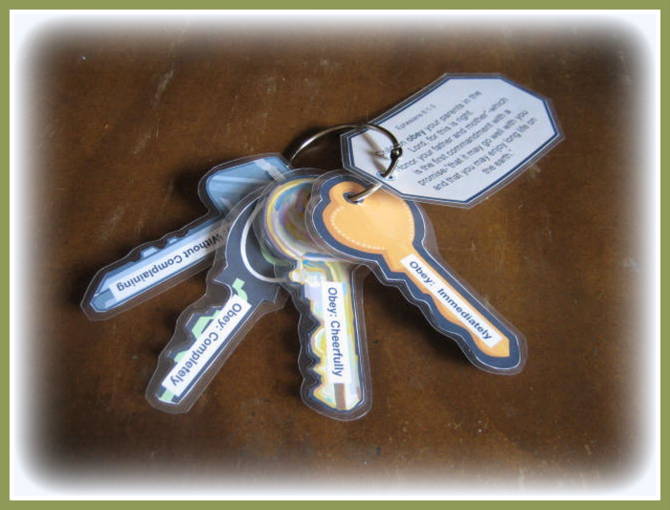
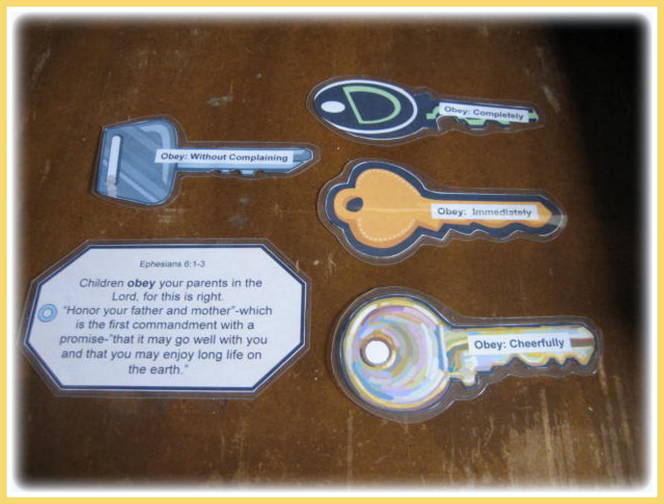
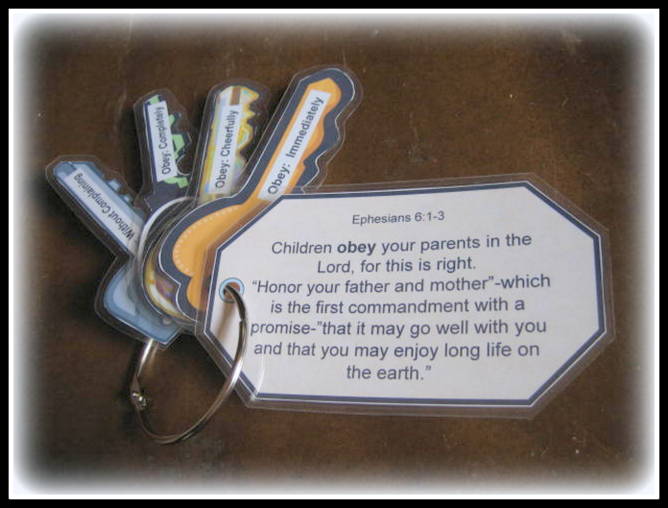
I recently saw this illustration that beautifully teaches the obedience/following directions concept on a child’s level. (See photo above) It is basically a key ring concept. The key ring has a tag with the Ephesians 6:1-3 verses typed out on it. On the key ring, 4 laminated paper keys teach how to obey:

  • Obey: Immediately
  • Obey: Cheerfully
  • Obey: Completely
  • Obey: Without complaining

If a child obeys, but is grumpy about it, you simply point out that they are missing a key and suggest that they find it and use it to unlock the blessing.  These small tangible reminders help to reinforce exactly what it means to obey.

Your Keys to Obedience

What an effective visual reminder for our kids! Thank you for the idea, Amy. How about the rest of you? What are your family’s keys to teaching obedience? Leave a comment to share your great idea. And come back tomorrow for Part 3, the final installment in Amy’s series. 

Obedience: The Formula for Fall Blessings, Part 1
Obedience: The Formula for Fall Blessings, Part 3

Do you like what you see at DifferentDream.com? You can receive more great content by subscribing to the quarterly Different Dream newsletter and signing up for the daily RSS feed delivered to your email inbox. You can sign up for the first in the pop-up box and the second at the bottom of this page.

By

Amy Stout is a wife, mother, and free-lance writer. You can visit her website at His Treasured Princess.

Author Jolene Philo

Archives

Categories

Subscribe for Updates from Jolene

Related Posts

Obedience: The Formula for Fall Blessings, Pt. 1

Obedience: The Formula for Fall Blessings, Pt. 1

Obedience: The Formula for Fall Blessings, Pt. 1

Obedience is an important skill to teach every child. Guest blogger Amy Stout is here with strategies parents can use to train their children to be obedient. Today, she talks about first steps parents need to take so kids will want to obey.

Obedience: The Formula for Fall Blessings, Pt. 1

Let’s face it.  Not many people like the word “obey.”   Anytime I use that word around Kylie’s therapists – Kylie, you need to obey Miss Therapist – they quickly change the wording to, “Yes, Kylie, please follow directions.”

People don’t like the word obey because it implies submission, and so many of us have a problem with authority. We want to be THE BOSS. I get it, I truly do. (I, also, have a slight issue with authority—we creative types always do.) Even though I don’t particularly LIKE the word “obey,” I still use it.  I use it because Jesus used it, and Jesus never did anything without a reason.

Obedience: Placing It Before Kids

My daughter at age 6 (and on the autism spectrum) knows the meaning and definition of the word “obey.” We have placed it before her since she was tiny. Did you notice what I just wrote? I used the phrasing “placed it before her” rather than “drilled it into her” for a reason.

You see, as a person who would rather be my own boss, I realize the importance of strategy and diplomacy. There is a way to get our children to obey without always placing a figurative yoke around their neck and dragging them to the task at hand. The thing is, kids are people pleasers. They WANT to make you happy, but they want to do it in their own time and in their own creative way. Sometimes, this poses a problem when REAL life enters the picture. Kids don’t understand that things in the adult world happen on a schedule. That some schedules are flexible and can change, but that other schedules absolutely cannot be changed.

Obedience Needs to Be a Habit

Charlotte Mason, a great educator from the past, once referred to the fact that obedience needs to be a HABIT, and that out of everything you can teach a child, obedience is the “single greatest pattern to be formed.” (Taken from For the Children’s Sake by Susan Schaeffer Macaulay.)

If for no other reason, our children need to know how to obey for safety reasons. Let’s say they are running toward a rolling ball that has left the playground and ventured into the parking lot. If we shout “stop!” and they don’t obey, their very life could depend on it.

Obedience Requires Respect

Many children—and especially children who experience special needs—have very valid reasons for not obeying. These reasons vary from they simply don’t respect the elder giving the directive to they didn’t hear the directive. If a child does not respect you enough to obey you, you might want to take a look at your personal character:

  • Are you trustworthy? (Or do you make promises that you don’t keep?)
  • Do you behave like an adult? (Or do you throw loud and uncontrolled temper tantrums?)
  • Do you control your emotions? (Or do you use emotions in an attempt to manipulate your child?)
  • Do you follow through? (When the sticker chart is full do you implement the reward? When the chore is completed, do you pay the allowance?)
  • Do you practice what you preach? (Or do you violate your own directives?)

These are just a few of the things that may cause your child to disrespect you.  If you are guilty in one or more area, apologize to yourself and then to your child and let them know you are going to be a better parent.  THAT will be a great first step toward reconciliation and restoration of the relationship.

Obedience and You

Ouch! Amy’s challenge may require some soul searching. Guess what I’ll be doing until tomorrow when Amy is back with Part 2 of the series. Until then, feel free to share your thoughts about the series so far in the comment box.

Obedience: The Formula for Fall Blessings, Part 2
Obedience: The Formula for Fall Blessings, Part 3

Do you like what you see at DifferentDream.com? You can receive more great content by subscribing to the quarterly Different Dream newsletter and signing up for the daily RSS feed delivered to your email inbox. You can sign up for the first in the pop-up box and the second at the bottom of this page.

By

Amy Stout is a wife, mother, and free-lance writer. You can visit her website at His Treasured Princess.

Author Jolene Philo

Archives

Categories

Subscribe for Updates from Jolene

Related Posts

Communication with My Daughter Who Has Down Syndrome

Communication with My Daughter Who Has Down Syndrome

Communication with My Daughter Who Has Down Syndrome

Communication with children who have special needs often requires creativity and flexibility. Today, guest blogger Ellen Stumbo describes the struggles and hopes she has with her daughter Nichole who lives with Down syndrome.

Just for a Day:
Communication with My Daughter Who Has Down Syndrome

by Ellen Stumbo

Just for a day, I wish my daughter with Down syndrome did not struggle with her speech. I know she gets frustrated when we don’t understand her, she tries as hard as she can to enunciate her words right, but sometimes, we still don’t understand what she is saying. She gets irritated, swings her little arms in desperation and yells at us. I don’t blame her, I would feel angry too.

Just for a day, I wish I could have a conversation with Nichole like I do with my other two daughters. I want to hear about her day at school, about what she likes and doesn’t like. I would ask her all about her favorite things, and I would spend the day talking, chatting, singing with her.

Just for a day, I wish Nichole’s speech was clear so that people would actually take the time to notice her, to enjoy her, and to listen to what she has to say.
Just for a day, I wish Nichole could speak her mind, all of it, good and bad. Non-stop chatter coming from her lips and straight into my ears.
Just for a day, I wish it was easy to communicate with my daughter.

She Has a Lot to Say

Nevertheless, Nichole does talk. Sure, her words and phrases might be hard to understand, but she has stories to tell us and things to say. The older she gets, the better her speech becomes, and I am confident that we will get there, that someday she will be talking so much we might even ask her to stop.

Things take Nichole a little bit longer, and it is easy to become impatient and take what we have now for granted. I love the fact that Nichole grabs my hand and shows me what she wants or needs. I love the fact that she is willing to repeat words after me. Her sweet voice is one of the loveliest sounds I have ever heard. I love her “daddy” call, and her laughter that comes from such an overflow of joy. I love how she surprises and amazes me with new words or new statements. And I know we will get there.

How Nicole Communicates

I love the way she signs, or the way she makes up signs. I smile thinking about the way she grabs my face to get my undivided attention, and to make sure I am listening to what she has to say.

I love the way she embraces people without caring what they look like or smell like. I have seen a grown man with tears in his eyes, as he expressed, “She makes me feel loved.” And I realized that without words my daughter was able to communicate a love to this man he had never received. And suddenly I wish I could speak her language of unconditional love.

And her speech will not always be an issue, I will have conversations with my daughter, and not just for a day.

Your Communication Struggles and Hopes

Thank you, Ellen, for transparently sharing your dreams for Nicole. You can also share dreams you have about communicating with your child in the comment box. Ellen and I would love to hear from you.

Do you like what you see at DifferentDream.com? You can receive more great content by subscribing to the quarterly Different Dream newsletter and signing up for the daily RSS feed delivered to your email inbox. You can sign up for the first in the pop-up box and the second at the bottom of this page.

By

Ellen Stumbo is a writer and speaker and the mother of three girls, two with disabilities. To read more of Ellen’s writing, visit her blog at www.EllenStumbo.com.  She can also be found on Twitter and Facebook.

Author Jolene Philo

Archives

Categories

Subscribe for Updates from Jolene

Related Posts