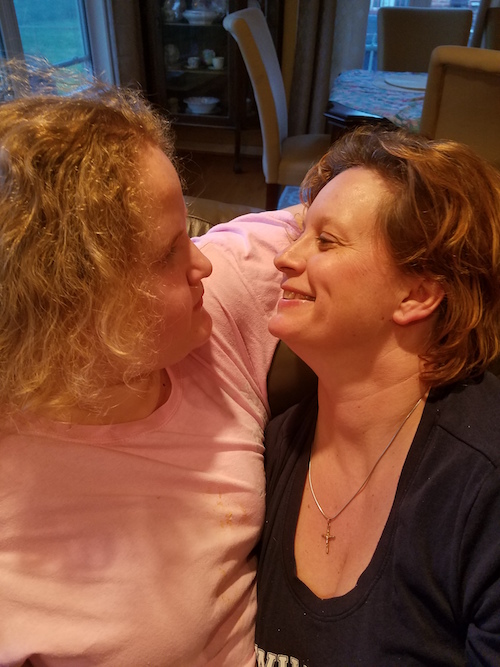
When All I Want Is to Be Done with Special Needs

When All I Want Is to Be Done with Special Needs

When All I Want Is to Be Done with Special Needs

One of the first words out of our oldest grandchild’s mouth was, “DONE!” He used it emphatically at the end of meals…

DONE!

When having his face washed or his nose wiped…

DONE!

Or my personal favorite…approximately two seconds after his parents put him in his crib for a nap and then carefully and oh-so-quietly shut the door to his bedroom…

DONE!

Lately, I’ve found myself silently echoing my grandson’s sentiments. When I’m asked to talk about my childhood spent caring for a father slowly being diminished by the ravages of multiple sclerosis. When someone wants to hear about the many surgeries our son’s endured during his early years. When I’m asked to recount our son’s diagnosis and treatment for PTSD. What I really want to say, instead of responding politely and patiently, is…

DONE!

Some days, all I want is to be done with special needs. I don’t want to talk about them I don’t want to think about them. After all, my dad died in 1997. My son’s surgeries and treatment for PTSD are distant memories. But, the truth is that I will never be done with those memories. They shaped and are still shaping the course of my life. They are part of who I am.

On days when I think I want to be done with special needs, what I really want is a way to create some distance, to carve out time to rejuvenate and gain perspective so I can continue the work God has given me to do. I’ve discovered some ways to make that happen. Maybe these tips can help you on those days when you want to be done with special needs, too.

To read the rest of this post, visit the Not Alone website at specialneedsparenting.net.

Do you like what you see at DifferentDream.com? You can receive more great content by subscribing to the quarterly Different Dream newsletter and signing up for the daily RSS feed delivered to your email inbox. You can sign up for the first in the pop up box and the second at the bottom of this page.

By

Jolene Philo is the author of the Different Dream series for parents of kids with special needs. She speaks at parenting and special needs conferences around the country. She’s also the creator and host of the Different Dream website. Sharing Love Abundantly With Special Needs Families: The 5 Love Languages® for Parents Raising Children with Disabilities, which she co-authored with Dr. Gary Chapman, was released in August of 2019 and is available at local bookstores, their bookstore website, and at Amazon.

Author Jolene Philo

Archives

Categories

Subscribe for Updates from Jolene

Related Posts

The Magic of Music Therapy for Kids with Special Needs

The Magic of Music Therapy for Kids with Special Needs

The Magic of Music Therapy for Kids with Special Needs

Happy St. Patty’s Day to everyone! Today’s post about the power of music, something the residents of the Emerald Isle have known for centuries, comes from Andrea Moriarty. She is the co-founder of the music therapy nonprofit Banding Together and mother of a son with special needs. Below, Moriarty shares an excerpt from her new book, One-Track Mind: 15 Ways to Amplify Your Child’s Special Interest. With the benefit of hindsight, Moriarty outlines the power of music therapy and strategies her family discovered to maximize their son’s strengths to discover purpose.

Taking a Tip from Disney

If you’ve watched as much bonus material on two-disc collector’s edition versions of Disney films as we have, you have heard composer Richard Sherman explain that Walt insisted the music move the plot forward. Sherman explains, “A successful song for a musical is not just pleasant listening. It tells a story, conveys character and personality. It’s the most difficult thing to do. You’re writing the whole book on the head of a pin.” The songs our music therapist helped my son compose were certainly moving the plot line of his life forward.

Music Generalizes Skills

Through a side-door miracle of sorts, after being in private special education settings for most of his life, Reid attended a highly competitive public high school with more than 2,500 students for his last two years in the system. He expressed interest in entering their “Idol” singing contest, modeled after the popular television show. Generalizing his musical skills to a new setting with many new people, he performed his original song, “Shine,” for the first time without his longtime music therapist, his band, or me present. This huge milestone came after significant consternation and anxiety. He wavered all morning in anguished self-talk.

Music Motivates Behavior

His aide texted me status updates. “He says he’s too nervous.”

I texted back, “That’s common; don’t offer any rewards or appear to make him do it. Just let him talk it through by himself. He usually decides to do it in the eleventh hour, as long as it’s his own choice.” Only I wasn’t sure if he would this time, without any of his usual entourage. I had to let it go. “Tell him it’s up to him.”

Then at last, the reply I wanted to read from around the corner where I was parked: “He’s gonna do it. He’s going up.”

At the last minute, from a concrete slab amphitheater in the center of the grassy quad, Reid announced to the gathered student body that he would sing “Shine” a cappella. That was a first! The song itself became the constant amid numerous other variables, including the spotty sound system.

Music Communicates Volumes

In essence, he was introducing himself at this new school, telling his story to a group of typical teens at lunchtime through the lyrics Angela and he had written. They had done what composer Eric Whitacre suggests, “Write the music your inside-you needs your outside-you to hear.”

You can do it if you really try
Don’t give up, reach for the sky
A spark in you has begun to grow
Shout it for the world to know, you’re gonna
Shine……Shine……Shine
Sing with your heart
Play your part
Jump to your feet
Dance in the street
Don’t be afraid
Let others see
The dreams you have
What you could be

Music Facilitates Inclusion

Apparently, the throngs of students stood to applaud, surely never imagining that the conspicuous boy they passed in the halls with his own instructional aide was capable of this. They texted me a photo of him post-performance, adrenaline rushing, arm in arm between his vocal coach and the school band teacher, who was one of the judges. It wasn’t about winning that day, but rather being included, mastering independence, and generalizing his musicianship to a new crowd and venue. Frank Sinatra’s words rang true, “If I can make it there, I’ll make it anywhere…”

Music Therapy is Magic

There are seven reasons music therapy is the magic in our story. Music therapy:

  1. Addresses practically any IEP goal.
  2. Is innately pleasurable; music is its own reward.
  3. Employs a relative strength.
  4. Utilizes the whole brain.
  5. Adapts through one’s lifespan.
  6. Generalizes easily outside the clinic.
  7. Allows for structure and creativity simultaneously.

Your Experience with Music Therapy?

Has your child benefited from music therapy? Andrea would love to hear your story if you’d like to share it in the comment box.

Do you like what you see at DifferentDream.com? You can receive more great content by subscribing to the quarterly Different Dream newsletter and signing up for the daily RSS feed delivered to your email inbox. You can sign up for the first in the pop up box and the second at the bottom of this page.

By

Andrea Moriarty recently published One-Track Mind: 15 Ways to Amplify Your Child’s Special Interest. She blogs at Autism Unplugged about both the challenges and triumphs of parenting a differently-abled child while offering affectionate humor and unending hope. Moriarty and her husband Jim are the proud adoptive parents of twins, Allie and Reid. Allie currently studies music education and music therapy at Berklee College of Music in Boston. Reid makes music, performs regularly, and hosts his own podcast: Talk Time with Reid Moriarty. Moriarty lives in Solana Beach, California, where she accumulates books, cooks from scratch, and whistles while she works. You can learn more about Andrea at her website, www.andreamoriarty.com.

Author Jolene Philo

Archives

Categories

Subscribe for Updates from Jolene

Related Posts

Adopting a Child with Special Needs

Adopting a Child with Special Needs

Adopting a Child with Special Needs

Guest blogger Kimberly Drew and her husband are adopting a child with special needs. This baby girl will be their second child who lives with disabilities. Today Kimberly shares what she’s learned about what kids with special needs truly need.

Adopting a Child with Special Needs

My husband and I are in the middle of the process of adopting a child with special needs, baby girl, from an extended family member. Because our daughter, Abbey, is thirteen and has multiple disabilities we are aware that to some people this pretty much sounds insane. We’ve even had close friends question our decision.

The truth is, we’ve been talking about adoption for years. We’ve prayed about it many times. When this need came up, we just knew God was asking us to step out in faith. I blog and write all the time about how much raising Abbey has changed my life for the better. It is by far the most difficult, and occasionally painful, journey I have ever been on. At the same time, it’s a beautiful and rewarding one too.

I started thinking about what it really means to have a child with special needs. I often define that by Abbey’s limitations and what we have to do in order to care for her. But as I was lying in bed and thinking about how to respond to those people how aren’t on the “I support you, I believe in you” bandwagon it occurred to me.

Yes. I am going to have two daughters with special needs. While I don’t know exactly what that’s going to look like, I know what I have learned so far about having a daughter with special needs.

My daughter has a SPECIAL NEED to be loved.

She requires extra hugs, kisses, and post-appointment cuddles. She can’t leave for school or home without hugging and signing, “I love you” multiple times to every person.

My daughter has a SPECIAL NEED to try new things.

We vacation differently and seek out new spots and activities that are friendly to her physical needs. We join different sports groups like therapeutic riding and have been wanting to try a local dance classes for the disabled. We even try new foods for her when we are ordering at a restaurant based on their consistency!

My daughter has a SPECIAL NEED to have amazing people in her life.

She attracts compassion and kindness. We have made some amazing relationships because it takes a special kind of person to befriend our family…people who “get it” and love us through the variables and chaos. They even tell us they are the ones who are blessed…

My daughter has a SPECIAL NEED to be a child.

She is not your typical teen. She still loves baby dolls and coloring. She laughs at silly things, and still pretends. You can keep your teen daughter’s iphone and sass…I will take a Bitty Baby and pack of crayons over those every time! I can’t wait to take her to Disney World for the first time…we will probably get to cut every line. Ha ha!

My daughter has a SPECIAL NEED to live life in light of eternity.

Every day is a gift. Every day is a reminder that this world is not our home, and the brokenness of this life is redeemed through the cross. We live with a truer hope, peace, and joy because what she has taught us about the love of God.

Yes, I’m going to have two daughters with special needs. Lucky me.

Any Advice for Kimberly about Adopting a Child with Special Needs?

Have you adopted a child with special needs or do you know someone who has? Share your advice with Kimberly if you like.

Do you like what you see at DifferentDream.com? You can receive more great content by subscribing to the quarterly Different Dream newsletter and signing up for the daily RSS feed delivered to your email inbox. You can sign up for the first in the pop up box and the second at the bottom of this page.

By

Kimberly grew up and went to college in the small town of Upland, IN. She graduated from Taylor University with a degree in Elementary Education in 2002. While at TU, she married her college sweetheart and so began their adventure! Ryan and Kimberly have four amazing kids on earth (Abigail, Jayden, Ellie, and Cooper), and a baby boy waiting for them in heaven. Their daughter Abigail (Abbey) has multiple disabilities including cerebral palsy, a seizure disorder, hearing loss, microcephaly, and oral dysphagia. She is the inspiration behind Kimberly’s  desire to write. In addition to being a stay at home mom, Kimberly has been serving alongside her husband in full time youth ministry for almost fourteen years. She enjoys working with the senior high girls, scrapbooking, reading, and music. You can visit Kimberly at her website, Promises and Perspective.

Author Jolene Philo

Archives

Categories

Subscribe for Updates from Jolene

Related Posts

Eight Ways to Make Therapy Fun

Eight Ways to Make Therapy Fun

Eight Ways to Make Therapy Fun

For two and half months last fall, I felt like a prisoner wearing a ball and chain. Not on my foot, but on my left hand. Not a ball made of iron, but of therapy appointments two or three times a week as well as hand and thumb exercises every two hours.

Day after day. Week after week. Month after month.

Lugging around the ball and chain designed to restore the function of a severed thumb tendon, I had plenty of time to think about kids who go to all sorts of therapy appointments. Who are assigned endless exercises, not for a few months, but for a lifetime. Whose parents drive them to therapy, schedule the appointments, and supervise exercises.

Day after day. Week after week. Month after month. Year after year.

During my stint with therapy, I came up with techniques to motivate myself. Many of them were plucked from the bag of tricks I used during my teaching years to motivate students. I’m passing them on to you, hopeful that they will lighten the weight of the therapy ball and chain and make therapy fun for your child.

Tip #1: Use Normal Daily Movements as Therapy

Many of the pictures of the exercises assigned by the therapist listed daily movements that used the same muscles and motions. One of them was folding laundry. So on laundry day, I folded clothes (something my husband usually does) instead of doing the exercises because it felt more purposeful. If children can occasionally substitute normal daily movements for contrived exercises, they’ll feel like they had a exercise break, but you’ll know better.

Tip #2: Make Therapy Fun

My idea of fun is not squeezing a ball of thera-putty for ten minutes twice a day. Most days I forced myself to do it. But the weekend we visited our grandkids was a different story. Rolling and squeezing the thera-putty with my three-year-old grandson was so much fun neither of us wanted to put it away. We rolled snakes, made them kiss, and squeezed them into cookie cutters. We even made a short video to show the hand therapist at my next appointment. All it took to turn drudgery to fun was a child’s imagination and an adult’s willingness to act like a kid again.

To read the rest of this post, visit the Not Alone website at www.specialneedsparenting.com.

Do you like what you see at DifferentDream.com? You can receive more great content by subscribing to the quarterly Different Dream newsletter and signing up for the daily RSS feed delivered to your email inbox. You can sign up for the first in the pop up box and the second at the bottom of this page.

By

Jolene Philo is the author of the Different Dream series for parents of kids with special needs. She speaks at parenting and special needs conferences around the country. She’s also the creator and host of the Different Dream website. Sharing Love Abundantly With Special Needs Families: The 5 Love Languages® for Parents Raising Children with Disabilities, which she co-authored with Dr. Gary Chapman, was released in August of 2019 and is available at local bookstores, their bookstore website, and at Amazon.

Author Jolene Philo

Archives

Categories

Subscribe for Updates from Jolene

Related Posts

Four Resources for New Special Needs Parents

Four Resources for New Special Needs Parents

Four Resources for New Special Needs Parents

Guest blogger Sylvia Phillips has been caring for children with special needs for 25 years. She wants to share four resources for new special needs parents she wishes she’d know about when her journey began.

Four Resources for New Special Needs Parents

I began my journey as a special needs mom more than 25 years ago. While I don’t claim to be an expert on special needs parenting, there are four things I wish I had known when my journey began that I’d like to share with you.

If you are an overwhelmed and worried young parent just starting out on your own unique journey with your very own precious and special little one…

The first and foremost thing I want new special needs parents to know is that without a doubt no one can predict what the future holds for your child with disabilities or special needs.

Doctors, therapists, and other professionals may give us their expert opinions on the subject, but when it comes right down to it, even they cannot predict at what level our kids will be functioning or what major milestones and amazing accomplishments they may achieve at any given time in the future.

While I do think we all need to be realistic about our special needs children’s capabilities, if your child has been given a disappointing prognosis, please do not despair, because a prognosis is just an opinion based on the observations of what others with similar challenges have experienced.

A prognosis cannot predict how happy your child will be in the future or foretell their future quality of life.

Never give up hope that your child will someday grow up to create a happy, satisfying, fulfilling, productive, and amazing life for him or herself!

Never give up doing and providing every resource within your power and ability to help your child succeed and become all that he or she can be!

The second thing I want new special needs parents to know is that most communities have resources available to support families on their special needs parenting journey.

Search online for and take advantage of all resources available in your community concerning your child’s particular special needs and for disabilities in general.

Join support groups and disability organizations, attend trainings and conferences, and apply for grants and other types of financial assistance.

The third thing I want new special needs parents to know is that there are government entitlements for which your child may be eligible.

Accessing government supports and services is your child’s right if he or she has an eligible disability.

Government entitlements offer such services as service coordination, respite care, community habilitation, community recreation, Social Security Insurance, Medicaid, future housing options, and more! Some states even have funds available to assist people with disabilities to purchase and maintain their own homes.

Such supports and services are designed to enrich and improve your child’s quality of life and give overworked and overwhelmed parents a break and a helping hand.

The fourth and last thing I want new special needs parents to know is that it’s never too early to start planning for your special child’s future.

Don’t wait until your child is nearly an adult to set up special needs trust funds, guardianship, stand by guardians, and future housing arrangements.

Guardianship must be set up before your child turns eighteen. The good news is that this can be a do-it-yourself job.

Many states have forms available online. All you have to do is fill them in, print them out and file them. While the thought of doing that yourself may be a little daunting, the instructions walk you right through the whole process, easy-peasy! Filling out and filing your own guardianship application will save you quite a bit of money. You’ll need to hire a lawyer to set up a special needs trust fund, however.

 All new special needs parents to know that they should:
  • Never give up hope that their child will grow up to live a happy and productive life!
  • Take advantage of all community supports and services.
  • Apply for all government programs that their child may be eligible for and entitled to.
  • Begin planning for their special needs child’s future now.

Your Advice for New Special Needs Parents

If you have more advice for new special needs parents to add to Sylvia’s, leave them in the comment box.

Do you like what you see at DifferentDream.com? You can receive more great content by subscribing to the quarterly Different Dream newsletter and signing up for the daily RSS feed delivered to your email inbox. You can sign up for the first in the pop up box and the second at the bottom of this page.

By

Author Jolene Philo

Archives

Categories

Subscribe for Updates from Jolene

Related Posts

An EA TEF Parent Is Born

An EA TEF Parent Is Born

An EA TEF Parent Is Born

When an EA TEF baby is born, so is an EA TEF parent. Different Dream is ending EA TEF Awareness Month with a post from Kamaile Hiatt. She’s the mother of Kanani, born in 2001. Kanani’s EA TEF was diagnosed and repaired on the day of her birth. Today Kamaile tells about her rebirth as an EA TEF parent and what’s she’s learned in this new role and new life.

An EA TEF Parent Is Born

I’ve had a recurring thought that we typically congratulate families, focusing the attention one the new babe, when in reality, with each new child born, so is a new mother and a new father.

An EA TEF Parent in the Early Years

With Kanani’s early arrival, our lives were completely up-ended. Not only were we first time parents, we learned within hours that we were brand-new-first-time-parents-of-an-infant-with-immediate-medical-needs. What a scary prospect that was.
Within hours of delivery, our new infant daughter was transferred to the neonatal intensive care (NICU) because her oxygen levels kept dipping. Her EA TEF was discovered when they tried to suction her and the suction tube would not go down as far as normal.

Not knowing any better, we assumed that the surgical correction when she was one day old would be a minor speed bump. Business, our lives, and our family would proceed as usual. We would carry on without a care in the world. Looking back, recovery from the corrective procedure seemed straightforward. But Kanani’s feeding and growth was problematic from the start and proved to be chronic. We sought the advice of a feeding clinic and they recommended g-tube placement. After carefully looking at our options and long term goals, we decided to follow that recommendation in hopes of eventually establishing good oral eating habits.

When Kanani was four months old, we learned her esophageal tissue was not as robust as is seen in healthy children. She suffered an injury during surgery when her paper-thin esophagus tore. The second repair to her esophagus took considerably more time to heal and additional stitching due to a pinhole leak that would not close.

An EA TEF Parent in the Toddler and Early School Years

One day, I watched Kanani let spit pour out of her mouth, not something she typically did. I gave her a drink from a water bottle and after a few swallows, the water came right back up. I waited a little while and offered her more water. When the same thing happened again, I took her in to the hospital. This was the first time we had something lodged in her esophagus above her repair stricture that required removal along with a dilation, or stretching of the stricture. From then on, she needed weekly dilations from October through December until food and liquid could pass without pooling and funneling through her narrowed scar tissue.

An EA TEF Parent in the School Years

Eventually the frequency of Kanani’s dilations slowed to once every six months, and then to once a year until she was eight. She had one foreign body removal at age 11, but the surgeon opted not to do a dilation due to the poor integrity of her esophagus. She will be 15 years old this year.

Future Expectations of an EA TEF Parent

We have learned the complications of repeated injury and chronic reflux early on means that Kanani has poor esophageal motility with flaccid and over-stretched tissue in the top half of her esophagus. In the lower portion, spasms that occur during peristalsis which can sometimes stop the movement of food down her esophagus.

We’re teaching her to take good care of her esophagus by sitting straight up when she eats and by chewing her food well so that she can reach adulthood with the her esophagus intact. There are not many options available if her esophagus continues to be injured.

On paper, this may sound tragic and scary and more. But, as a mother of a child with EA TEF, I have learned, and am continuing to learn how to be a good parent. I have learned that esophagoscopy and dilations are minor procedures. I’ve learned how to encourage good meal time behavior. My hope is to see her happy, eating a broad range of foods, intuitively and proactively using strategies to help food move through her esophagus so she is comfortable and healthy.

Your Response?

Depending on whether you are or aren’t an EA TEF parent, your response to Kamaile’s story is either one of instant familiarity or amazed bewilderment. Either way, your comments are most welcome in the comment box.

Do you like what you see at DifferentDream.com? You can receive more great content by subscribing to the quarterly Different Dream newsletter and signing up for the daily RSS feed delivered to your email inbox. You can sign up for the first in the pop up box and the second at the bottom of this page.

By

Kamaile is a speech and language pathologist and mother of a daughter with EA-TEF.

Author Jolene Philo

Archives

Categories

Subscribe for Updates from Jolene

Related Posts