Living Well Despite Adversity

Living Well Despite Adversity

Living Well Despite Adversity

Different Dream welcomes author Harriet Cabelly as today’s guest blogger. She’s here for an interview about her new book, Living Well Despite Adversity, for parents and caretakers of loved ones with special needs. 

Question #1: Why did you write Living Well Despite Adversity?

The idea that we all go through bad things and yet some people come through and live on well while others seem to crumble, has been a passion of mine for as long as I can remember. Since no one gets through this life unscathed–loss and pain is part of the human condition–the key is how to live well despite….

When my middle daughter miraculously survived and fully recovered from her medical crisis, I looked for something positive to do with this miracle. This book is an outgrowth of both my life theme and what I consider to be my new lease on life. This has been part of my  personal post traumatic growth.

Question #2: There are some well-known people in this book. How did you get them to do an interview for you?

The simple answer – I asked! My new and evolved way of living has become going beyond my comfort zone, taking risks and not being afraid of being told no. I did stop at Oprah though; I didn’t ask her. Maybe for my next book of interviews!

Question #3: What are some key concepts you’d like your readers to take away?

The main concept is that it’s not about circumstance; it’s about our response to our situation. That’s what got me interested in this theme to begin with. I would see similar things happen to many people. I became fascinated and inspired with how it was that some could rise above and carry on and others would remain in the depths of despair? So then it’s not necessarily what happens to us; it’s how we respond. I first learned of this concept in Viktor Frankl’s book, Man’s Search for Meaning.

Another key idea is that of choice. We can choose how we respond and we can shape our attitude. It’s not just how and what we’re born with.

Which brings me to the last point: we can grow our resilience. It’s not a fixed amount in our inborn or genetic pool. We all have internal strengths which we can build on and bring forth more to our benefit.

Question #4: What are you hoping readers will get from this book?

I’m hoping they will get inspiration from those they read about; but more that that they will see that it is possible to cope and live on well through their personal challenges. I hope they take on some of the ideas and concepts and begin to incorporate and apply them in their lives. I want them to feel hopeful in their own difficulties – that there can be light once again with intentional actions and ways of living.

Question #5: Who will this book appeal to?

Since the theme of dealing and living with hardships and loss is universal. I think it can appeal to everyone. As I said initially, we all have rough and painful things to contend with in our lives, therefore the array of various circumstances and adversities that are highlighted here will hopefully resonate with many, many people. The ideas and tools are applicable to all. And life lessons abound!


Do you like what you see at DifferentDream.com? You can receive more great content by subscribing to the quarterly Different Dream newsletter and signing up for the daily RSS feed delivered to your email inbox. You can sign up for the first in the pop up box and the second at the bottom of this page.

Harriet Cabelly is a social worker, speaker and workshop facilitator who has appeared on ABC News as a parenting coach and on WOR Radio’s Change Your Attitude, Change Your Life show as a guest coaching expert. As a positive psychology coach, Harriet journeys with her clients as they cope with and grow beyond their painful situations.

By

Jolene Philo is a published author, speaker, wife, and mother of a son with special needs.

Author Jolene Philo

Archives

Categories

Subscribe for Updates from Jolene

Related Posts

11 Back to School Special Needs Posts for Parents

11 Back to School Special Needs Posts for Parents

11 Back to School Special Needs Posts for Parents

Back to school posts for parents of kids with special needs can be hard to find. And what parent has time to unearth them while caught in the back-to-school whirlwind. So Different Dream has compiled 11 of its best back to school posts for parents of kids with special needs. Here they are in chronological order of appearance on the website.

#11: Back To School, Coffee and a Little Nostalgia

Guest blogger Kimberly Drew serves up nostalgia and coffee, along with some proactive tips to help kids with special needs make a successful transition in Back To School, Coffee, and a Little Nostalgia.

#10: Eight Ways to Advocate at School for Kids with Special Needs

Mary Ashby, a consultant with All Belong, offers with tips for parents in Eight Ways to Advocate at School for Kids with Special Needs.

#9: Back To School–Eight Tips for a Smooth Transition

Different Dream’s founder, Jolene Philo, draws upon her experiences as both parent and teacher, to provide these Eight Tips for a Smooth Transition.

#8, 7, 6, & 5: How To Be Part of Your Child’s Special Education Team

This 4 part series, based on a panel discussion comprised of blue ribbon special education professionals, gives parents the inside school on how to be effective members of their children’s special education team.

Part One: 7 Ways to Advocate Before an IEP Meeting
Part Two: 4 Special Needs Obstacles to Avoid at School
Part Three: 10 Ways to Advocate at a Difficult IEP Meeting
Part Four: 3 Strategies for Good Communication after an IEP Meeting

#4: Ten Positive Ways to Advocate at School

Are you getting the idea that parental advocacy is an important component of a child’s successful school year? You are absolutely right, and this post suggests 10 Positive Ways to Advocate at School.

#3: Four After School Tips to Lower Stress in Kids with Special Needs

Child psychologist Liz Matheis shares her expertise by outlining Four After School Tips to Lower Stress in Kids with Special Needs. Her ideas are practical and doable, so take a look.

#2: Four Ways to Support Medically Fragile Children at School

Mom and guest blogger Deborah Arrona shares Four Ways to Support Medically Fragile Children at School she’s learned as the mom of a medically fragile daughter.

#1: Six Tips to Gear Up for a New School Year

Barb Dittrich, founder of Snappin’ Ministries, shares Six Tips to Gear Up for a New School Year gleaned from her years as the parent of a child with special needs.

Other Great Back to School Special Needs Posts?

Do you know of other great back to school special needs posts for parents. You’re invited to share them in the comment box. Thanks!


Do you like what you see at DifferentDream.com? You can receive more great content by subscribing to the monthly Different Dream newsletter and signing up for the daily RSS feed delivered to your email.

By

Jolene Philo is a published author, speaker, wife, and mother of a son with special needs.

Author Jolene Philo

Archives

Categories

Subscribe for Updates from Jolene

Related Posts

5 Tips to Prevent Isolation in Special Needs Parents

5 Tips to Prevent Isolation in Special Needs Parents

5 Tips to Prevent Isolation in Special Needs Parents

Isolation in special needs parents is a reality many of us deal with on a daily basis, including today’s guest blogger, Todd Sensing. Today he’s at Different Dream with 5 tips he uses to prevent isolation.

5 Tips to Prevent Isolation in Special Needs Parents

I get it. As a parent of two boys diagnosed with autism spectrum disorder, the pull to isolate is very real. It can be easy just to stay locked up in our little world with our own routines and habits because the world out there can be stressful for a family like ours. The problem is that isolating is not good for our physical or mental health in the long run. Here are some tips to jump start getting our minds and bodies in a good place to interact with others so we can reap the benefits of living a more social life as parents raising kids with special needs.

Exercise

Exercise a great activity to do with a friend to break up the day to day routines and demands of caregiving. It can provide the much-needed outlet of conversation that relates to topics other than those that we typically spend most of our day thinking about as parents of children with special needs. Also, exercise releases endorphins in our brain which acts as a natural stress reliever as has been shown to decrease symptoms of depression.

Join a Support Group

Support groups provide the opportunity to gain information and relate directly to people going through the same circumstances that you are. By reaching out in this way, you can find other parents that can offer tips, a shoulder to cry on, and maybe a new friend to socialize with outside of the group.

Find a Hobby

We need to take a break now and then from the role of caregiver and remind ourselves that we have a life that can be complimented with creative pursuits that can bring us joy. Think about something you’ve always wanted to try; maybe take singing lessons, a photography class, or even try learning a new language. Having this outlet to focus on gives our minds the break it needs and allows us to socialize with others with similar interest while providing stress relief.

Volunteer

Sometimes helping others that are struggling with their own life circumstances can provide a sense of oneness with those around us. It can remind us that we’re not alone in our struggles and that we can gain immense personal satisfaction and joy by helping others through their hardships. You can volunteer at a nursing home and provide companionship for those who are lonely or at a shelter or food kitchen. There are many opportunities to give back to the community and find ways to “pay it forward” for those times that people have given a helping hand to you and your family.

Ask For and Accept Help

You won’t be able to participate in any of these activities if you don’t have some help. When someone offers to pick up the kids for you so you can have lunch with a friend, take them up on it. If you have a class you want to attend, ask for help so you can get there. Reach out to your support system and let them help you along this journey.

Your Best Tips to Prevent Isolation in Special Needs Parents

What do you do to avoid isolation as a special needs parent? Leave your suggestions in the comment box.


Do you like what you see at DifferentDream.com? You can receive more great content by subscribing to the monthly Different Dream newsletter and signing up for the daily RSS feed delivered to your email.


By

Todd Sensing, CFA, CFP, started FamilyVest, a financial planning and investment management firm, to draw on his more than two decades of financial and investment experience for the benefit of families. As a father of two children diagnosed with autism, he understands how much planning goes into taking care of a family, particularly those with children with special needs. He finds it gratifying to help families achieve peace of mind in knowing that they are prepared to provide for their loved ones’ futures. Todd lives in Santa Rosa Beach, FL with his wife, Crissie, and two boys. He works with clients locally as well as nationwide. You can learn more about Todd at his website, www.FamilyVest.com.

Author Jolene Philo

Archives

Categories

Subscribe for Updates from Jolene

Related Posts

3 Special Needs Transition Techniques for a New School Year

3 Special Needs Transition Techniques for a New School Year

3 Special Needs Transition Techniques for a New School Year

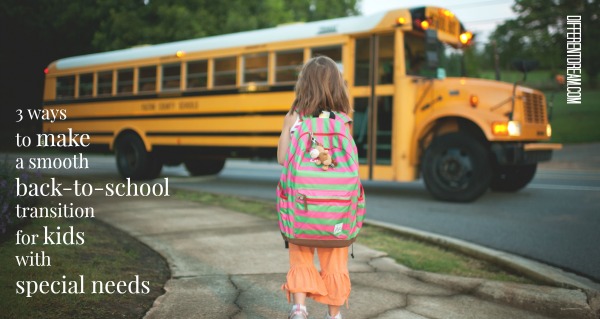
A parent can never have too many special needs transition techniques at the beginning of a new school year. Today, guest blogger and child psychologist Liz Matheis outlines 3 special needs transition techniques that can make the start of the upcoming school easier for the whole family.

3 Special Needs Transition Techniques
for a New School Year

Transitions are tough. As a parent of a child with special needs, I am sure you are beginning to anticipate September coolness and the first day of school with a mix of anxiety and a little bit of excitement! How are you going to prepare your child for a new grade, a new school year, a new change, and a new routine? Read on for 3 special needs transition techniques to help you ease into the 2017-2018 school year.

Reel it In

If your house is anything like mine, your child’s bedtime may have become later and later as the summer went on. In August, begin to set your child’s bedtime 15 minute earlier every 2-3 days until you reach the desired bedtime again. Also set the alarm clock 15 minutes earlier each morning until you reach your child’s school wake up time. The transition will be slow and not very noticeable to your child making the change in bedtime less drastic and monumental.

So what else can you do to accomplish this goal? Begin to close the house a bit earlier each night. Dim the lights, close the blinds, slow down the pace of the house and begin to bring the day to an end. Make it a family affair by heading upstairs and putting on your pajamas and turn down your bed.

A Visit Before the First Day

Instead of waiting for the first day of school, take a walk with your child to the playground a few weeks before school starts. Find the door that your child will stand by to line up before the bell rings. Play on the playground and walk around the building so it loses its novelty. Call the building principal and ask for a walk through the building without staff and other students. This will take away the element of the unknown and make the school premises familiar, even the parts of the building that your child may not walk through.

Once your child has an assigned teacher, ask the principal if your child can visit the new classroom and teacher prior to the first day of school. They can meet without the pressure of other students, ringing bells, and the need to keep the schedule moving forward. By the time your child starts on the first day, the building, your child’s teacher, and the routine of where to go is nothing new and all good!

There’s a Visual For That

If you don’t have a visual schedule for week days and weekends, create one for the rest of the summer. If your child goes to camp, include that on the schedule. You don’t necessarily have to include times, but rather include the sequence.

Then, have your child help you create a visual schedule for the school year. Include tasks like wake up, brush teeth, get dressed, and eat breakfast. You, or better yet your child, can create it in whatever visual format you like by hand or on the computer. The more your child is able to anticipate the day’s events, the less the days feel unpredictable, but rather consistent and within her control.

As the new school year begins, these special needs transition techniques can help make it a smooth one. I’m a big summer person so, until then, I plan on enjoying the sunshine, bare feet, bathing suits and fireflies!

Do you like what you see at DifferentDream.com? You can receive more great content by subscribing to the quarterly Different Dream newsletter and signing up for the daily RSS feed delivered to your email inbox. You can sign up for the first in the pop up box and the second at the bottom of this page.

By

Dr. Liz Matheis is a clinical psychologist and school psychologist in Parsippany, NJ. She offers support, assessments, and advocacy for children who are managing Autism Spectrum Disorders, ADHD, learning disabilities, and behavioral difficulties, as well as their families. She is also a contributor to several popular magazines. Visit www.psychedconsult.com for more information.

Author Jolene Philo

Archives

Categories

Subscribe for Updates from Jolene

Related Posts

2 Universal Special Needs Stresses

2 Universal Special Needs Stresses

2 Universal Special Needs Stresses

3 universal special needs stresses are alive and well in the western and eastern hemispheres. I know this is true, thanks to 2 groups of wonderful special needs moms–one from central Iowa and the other from Latvia.

For those of you who don’t know where central Iowa is, it’s 6 hours west of Chicago.  For those of you who don’t know where Latvia is, it’s in northern Europe on the Baltic Sea, straight east of Sweden and straight south of Finland.

But enough with the geography.

Let’s get back to those wonderful moms and the universal special needs stresses they mentioned. I met the first group in early June at the Wonderfully Made Family Camp (WMFC), and the second group later that month in Pelchi, Latvia. When the kids were shepherded by their buddies to do fun kid stuff, we moms gathered for some fun mom stuff. Which consisted mainly of talking, crying, laughing, hugging, talking and crying and laughing and hugging some more. To break the ice on the first day, I asked the same question:

What are your greatest challenges as parents of kids with special needs?

Without hesitation, without blinking, without thinking, moms in both groups blurted out the same concerns:

Time
Assurance

Time to care for their kids with special needs. Time for the other members of their families. Time for themselves. Time for work, cooking, cleaning, and shopping. Time to advocate for their children. These moms never have enough time. (Insert crying, laughing, and hugging here.)

These moms need assurance, too. They need assurance that their children with special needs are okay when in the care of others–teachers, day care providers, family members, friends, and co-workers. They want to know that their kids will be okay once their parents are no longer able to care for them. But most of all, as many of them made clear, they want their children to experience the love and care of Jesus, and they want to be reunited in heaven one day with their children perfectly restored and whole. These moms crave blessed assurance. (Insert more crying, laughing, and hugging here.)

Time and assurance. Moms deal with these 2 universal special needs stresses every day and every minute of their lives.

And yet.

When I asked them if they could name any joys about parenting their children, they did so without hesitation, without blinking, and without thinking.

She made me a better person.
My faith is much stronger.
I’m not the same person I was before.
Little things don’t bother me now.
I know what love is now.
He loves me unconditionally.
(Insert crying, laughing, and hugging here.)

Across 1 ocean, 7 time zones, 2 cultures, and in 2 different languages, this is the reality of parenting children with special needs: stress and joy co-exist in the same space.

So when you meet moms of children with special needs, anywhere in the world, and want to lighten their loads, try one of these:

  • Offer to spend time with their children so the moms can tend to pressing tasks or take a break.
  • Help locate resources so moms can provide for their children’s futures.
  • Ask them to tell you something wonderful about their children.
  • Advocate for a special needs ministry at your church so all kids can learn about Jesus.

And always, always, always be prepared to cry with them, laugh with them, hug them, and keep the tissues handy.

Do you like what you see at DifferentDream.com? You can receive more great content by subscribing to the quarterly Different Dream newsletter and signing up for the daily RSS feed delivered to your email inbox. You can sign up for the first in the pop up box and the second at the bottom of this page.

By

Jolene Philo is a published author, speaker, wife, and mother of a son with special needs.

Author Jolene Philo

Archives

Categories

Subscribe for Updates from Jolene

Related Posts

My Child has ADHD and the School Can’t See It

My Child has ADHD and the School Can’t See It

My Child has ADHD and the School Can’t See It

What do you do when your child has ADHD and the school can’t see it? That’s a puzzle Trish Shaeffer had to solve during the past school year. In this blog post, she shares resources and strategies she discovered in case you are in a similar situation in the upcoming school year.

My Child has ADHD and the School Can’t See It

Keeping it all together at school can be hard for my son Logan. His behaviors and meltdowns at home keep getting worse when certain seasons, like testing and PSSA, roll around.

Unfortunately, the school can’t see it as I do or as his doctors and therapist do. Often, the school states that they do not see our child’s ADHD behaviors at school. They don’t know that our son keeps it together all day at school and then when he gets home, he explodes. A simple homework task can take 3 hours or more because of meltdowns, anger and the life-isn’t-fair speech. Destructive behaviors surface because he wants to be heard and get his frustrations out after school–unfortunately the trash can was the target that day.

A parent can feel alone or crazy because the school can’t see it. This has happened for me with Logan. When he started kindergarten, the school exchanged his preschool IEP for a 504 plan. All it mentioned was his peanut allergy. Logan did okay in kindergarten because his teacher understood him and less was expected of him during that year.

Fast forward to first grade, and Logan struggled in every area. No matter how we tried to help him and study, it didn’t add up. It took hours, if not days to complete one page, and the meltdowns when from small to critical. No matter how much I talked to the school and the teacher they couldn’t see it. I felt like they thought I was crazy or making it all up even though I had documentation.

By the end of the third marking period, the school called and said that Logan needed help and testing. It surprised me, but also frustrated me. Why did it take so long?! No one really knows. But I sigh with relief because Logan will now be put in therapy groups for behaviors and anger issues. He’s being tested. Finally I am being heard and Logan is hopefully going to get the help he needs.

As a parent, I try to read as much as I can to keep on top of the issues with schools regarding ADHD. I’ve learned the best way to work with the school is to know as much as I can and teach them along the way. Here are some books I have recently read to hopefully close the gap on ADHD and autism for teachers and parents.

Remember that knowledge and advocating is key. You need to write down the facts that show your child has ADHD or autism or behavior issues. It maybe taboo to talk about meltdowns, anger, and behaviors because it feels like you have failed as a parent. But it’s not about us. We all love our kids, and we want to help them. We need to stay strong and positive as parents. We need all the help and support we can get and so do our kids. We need to keep advocating until the school sees our kids as we do, so they get the help they need.

Do you like what you see at DifferentDream.com? You can receive more great content by subscribing to the quarterly Different Dream newsletter and signing up for the daily RSS feed delivered to your email inbox. You can sign up for the first in the pop up box and the second at the bottom of this page.

By

Trish Shaeffer is the mom of 3 active boys with special needs. She’s a peer supporter for Parent to Parent and volunteers with the United Cerebral Palsy Network, Special Olympics, and the United Way. She’s also an equine volunteer at Leg Up Farm. She’s married to her best friend and biggest supporter, Chris Shaeffer.

Author Jolene Philo

Archives

Categories

Subscribe for Updates from Jolene

Related Posts