Just As I Am

Just As I Am

Just As I Am

I was not a fan of Billy Graham as a child. My dislike had nothing to do with him or his message. Rather, it had everything to do with the disruption his televised crusades brought to our family’s TV viewing schedule. Mom, a school teacher who wanted her kids to be active readers and not passive consumers, controlled how much television we watched at our house. However, she granted Dad control of what we watched.

Because, as his multiple sclerosis progressed, the television screen was his primary link to the outside world.

Dad was a big consumer of the nightly news, football, variety shows, and hokey sitcoms. As a former county extension agent, he especially loved the bumbling county extension agent on Green Acres. He would laugh until he cried as Hank Kimball’s meandering answers left the farmers who consulted him more confused than ever.

“Jo, get Harlan a tissue,” Mom would order when Dad’s nose began to run.

“Make that two,” Dad would gasp between chuckles, “no, three.”

As much as Dad loved Green Acres, he loved Billy Graham more. While my sister, brother, and I grumbled when Graham’s crusades preempted our favorite shows for three or four nights in a row, Dad anticipated crusade weeks with delight. Every night he rolled away from the supper table early and positioned his wheelchair in the center of the living room directly in front of the TV. We three kids, on the other hand, dragged into the living room, rolled our eyes and assumed our best martyred children poses after flopping onto the couch and easy chairs.

To read the rest of this post, visit Key Ministry’s website for parents of kids with special needs.

Do you like what you see at DifferentDream.com? You can receive more great content by subscribing to the quarterly Different Dream newsletter and signing up for the daily RSS feed delivered to your email inbox. You can sign up for the first in the pop up box and the second at the bottom of this page.

By

Jolene Philo is a published author, speaker, wife, and mother of a son with special needs.

Author Jolene Philo

Archives

Categories

Subscribe for Updates from Jolene

Related Posts

The Caregiver’s Treasure

The Caregiver’s Treasure

The Caregiver’s Treasure

This morning, in the chilly half dark, I passed the houses along the route that leads to my favorite path. The acrid odor of burning electrical wires grew strong when I neared a ramshackle, uninhabited house that is the neighborhood eyesore. Yellow fire scene tape, barely visible in the dim light, stretched along the chain link fence surrounding the property, and I resolved to retrace my steps and get a better look near the end of my walk.

The clear light of day revealed the extent of the damage. The roof of the small, ranch house had caved in. Two sides of the house were burned away. The interior walls had collapsed. The house’s contents were unrecognizable, melted lumps of goo.

Yesterday, when I walked by, the house had been standing–in need of paint, sporting several broken windows, the yard shaggy and neglected–but it was still there.

This morning it is gone.
Dead.
Finished.
I am once again aware of how quickly and completely life can change.

I stared at the house and thought of when I first learned that lesson: the day my father died. For 38 years, my mother, my siblings and I watched multiple sclerosis rob Dad of the ability to walk, to write, to read, to control his bodily functions, to think clearly, to speak, and to feed himself.

The changes were small and incremental, sometimes barely discernible. They came so slowly and so gradually that for years it felt like nothing would ever change. Dad was trapped in a body that continually betrayed him. We were in limbo, waiting for the end we all knew was coming. But when he began to struggle to swallow, we knew the end was near.

On Sunday, Dad was fine when I took my 7-year-old daughter to read a story to him.
On Monday night, we received a call that Dad was running a fever.
On Tuesday, he died before noon.

One day Dad was there–his body compromised, his mind weakened, his spirit calm–but he was there.

The next day, he was dead.
His life was finished.
He was gone.
I experienced, for the first time, how quickly and completely life can change.

I stared at the burned out shell of the house. When the officials complete their inspection of the fire scene, there will be little for the demolition crew to do but cart away the rubble and smooth the ground. The house will be gone forever.

But, I realized, the same can not be said about Dad. My father is still here. He is part of who I am. Because of him, my perception of what constitutes a good life is quite different from the world’s view of a life well-lived.

For caregivers, a good life isn’t measured in major accomplishments–
Races won.
Money earned.
National acclaim.
Education achieved.

For caregivers, a life well-lived is measured in the small things–
A delayed milestone reached.
A tender moment shared.
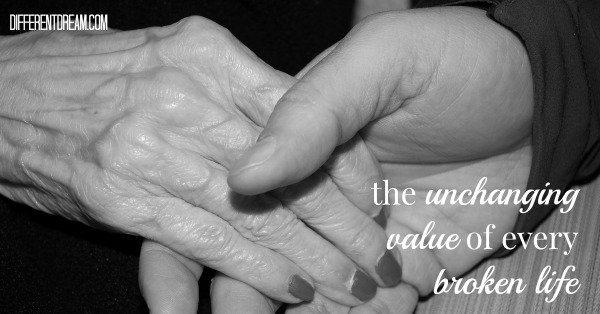
The squeeze of a hand.
A fleeting smile of recognition.

These are the things Jesus teaches his people to treasure.
These are the things that matter.
This is the jewel caregivers carry with them when their loved one lives and when their loved one dies–
the unchanging value of every broken life.

Do you like what you see at DifferentDream.com? You can receive more great content by subscribing to the quarterly Different Dream newsletter and signing up for the daily RSS feed delivered to your email inbox. You can sign up for the first in the pop up box and the second at the bottom of this page.

 

By

Jolene Philo is a published author, speaker, wife, and mother of a son with special needs.

Author Jolene Philo

Archives

Categories

Subscribe for Updates from Jolene

Related Posts

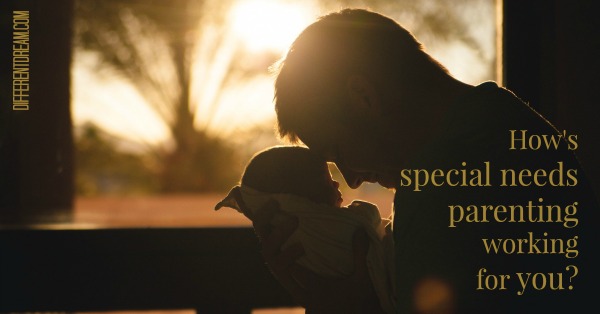
How’s Special Needs Parenting Working for You?

How’s Special Needs Parenting Working for You?

How’s Special Needs Parenting Working for You?

In May of 2016, our daughter, her husband, and their one-year-old son moved in with my husband and me. Not for a few weeks or months until they found their own place to live. But permanently. Forever. As in, we are here to assist them while they raise their family, and they’ll be our caretakers when we can no longer care for ourselves.

When people hear about the arrangement–even though we explain that the decision was made after months of prayer, frequent discussions, and a three week trial–the reaction is identical. The same worried expression appears on every face, and the same question gets asked.

How’s that working for you?

The fact of the matter is that our grand adventure of multi-generational living* is working quite well. We’re pretty sure the reason the adjustment has gone smoothly is the prayer and planning that preceded the decision. And God’s provision through the quick sale of our previous house after we unexpectedly found one that meets our new family circumstances beautifully. But truth be told, our changed circumstances are doing more than working for our family.

Our changed circumstances are working change in me.

Daily, my admiration grows for parents who graciously accept the constant disruption that is part of raising young children. The young parents at our house are living examples of how to adjust priorities, how to put the needs of others ahead of self, and the importance of being flexible. All skills I relinquished with glee when we became empty nesters and that I am now relearning.

To read the rest of this post, visit Key Ministry’s website for parents of kids with special needs.

Do you like what you see at DifferentDream.com? You can receive more great content by subscribing to the quarterly Different Dream newsletter and signing up for the daily RSS feed delivered to your email inbox. You can sign up for the first in the pop up box and the second at the bottom of this page.

By

Jolene Philo is a published author, speaker, wife, and mother of a son with special needs.

Author Jolene Philo

Archives

Categories

Subscribe for Updates from Jolene

Related Posts

What Can You Say When There Are No Words?

What Can You Say When There Are No Words?

What Can You Say When There Are No Words?

Guest blogger Maggi Gale shares a poignant moment from this past summer’s holiday break. She’s here to answer a question almost all parents of children with special needs encounters at some point as they rub elbows with other parents raising kids with disabilities or health needs: What can you say when there are no words?

What can you say when there are no words?

That’s a question I pondered recently when we spent time with close family friends. It’s always great to reconnect with people you love and enjoy. But this time someone was missing. Their 14-year-old daughter was in the hospital, where she’s been for over a year now, struggling with a syndrome that takes away her desire to exercise, eat, socialize, and basically live her life.

Shocking, unforeseeable, unbelievable…
Actually there are just no words to adequately describe what this family is experiencing. So, amongst the words, we cried together.

When we see this kind of suffering, suffering we can’t fathom, suffering that seems so unreasonable, we can’t help but ask…
Where exactly is God?
What is He doing?
Why is this taking so long?
What has gone wrong?
After all, we have all prayed so long for healing!

And yet in a multitude of ways, when we open our eyes, it’s plain to see that God is right here…
showing up day after day in the daily provision of kind, professional doctors and nurses,
in the friendship and care of friends
in His majestic presence through worship
in hilarious laughter that had tears of a different kind rolling down our faces.

This summer I again saw the truth that when we wholeheartedly search for Him in our suffering, God is accessible to us.
He is with us, often in unnoticed and uncounted blessings day after day. I came away with a deeper grasp of the fact that God is not a magician with a magic wand. And despite what this precious girl is going through, God is kind, and He is powerful.

He most definitely is present in that suffering.
Our children are not born with this guarantee attached that states they will not experience any syndrome, illness or disability that might seem unreasonable or unfair. Nor are we issued anything like that when we become Christians.

But we are guaranteed that, like Moses, God will go with us and give us rest.
David says that even though we walk through the darkest valley, we are not on our own.
Paul says that His grace is sufficient for us.

These are guarantees we can lean on in the tough, tough times of life.
But they are time tested and solid, and they are more than just words. They are words we can stand on when there are no other words.

Do you like what you see at DifferentDream.com? You can receive more great content by subscribing to the quarterly Different Dream newsletter and signing up for the daily RSS feed delivered to your email inbox. You can sign up for the first in the pop up box and the second at the bottom of this page.
By

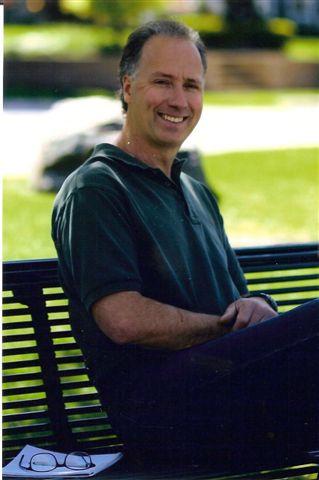
Maggi is a wife and mother of two daughters. She is a primary school teacher, having worked in Africa for 14 years before moving to the Middle East. Her passions are her animals and art. Her youngest daughter was born with tracheoesophageal fistula (TEF). This birth condition was to be the start of an arduous journey, impacting the whole family for several years. Through writing, she hopes to turn her experiences into encouragement for others on similar paths.

Author Jolene Philo

Archives

Categories

Subscribe for Updates from Jolene

Related Posts

Going Through the Grits of Special Needs Parenting

Going Through the Grits of Special Needs Parenting

Going Through the Grits of Special Needs Parenting

Guest blogger Scott Newport is a carpenter and a craftsman. He’s also a dad of a child with special needs. Today he’s sharing his thoughts about going through the grits makes these two very different roles very much the same.

Going Through the Grits of Special Needs Parenting

It was another day at a renovation project on the fourth floor of an office building. Glancing at my iPhone, I noticed that my buddy Dave had called a couple of times. Now, coming down a stepladder for what seemed like the hundredth time, I saw his name pop up again. This time I set down my hammer and found a quiet place.

“Hey Scott, ol’ buddy, I got a request,” Dave said. “Last week at hunting camp, a friend of mine was impressed with my restored knife. As we were sitting around the campfire, I told him that you’re kind of a blacksmith, and that you refurbish knives. I wonder if you could fix up his, too. He lent it to me, and I want to return it to him as a Christmas present.”

After work, I picked up the knife from Dave and headed home. There I walked into my workshop, a few yards from my house, set the knife on my bench, then went up to the house.

Stepping inside, I received a text: “Hey Scott, it’s Ryan and I’m not sure what to do. Hospice wants to come talk with us on Monday.”

Ryan is a young guy referred to me about a year ago by Children’s Special Health Care Services here in Michigan where I mentor dads and families with children who have a terminal illnesses.

Earlier in the day, Ryan had texted me that his younger son had been readmitted to the pediatric intensive-care unit and was struggling to breathe. I’d texted back that I would be praying for him, and that we could catch up by phone in the morning.

“The conversations at the hospital have been scary today,” he’d replied. “And what a way to spend a Friday.”

Standing there, at the top of the stairs, I said a prayer for him. Then I walked back out to the shop, sat down at my bench and examined the knife. It was old, but of good quality; the leather sheath was broken in but intact, and the dull blade was rusty. Gingerly rotating the blade within my fingers, I could tell that it had been sharpened before, but only on one side.

With the flip of a switch, I started up my grinder and touched the blade to the sanding belt. Steadily, I worked my way through a series of belts, from the coarsest-grit sandpaper to the finest–a process known as “going through the grits.”

Time passed. As the clock ticked past six, I kept right on. The smooth rasp of grit against steel and the sight of the sparks bouncing off the surface felt almost magical. I found the whole process soothing–especially now.

You see, this week was the anniversary of my own son’s death. He died seven years ago, the day after Thanksgiving, at age seven.

After finishing the grinding process, I paused to inspect the blade through my bench magnifier. Assorted divots and heavy scratches still scarred the steel. To achieve a perfect polish, I’d have to go back over those blemishes.

So I carried out the grinding process once more, working my way through the coarse 120-grit and 150-grit sandpapers and finishing with superfine 400-grit.

Again, I peered through the magnifier. The imperfections were still there. As I headed over to grab a fresh sanding belt, Ryan texted me again: “Sounds good, we can talk tomorrow.”

Something about his message stopped me in my tracks.

It might not be a good idea to go through the grits again, I thought. If I keep trying to get the knife perfect, there’ll be nothing left. I mean, who wants a knife with only half a blade?

Checking out the blade again under the magnifier’s illuminated glass, my thoughts turned to Ryan and his son. Quickly, before I could let myself go there, I grabbed a piece of softened sandpaper and started to refine the blade by hand.

Holding the knife under the magnifier, I also saw my hands, with their own grooves and dings from a hard day’s work.

I knew that the finish paper couldn’t remove the knife’s deepest scars; but the polishing would give the whole blade a mirror finish, something I thought its owner might appreciate.

Awakening the next morning, I rolled over to check my phone and see if Ryan had tried to contact me.

Lying there, I tried to figure out what I could say to him today. I never want to tell families that everything will be okay, or try to take away their grief. I tell them that I’m just there to listen and to help them navigate the journey of living with a sick child.

I also started to think about the knife. If I grind it anymore, I’ll destroy it.

An idea came to me. Maybe I can tell Ryan about the knife and how it was made by a blacksmith, years ago. Maybe we can talk about the original creator’s dream for the blade. Maybe it was a Christmas gift for someone–a gift that’s been passed down to its present day owner. With all the wear and tear on this knife, there’s no doubt that it holds a mountain of stories within its core.

I thought about my boy, Evan, and about Ryan’s son, Kaleb.

In a way, they might be a bit like that imperfect steel, I reflected. I know the doctors don’t want to keep trying interventions that may take Ryan’s son’s life. Maybe I can talk to him about how some things are better not fixed, and that maybe it’s okay to just polish them up a bit. Man, I just don’t know–but there’s something there, I feel it. Maybe I shouldn’t say “better not fixed….”

I was asking God for the right words. Please, Lord, show me the way.

I know that, for me, it’s the memories that keep me going. Even though my Evan was also not perfect, the memory of his glowing face is a perfect fit for the sheath in my own life–one I carry with me every day. The experience of living with a very sick child forges a deeper appreciation for life, an enduring spirit of hope that I can pass down to my family and the ones I serve. It’s never easy to talk about a child’s impending death, but maybe the reflections I’ve received today will one day help those whose hands I hold through the journey of not being able to take out all the scratches.

Yeah, scratches stink, don’t they? But without them, there would be no proof of how we lived. And, thank the Lord, the original blacksmith, He doesn’t use a magnifier.

Now, in the heart of the Christmas season, I pray that my reflections today can be a gift for Ryan–one that we both can share. And maybe, just maybe, I will share this story with Dave and his hunting buddy. I’m sure that they have a few things in their lives that can’t be fixed, either. Don’t we all?

Are you going through the grits of special needs parenting today? Feel free to leave a comment about how you’re feeling.

Do you like what you see at DifferentDream.com? You can receive more great content by subscribing to the quarterly Different Dream newsletter and signing up for the daily RSS feed delivered to your email inbox. You can sign up for the first in the pop up box and the second at the bottom of this page.
By

Scott Newport is a carpenter who has a vision for unwanted, damaged wood. His finds are treasures to his soul. Each discovery he makes unfolds into a beautiful piece of furniture for which he finds a home, usually with a child or caregiver of a child with special needs. He writes about the life lessons he learns from his 3 children, especially from Evan who died in November of 2009 after 7 years of joyful life. To access all of Scott’s guest posts, click on the magnifying glass at the top of the page and type “Scott Newport” in the search box.

Author Jolene Philo

Archives

Categories

Subscribe for Updates from Jolene

Related Posts

As Long as I Can Walk I Will Walk

As Long as I Can Walk I Will Walk

As Long as I Can Walk I Will Walk

“What I remember about your dad,” my cousin said at a recent family reunion, “is that he was a big kid. He was always in the thick of things, playing with us. He never sat still.”

My cousin’s lip trembled a bit, and tears came to his eyes.

My eyes also went damp, as they always do when my older cousins describe their Uncle Harlan’s antics. Though their memories bring me to tears, I crave their stories.

These cousins remember an uncle who could walk and run and read and write.

A few minutes later, my brother sat down beside me. “Everyone keeps asking when I’m planning to slow down and take it easy. They don’t get it, Jo. They just don’t understand that as long as I can walk, I’m going to walk.

His words echoed something I had said earlier in the summer.

I was teaching a class about time management and organization at a writing conference. “Some of you don’t realize the gift you’ve been given. You get up in the morning and take your ability to walk and read and write for granted.

“But I don’t.

“I have older cousins who remember my father as the life of the party. He was the uncle who played games with them and played tricks on them. But I remember a father who couldn’t do any of those things. He was diagnosed with multiple sclerosis in 1959 when he was 29 and I was 2.

To read the rest of this post, visit Key Ministry’s website for parents of kids with special needs.

Do you like what you see at DifferentDream.com? You can receive more great content by subscribing to the quarterly Different Dream newsletter and signing up for the daily RSS feed delivered to your email inbox. You can sign up for the first in the pop up box and the second at the bottom of this page.
By

Jolene Philo is a published author, speaker, wife, and mother of a son with special needs.

Author Jolene Philo

Archives

Categories

Subscribe for Updates from Jolene

Related Posts