5 Simple Ways to Make Your Church More Accessible to People with Disabilities

5 Simple Ways to Make Your Church More Accessible to People with Disabilities

5 Simple Ways to Make Your Church More Accessible to People with Disabilities

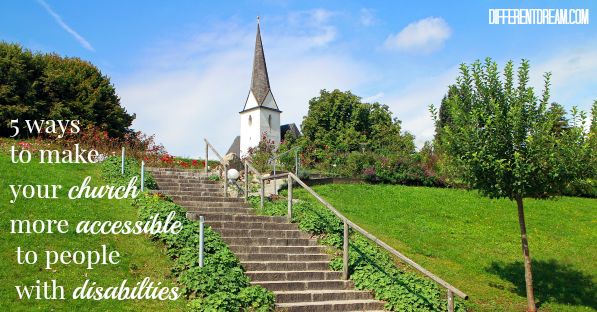
If your church wants to be more accessible to people with disabilities, there are several things that can be done immediately to jump start the process. Most of them take more time than money, but none of them require a huge time commitment. Here are 5 simple things I learned from watching Mom wheel Dad into church when I was a kid, from taking our son with special needs to church, from teaching kids with special needs, and from parents raising kids with disabilities. Each item in this list will make your church more accessible. The last one might motivate you to implement more inclusion efforts in your church and beyond.

#1: Improve Signage

From the parking lot to the foyer to the hallways, assess and upgrade signage as needed. Label the most accessible entrances as “quiet” or “family” entrances rather than “disabled” or “handicapped.” Make sure your welcome center is clearly marked so newcomers see right away where to go for information. Have signs inside entrances that indicate how to get to the nursery, the children’s programming wing, and so on.

#2: Train Greeters and Ushers

Train greeters to assess people as they arrive. Then they will know to direct families with babies and children to the nursery and children’s programming wing. They know to point out accessible bathrooms and seating to people with mobility issues, escort those with visual or hearing impairment to accommodation devices, and so on. Ushers should also be trained in case someone slips past the greeters in a crowd, and for those who come after the greeters have left their posts.

#3: Move the Furniture

Look at how the furniture is arranged in your foyers and classrooms. Is there room to maneuver a wheelchair or walker in those spaces? If not, declutter and move the furniture to create easy pathways for everyone. If your worship area has pews, cut some of them down to make spaces for wheelchairs and walkers. If your worship area has chairs, leave spaces open on the aisles for the same purpose. Intersperse these spaces throughout the worship area rather than concentrating them in the front or back row so those with disabilities feel like they are part of the congregation rather than observers on the sidelines.

#4: Open Doors

Get in a wheelchair and test every door in your church to see if it can be opened by someone who uses mobility equipment. When you discover the doors that fail the test (and there will be plenty), work to create a solution. You might prop doors open on Sunday morning or have someone positioned near the doors to open and shut them. Most important, though, is reminding your congregation members to watch for those with mobility issues so they can offer to help.

#5: Study Matthew 19:14

Encourage fellow church goers to study and meditate upon Matthew 19:14: “Jesus said, ‘Let the little children come to me and do not hinder them, for to such belongs the kingdom of heaven.’ (ESV)

Ask each other, Who is excluded from approaching Jesus in this passage? Then apply the passage to your congregation. Ask, Who is excluded from approaching Jesus at your church? Then identify what excludes them and look for ways to change that. Also ask the Holy Spirit to touch hearts to make your church more accessible to people with disabilities and special needs. And be prepared, when God answers those prayers, to seek ways to make your church more accessible to everyone who needs Jesus.

Do you like what you see at DifferentDream.com? You can receive more great content by subscribing to the quarterly Different Dream newsletter and signing up for the daily RSS feed delivered to your email inbox. You can sign up for the first in the pop up box and the second at the bottom of this page.

By

Jolene Philo is a published author, speaker, wife, and mother of a son with special needs.

Author Jolene Philo

Archives

Categories

Subscribe for Updates from Jolene

Related Posts

Every Believer’s Loneliness Ministry

Every Believer’s Loneliness Ministry

Every Believer’s Loneliness Ministry

Loneliness. Every school day of my childhood I saw it written on Dad’s face when Mom, my siblings, and I hurried out the door. Even now, I close my eyes and can see him sitting in his wheelchair at the kitchen table, sipping coffee through a straw and waving good-bye. His grin couldn’t hide his dread of spending another day with only the television to keep him company.

In fact, Dad’s face came immediately to mind when I heard that Theresa May, Prime Minister of the United Kingdom, had appointed a Minister of Loneliness in response to the Cox Commission report which said the following about the pervasiveness isolation in society today:

“Young or old, loneliness doesn’t discriminate. Throughout 2017 we have heard from new parents, children, disabled people, carers, refugees and older people about their experience of loneliness.”

This report was already old news to Dad in the 1960s.

Had the report been issued in his day, he would have ridiculed the idea of a government appointing a minister of loneliness, the UK equivalent of a cabinet position in the US. Dad knew the government couldn’t cure his loneliness. He also knew that the people of God could.

And the people of God did.

Often, when my siblings and I came home from school, we found our pastor and Dad visiting in the living room. When a retired clergyman moved in down the street, he played cards with Dad several afternoons a week. Our uncle, who was married to Mom’s sister, often stopped on his way home from school to chat with Dad. Members of my parents’ Sunday school class dropped by, too. For years. For decades.

I can still see Dad’s joy when the people of God revealed His presence through them.

To read the rest of this post visit Key Ministry’s blog for parents of children with special needs.

Do you like what you see at DifferentDream.com? You can receive more great content by subscribing to the quarterly Different Dream newsletter and signing up for the daily RSS feed delivered to your email inbox. You can sign up for the first in the pop up box and the second at the bottom of this page.


By

Jolene Philo is a published author, speaker, wife, and mother of a son with special needs.

Author Jolene Philo

Archives

Categories

Subscribe for Updates from Jolene

Related Posts

The Grief We Live with as Parents of Kids with Special Needs

The Grief We Live with as Parents of Kids with Special Needs

The Grief We Live with as Parents of Kids with Special Needs

The grief we live with as parents of kids with special needs is real and pervasive.  This week, it showed up in two different places at two unexpected times.

Grief’s first appearance came as I sat enthralled by our granddaughter who was sleeping in my arms. She’s 2 1/2 weeks old, I thought to myself while gazing at her peaceful face and perfect, unmarked skin. She’s the same age our son was when he was released from NICU. With that, grief for his surgical scars and the pain he bore during his early weeks washed over me. I grieved for the 17 days he spent in the hospital instead of in our home as a newborn. My grief felt as fresh and real as it had been after he was born in 1982.

Soon though, the all too familiar sense of loss passed. What remained was gratitude for the child in my arms and the blessing of being part of her early days. A few days later I was grateful again when the grief we live with as parents of kids with special needs appeared in a different place and another unexpected time.

This appearance occurred while I completed one of the final parent interviews for the book I am co-authoring with Dr. Gary Chapman. Each interview ends with the same question: Is there anything else you’d like to mention? I presented that question to the mother of an almost 3-year-old, adorable red-headed boy who has cognitive and speech delays. Here’s what she said:

If necessary, go through counseling to talk about hard things. Have a safe space and a safe person who can help you see more clearly. I’ve done some mental health counseling. There is an element of grief that your life and your child aren’t what you expected. Give yourself space to grieve. Being honest about your grief lets you see what kids with disabilities really need instead of dwelling on all the broken things. So give yourself permission to grieve.

This wise, young mother and I sat in her living room. “Even thought its not something we asked for, our son may live with us the rest of our lives. It’s worth every minute,” she said and smiled at her adorable, red-headed son and said, “You’re worth every minute.”

We looked at one another, connected by the grief we live with as parents of kids with special needs, the grief that binds us together and makes us grateful for the blessings and relationships we never take for granted.

I thought of my son and the 36 years of mingled joy and grief we have known with him. Worth every minute, I offer back in silent prayer. I am so grateful for your life, my son.

Do you like what you see at DifferentDream.com? You can receive more great content by subscribing to the monthly Different Dream newsletter and signing up for the daily RSS feed delivered to your email.

By

Jolene Philo is a published author, speaker, wife, and mother of a son with special needs.

Author Jolene Philo

Archives

Categories

Subscribe for Updates from Jolene

Related Posts

When We Seek the Mind of Christ

When We Seek the Mind of Christ

When We Seek the Mind of Christ

Our thermometer read nine below zero this morning. The double doors that open onto our south-facing deck are frozen shut. A crust of frost along the bottom of the inside of each door led to a rolled blanket on the floor in front of them. I spent most of the day at my computer in front of a south-facing window where cold sunlight streamed in. I was tempted to bemoan the weather–I mean, really what could be worse than a barely respectable skiff of snow coupled with below zero temperatures.

But the picture a tiny baby in the manger, whose birth we celebrated only a few days ago, reminded me of a scandalous truth that stopped my grumbling before it could gain steam, and one holy thought derailed my discontent. On the worst weather day of the year, my circumstances are far more comfortable than those that greeted God who came to earth in the form of a baby.

Even after factoring in the warmer climate of Jesus’ birthplace and the likelihood that He was born in spring, the stable where He was born remains a less hospitable place than my cozy home in winter. Face to face with the sacrifice of Christ that began with His meager birth and ended with His death on the cross, my dissatisfaction transformed into gratitude and wonder, honor and praise. I found myself humming the melody of And Can It Be? and searching for the lyrics online. Once found, the words of the third verse mirrored my thoughts precisely.

He left His Father’s throne above,
So free, so infinite His grace;
Emptied Himself of all but love,
And bled for Adam’s helpless race;
‘Tis mercy all, immense and free;
For, O my God, it found out me.
Amazing love! how can it be
That Thou, my God, should die for me!

I can take no credit for the reversal in my train of thought. The turn from ingratitude to joy is not natural for me or for you. We can’t negotiate a mindset change by ourselves. It is only accomplished when we recognize and confess our weakness, when we ask the Holy Spirit to give us the mind of Christ as we seek to honor Him in the most mundane or uncomfortable situations.

This is a worthy endeavor for a new year, one we can pursue in complete confidence because it is in God’s will. Certainly we will fail at times, and certainly our best efforts will be imperfect. But just as certainly, God will be pleased by our desire to honor Him. And next year in the dead of winter, we will look back and rejoice to see how deeply His Spirit has changed our hearts in 365 days.

“But a natural man does not accept the things of the Spirit of God…
But we have the mind of Christ.
1 Corinthians 2: 14, 16

Do you like what you see at DifferentDream.com? You can receive more great content by subscribing to the quarterly Different Dream newsletter and signing up for the daily RSS feed delivered to your email inbox. You can sign up for the first in the pop up box and the second at the bottom of this page.

By

Jolene Philo is a published author, speaker, wife, and mother of a son with special needs.

Author Jolene Philo

Archives

Categories

Subscribe for Updates from Jolene

Related Posts

Showing Kids with Special Needs How to Pray: Jesus, Let’s Talk

Showing Kids with Special Needs How to Pray: Jesus, Let’s Talk

Showing Kids with Special Needs How to Pray: Jesus, Let’s Talk

Showing kids with special needs how to pray. That’s a lesson guest blogger, Lisa Jamieson, learned from her daughter Carly, who lives with Angelman Syndrome. That lesson led to Lisa’s new children’s book, Jesus, Let’s Talk, which contains pictures showing kids with special needs how to pray. She’s at Different Dream today to talk about her new book.

Would you tell Different Dream readers a little bit about yourself and your family?

My husband, Larry, and I have three adult daughters and live in Minnesota with our youngest, Carly, who is 19 years old and has Angelman Syndrome. She loves water, music and riding anything that goes fast! Much of my time is spent caring for our household but I also write, speak and serve in ministry as an advocate for caregivers of all generations. Larry works for a men’s discipleship ministry and does business consulting. We are excited to celebrate 30 years of marriage this summer.

 As the parent of a child with special needs, what’s your number one piece of advice for other parents raising kids with disabilities and special needs?

The advice I have to give myself every day is—slow down! There are so many interesting things competing for our attention along with cultural and internal pressures to do more than our mental bandwidth can bear. In a special needs family, we add the constant possibility that our routines will be interrupted by something unexpected and urgent. The reality is that our relationships matter so much more than our activities, projects and causes. I feel most satisfied, effective and rested when I slow down to appreciate things, spend intentional time with our children, commit to weekly date nights with Larry, and maintain adequate self-care. 

Why did you write Jesus, Let’s Talk?

God taught me a lesson late one night when Carly was having trouble sleeping and seemed to be in pain. In tearful frustration, I called out, “Jesus, help!” while simultaneously signing “help” for Carly to see. Suddenly it occurred to me that we had not explained to her about asking God for help. Although we had been teaching Carly “thank you” and “I love you” prayers around meal time and bedtime, I realized most other prayers happened inside my head, between me and God. I began teaching Carly a broader range of prayers and a representative gesture or American Sign Language with each scenario. Since I had made Carly photo scrapbooks to model new skills over the years, I began envisioning one pairing basic prayers with key signs. It seemed like a book that could help others but I found nothing like it on the market. I asked my friend, Ann, to pray about the project with me. Ann travels internationally for missions work, is a professional photographer, and shares my passion to help people of all ages connect with Jesus. We sensed God putting us in partnership with a special vision and quickly set a plan. We had so much fun creating Jesus, Let’s Talk and working with all the beautiful young people who modeled with us!

Who is the audience for the book?

While I hope lots of children all around the world will enjoy Jesus, Let’s Talk, I wrote it with young people like my daughter and their caregivers at the top of my mind.

What message do you want readers to hear from the book?

Most of all, I want readers to be encouraged in the truth that God loves them, considers them exceedingly precious and wants to have relationship with them. I want children to grow up knowing God is easy to talk with and that He has the power to meet their needs. Whether they are happy or hurting, feeling sad or alone, needing help or hope, it’s been my prayer that readers will start talking to God about everything that matters to them.

Where will readers find the book?

Jesus, Let’s Talk is currently available at Amazon. Larger orders (10 or more) can be placed directly through the publisher at www.WalkRightIn.org. 

What other writing projects do you have in the works?

I’m very excited to be working on a new book with our adult daughters, Alex and Erin. I’ve also been invited to blog about parenting typical children who have a sibling(s) with special needs. These special siblings have unique needs and perspectives so I’m hoping to help give voice to these unsung heroes.


Do you like what you see at DifferentDream.com? You can receive more great content by subscribing to the quarterly Different Dream newsletter and signing up for the daily RSS feed delivered to your email inbox. You can sign up for the first in the pop up box and the second at the bottom of this page.

By

Lisa Jamieson is an author and speaker who advocates for families affected by disability and caregivers. She leads the Minnesota Disability Ministry Connection and serves as executive director of Walk Right In Ministries. Lisa co-wrote Finding Glory in the Thorns and its companion Bible study guide with her husband, Larry. Her children’s book, Jesus, Let’s Talk, features delightful photography of young people from around the world, many with developmental differences. Lisa and Larry have three grown daughters and are excited to celebrate 30 years of marriage this summer. Their daughter, Carly, has Angelman Syndrome and lives happily at home with them in Minnesota.

Author Jolene Philo

Archives

Categories

Subscribe for Updates from Jolene

Related Posts

The Gift of Disability

The Gift of Disability

The Gift of Disability

The gift of disability wasn’t on my Christmas list. But in early October, when I tripped and broke the fifth metatarsal on my right foot, I discovered God had moved temporary disability to the top of His list for me. The gift included 1 set of crutches, 1 wheelchair, 1 walker, 1 surgery, 1 pin, 2 boots, 4 x-rays, 6 doctor appointments, 8 weeks of bearing no weight on the injured foot followed by 4 weeks of partial weight-bearing, and 12 weeks of being unable to drive.

I reluctantly unwrapped this gift of disability during the 3 excruciatingly slow months it took for my 61-year-old bone to heal. Perhaps God orchestrated this slow march to wellness because He knew it would take that long to teach these ten hidden lessons He tucked in with the gift.

10.  Most handicapped bathrooms aren’t fully accessible. Doors are often too heavy to open and impossible to shut, stalls aren’t big enough, grab bars are too far away, sinks and soap can’t be reached, and hand dryers can only be accessed by wheeling to them wet-handed.

9.  Strangers can be surprisingly kind. I’ve lost count of the number of people who have held open doors, shut bathroom stalls, braked so I could cross the street, and asked what else they could do. The really good news is that many of the Good Samaritans were young people. As in teenagers or young kids.

8.  Online retailers make shopping accessible to people with many disabilities. Christmas shopping would have been a bust without online shopping. During our 2 forays into stores, husband and I discovered that Christmas displays and extra merchandise make many aisles inaccessible for people in wheelchairs. Thanks to free shipping at many online sites, our loved ones found our gifts under their Christmas trees on December 25.

7. My father exhibited astounding grace and dignity during his 38 years in a wheelchair. Each time an obstacle made my temporary disability difficult, I thought of how my father handled his nearly 4 decade battle with multiple sclerosis. When tempted to self-pity or complaint, I chose–with occasional lapses–to honor his example by focusing on what I could do instead of what I couldn’t. Thank you, Dad.

6. Children have worries, too. We have 3 grandchildren who voiced their worries during my weeks of healing. “Why didn’t the doctor kiss your foot and make it all better?” one asked. “Will you ever walk again?” asked another. “Does your foot hurt inside the boot?” wondered the third. Remembering how I concealed my young worries about Dad’s illness and grateful that these children voiced their fears, I answered their questions completely, invited them to assist in putting on my boot, and took them for wheelchair rides.

5. God provides assurance when we need it most. The few days after learning that my foot wasn’t healing and surgery would be required, news came that a new contract 8 months in the making was a go. Not just any book contract, but the opportunity to co-author a book with Dr. Gary Chapman about how families of kids with special needs can use the 5 love language to strengthen their relationships. Though God could have sealed the deal any time during the past 8 months, He chose to do it the week when I needed assurance of His plans for me to write again.

4. Other people don’t see the world as those with disabilities do. God knows exactly what people with disabilities need at any given time, but other people don’t. They don’t know what we can do on our own and how important it is to preserve our independence by allowing us to do those so. And they don’t know what our world is like–that a chair pushed back from the table and toys left on the floor create obstacles, that carrying an uncapped hot drink is impossible, where a person needs to stand to help negotiate stairs, and so on. Therefore, we have to ask for help only when its needed, and we must explain the simple things they can do to make life less complicated.

3. Slow down. I love planners, to do lists, efficiency, and multi-tasking. But the gift of disability forced me to shelve the planner for several days after surgery, shorten my to do lists, accept inefficiency, and redefine multi-tasking into things like wheeling a chair to the kitchen with a grandchild on my lap. In the process, Slowing down eventually led to redefined priorities and gratitude for even the smallest accomplishments.

2. Let go. As I slowed down and redefined priorities, I learned to let go of certain habits and desires. Counter clutter, a prettily set table, Christmas presents, neatly wrapped and under the tree early, control of the calendar, and much more went by the wayside this fall. And yet, as I discovered, life is still good.

1. God waits to heal the body until He’s healed our hearts. The bone in my foot is healing more slowly than the doctors expected. As one discouraging x-ray followed another, I sensed the Great Physician had more in His prescription for healing than filling the gaps in my foot with new bone. He wanted to fill the gaps in my heart with greater knowledge of Him, greater love for His Son, and greater trust in His plans.

This gift of disability, which was not on my Christmas list, becomes more precious as 1 set of crutches, 1 wheelchair, 1 walker, 1 surgery, 1 pin, 2 boots, 4 x-rays, 6 doctor appointments, 8 weeks of bearing no weight on the injured foot followed by 4 weeks of partial weight-bearing, and 12 weeks of being unable to drive later, this 1 woman is eternally grateful for 10 lessons that showed how high and complete are God’s ways compared to the ways of men.

Do you like what you see at DifferentDream.com? You can receive more great content by subscribing to the quarterly Different Dream newsletter and signing up for the daily RSS feed delivered to your email inbox. You can sign up for the first in the pop up box and the second at the bottom of this page.

By

Jolene Philo is a published author, speaker, wife, and mother of a son with special needs.

Author Jolene Philo

Archives

Categories

Subscribe for Updates from Jolene

Related Posts