Special Needs Guardianship:  What Parents Should Know, Pt. 2

Special Needs Guardianship: What Parents Should Know, Pt. 2

Special Needs Guardianship: What Parents Should Know, Pt. 2

Special needs guardianship was the topic at DifferentDream.com yesterday, and it still is today. Guest blogger Liz Matheis began Part 1 of the series by explaining what’s required for obtaining it and how long it takes. Now she’s back to finish the series.

Special Needs Guardianship: What Parents Need to Know, Pt. 2

Special Needs Guardianship: Limited vs. Full

Within the psychological report, the psychologist will make the recommendation as to the type needed: limited vs. full.  If the parent or other adult has full guardianship, this means that all decisions regarding education, finances, area of residence, vocation, and medical decisions requiring informed consent will be made by the guardian. This does not mean that the individual does not have a say in the matter, however all final decisions are made by the guardian.  If the guardian has limited guardianship, the psychological report should indicate in which of the 5 areas listed above the individual has the ability to make decisions, and in which areas the guardian makes decisions.

It is also good practice to recommend that the issue is re-visited when the individual is 30 years old (or sooner) in order to assess level of functioning and if guardianship needs to be a change from full to limited, or if there are a greater number of areas in which the individual can make decisions. The re-visiting of this legal issue takes into account that the individual will have had greater life experiences and life training that may decrease the need for guardianship in all areas or the majority of areas.

Special Needs Guardianship and Power of Attorney: What’s the Difference?

Power of Attorney (POA) is a document that allows a person to appoint an Agent to make financial and legal decisions on his/her behalf and have access to his/her financial and legal records.  POA is designed to allow the Agent to carry out the wishes of the young man or woman on legal and financial matters.  This is a legal document usually drafted by an attorney; however, that is not required.  POA does not require going to court. Instead, POA is registered through the Community Health Law Project.

Here is the key difference – the POA can be revoked verbally or in writing at any time. Therefore, if the individual is believed to be vulnerable or can be exploited easily, POA may not be the best option. Remember, guardianship is the removal of a person’s right to make decisions; however, it is done with the intention to protect a young man or woman with a developmental disability who may be at risk for exploitation.

Any More Questions?

Thank you, Liz, for your clear explanation of what this topic. If you have more questions, leave a comment. Maybe Liz will be able to answer it. If you haven’t read Part 1 of the series, be sure to check it out, too.

Do you like what you see at DifferentDream.com? You can receive more great content by subscribing to the quarterly Different Dream newsletter and signing up for the daily RSS feed delivered to your email inbox. You can sign up for the first in the pop-up box and the second at the bottom of this page.
By

Dr. Liz Matheis is a clinical psychologist and school psychologist in Parsippany, NJ. She offers support, assessments, and advocacy for children who are managing Autism Spectrum Disorders, ADHD, learning disabilities, and behavioral difficulties, as well as their families. She is also a contributor to several popular magazines. Visit www.psychedconsult.com for more information.

Author Jolene Philo
Archives

Categories

Subscribe for Updates from Jolene

Related Posts
Special Needs Guardianship: What Parents Should Know, Pt. 1

Special Needs Guardianship: What Parents Should Know, Pt. 1

Special Needs Guardianship: What Parents Should Know, Pt. 1

Guardianship. What’s that mean exactly? What’s involved in establishing guardianship? A new DifferentDream.com guest blogger and licensed clinical psychologist, Liz Matheis, is here to answer our questions. In the first part of a two-part series, she explains what’s required in obtaining legal guardianship and when to start.

Special Needs Guardianship:  What Parents Need to Know

Remember when we counted the days until our 18th birthday and reminded all the adults around us that we were going to be in charge within a few days?  At 18 years of age, a young man or woman becomes an adult and is becomes responsible for making decisions about how to spend money or where to live.  However, for some young adults with developmental disabilities, their 18th birthday marks the time when their parents lose all legal ability to make decisions for their child. As a result, parents may seek to gain guardianship, or the removal of the constitutional right of self-determination because the young man/woman is unable to make decisions in his/her own best interests, and therefore needs to be protected.

Special Needs Guardianship: What is Required?

Let me be more specific. A guardian is a person who is appointed by the court to care for the adult. The guardian is usually a family member or close friend who petitions the court to become the guardian.  Note that the guardian consults with an attorney privately. Two evaluations are required: one psychological and one medical, or two medical evaluations.  A trained licensed Clinical Psychologist completes the psychological evaluation, and the medical evaluation is completed by a physician. Both the psychologist and physician must provide a written report that answers the question, “Does this person have the capacity to make decisions in his own best interests?”  This decision is made by assessing functioning in the following 5 areas:

  • Education
  • Finances
  • Area of residence
  • Vocation
  • Medical decisions that require informed consent

Keep in mind that transferring guardianship also takes away the person’s ability to vote or marry. Therefore, make certain that these two areas are assessed and addressed in the psychological and/or medical report. The report must indicate, clearly, whether the individual will retain the ability to vote and/or marry.  If the person will retain the ability to marry, the Psychologist may want to indicate whether this can be done with guardian guidance.

Special Needs Guardianship: Through the Court We Go….

Guardianship proceedings take approximately 3-6 months to complete and are handled through the court. So, begin the process by the middle of your child’s 17th year. And come back tomorrow to learn about the differences between limited vs. full guardianship and between guardianship and power of attorney.

What Questions Come to Mind?

Did questions coming to mind as you read what Liz wrote. Then jot them down and save them for Part 2 of the series.

Do you like what you see at DifferentDream.com? You can receive more great content by subscribing to the quarterly Different Dream newsletter and signing up for the daily RSS feed delivered to your email inbox. You can sign up for the first in the pop-up box and the second at the bottom of this page.

By

Dr. Liz Matheis is a clinical psychologist and school psychologist in Parsippany, NJ. She offers support, assessments, and advocacy for children who are managing Autism Spectrum Disorders, ADHD, learning disabilities, and behavioral difficulties, as well as their families. She is also a contributor to several popular magazines. Visit www.psychedconsult.com for more information.

Author Jolene Philo

Archives

Categories

Subscribe for Updates from Jolene

Related Posts

Hurricane Sandy: What to Add to the FEMA Survival Checklist

Hurricane Sandy: What to Add to the FEMA Survival Checklist

Hurricane Sandy: What to Add to the FEMA Survival Checklist

Hurricane Sandy blew itself out a couple weeks ago, but the clean-up continues. Many people—special needs parents included—are assessing the preparations they made before the big storm and tweaking them for future hurricanes they hope will never come. New guest blogger, Kimberly Drew, wrote her first DifferentDream post while the storm was still raging. Read on to find out what she’s adding to her basic FEMA survival checklist so she can meet the needs of her daughter Abbey who lives with multiple disabilities including cerebral palsy, a seizure disorder, hearing loss, microcephaly, and oral dysphagia.

Surviving Hurricane Sandy without Power:
Help, Where’s the iPad!

I’m on borrowed time…gasoline, and power.  Hurricane Sandy has swept through our county and the state of New Jersey in a tree-crashing, flood-rising, power-stealing frenzy.  As I type I hear the loud hum of the generator my brother-in-law loaned us today.  The gas “full” line is dropping rapidly, and I realize that my time with power in the kitchen is limited.  I’m blessed to say that we’re safe and, compared to our neighbors about an hour away, we are only inconvenienced.

Hurricane Sandy Logical Preparations

As we were preparing for the storm, I was thinking about how my preparations are different than most. As a parent, you immediately think about what things you need to do in advance to take care of your children.  As a parent of a child with special needs, you immediately think about what you will need to do that is above and beyond what is recommended.

Hurricane Sandy Frustration Avoidance Preparations

I planned for water, food, and shelter with ease.  What I did not plan for was the frustration that comes with an interruption in routine and the lack of conventional entertainment.  To most, this would seem like an insignificant problem. But for our daughter Abbey, who has multiple disabilities, living without power has proved to be a frustration. She woke up this morning and, like many children with special needs, planned on our routine: hot oatmeal for breakfast, school, a signing video with music, lights. It wasn’t even that dark, but she kept pointing to the light switches and signing “on,” two seconds later, “on,” and again “on.” To add to this insult, we did not have hot water for her oatmeal. AHHHH, why didn’t I boil water and keep it in a carafe for the morning?? I’ll be adding that one to the list FOR SURE.  When she finally realized that this was not our typical morning, and she was not going to school, she immediately wanted to watch a movie. I said, “No” for what seemed like the hundredth time this morning, and it was just too much for her. She dropped to her knees and started to cry.

We were finally able to provide some comfort by getting her iPad out and pulling up the camera roll to flip through pictures. Because she uses it for speech, we have not added any extra apps to it. (This is something else I will change for next time. Some interactive apps for children, a movie, or free children’s books can all be deleted later.) However, just the swiping motion is a comfort for Abbey and her disposition changed immediately.

Additions to FEMA Survival Checklist

In addition to the basic FEMA survival checklist found on FEMA’s website, may I add:

  • Think through your child’s routine and prepare to keep it as close to normal as possible.
  • Charge EVERYTHING electronic (even though portable DVD players don’t seem like a priority)
  • Download something new to your device of choice that will attract your child’s attention
  • Limit frustration by PREPARING, PREPARING, PREPARING!

Hurricane Sandy Survivors: What Would You Add to Kimberly’s FEMA Survival Checkist?

Thanks, Kimberly, for sharing lessons learned by experience. How about the rest of you who survived Hurricane Sandy with kids with special needs? What would you add to Kimberly’s list? Leave a comment.

Do you like what you see at DifferentDream.com? You can receive more great content by subscribing to the quarterly Different Dream newsletter and signing up for the daily RSS feed delivered to your email inbox. You can sign up for the first in the pop-up box and the second at the bottom of this page.

By

Kimberly grew up and went to college in the small town of Upland, IN. She graduated from Taylor University with a degree in Elementary Education in 2002. While at TU, she married her college sweetheart and so began their adventure! Ryan and Kimberly have four amazing kids on earth (Abigail, Jayden, Ellie, and Cooper), and a baby boy waiting for them in heaven. Their daughter Abigail (Abbey) has multiple disabilities including cerebral palsy, a seizure disorder, hearing loss, microcephaly, and oral dysphagia. She is the inspiration behind Kimberly’s desire to write. In addition to being a stay-at-home mom, Kimberly has been serving alongside her husband in full time youth ministry for almost fourteen years. She enjoys working with the senior high girls, scrapbooking, reading, and music. You can visit Kimberly at her website, Promises and Perspective.

Author Jolene Philo

Archives

Categories

Subscribe for Updates from Jolene

Related Posts

Yellow Pages for Kids with Special Needs

Yellow Pages for Kids with Special Needs

Yellow Pages for Kids with Special Needs

The yellow pages folks recently delivered an updated hard copy of our local publication. Its arrival was a good reminder to pass on an update to a special needs yellow pages post from July of 2010.

Yellow Pages from Wright’s Law

Wrightslaw is best known for their educational and advocacy work in the field of special education law. They travel around the country educating parents through their special education law and advocacy training workshops. They have an online version of the workshop, which is great for parents who can’t leave home because they are caregivers for their children with special needs. But I digress.

How to Use the Yellow Pages

On the Yellow Pages webpage, you can locate your state in the pull-down menu or by clicking on your state on the map of the United States. The yellow pages for my state (Iowa) includes contact information for private organizations, foundations, practitioners, governmental organizations, and more. If the site seems confusing, check out their yellow pages user guide. What a time saver! I used the Yellow Pages often while doing research for Different Dream Parenting: A Practical Guide to Raising a Child with Special Needs.

How to Be Listed in the Yellow Pages

Your organization that provides services to families of children with disabilities can listed, too. According to the information at their website, they are looking for “private special education schools, clinics, health care professionals, special education attorneys and special education lay advocates, and related service providers and supplemental service providers as defined by IDEA 2004 and No Child Left Behind (NCLB). Listings are free, however, not all listings will be accepted.” Learn more at the yellow pages listing application page.

Have You Used the Yellow Pages?

Have you had experience with the Wright’s Law yellow pages? Were you able to locate what you needed? Leave a comment about your experience if you like.

Do you like what you see at DifferentDream.com? You can receive more great content by subscribing to the quarterly Different Dream newsletter and signing up for the daily RSS feed delivered to your email inbox. You can sign up for the first in the pop-up box and the second at the bottom of this page.

By

Jolene Philo is the author of several books for the caregiving community. She speaks at parenting and special needs conferences around the country. Sharing Love Abundantly with Special Needs Families: The 5 Love Languages® for Parents Raising Children with Disabilities, which she co-authored with Dr. Gary Chapman, was released in August of 2019 and is available at local bookstores, their bookstore website, and Amazon. See Jane Dance!, the third book in the West River cozy mystery series, which features characters affected by disability, was released in October of 2023.

Author Jolene Philo

Archives

Categories

Subscribe for Updates from Jolene

Related Posts

Celebrate Special Needs Victories

Celebrate Special Needs Victories

Celebrate Special Needs Victories

Celebrate! New guest blogger Becky Hallberg has learned to celebrate special needs victories–even the small ones–as she homeschools her three children, one of whom experiences sensory deficits. Today she introduces DifferentDream.com readers to her family and talks about what they’re celebrating.

Celebrate Special Needs Victories!

“Autumn is a second spring when every leaf is a flower.”
-Albert Camus

This is my favorite time of the year. The long days of summer have passed; the cold, East coast winter has not set in yet. It’s still warm enough to get outside to enjoy the sunshine on our faces.  And the deep, warm colors are appearing everywhere we look—pumpkins, trees, shrubs, plants. Beautiful!

Celebrate Autumn

In our home, autumn brings with it a natural slowing down of life. We have settled into the new school year after a few bumpy weeks. The days begin to get shorter and we start to note, sometimes daily, how soon the evening comes. We seem to buy more hot cocoa at this time of year, preparing for cool, crisp nights and brisk mornings. I can’t bear to turn the heat on, not yet. Soon enough it will go on and warm our home, but for now you’ll find us snuggled under blankets, putting on a pair of socks and enjoying the last few days of keeping the windows open.

Celebrate the Past Year

This is the time of year when people begin to reflect back on the year. For some it’s been long, for others it seems to have passed too quickly. Yet it seems that we all take some time, during autumn, to reflect and remember. With each leaf that changes color, with each vibrant color of fall plant, we pause and realize that we are one moment closer to finishing another year.

We deal with special needs in our home, and this has taught us so many things. One of the most important, though, is that each moment is special, and each victory is worth celebrating, not just for this son, but for all of our children! As I reflect on the year our kids have had, I’m always amazed—so many noteworthy remembrances. They are learning and growing remarkably well, they are all healthy, all have their special interests and are pursuing those, all are showing spiritual growth and depth. I cannot ask for more!

Celebrate Small Victories

As I consider, particularly, our son with special needs, a wonderful thought occurs to me. We have intentionally focused on celebrating every small victory for him and for our other two children. Every one of them. Because of that, my heart is full.  As I pause and look around at each warm, vibrant shade of autumn, I am overwhelmed—each changing leaf, each lovely shade of autumn, represents a warm memory of our year. Maybe it was a pronouncement of physical health by our favorite pediatrician; maybe it was a new skill learned and mastered; maybe it was a kindness extended to another. We’ve come a long way and every autumn gives me a chance to reflect in that and to enjoy the warm remembrances that fill my heart!

Celebrate Your Family

Thank you, Becky, for reminding us to celebrate special needs victories, even the small ones. How about you? Did you think of something to celebrate? Please leave a comment so we can celebrate with you.

Do you like what you see at DifferentDream.com? You can receive more great content by subscribing to the quarterly Different Dream newsletter and signing up for the daily RSS feed delivered to your email inbox. You can sign up for the first in the pop-up box and the second at the bottom of this page.

By

Author Jolene Philo

Archives

Categories

Subscribe for Updates from Jolene

Related Posts

Down Syndrome: A Teacher of Life

Down Syndrome: A Teacher of Life

Down Syndrome: A Teacher of Life

Down Syndrome Awareness Month will soon come to a close. But not before guest blogger Ellen Stumbo shares what she’s learned from her daughter who lives with Down syndrome.

My Teacher of Life

My daughter has Down syndrome. She is only four years old, but we have dreams for her future. Some of those dreams look like possibilities, like a chance to go to college, a chance to get married, or a chance to have a job. She is a smart little girl, with lots of spunk and personality. At times, I can even imagine her walking to receive her college diploma.  However, we are aware of the areas of her development where she is behind her peers. We cannot ignore that she has delays.

Down Syndrome and the Future

What if Nichole is not able to go to college? What if realistically her intellectual capabilities are not found in a classroom of higher education, even in programs targeted for others with intellectual disabilities? Will we have failed? Will she have failed? Will there be less value to her life?

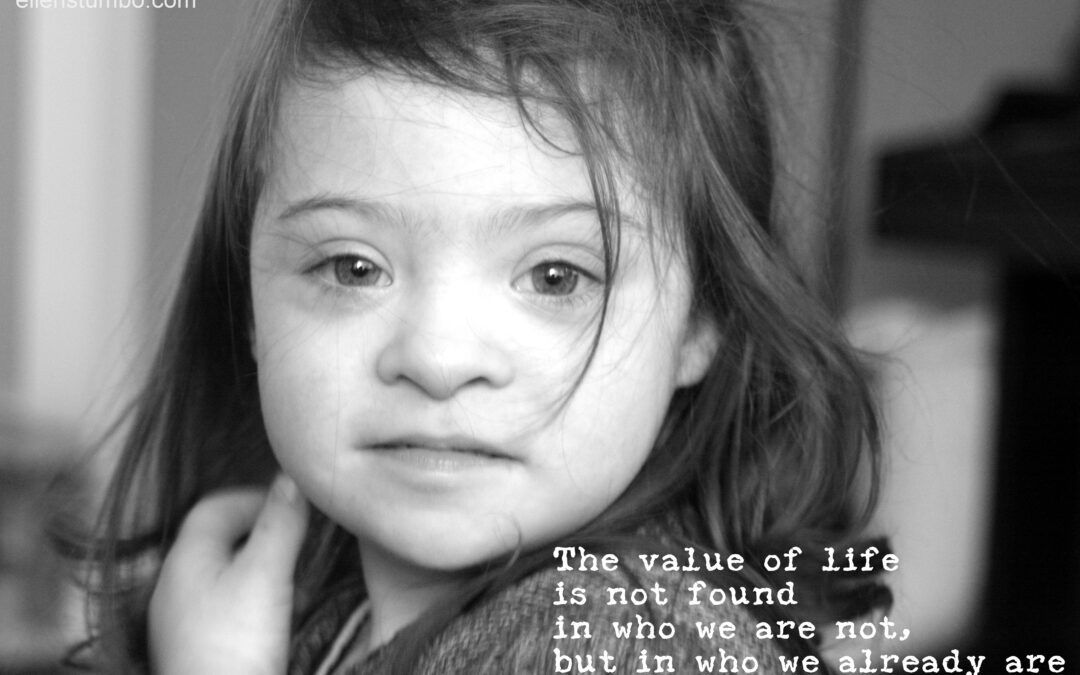
She will never be a doctor, a lawyer, or a scientist. She will not be the greatest athlete or performer. She will not find the cure for cancer, and she will certainly not be the next president. But then I look at Nichole and I am trapped in her eyes, unable to look away, unable to question anymore. The little girl who looks back at me is not broken, and she is not less than perfect. The value of her life is not found in all the things that she will never be, but in the things that she is. And at only four years old, her accomplishments are those that many of us seek to achieve someday.

Down Syndrome Teacher

Nichole might not get to be a college graduate, but she is my teacher, my teacher of life. She has taught me what celebration looks and feels like. The power of cheering for others and the freedom of dance. She has taught me that a worthy performance is not found in a basketball court or a stage, but on a living room floor matching words and letters, and in saying simple broken sentences, “Come back sit mom.” I see it as she embraces hurting people, and her love brings them to tears. “She makes me feel loved like I never have been before,” they say. I have seen worship to God that is so honest and seems so pleasing, that it moves me. I see it as Nichole tries to sing along at church, raising her arms to the God who gave her life, or singing along and dancing to a video while she tries to sing “Let everything that breath sing praises to the Lord, praise the Lord!” She has partnered with God to work in my selfish heart. A heart that many times is so lost in this world that it forgets that the standards I live for are not the ones set by people, but those set by God. She lives them, she teaches them to me.

Down Syndrome and Joy

I have seen joy in her and wished that I could feel what she feels. It is so pure. I have felt peace and love through her. At times when I am down, she instinctively knows it and comes to pat my back, and then she pulls me tight into a hug and offers a smile, maybe even asks if I need some crackers or chips too.

And every day she works harder than I do to master and accomplish new skills.

No diploma will ever be able to credit the value of Nichole’s life or the meaning of her accomplishments. She is already ahead of me in the things that really matter in life, and therefore she is my teacher and I her student.

And someday, maybe I will get to “graduate” and she will be the one cheering for me saying, “You did it mom! You did it!” And I hope that she is as proud of me as I am proud of her now.

What Have You Learned from Your Child?

Okay, maybe a tissue warning should have been issued beforehand. Sorry about that! Now it’s your turn to tell us what you’ve learned from your child. Not just kids who live with Down syndrome, but all kids with special needs.

Do you like what you see at DifferentDream.com? You can receive more great content by subscribing to the quarterly Different Dream newsletter and signing up for the daily RSS feed delivered to your email inbox. You can sign up for the first in the pop-up box and the second at the bottom of this page.

By

Ellen Stumbo is a writer and speaker and the mother of three girls, two with disabilities. To read more of Ellen’s writing, visit her blog at www.EllenStumbo.com.  She can also be found on Twitter and Facebook.

Author Jolene Philo

Archives

Categories

Subscribe for Updates from Jolene

Related Posts