3 Ways to Focus on the Future as Special Needs Parents

3 Ways to Focus on the Future as Special Needs Parents

3 Ways to Focus on the Future as Special Needs Parents

Guest blogger Kathy Guzzo is back after a season of dealing with health issues. Today, she’s glad to announce that not only is her health better, but also her adult daughter’s health is improving, too. Today, Kathy writes about how she’s learning to focus on the future again.

Focus on the Future

It had been more than ten years, that’s more than 3650 day since I had seen my daughter styling her own natural hair. Ten years of hairpieces, baseball caps, scarves, and hoodies. Ten years of the constant reminder that she had a chronic illness. Ten years of hoping and fervently praying that one day, life would get better for her. And then it happened. Her hair grew back.

The Past

The saga of my daughter’s hair loss began when she became seriously ill at the age of 16. The stress on her body of two years without a correct diagnosis of lupus and Epstein Barr Replication came severe complications to her organs, muscles and obviously immune system.

Prior to becoming ill, she loved sports; her hair was long, thick and usually pulled back in a ponytail through her baseball cap. When she began losing her hair, she didn’t verbally complain, didn’t lash out at those that stared at her with questioning eyes, but she did become more introverted.

During the toughest years of her illness, although we didn’t really discuss her hair loss, which included brows and lashes, our entire family continually supported her through the ups and downs of the diseases. However, as her mom a piece of my heart broke each time I thought about how these diseases weren’t just ravaging her body internally, but they were attacking her outwardly as well.

The Present

It wasn’t until her hair began growing back, that I realized part of me had lost hope in that possibility. I was afraid to hope, afraid to raise my expectations for a small thing like hair for my daughter, afraid of appearing vain on her behalf, After all, hair is just hair and not as important as her overall health.

Now that her hair has been steadily growing back for a year, I once again find myself struggling with fear. Before it was the fear that it wouldn’t grow back, now it’s the fear that it will fall out again. And that is an awful place to be and not at all where God wants me to be.

The Future

Continually looking back at what was, forces me to take my eyes off of what will be. Even allowing myself to mentally walk backwards, while facing forward creates a shadow of the past and may still cause me to stumble. I need not fear nor walk in the shadow of the past, it can’t be changed. And, I shouldn’t fear the future, what may or may not happen. I need to rejoice in the victories of today, smile when she tells me she got her hair cut again and needs to learn how to style it now that it’s growing in curly.

To accomplish this I have a few phrases I say to myself, sometimes even out loud.

  • When fearful, I ask myself “What If…?” and realize even in the worse case repeat scenario, I remember we’ve been there, done that, and we can do it again if necessary.
  • When I feel I’m unable to move forward, I remind myself that all mountains are scaled one step at a time, so while I force myself to take a even a small step, I think about the view that’s ahead.
  • When I’m struggling to find even a small victory, I choose joy, not because I necessarily feel like being joyful, but because I can rejoice in knowing that God is not only able, He is able to surprise us.

These days, I focus on the future: on moving ahead, anticipating the surprise God has around the next corner, finding hope in the future, not looking back at the shadows of the past.

How Do You Focus on the Future?

Kathy wrote about how she’s learned to focus on the future. How about you? How do you focus on the future instead of dwelling on past difficulties in your life as the parent of a child with special needs? Leave your ideas in the comment box below. Thanks!

Do you like what you see at DifferentDream.com? You can receive more great content by subscribing to the quarterly Different Dream newsletter and signing up for the daily RSS feed delivered to your email inbox. You can sign up for the first in the pop up box and the second at the bottom of this page.
By

Kathy Guzzo and her husband live in Northern Illinois and have 4 adult children. One of her daughters was diagnosed with lupus and Epstein Barr Replication as a young adult. Another began struggling with depression and OCD in her mid-twenties. She understands the need for her daughters to be able to make their own decisions regarding their health, but the nurturer in her sometimes has a hard time letting go. She desires to direct others to the peace and hope that God has abundantly available for them.

Author Jolene Philo

Archives

Categories

Subscribe for Updates from Jolene

Related Posts

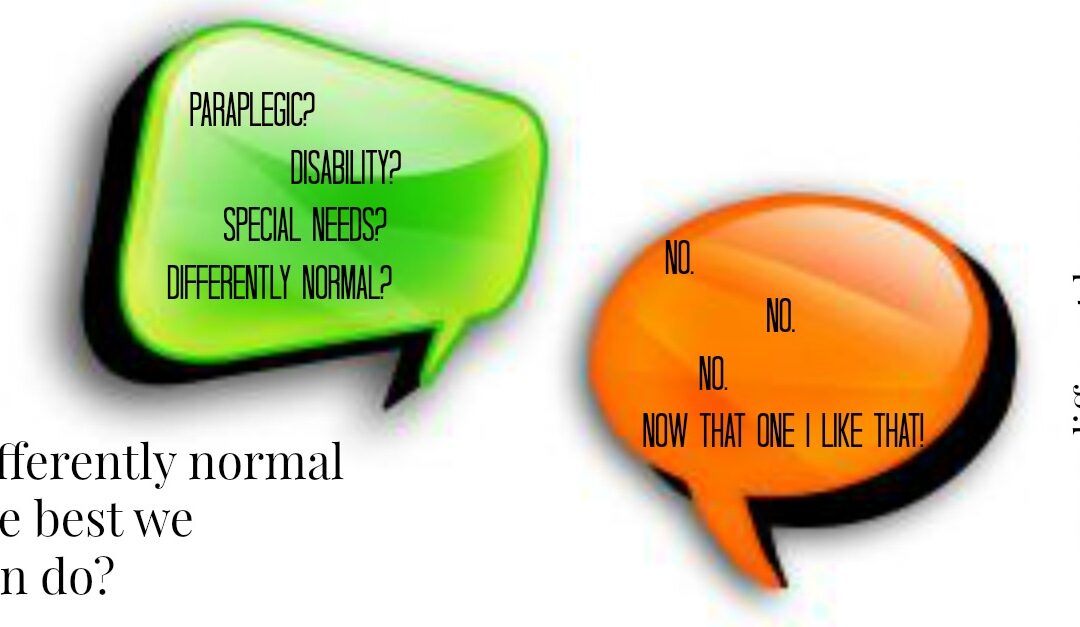
Is Differently Normal the Best We Can Do?

Is Differently Normal the Best We Can Do?

Is Differently Normal the Best We Can Do?

Terry Pratchett has a way with words. He’s written oodles of fantasy fiction, and his make-believe worlds are filled with golems, goblins, dwarves, and men. In Making Money some of his human characters discuss politically correct terms for golems, goblins, and dwarves. Finally, they settle on “differently normal” rather than golems, goblins, and dwarves. Which made me laugh.

It also made me think of the present, hot debate in my world about the politically correct way to refer to the special needs disability handicapped differently normal community.

Differently Normal or “Paraplegic Coming Through!”

In a way, the hot debate has been swirling through my life for as long as I remember. For me it began in the early 1960s when our family went to local football games. Dad was in a wheelchair, so mom was allowed to inch our car through the football field’s, drive behind the stadium, and pull up close to the edge of the field. To part the crowd, Dad would stick his head out the car window and yell, “Paraplegic! Paraplegic coming through!”

As you may have guessed, Dad was not shy about his handicap disability differently normal status. He also liked the word “paraplegic”, he told us often, because big words impress people so they moved faster.

Many years later, Dad was told paraplegic was a negative term he shouldn’t use.
So he switched to handicapped—long before handicapped parking spaces were mandated—until that term was nixed.

Then he used disabled—though he never received Social Security disability pay—until that term was given the kibosh, too.

I watched, puzzled, as the terminology changed, but Dad’s condition remained the same. Whatever the approved terms were, Dad still had multiple sclerosis. He was still in a wheelchair. He still couldn’t walk. He still couldn’t work. He still used a urinal and needed help to get in and out of the passenger seat of the car. He still had a great sense of humor for the 38 years he lived with his disease. And I still loved him—still do love him—no matter what word was the politically correct term of the month.

Special Needs Disabled Handicapped Differently Normal

Today, the debate’s still swirling. And I’m still puzzled by our attempts to use words to change the reality of our kids and their special needs. Sometimes we spend all our time and energy discarding words perceived as negative by someone, somewhere. And we forget that our kids who they are. Our kids have special needs handicaps disabilities. No matter what words are used to describe them, our children are who they are. We love them fiercely, no matter what the politically correct word of the month is.

So perhaps instead of using all our energy creating and lobbying for meaningless terms like “differently normal,” we should help others see beyond our kids differently normalness. Maybe we should raise them so they bravely face the world, stick their heads out the car window, shout, “This is who I am, and I’m coming through,” and watch the crowds step back in awe.

Your Thoughts about Differently Normal?

What’s your preferred term for differently normal? What are your thoughts about the entire terminology debate? Leave them in the comment box.

Do you like what you see at DifferentDream.com? You can receive more great content by subscribing to the quarterly Different Dream newsletter and signing up for the daily RSS feed delivered to your email inbox. You can sign up for the first in the pop up box and the second at the bottom of this page.

By

Jolene Philo is the author of the Different Dream series for parents of kids with special needs. She speaks at parenting and special needs conferences around the country. She’s also the creator and host of the Different Dream website. Sharing Love Abundantly With Special Needs Families: The 5 Love Languages® for Parents Raising Children with Disabilities, which she co-authored with Dr. Gary Chapman, was released in August of 2019 and is available at local bookstores, their bookstore website, and at Amazon.

Author Jolene Philo

Archives

Categories

Subscribe for Updates from Jolene

Related Posts

5 Tips for Using Power of Attorney

5 Tips for Using Power of Attorney

5 Tips for Using Power of Attorney

In a previous post I explained why my life felt like juggling with knives from December through mid-February. Along with juggling the details concerning Mom’s finances, insurance reimbursement, and helping her adjust to a new living situation, one completely unexpected item was thrown into the mix – power of attorney issues.

5 Tips for Using Power of Attorney

Like I said, the power of attorney hiccups were totally unexpected. Why? Because long before Mom’s memory issues again, she scheduled an appointment with her lawyer, during which he drew up, we signed, and he notarized her power of attorney, living will, and medical power of attorney documents. For years our family believed that because the documents were prepared, financial institutions and insurance companies would gladly accept them when the time came.

Boy, were we wrong. Several months into life with Mom in residential care, I’m much older and wiser. This blog shares some of that wisdom, much of which has implications for parents of kids with special needs, especially those who will one day have power of attorney for their adult children.

  1. Prepare power of attorney documents ahead of time. If you can’t afford a lawyer, do an internet search using the key words “power of attorney” followed by the name of your state. Then, fill out the form and sign it in the presence of a notary public, who will then notarize it.
  2. Make m-a-n-y copies of the document. Put the original in a safety deposit box or fireproof safe. File the copies in an easily accessible place.
  3. Call your loved one’s insurance companies and financial institutions. Ask how to send copies of the power of attorney document to them. Then follow their directions to the letter.
  4. Ask their representatives what needs to be done for them to approve the power of attorney. Write that information down and keep it in a safe place for when the time comes. Some companies require an update form after a certain number of years. Others require a signed statement from the doctor.
  5. Complete the steps for invoking power of attorney. Do this before sending any other documents to insurance companies and financial institutions. Otherwise, if they require those documents to be dated after the power of attorney is approved, you will probably have to fill out and send the documents in again.

Your Power of Attorney Tips?

Do you have any gems of wisdom about power of attorney to pass along? Share them in the comment box.

Do you like what you see at DifferentDream.com? You can receive more great content by subscribing to the quarterly Different Dream newsletter and signing up for the daily RSS feed delivered to your email inbox. You can sign up for the first in the pop up box and the second at the bottom of this page.

By

Jolene Philo is the author of the Different Dream series for parents of kids with special needs. She speaks at parenting and special needs conferences around the country. She’s also the creator and host of the Different Dream website. Sharing Love Abundantly With Special Needs Families: The 5 Love Languages® for Parents Raising Children with Disabilities, which she co-authored with Dr. Gary Chapman, was released in August of 2019 and is available at local bookstores, their bookstore website, and at Amazon.

Author Jolene Philo

Archives

Categories

Subscribe for Updates from Jolene

Related Posts

Grandparenting Kids with Special Needs: 7 Ways to Connect

Grandparenting Kids with Special Needs: 7 Ways to Connect

Grandparenting Kids with Special Needs: 7 Ways to Connect

A little more than 2 years ago, my husband and I became grandparents. He, and now his new baby sister, live 4 1/2 long, long hours away. Ever since our first grandchild was born, I’ve fought the urge to crawl to my children’s grandparents on my knees to apologize for the emotional pain we inflicted on them by living far, far away from them when our first child was born.

And for having to use the phone to keep them up-to-date on all the cute things he did.
And to break the news, more times than I could count, of his latest special needs setbacks and surgeries.

Grandparenting Kids with Special Needs from a Distance

As a mom, I know both how hard it is to parent babies and toddlers, with or without special needs. As a grandma, I know how hard it is to live far, far away from grandkids, unable to help out in practical ways or to connect with these children who stole my heart the first time I saw them. So when the first grandchild was nearing his second birthday, right around the time he started remembering us between visits, I decided to come up with a way to connect with him across the miles. Several months later, we are closer than ever.

Grandparenting Kids with Special Needs: 7 Ways to Connect

These 7 ideas are so simple, they can help grandparents everywhere be involved in their grandkids lives, too.

  1. Find out what interests your grandchild. Listen to what the child’s parents say about their child’s likes and dislikes. When you visit, watch for your grandchild’s favorite toys, books, activities, and topics of conversation.
  2. Do stuff together. During visits, be as actively involved as you can as early as you can with your grandchild. Read, go on walks, get on the floor and play, sing, dance, and create as many memories as you can.
  3. Pick up the phone. When my kids were little, the grands only called on Sunday afternoon when phone rates were low. Even though cell phones make it possible to call whenever and where ever, we do it on Sunday afternoons, after our grandson gets up from his nap. Now that he “gets” talking on the phone, we ask about his favorite things or mention things we’ve done with him.
  4. Take advantage of technology. Skype and Facetime are wonderful inventions. Use them now and then so your grandkids can “see” and remember your face.
  5. Send weekly notes and trinkets. Phone calls, Skype, and Facetime are wonderful, but surprisingly, writing a card to our grandson every week has been the most effective way to connect with him. It’s just a short note about the weather, what we’ve been doing (especially if stories about tools we’ve used because our grandson loves tools), remembering things we did with him, and talking about projects to do together during our next visit. I also slip in a few stickers, because he likes crafts. Very often, he uses the stickers to make something for us or to send to his great-grandmas.

These 5 ideas will go a long way to strengthen your ties with grandkids who live far away. Grandparents of kids with special needs can add two more.

  • First, accept grandchildren as they are and love them unconditionally.
  • Second, learn more about a grandchild’s specific special need. Ask parents where to start researching and how you can assist them.

Parenting kids with special needs can be very isolating, so a grandparents unconditional acceptance and active involvement is not only a wonderful gift but also a powerful way to draw closer to both grandkids and their parents.

Grandparenting Kids with Special Needs: Your Ideas?

Whether you’re the parent or grandparent of a child with special needs, I’d love to hear how you foster the grandparent-grandchild connection. So share your ideas in the comment box. Thanks!

Do you like what you see at DifferentDream.com? You can receive more great content by subscribing to the quarterly Different Dream newsletter and signing up for the daily RSS feed delivered to your email inbox. You can sign up for the first in the pop up box and the second at the bottom of this page.

By

Jolene Philo is the author of the Different Dream series for parents of kids with special needs. She speaks at parenting and special needs conferences around the country. She’s also the creator and host of the Different Dream website. Sharing Love Abundantly With Special Needs Families: The 5 Love Languages® for Parents Raising Children with Disabilities, which she co-authored with Dr. Gary Chapman, was released in August of 2019 and is available at local bookstores, their bookstore website, and at Amazon.

Author Jolene Philo

Archives

Categories

Subscribe for Updates from Jolene

Related Posts

Plan Now for Next Year’s Special Needs Homeschooling

Plan Now for Next Year’s Special Needs Homeschooling

Plan Now for Next Year’s Special Needs Homeschooling

When March rolls around, parents and kids start counting the weeks until school ends and summer begins. March is also the month when parents who homeschool their kids with special needs make preliminary plans for a new year in the fall. Experienced homeschool mom and guest blogger Sylvia Phillips is here to give parents a head’s up about what to do now so next year begins on the right foot.

Plan Now for Next Year’s Special Needs Homeschooling

Spring’s the time of year when schools generally begin doing their annual IEP reviews. But what if your special needs child doesn’t attend the local public school or even a private school/ What if you homeschool your special needs child?

In New York state you are not required to file an IEP with your school district, but you are required to file an Individualized Home Instruction Plan (IHIP). Please visit Homeschool Legal Defense Association (HSLDA) or your state’s Department of Education to find out what your state requires if you plan to homeschool your special needs child.

Even though I am not required to file a formal IEP for Bethany, I do write her IHIP as if it were an IEP also. I include in Beth’s IHIP the specialized life skills goals and objectives that I would like for her to work on. This assures me that I am providing her with a well-rounded and individualized quality education.

Special Needs Homeschooling Reflection

At this time of year I usually take a few days to analyze and reflect on how our school year has been going so far. I review Bethany’s current IHIP to be sure that we are still on track and on schedule with the goals and objectives that I have reported we’d be attempting to accomplish this year. If I have added anything new or made changes to our IHIP I will notify the school district in my next quarterly report.

By the third quarterly report I must let our Committee on Special Education know what type of annual assessment I will be administering to Bethany and whether or not I will be continuing to homeschool her for the next year.

Because Bethany is not capable of completing a standardized test, our school district has always permitted me to send in a written narrative of Bethany’s accomplishments as an alternative to testing for our year end assessment. I could also choose to have her tested by an independent professional or ask for the school district to test her for me.

Each spring, my thoughts also turn toward planning for next year. I contemplate what educational activities and learning experiences I would like for Bethany to participate in for our next school year.

Special Needs Homeschooling Goal Writing

In preparation for writing Bethany’s IHIP for the upcoming school year, I begin scouring the multitudes of homeschool publishing companies, hands-on learning supply companies, and even other homeschooling bloggers on the internet for fresh, new, exciting and creative ideas. I even request copies of paper catalogs so that I can scan them for inspiration at my leisure.

In my new IHIP I will also include all activities and field trips that Bethany will be attending with her special needs social clubs or her personal aide, and any exciting activities that we may do together as a family that could also be considered educational, such as gardening, cooking, taking a trip, going to the park…etc.!

If Bethany is going to be receiving any private services such as occupational, physical, speech, or hippo therapies I also include these in her IHIP. In New York state, homeschoolers can request that the school district perform speech, occupational, and physical therapy evaluations. They must also offer to provide these services if it was determined that a homeschooled child needs them.

Special Needs Homeschooling Planning Deadlines

After I have compiled all the information that I need, have planned out all the learning activities and educational experiences that Bethany will be participating in and have decided upon the books and materials we will be using, I can then begin writing Beth’s IHIP which must be received by our school district in August to be approved before the next school year begins.

The Committee on Special Education will notify me if our IHIP has been approved or if I need to make any changes to our plan. But they cannot refuse to allow me to homeschool Bethany or force me to send her to school for any reason other than educational neglect, which would have to be proved.

Special Needs Homeschooling Resources

If you are thinking about homeschooling your special needs child I highly recommend getting in touch with and/or even joining the Homeschool Defense Association prior to informing your school district just to make sure you know where you stand legally. You can also check out these online resources for more ideas and information:

Disclaimer: The information in this post is not to be misconstrued as legal advice. Sylvia not a lawyer. If you plan to homeschool your special needs child please contact your school district, HSLDA, or a lawyer before commencing your homeschool program to ensure that you are doing so legally!

How Do You Manage Special Needs Homeschooling?

Are you a special needs homeschooling parent? How do you plan for a new year? Are there special conditions in your state? Share your expertise in the comment box.

Do you like what you see at DifferentDream.com? You can receive more great content by subscribing to the quarterly Different Dream newsletter and signing up for the daily RSS feed delivered to your email inbox. You can sign up for the first in the pop up box and the second at the bottom of this page.

By

Author Jolene Philo

Archives

Categories

Subscribe for Updates from Jolene

Related Posts

5 Ways to Recover from Caregiving Chaos

5 Ways to Recover from Caregiving Chaos

5 Ways to Recover from Caregiving Chaos

Two days before Thanksgiving of 2014, my life descended into caregiver chaos. Not because of a kid with special needs. But because of an aging parent with special needs. My mom, to be specific. Who came to stay with us until the end of the year to give her primary caregivers, my brother and his wife, a much needed break.

That break nearly broke me because in quick succession…

Mom had what we think was a TIA that affected her balance and thinking.
My husband’s back went out, and he was MIA for several days.
My brother and I put Mom’s name on an assisted living facility’s waiting list, expecting a 2 month wait.
A week later, someone from the facility called to announce they had an immediate opening.
The next week, our granddaughter was born 10 days early.
The same day the page proofs came for my latest book.
And our daughter and her husband moved into a new condo.
A week later, we moved Mom into the care facility.
The next day, I went to help with the new baby for several days.
When I came home, my husband and I arranged to haul furniture to our kids’ new condo.

I am not making this up.

And I’m not even mentioning the time spent dealing with an email hack, a Facebook hack, the sudden death of the business software I’ve used for years, wrangling with Mom’s insurance company, wrangling with a financial institution not eager to cash in one of Mom’s annuities, a week long visit from our daughter and son-in-law right before their move, the dog that died, or the evil laugh Mom gives when she beats me at Uno, which is pretty often.

To read the rest of 5 Ways to Recover from Caregiving Chaos go to the Not Alone website at www.specialneedsparenting.net.

Do you like what you see at DifferentDream.com? You can receive more great content by subscribing to the quarterly Different Dream newsletter and signing up for the daily RSS feed delivered to your email inbox. You can sign up for the first in the pop up box and the second at the bottom of this page.

By

Jolene Philo is the author of the Different Dream series for parents of kids with special needs. She speaks at parenting and special needs conferences around the country. She’s also the creator and host of the Different Dream website. Sharing Love Abundantly With Special Needs Families: The 5 Love Languages® for Parents Raising Children with Disabilities, which she co-authored with Dr. Gary Chapman, was released in August of 2019 and is available at local bookstores, their bookstore website, and at Amazon.

Author Jolene Philo

Archives

Categories

Subscribe for Updates from Jolene

Related Posts