Behaviors in Kids with Disabilities

Behaviors in Kids with Disabilities

Behaviors in Kids with Disabilities

Behaviors in kids with disabilities are something we like to sweep under the rug and ignore. But Trish Shaeffer, mom to 3 sons with disabilities, is transparent about her boys’ behavior issues. In this guest post, she deals with the topic head on.

Behaviors in kids with disabilities–let’s talk about them.

Anyone who says their child with a disability is a perfect angel is lying. In my experience around the age of 9, you’ll see behaviors in your child similar to the terrible 2’s or 3’s. I think this is because children starting to notice their disability. They get frustrated with their own body and possibility compare themselves to their peers or siblings. This is true even if they have an intellectual disability.

My son Alex may have the mindset of a 4 or 5-year-old, but he understands that he is different. He has a temper and holds his wheelchair wheels so you cannot push him or he refuses to push himself. He has epic meltdowns. He will throw toys or bite or hit. People see his big smile and say he’s such a sweet boy and well-behaved. They need to spend some time with him at home. As we know, children tend to display behaviors in a safe place such as home.

Despite his meltdowns, I give Alex space and time to cool down while giving him options to communicate his frustrations. Communication of feelings is hard for Alex. He can talk, but he cannot express what’s really going on. Is he mad, sad, in pain? Sometimes we don’t know. We have a visual chart for pain and feelings for him to use when he cannot express what’s bothering him. He is also learning to use the same chart in school. Many can be downloaded and printed out online.

Right now we do wheelchair time outs. We put him in a safe place during meltdowns and leave him to cool down. Those time outs are timed. It took trial and error to find the amount of time that works for calming him down. For Alex it’s a half hour, but it could be different for your child.

We also take away his iPad time for the day, which helps. If your child uses the iPad as a communication device, this may not work. You’ll have to look for another motivator such as removing a favorite toy, snack, or TV show.

We make a big deal when Alex expresses his feelings verbally and without a meltdown. This instill the concept that it’s okay to have feelings and to express them in a healthy way. We also talk about his feelings when he’s calmed down after a meltdown. This doesn’t always work, but it’s still good to let him know he’s not alone. It shows him that adults, even Mommy, can have a bad day.

Remember, no child is perfect, disability or not. You and your child do not have to meet society’s expectations of what is normal or perfect. Some days will be harder than others. Some days our kids will push us and give us grey hair. When that happens, it’s okay to walk away and regroup. You may feel like you’re heart is breaking watching your child cry or scream. Pick up the pieces of your heart and keep going. On days when you are at your wits end, leave a comment here. We all have your back. We will cheer you on!
 

By

Trish Shaeffer is the mom of 3 active boys with special needs. She’s a peer supporter for Parent to Parent and volunteers with the United Cerebral Palsy Network, Special Olympics, and the United Way. She’s also an equine volunteer at Leg Up Farm. She’s married to her best friend and biggest supporter, Chris Shaeffer.

Author Jolene Philo
Archives

Categories

Subscribe for Updates from Jolene

Related Posts

Just Talk

Just Talk

Just Talk

Just talk. That’s guest blogger Kimberly Drew’s advice for parents worrying about their children’s future. Today Kimberly talks about what happens when she and her husband make time to just talk.

The summer sun is staying up longer in the day and I find myself waiting for it to get dark to put the kids to bed. There is something about those couple of hours when they are all tucked in and my husband Ryan and I have a few minutes of peace and quiet. The last few years have been a strain as we have accepted the call and challenge of adopting a child with special needs. This brings our family total to two children with disabilities and two without.

Most days we feel outnumbered, but some days we feel inadequate at best.

It’s in those quiet moments when the kids are in bed that we can talk about how we are handling life. Sometimes one of us needs a pep talk. Usually me. Sometimes we just need the reassurance that it’s going to be okay.

It has taken Ryan and me a long time to be able to voice our darkest thoughts and fears about raising our two daughters with disabilities. We’ve been to seminars and counseling sessions, talked with pastors and friends. But the real hashing out of thoughts and feelings happens when all the distractions are peeled away, and the two of us just talk.

On our most recent, long overdue getaway, we spent some time talking about the need to start long term planning for our girls. We don’t want the burden of care to fall on our two sons. It’s not an easy topic.

Will there be enough money to retire?
If we choose assisted living, will someone hurt our non-verbal girls?
Should we move somewhere warmer for their health?
When our parents are gone…will we ever be able to go away together again without the kids?
What do those years in the future look like?

Eventually, the conversation rolls back to the idea to enjoy the now. So. In the now–

We savor the moments when the kids are in bed.
We try to make a habit of sitting down together every night.
We talk about our worries enough to let them pass and turn on a favorite TV show to relax.

It’s a rare thing to find answers to the complex issues that surround raising children with special needs. But if we don’t make it a habit to just talk things out, communication gets more difficult as the years go by. Sometimes just a little talk is all I need to have the peace of mind and soul to press on through another day.

If you haven’t had a good talk with your spouse lately, I encourage you to make a list of things to talk about. After a while, you won’t need a list. Don’t always talk about your children.

Just talk about the things that matter to you both.
Just talk about things that don’t matter at all and everything in between.
Just talk.

Do you like what you see at DifferentDream.com? You can receive more great content by subscribing to the monthy Different Dream newsletter and signing up for the daily RSS feed delivered to your email inbox. You can sign up at the bottom of this page.

By

Kimberly graduated from Taylor University with a degree in Elementary Education in 2002. Kimberly and her husband Ryan have 4 amazing kids on earth (Abigail, Jayden, Cooper, and Ellie), and a baby boy waiting for them in heaven. Their daughters have multiple disabilities. They are the inspiration behind Kimberly’s desire to write. In addition to being a mom, Kimberly serves alongside her husband in full time youth ministry. She enjoys working with the senior high girls, scrapbooking, reading, and music. You can visit Kimberly at her website, www.promisesandperspective.blogspot.com.

Author Jolene Philo

Archives

Categories

Subscribe for Updates from Jolene

Related Posts

A Letter to Our Other Child

A Letter to Our Other Child

A Letter to Our Other Child

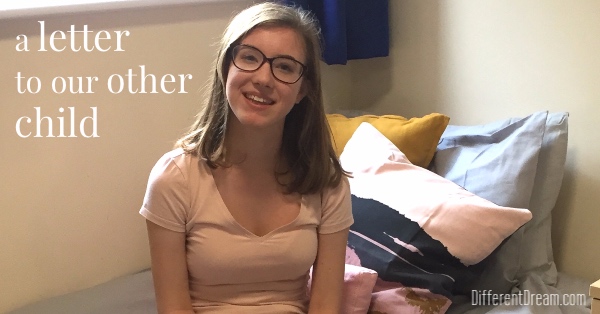
For many who parent children with special needs, they are not the only child in the family. We may have other children also needing love, nurturing, care and support. Our other child is Phoebe, who at 19 is 2 1/2 years older than our autistic son James. This is a letter to Phoebe and to the other child, the brothers or sisters of those with special needs or disabilities.

Dear Phoebe,

We love you, you are very precious to us. We are enormously proud of you for being the fine young woman that you have grown into. This letter is a small way of acknowledging all you do to support your brother and us.

You are a carer for James, helping out with a range of tasks to keep the wheels on our particular family bus. You are great at spotting when James is starting to get distressed. You’ve cleaned up stuff that you would rather not see, you’ve helped in the middle of the night when James was having a meltdown, you’ve watched endless episodes of his favorite videos with him. You call us out when we let James off for something he does that is less about autism and more about being a 17-year-old who is pushing boundaries.

But you’ve missed out on things many young people take for granted. The times we skipped going to something, or came home early because James was struggling. We can’t go out to the movies or a meal on a whim as most families can though you might have liked to go somewhere different for a change. We invite people to our house rather than visit because it’s easier for James in the familiarity of his own den, and we’ve got everything we need to support him.

We were able to understand what having a child with special needs would mean, although in reality we still had everything to learn. For you it meant your brother was a bit different than the brothers and sisters of your friends. As you grew up you noticed the differences more, asked more questions, learned more about your brother, were affected more by living with him.

In all of this, you rarely complained, although you have your moments. You got on with life and the challenges of being the sibling of a brother with additional needs. There are times when you mention that all of our time and energy seems to be focused on James, and that you don’t get enough of our time and focus. We need to do better, to learn, and to change.

We are incredibly proud of the well-rounded, caring, thoughtful, intelligent, faith-filled young woman you have become. There are thousands like you, who quietly cope while a brother or sister has a difficult day. Thank you for being a wonderful daughter, an inspiring and caring sister. We love you more than we sometime show and more than you will ever know.

“Be completely humble and gentle; be patient, bearing with one another in love.”
Ephesians 4:2

Mum and Dad
xx

Whether we are parents or the children’s and youth workers who care for the other child in other ways, let’s celebrate the contributions siblings make to the world. Let’s acknowledge how hard it can be for them, and make sure that we love, nurture, care, and thank them for all that they do.

Do you like what you see at DifferentDream.com? You can receive more great content by subscribing to the quarterly Different Dream newsletter and signing up for the daily RSS feed delivered to your email inbox. You can sign up for the first in the pop up box and the second at the bottom of this page.

By

Mark Arnold is the Additional Needs Ministry Director at Urban Saints, a leading national Christian children’s and youth organization. He is co-founder of the Additional Needs Alliance, a national and international advocate for children and young people with additional (special) needs or disabilities and is passionate about enabling everyone engaging with them to be inspired, trained and well-resourced. Mark is a Churches for All and Living Fully Network partner, a member of the Council for Disabled Children and the European Disability Networ. He writes an additional needs column for Premier Youth and Children’s Work (YCW) magazine and blogs at The Additional Needs Blogfather, He is father to James, who has autism spectrum condition, associated learning disability, and epilepsy. To find out more about how Mark’s work can help you, contact him at: marnold@urbansaints.org or @Mark_J_ArnoldImage rights: © author’s own

Author Jolene Philo

Archives

Categories

Subscribe for Updates from Jolene

Related Posts

Hello Noon and Special Olympics Athletes Rock Out in Music Video

Hello Noon and Special Olympics Athletes Rock Out in Music Video

Hello Noon and Special Olympics Athletes Rock Out in Music Video

Hello Noon, a California-based band, released a music video done in collaboration with Special Olympics athletes. Stephen, who plays guitar and performs vocals for Hello Noon, explains how the Run Free video came into being.

When Stephen Spies, guitarist and singer from Hello Noon, was asked to teach music to a neurodiverse class (those with variation in brain function and behavioral traits), the classroom teacher warned him that the students may not participate. To his and the teacher’s surprise, every student in the room was drumming along and fully engaged! 

Kate and Rebecca, pianist and violist in Hello Noon, reflected with Stephen about their similar experience as music teachers with neurodiverse classes. This inspired them to start planning a project that would showcase the neurodiverse community. They reached out to Caley Versfelt, a Special Olympics swimmer and athlete from their hometown, about filming a music video with Hello Noon. She responded without hesitation that she was on board. Caley and Special Olympics Southern California worked with Hello Noon to secure two more athletes, Cole Sibus, and Jared Cozak, and filming began. 

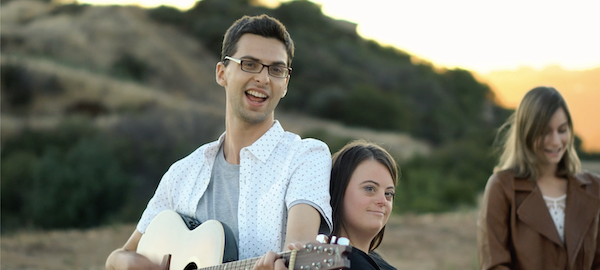
After an amazing day of incredible interviews and sport demonstrations, Cole, Jared and Caley enthusiastically joined Hello Noon for the final performance shot! Cole rocked the electric guitar back to back with Stephen.The band Hello Noon jammed out with Special Olympics athletes to create a new music video, Run Free. In this post, watch the video and learn how the project came into being.

Jared showed his amazing drumming skills side by side with Kyle (drummer from Hello Noon). Caley jumped on both the mandolin and the viola next to Rebecca. With only 20 minutes to film before the sun set atop a mountain in Malibu, the performance shot couldn’t have gone smoother and it was easily everyone’s favorite part of the shoot.

The band Hello Noon jammed out with Special Olympics athletes to create a new music video, Run Free. In this post, watch the video and learn how the project came into being.

On July 9th, 2019, Hello Noon released this music video, showcasing the incredible work Special Olympics Athletes do! Hello Noon created this video to celebrate neurodiversity and highlight the intelligence, kindness and positivity Special Olympics Athletes demonstrate that we can all learn from! 


I was so impressed by how much these athletes have accomplished! Jared is an actor on Nickelodeon, while Cole is an actor in feature films. Caley is on the Board of Directors for Special Olympics Southern California and started her own business, Tides of Kindness. All of them have been featured in the award winning docuseries ‘Born This Way’.”Stephen Spies, guitarist and vocalist from Hello Noon

I hear a lot of people saying to me, ‘Oh, I’m not beautiful enough or I’m not smart enough’, but guess what? You have the best two qualities and that’s your friendship, and your personality to other people” – Caley Versfelt, quote taken from her interview in the music video on tackling insecurities 

About the Band: Hello Noon is an orchestral, pop-rock band with a message of positivity and inclusion through social activism. Beginning as a group of friends and songwriters, Hello Noon came together sharing music with each other while music students at UCLA. They immediately realized their shared passion of serving others through musical performance. Since then, they have performed for the Special Olympics 50th Anniversary–“Pier Del Sol”–at the Santa Monica Pier, the Healthy Campus Initiative celebration at Pauley Pavilion (UCLA), the LA Cancer Challenge run to end pancreatic cancer, Angel City Games for Paralympic athletes at Drake Stadium (UCLA) and more! Their debut album, Into Place, brings to light the potential we have as a community to work together and build a brighter future.

Do you like what you see at DifferentDream.com? You can receive more great content by subscribing to the monthly Different Dream newsletter and signing up for the daily RSS feed delivered to your email inbox. You can sign up for the first in the pop up box and the second at the bottom of this page.

By

Jolene Philo is a published author, speaker, wife, and mother of a son with special needs.

Author Jolene Philo

Archives

Categories

Subscribe for Updates from Jolene

Related Posts

Special Needs Families Can Be Grateful to Live in the USA

Special Needs Families Can Be Grateful to Live in the USA

Special Needs Families Can Be Grateful to Live in the USA

Special needs families can be grateful to live in the USA. It’s true, even in this time of contentious politics and dissatisfaction with our government. On this day before Independence Day, here’s the quick list I scribbled down without breaking into a sweat.

  1. Special needs families can be grateful for freedom of religion. Whatever faith community our families embrace, our country allows us to worship as we wish. Better yet, thanks to the growth in inclusive ministry initiatives in all denominations and faiths, more houses of worship are accessible to people with disabilities and special needs than ever before.
  2. Special needs families can be grateful for Medicare wavers and government disability payments. Yes, the paperwork is terrible and red tape is sticky and getting stickier. But these programs are lifesavers for many. May we always feel more grateful for than entitled to them.
  3. Special needs families can be grateful for elections. They allow us to speak for our children and to become change agents on local, state, and national levels. Therefore, we should exercise our right to vote at every turn and teach our children to do the same.
  4. Special needs families can be grateful for freedom of speech. This freedom, guaranteed by the Bill of Rights, is another way to advocate for our children. It’s also a way they can self-advocate and engage in public debate without fear. Let’s teach them to do it effectively, kindly, and with compassion.
  5. Special needs families can be grateful for medical advancements funded by government research. My child is alive because of those advancements. Perhaps your child is, too.
  6. Special needs families can be grateful for taxes. They seem excessive sometimes, but their benefits–public libraries, free public school education, good roads, safe air travel, Medicare waivers, to name a few–enhance quality life for us and our loved ones with disabilities.
  7. Special needs families can be grateful for Social Security and state pensions. These allow grandparents to devote time to their grandchildren with disabilities and special needs. In a few years, they’ll allow my husband and I to devote ourselves fully to special needs and disability ministry. I. Can’t. Wait.
  8. Special needs families can be grateful for public schools. We like to grumble about what public schools don’t do for our kids while ignoring what they do provide. Public schools have been the primary agents of change to create more inclusive environments for our kids. They have also been instrumental in changing public attitudes toward those with disabilities. Yes, much remains to be improved, but we can be grateful for what’s already been done.
  9. Special needs families can be grateful for the Americans with Disabilities Act (ADA). I remember how hard it was to get my dad from place to place in his wheelchair before the ADA was signed into law. More remains to be done, but we should be grateful for the accessibility this law brought into being.
  10. Special needs families can be grateful for the ABLE Act. Passed in 2014, this law created a way for families to save money for their children with disabilities and special needs. For more information about what ABLE is and does, check out this blog post.

So, that’s the list I came up with. What do you like about it? What would you add to it? Leave your comments below!

Do you like what you see at DifferentDream.com? You can receive more great content by subscribing to the Different Dream newsletter and signing up for the daily RSS feed delivered to your email inbox. You can sign up for the first in the pop up box and the second at the bottom of this page.

By

Jolene Philo is a published author, speaker, wife, and mother of a son with special needs.

Author Jolene Philo

Archives

Categories

Subscribe for Updates from Jolene

Related Posts

4 Caregiving Lessons Mom Taught Me

4 Caregiving Lessons Mom Taught Me

4 Caregiving Lessons Mom Taught Me

The caregiving lessons Mom taught me came thick and fast during my childhood. Every day, as she cared for my dad, her example provided lessons – some good and some not so much – to last a lifetime.

Or so I thought.

Nowadays, Mom lives in a memory care unit. She’s been there 4 years.

“How are you?” I ask at the beginning of my visits.

“Lonely,” has been her consistent reply for the past few months.

No matter how often my siblings and I visit her, take her on outings, or call, her response remains the same.

“I’m lonely,” she says.

Her perceived reality breaks our hearts. In our search for ways to relieve her loneliness, I learned 4 strategies to add to the lifetime of caregiving lessons Mom taught me as a child. Their effectiveness makes me want to go back to my days as mom to a child with special needs and give them a try with him, too. Since that’s not going to happen until somebody works the kinks out of time travel, I’ll pass the caregiving lessons Mom taught me on to you.

Lesson #1: Preserve your loved one’s dignity.

This lesson is paramount whether the person in your care is 9 months old or 90 years old. Our loved ones hear and remember, in one way or another, what we say about them. Our words affect their how they view themselves. Therefore, we have to find ways to preserve their dignity while communicating our observations and worries with the professionals – in home care workers, residential care providers, doctors, teachers, therapists, and others.

To read the rest of this post visit the blog for special needs parents at Key Ministry.

Do you like what you see at DifferentDream.com? You can receive more great content by subscribing to the quarterly Different Dream newsletter and signing up for the daily RSS feed delivered to your email inbox. You can sign up for the first in the pop up box and the second at the bottom of this page.

By

Jolene Philo is a published author, speaker, wife, and mother of a son with special needs.

Author Jolene Philo

Archives

Categories

Subscribe for Updates from Jolene

Related Posts