When Your Special Needs Mess Is Your Message

When Your Special Needs Mess Is Your Message

When Your Special Needs Mess Is Your Message

When your special needs mess is your message, telling others about it can be, um, intimidating. Even so, guest blogger Heather Braucher found a good reason to share her family’s messy story anyway. Maybe she’ll convince you to do the same.

There are people in my life whom I watch in awe. In awe of their strength, resilience, and endurance to keep going in the midst of long suffering.

I have wondered how they keep it all together and remain positive despite the turmoil or pain around them. I would secretly think, I would be an absolute mess on the ground in the fetal position if I were in their shoes. How are they still standing?

Not too long ago, I believed that certain things in life were a luxury afforded to or deserved by those with enough margin, enough order, or enough strength. Things like a consistent exercise routine, working outside the home, or even pursuing one’s passions or interests.

I assumed that when life’s demands were too overwhelming and too chaotic, it was selfish and impractical to consider anything beyond managing the chaos and surviving.

I get that life brings us through seasons of busyness, seasons of healing, seasons of thriving, and seasons of making ends meet. In all honesty, our season of surviving felt never ending.

One day I thought to myself, What if this season is never ending? What if I am waiting for a season that will never come?

I felt compelled to start doing the things I needed to do to take care of my own personal physical and mental health. If I waited any longer, I would be waiting forever.

Suddenly, I found myself becoming a person who, in the face of trial, was still standing.

I was no longer on the floor in the fetal position when heartache and grief struck. Now I was on the receiving end of the comments I used to give to others. How are you still standing? How do you do it?

I share this not to gloat, but to remind others and myself to stop waiting until we are all put together to move forward or even help others.

This week chaos struck again. The all-too-familiar whispers began.

  • Who are you to think you could work outside the home?
  • Who are you to share words of hope with others when your life continues to be at the mercy of your children’s extra needs?
  • Who are you to encourage others when the behavioral issues of your children require constant monitoring and intervention?
  • Who are you to think you have a message to share when all anyone can see is the mess?

I reflected on my heroes of the faith whom I observed with awe. I remembered the thing that amazed me and inspired me the most.

Their struggle was not over, yet they were still willing to fight for hope.

They kept moving forward in faith, trusting that God is sovereign over their lives and that the Author and Perfecter of their faith wasn’t done writing their story.

When your special needs mess is your message, remember that you are not disqualified from receiving hope or giving it to others. You might be inspiring someone just as you are and exactly where you are without even knowing it.

And we know that in all things God works for the good of those who love him,
who have been called according to his purpose.
Romans 8:28

Do you like what you see at DifferentDream.com? You can receive more great content by subscribing to the monthly Different Dream newsletter and signing up for the daily RSS feed delivered to your email.
Image by Pexels from Pixabay 

By

Heather Braucher is a member of the “Braucher Bunch” aka her energetic family of 5. The bunch includes her husband and their three children, all of whom are dominant and extroverted and are going to change the world (if she can keep them alive!) She has always held a passion for writing, but motherhood has given her a reason to share her experiences, heartaches, and victories with others. In her writing you will hear stories of hope as well as grief, as her family has navigated life in ministry in the US and overseas, all while discovering that 2 of her children have special needs. Her desire is to provide others with connection, understanding, encouragement and laughter, all washed with the love of Christ.

Author Jolene Philo

Archives

Categories

Subscribe for Updates from Jolene

Related Posts

Flying Near the Sun as a Special Needs Parent

Flying Near the Sun as a Special Needs Parent

Flying Near the Sun as a Special Needs Parent

Flying near the sun as special needs parents? What is guest blogger Lisa Pelissier talking about? In this post, she brings in a little C.S. Lewis, a little Greek mythology, and a little of her own fiction to explain how she deals with a phenomenon that is all too common for parents raising kids with disabilities and special needs.

“Still the thermometer rose. The walls of the ship were too hot to touch. It was obvious that a crisis was approaching. In the next few hours it must kill them or get less.

It got less.”

From Out of the Silent Planet by C. S. Lewis

The passage from C. S. Lewis’ Out of the Silent Planet resonates with me as a special needs mom. Although the main character Ransom’s voyage through space was way outside the boundaries of my experience, I repeatedly live through the same kind of stress. Things happen. Then more things. And more things. I’m putting out fires left and right until I stop caring whether I burn up or not. Like Ransom and the others, I am flying near the sun as a special needs parent in a desperate attempt to journey successfully through this life.

As special needs parents, this is our story much of the time. There are too many things to deal with, too many problems to field, too many medical appointments, too much medicine to track, too much angst to soothe, too much sorrow to mop up with our already soggy souls. It’s easy to become overwhelmed, frustrated, and hopeless.

How do I, to mix my metaphors, keep my wings from melting in the sun? How do you emerge from the trials and still have something left to give? Here are some things that help me.

  1. I know this world is not my home. The eighty-three years I plan to spend here in this life (don’t laugh—I’m a planner) are just a speck of dust compared to the eternity of the next world. With that perspective, the trials of this world look more trivial and less all-encompassing. Romans 8:18 says, “For I consider that the sufferings of this present time are not worthy to be compared with the glory that is to be revealed to us.” Good things are yet to come.
  2. I count my blessings. There are many. I have a lot for which to be thankful. My trials and burdens are great, but looking back over the course of my life, I can see God’s hand faithfully leading me through the darkest places, especially during those times I felt farthest from Him. It helps me remember that though I may not experience the felt presence of God now, He is with me and providing for me.
  3. I work to see what magnificent miracles my children are. They are all delicious human beings. I like being with them. They make me laugh. They are smart and funny. I like the dark, dry humor of my youngest, even if it is born out of depression and anxiety. There’s more to them than what the world might tot up on a checklist of “ways to know your children turned out okay.”
  4. I take breaks and escape to another world. This will look different for everyone, but for me, I write fiction. I leave this world altogether and immerse myself in the trials of the characters who inhabit Gannoir, the inverted star where my angsty characters fight for what is right (and sometimes go off the rails). They’re so real to me now that I feel like I know them, and despite their difficulties being 100 percent my fault, I don’t have to feel guilty. Not everyone will find pleasure in torturing fictional characters, but escaping is vital when stress levels get too high.
  5. I lean on my friends. I have a few who are in the trenches with me, and a good number more who don’t completely understand, but who are always ready to sympathize and offer a listening ear and a helping hand.

I hope that these strategies and my journey are a blessing to you. If you have other methods for coping when you’re flying near the sun as a special needs parent, please post in the comments.

Do you like what you see at DifferentDream.com? You can receive more great content by subscribing to the monthly Different Dream newsletter and signing up for the daily RSS feed delivered to your email.

Image by Dimitris Vetsikas from Pixabay 

By

Lisa Pelissier lives in Oregon where she is a homeschooling mother of four (three with disabilities) and author of four middle-grade fiction novels as well as a YA fantasy novel. Lisa owns SneakerBlossom Books, offering Christian, classical homeschool Study Guides and curriculum. She blogs at Eleventh Willow, offering encouragement for Christians parenting the mentally ill. She also works as a freelance copy editor, an artist, and a substitute teacher. In her spare time Lisa enjoys playing the piano and fretting about things over which she has no control. 

Author Jolene Philo

Archives

Categories

Subscribe for Updates from Jolene

Related Posts

A Caregiver’s Hope Can Be Found in Unexpected Places

A Caregiver’s Hope Can Be Found in Unexpected Places

A Caregiver’s Hope Can Be Found in Unexpected Places

A caregiver’s hope can be found in unexpected places. Guest blogger Heather Braucher and her husband recently discovered that hope through the words of Joni Eareckson Tada. Heather describes how hope has changed their perspective of their caregiving journey.

A caregiver’s hope can be found in unexpected places.

My husband was not looking for it. Even more, I’m not sure he knew how much he needed it. Because let’s be honest, hope can actually feel scary.

Sometimes it feels safer to accept the daily struggle and battle that is your reality. When you taste a sliver of possibility that life could be different, or things might be getting easier, when the all-too-familiar reminder that your circumstances have not changed and your situation is here for the long-haul returns, you regret feeling that small piece of hope.

For parents of children with special needs or medical needs and for caregivers, the temptation to live in a place of sober acceptance of your life’s realities is strong. In fact, it can become our only comfort.

Joni Eareckson Tada said it perfectly in John Piper’s book Suffering and the Sovereignty of God. She wrote, “I did not want to let go of the sick, strange comfort of my own misery.”

This from a woman who, at the age of 17, had a diving accident that left her paralyzed from the neck down and confined to a wheelchair. She has been a quadriplegic for 40 years now and if anyone knows the battle that exists between finding hope in the midst of the daily struggle, it is her. You can find more of her story at Joni & Friends.

My husband came across Joni’s story and a perspective on suffering and hope that he had never heard before in Piper’s book. Joni referenced Luke 12:48: “When someone has been given much, much will be required in return; and when someone has been entrusted with much, even more will be required.”

My husband said, “Typically I view this verse through materialistic means—finances, time, talents—they are not for our own benefit but for the blessing of others. The verse left me feeling personally condemned or like I am just simply not doing enough. When honestly, I’m just trying to make it another day managing the special needs around me. But when Joni spoke about this verse the way she did, I felt encouragement instead of condemnation for the first time. I felt freedom to serve others. I felt hope.”

Joni said, “The way I see it, I’ve been given so much, I must pass on the blessing. We simply must, must pass on the hope to others.”

Here is a woman who has suffered greatly, and she is claiming to have been given much.

Our first reaction to her statement is “What? How?” How did she get to this place? This place of seeing suffering as a gift? And a gift that keeps on giving?

My husband and I have three children ages 11, 9, and 7. We have been managing the special needs of our youngest two for over 5 years now. Every year has looked different. For a while it felt like every year brought a new diagnosis. Caring for them well has required a lot of self-sacrifice and heartache. While we have so much to be grateful for, we fight daily the belief that life will always be hard and full of grief.

Through Joni, we saw that a caregiver’s hope can be found in unexpected places. She speaks to our very souls when she says, “For me, suffering is still that jackhammer breaking apart my rocks of resistance every day. It’s still the chisel that God is using to chip away at my self-sufficiency, and my self-motivation, and my self-consumption. Suffering is still that sheepdog snapping and barking at my heels, driving me down the road to Calvary where otherwise I do not want to go. My human nature, my flesh, does not want to endure hardship like a good soldier (2 Timothy 2:3) or follow Christ’s example (1 Peter 2:21) or welcome trial as friend. No, my flesh does not want to rejoice in suffering (Romans 5:3) or be holy as he is holy (1 Peter 1:15). But it is at Calvary, at the cross, where I meet suffering on God’s terms.”

She said, “It is when your soul has been blasted bare, when you feel raw and undone, that you can be better bonded to the Savior. And then you not only meet suffering on God’s terms, but you meet joy on God’s terms.”

Through the life, suffering, and ministry of another, my husband and I are encouraged to view our lives filled with caring for children with special needs through the lens of hope, purpose, and possibility.

My husband now sees the possibility for life to be more than simply making it through each day. He believes that there is a blessing here that we have been given because of joy that comes from the Lord (Romans 15:13) and can come through suffering. We both believe that we are blessed to be a blessing, and we now see that a caregiver’s hope can come from unexpected places.

Do you like what you see at DifferentDream.com? You can receive more great content by subscribing to the monthly Different Dream newsletter and signing up for the daily RSS feed delivered to your email.

Image by Joe from Pixabay 

By

Heather Braucher is a member of the “Braucher Bunch” aka her energetic family of 5. The bunch includes her husband and their three children, all of whom are dominant and extroverted and are going to change the world (if she can keep them alive!) She has always held a passion for writing, but motherhood has given her a reason to share her experiences, heartaches, and victories with others. In her writing you will hear stories of hope as well as grief, as her family has navigated life in ministry in the US and overseas, all while discovering that 2 of her children have special needs. Her desire is to provide others with connection, understanding, encouragement and laughter, all washed with the love of Christ.

Author Jolene Philo

Archives

Categories

Subscribe for Updates from Jolene

Related Posts

I Press On

I Press On

I Press On

I press on is all a special needs parent can do sometimes. Guest blogger Kelly Simpson returns to talk about what she’s learned about pressing on while raising a child with special needs. She ends with some great ideas to help you press on during hard times, too.

During my husband’s deployment, our newborn was in the Neonatal Intensive Care Unit (NICU) for 19 days. That stay was short compared to other families, but long enough and overwhelming for a first-time mother who was also walking through her husband’s first deployment. Our son’s first year was also long and hard—nine plus surgeries and procedures. I pushed through this season while working full time. Sulking and rolling around in my circumstances would have been easy to do, but it would not have been a healthy choice.

With each surgery or procedure, I had faith that it was going to get better. It had to get better.

It was going to be okay. We were going to be okay.

Eventually I ran dry on my own determination and drive. I could only be sustained from endurance given to me through Christ Jesus, so with His help, I pressed on.

Seasons of life take me high and leave me low. Jesus has to be my cornerstone—He is who I have to build my life on. 2 Peter 2:6 it says, “I lay a stone in Zion, a chosen and precious cornerstone, and the one who trusts in him will never be put to shame.” My walk in life must bring God glory—the surgeries, the tears, the mess, the mountains, and the valleys. I am his and chosen. He will walk with me each step of the way on my journey. He is with me, and he will be with you too.

But I press on to make it my own, because Christ Jesus has made me his own.
Philippians 3:12.

Doesn’t the Lord know His plan for me? Doesn’t he know every hair on my head? Hasn’t he stood before time and seen every second of my life? Because he is God, there’s not a place where I’ll go that he has not already stood.

So I press on.

Rolling around in self-pity, asking why, and running conversations over and over in my mind only leaves me dry. I have to go past that. When worry, fear, and doubt are heavy in my mind, I lift it up and I press on! I ask for His presence and strength, then I press on! It’s not the easiest to do, but each time it gets a little easier.

I’m writing this article from a valley and that is no surprise to God. I know when I am in my deepest pain, at my darkest point, my brokenness can be used when I surrender it to Him.

I want to leave you with encouragement and steps so that you can press on!

I press on toward the goal for the prize of the upward call of God in Christ Jesus.
Philippians 3:14

5 Steps for Pressing On:

  1. Prepare to move on. It’s natural to question and to be upset, confused, and hurt. Accept and realize you cannot stay in that place.
  2. Completely give your situation over to God. If you find your mind wandering, give it back to Him again, and again.
  3. Surround yourself with people who will encourage you and point you back to Christ.
  4. Try one or more of the following ideas. Listen to uplifting music, read and hold on to God’s promises and His word, read a book about a helpful topic, journal.
  5. Keep going in your life. Take each day as it comes. Take steps forward. Times get hard, but life does not stop, and neither can you.

Do you like what you see at DifferentDream.com? You can receive more great content by subscribing to the monthly Different Dream newsletter and signing up for the daily RSS feed delivered to your email.

Image by wal_172619 from Pixabay

By

Kelly has lived her whole life in Kentucky. She and her husband, Jeremy, have an almost-four-year-old son, who, born during a deployment, was diagnosed with tracheoesophageal fistula (EA/TEF). She has always felt a calling to serve others and is living the dream as an Army wife, middle school teacher, and now, as an encourager to those who are living a dream different than they had planned.

Author Jolene Philo

Archives

Categories

Subscribe for Updates from Jolene

Related Posts

The Empty Nest

The Empty Nest

The Empty Nest

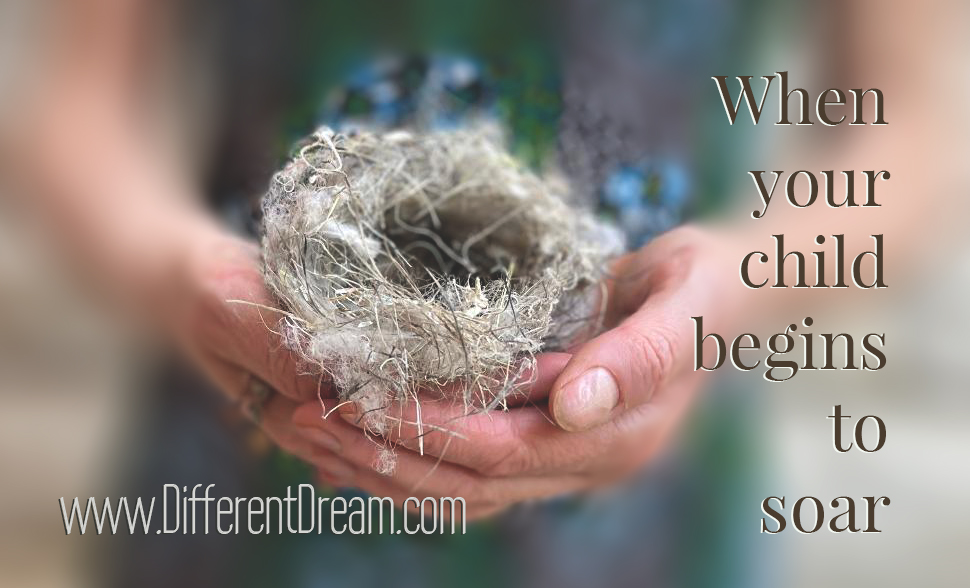
The empty nest feels like an unachievable possibility to caregiving parents whose children have conditions that threaten their lives and restrict their independence. In today’s post, guest blogger Maggi Gale looks at the empty nest she and her husband now share and wonders how it came about.

Out walking with my dog yesterday, something unusual on the ground caught my eye. It was a tiny bird’s nest that had fallen from a tree. As an early years teacher, I couldn’t resist picking this up and taking it home. We had talked about nests this week in class—now I could show them a real one!

Glancing at the nest this morning as it sat on my shelf waiting to go to school on Monday, I suspected there might be a deeper message in it, not for my class, but for me.

I’m a mother of 2 daughters, the younger one being born with TOF/OA (we’re British—TEF/EA for Americans). As anyone with experience with this condition will understand, early childhood in our home was an intense battle with a tricky oesophagus.

It is astounding that one small body part can wreak such havoc over family life for years on end. Our mealtimes were often fraught with vomiting, our social engagements sometimes ruined by “funny” comments about her “smoker’s cough,” and I had a single-track mind—how to feed my daughter so that she could escape the downward spiral of chronic infections.

We weren’t the sort of family you would call easy company for a night out.

Yet here we are in 2023, with both of our daughters leading independent, successful lives—flying their wings you could say. My TOF baby is now a 19-year-old au pair in England. That’s 4000 miles away from us, her mum and dad, as we work in the Middle East.

How did we get from there to here? I think the answer is one slow step at a time. In our case, the progress was so slow that it can only be perceived through looking back. The incidences of food getting stuck gradually turned from a few times a week to something less often. The chaotic rushes to the hospital became less frequent. And as she grew, my daughter assumed more responsibly for herself, preventing these awful incidences through meticulous planning, avoidance of triggering foods, and laborious chewing. That’s a lot to ask from a teenager, but life had given her very little choice.

People sometimes ask me if I miss my daughters. Well, nowadays, sometimes the fridge is very organized, which feels odd. Occasionally I notice a lack of Taylor Swift music blaring out of the bathroom, which feels strange. And now my calendar has fewer confusing scribbled notes on it of comings and goings, which looks a bit too tidy, somehow.

But do I miss them?

In my heart, there’s no room for missing. After our battles to feed and nourish my daughter, I cannot be anything but grateful that she has grown! After the years which seemed full of all of medical chaos, my daughter is now able to manage her condition, with just a little support on the end of the phone when needed. I am so grateful that somehow, imperceptibly at times, God not only got us through, but that my daughters have both become independent, successful, capable, and caring women.

Maybe you have your own version of this story. Your battle might not be with an oesophagus, but if you read this far, chances are you can relate to something I’m saying. In a word, there is hope. As we look back, we can sometimes see how far we have come. That tiny, empty nest I found has shown me that today.

Maybe I won’t take it to school after all.

Do you like what you see at DifferentDream.com? You can receive more great content by subscribing to the monthly Different Dream newsletter and signing up for the daily RSS feed delivered to your email.

By

Maggi is a wife and mother of two daughters. She is a primary school teacher, having worked in Africa for 14 years before moving to the Middle East. Her passions are her animals and art. Her youngest daughter was born with tracheoesophageal fistula (TEF). This birth condition was to be the start of an arduous journey, impacting the whole family for several years. Through writing, she hopes to turn her experiences into encouragement for others on similar paths.

Author Jolene Philo

Archives

Categories

Subscribe for Updates from Jolene

Related Posts

The Joy of an Unexpected Breakthrough

The Joy of an Unexpected Breakthrough

The Joy of an Unexpected Breakthrough

The joy of an unexpected breakthrough is worth waiting for. Guest blogger Mark Arnold felt that joy when his son James recently overcame his anxiety and did something he hadn’t done for five years.

Most of the time, a change of plan is inconsequential. It may be hard in that moment, but the effect of the change is minimal. Occasionally, though, a change of plan can be transforming and have a lasting, life-altering impact.

This is the story of the joy of an unexpected breakthrough.

James is twenty. A little over five years ago, epilepsy arrived, adding to diversities and additional needs that include autism and learning difficulties. The onset of epilepsy was more profound than we imagined at the time, as it sparked overwhelming feelings of anxiety. For fourteen months, James was unable to go outside. A breakthrough helped him to return to some familiar places that held positive memories, but nowhere new.

Last week that changed.

We took James to his weekly craft session at the local community center, a routine that’s been in place since September. Due to James’ anxiety, he won’t leave the car when we get there, so the team brings the craft to him. Since September we’ve made collage pictures of dinosaurs, elephants, Christmas trees, lions, sharks, and hedgehogs. But in the car, not in the classroom.

Until last week. Until the breakthrough.

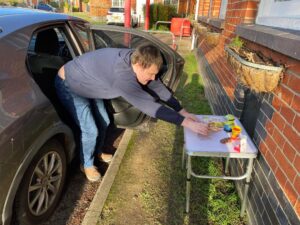
That day we parked near the entrance to the community center and used a new technique to coax James out of the car. We put a small folding table about three feet away from James’ door and put things James likes on it—iced gingerbread, crisps, his Minion nightlight, Play-Doh. Our hope was that James would step outside, collect something, and return to the car. We’ve had some positive results.

Last week James took us all by surprise.

Donna, a team member, passed the tray with the craft activity into the car, but there had been a mistake. She brought the craft from the week before. Donna and my wife Clare returned to the classroom to find a new craft activity. While we were waiting, I encouraged James to collect something from the table.

To my delight, he did so three times!

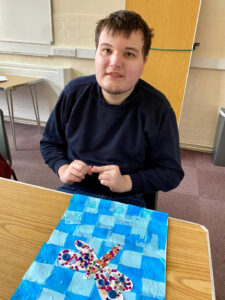
The third time, he stood by the table looking toward the entrance to the community center. I had to pull myself together and act fast. I slid out of the car on James’ side and gently encouraged him to walk to the entrance. Soon we were at the automatic doors. On we went into the foyer area where the sight of Clare helped him to move on again. Before we knew it, James was sitting at a table in the classroom. He sat at a table! He had a wonderful time creating a dragonfly picture. He was happy and engaged throughout. The challenge was getting him to stand up and return to the car an hour later. We were amazed, thrilled, proud of James, and slightly shocked. This was a mountain top. There will be valleys again.

But the view from that mountain top was magnificent!

Many families like ours have children who have been housebound for years. If that is you, let James’ story gives you hope. Hope that your child will be supported and have the joy of an unexpected breakthrough too. Hope of a mountain top moment sooner than you think.

Do you like what you see at DifferentDream.com? You can receive more great content by subscribing to the monthly Different Dream newsletter and signing up for the daily RSS feed delivered to your email.

By

Mark Arnold is the Additional Needs Ministry Director at Urban Saints, a leading national Christian children’s and youth organization. He is co-founder of the Additional Needs Alliance, a national and international advocate for children and young people with additional needs or disabilities. Mark is a Churches for All and Living Fully Network partner, a member of the Council for Disabled Children and the European Disability Network. He writes an additional needs column for Premier Youth and Children’s Work (YCW) magazine and blogs at The Additional Needs Blogfather. He is father to James, who has autism spectrum condition, associated learning disability, and epilepsy. To find out more about how Mark’s work can help you, contact him at: marnold@urbansaints.org or @Mark_J_Arnold

Author Jolene Philo

Archives

Categories

Subscribe for Updates from Jolene

Related Posts