EA/TEF Awareness Month 2023

EA/TEF Awareness Month 2023

EA/TEF Awareness Month 2023

EA/TEF Awareness Month begins each year as soon as the ball drops at Times Square. Different Dream is celebrating awareness month by featuring stories written by parents who are raising kids born with EA/TEF. Some are raising children who are still quite young. Others are parenting teens. Some, like me, have adult children who are out on their own.

Because Different Dream is a blog for parents raising kids with a variety of disabilities and special needs, not all of our readers are familiar with EA/TEF. If that’s the case for you, here’s a quick summary.

EA/TEF is short for esophageal atresia with or without tracheoesophageal fistula. No wonder it goes by its initials, right? EA/TEF is a congenital anomaly in which the esophagus is not a completely open tube. It has a number of several different types which are described and illustrated at this EA/TEF link. The condition is fatal unless newborns receive immediate treatment which requires surgery and a NICU stay. Each child’s recovery is unique, as this month’s guest blog posts will show.

Different Dream devotes all of January to raising awareness for a very simple reason. My son, born in 1982, was an adult before I met another EA/TEF parent. We lived in a very remote area of the United States for the first three years of his life, which is a partial explanation for our isolation. We moved to Iowa in 1985, but it took 2 decades and a connection with someone at our church for me to meet that first EA/TEF parent face to face. It still happens so rarely that reading the paragraph below (from an advertisement for a local pediatric clinic) got me really excited.
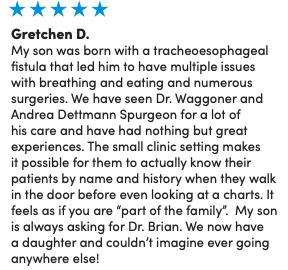
My hope is that when new EA/TEF parents search the internet, they’ll find this website and be encouraged by the stories shared here. I also hope that whether or not your child lives with EA/TEF, these stories will encourage you, too.

Do you like what you see at DifferentDream.com? You can receive more great content by subscribing to the monthly Different Dream newsletter and signing up for the daily RSS feed delivered to your email.

Photo by nine koepfer on Unsplash

By

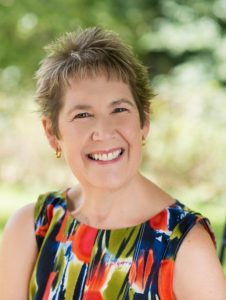
Jolene Philo is the author of several books for the caregiving community. She speaks at parenting and special needs conferences around the country. Sharing Love Abundantly With Special Needs Families: The 5 Love Languages® for Parents Raising Children with Disabilities, which she co-authored with Dr. Gary Chapman, was released in August of 2019 and is available at local bookstores, their bookstore website, and Amazon. See Jane Sing!, the second book in the West River cozy mystery series, which features characters affected by disability, was released in November of 2022.

Author Jolene Philo
Archives

Categories

Subscribe for Updates from Jolene

Related Posts
Jesus is FOR Caregiving Parents

Jesus is FOR Caregiving Parents

Jesus is FOR Caregiving Parents

Jesus is FOR caregiving parents, but when parenting gets rough it’s easy to forget that truth. In the fifth and final post of Heather Braucher’s FOR series, she talks about how she finds assurance of Jesus’ presence when the lows of parenting drag her down.

High highs and low lows is the phrase we have used this year when others ask how our family is doing. To be honest, I have been tempted to view life through the lens of dread, fearing hope because I have gotten so used to the other shoe dropping.

It feels easier to protect myself from the pain and disappointment that the unexpected can bring when I forgo hope and choose to remain jaded, skeptical, sarcastic, and cynical. It’s too risky to choose hopefulness.

Hope is like a balloon that wants to fly high in the sky and float. Hope says, “I don’t know what I will encounter, but right now, I feel joy and I want to embrace it and move forward.” Hope knows that fear is real and the unexpected might happen, but even in the face of that risk, it chooses to be brave in order to embrace joy.

Fear is like the weight that keeps the balloon from flying away. It keeps hope locked in the ground. Fear tells you to give up, stop trying, stop fighting the good fight and let sorrow win.

I had been struggling with this internal battle, feeling like I should let my balloon fly, but keeping it tethered for fear of future heartache. One day, in the midst of carrying the weight of it all—

  • The heaviness and intensity of having 2 boys with special needs,
  • The reality of a loved one’s suffering and limited time,
  • The consistent financial tension that living on a one-income ministry salary can bring,
  • and anything else unexpected that we just don’t have any margin for,

—I cried out to the Lord in surrender.

I cried out, completely overcome with it all, with no rest in sight, and completely devoid of hope that Jesus is for caregiving parents like us.

And in His great mercy, God answered and I saw our high highs and low lows from a new perspective.

I had been battling the great weight of those lows that kept piling up. I had been angry and frustrated because as soon as I would experience a win––be it good news, positive feedback, or a day with no phone calls from the school––something bad would happen within hours, even minutes of embracing joy.

When He answered the prayers of my heart, He reminded me that my struggle was not unseen by my God.

He gave me eyes to see, and I finally saw Him above everything else. I saw that

  • He kept showing up.
  • For every victory overcast by another trial, another victory would come.
  • He never stopped bringing joy.
  • He never stopped providing.
  • He never stopped healing.
  • He never withheld recovery.
  • We were never forsaken.

The high highs are proof that God keeps showing up. As often as pain comes, so does He. He even tells us in John 16:33 that we will have pain but need not fear because “I have overcome the world.”

We are reminded of this again in the book of Revelation. As believers in Christ, we know how this story ends. And it’s not on a low!

Jesus is for caregiving parents. Never forget that.

Part 1: We are FOR Parents and Children
Part 2: Mothers are FOR their Children with Disabilities and Special Needs
Part 3: Caregiving Spouses are FOR Each Other
Part 4: Caregiving Moms are FOR Other Caregiving Moms
Part 5: Jesus is FOR Caregiving Parents

Do you like what you see at DifferentDream.com? You can receive more great content by subscribing to the monthly Different Dream newsletter and signing up for the daily RSS feed delivered to your email.

Image by Rudy and Peter Skitterians from Pixabay 

By

Heather Braucher is a member of the “Braucher Bunch” aka her energetic family of 5. The bunch includes her husband and their three children, all of whom are dominant and extroverted and are going to change the world (if she can keep them alive!) She has always held a passion for writing, but motherhood has given her a reason to share her experiences, heartaches, and victories with others. In her writing you will hear stories of hope as well as grief, as her family has navigated life in ministry in the US and overseas, all while discovering that 2 of her children have special needs. Her desire is to provide others with connection, understanding, encouragement and laughter, all washed with the love of Christ.

Author Jolene Philo

Archives

Categories

Subscribe for Updates from Jolene

Related Posts

How Can I Be Grateful for Disability

How Can I Be Grateful for Disability

How Can I Be Grateful for Disability

How can I be grateful for disability? The question seems ludicrous, even unfeeling, when I consider what my father, son, and now my mother experienced due to disability.

So how is it, on this day after Christmas, I am grateful for the disabilities that continue to bring sorrow, pain, and loss to our family? The more I reflect upon this question, the more I see that the answer can be found in the smiles of my father, my son, and now my mother. Let me explain.

My father was bedridden for almost 3 decades. My mom was his primary caregiver with my sister, brother, and me playing supporting roles. He was completely dependent on us. We fed him, washed him, dealt with his bodily needs, and kept him company. When we entered Dad’s bedroom, he lit up. Not because of what he wanted us to do for him, but because we were with him.

Our infant son was similarly dependent upon my husband and me. Our baby’s first year was a revolving door of painful surgeries, invasive tests, and illness. Nevertheless, he smiled at us early. When we entered his room in the middle of the night to change his diaper, he smiled. When we talked and cuddled with him during his tube feedings, he smiled. When he was in the hospital and we sat beside his crib, he smiled. Not because we could take away his pain, but because we were with him.

To read the rest of How Can I Be Grateful for Disability, click here to visit the Key Ministry website for special needs parents.

Do you like what you see at DifferentDream.com? You can receive more great content by subscribing to the monthly Different Dream newsletter and signing up for the daily RSS feed delivered to your email.

Image by Grae Dickason from Pixabay 

By

Jolene Philo is the author of several books for the caregiving community. She speaks at parenting and special needs conferences around the country. Sharing Love Abundantly With Special Needs Families: The 5 Love Languages® for Parents Raising Children with Disabilities, which she co-authored with Dr. Gary Chapman, was released in August of 2019 and is available at local bookstores, their bookstore website, and Amazon. See Jane Sing!, the second book in the West River cozy mystery series, which features characters affected by disability, was released in November of 2022.

Author Jolene Philo

Archives

Categories

Subscribe for Updates from Jolene

Related Posts

How the Christmas Story is a Special Needs Story

How the Christmas Story is a Special Needs Story

How the Christmas Story is a Special Needs Story

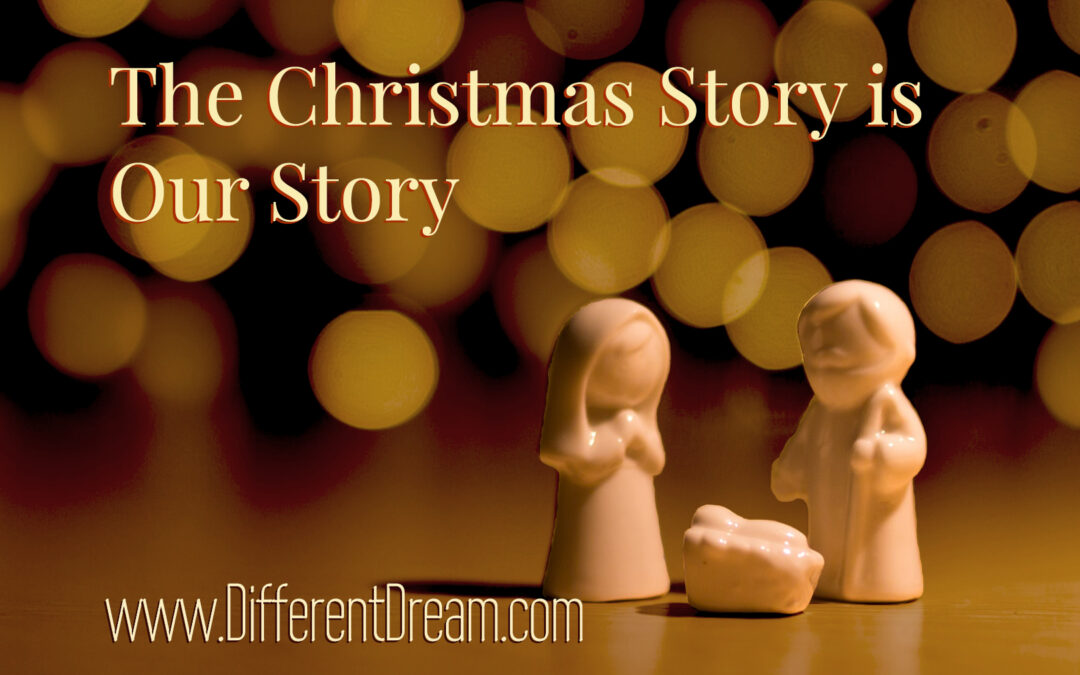
How the Christmas story is a special needs story is something guest blogger Mark Arnold is thinking about this time of year. What he has to say will help you see how Emmanuel, God with us, is with caregiving families in a deep and meaningful way.

Every year we hear the Christmas story of Mary and Joseph heading to Bethlehem, of the innkeeper, angels, shepherds, wise men, and of course the baby Jesus. Have you ever looked at it as a metaphor for special needs families? Here’s a look at how this story parallels the story of parents of children with special needs or disabilities.

Unexpected news

Mary is visited by the angel Gabriel who tells her that she will have a very special child. This surprised Mary. She was ‘greatly troubled at his words’ before she accepted his message and said, May it be to me as you have said.” (Luke 1:26-38)

For the families of children with special needs, unexpected news can arrive during a pre-natal scan. It can be troubling, devastating even. Not every parent accepts the news as Mary did. For some who learn their child will not survive or will be significantly disabled, parents grieve all that their child might have been.

A different location

Mary and Joseph traveled to Bethlehem for the census. Joseph, belonging to the house and line of David, had to register with Mary in Bethlehem, the town of David. (Luke 2:1-5)

Places where a baby with pre-birth concerns can be delivered may be limited. This might require a journey to an unfamiliar town. Though the trip won’t involve a ride on a donkey, it may still be a difficult journey.

Unexpected kindness

Mary needed somewhere safe to give birth to her baby in Bethlehem. Although there are no rooms available for them to stay in the inn, the innkeeper allowed them to use the stable, and the newborn baby was placed in the animals’ manger. (Luke 2:6-7)

Families of children born with special needs or a disability often mention one person who brought a cup of tea and a kind word during an overwhelming medical crisis. A simple act of kindness transformed their profoundly challenging situation into something a little more bearable.

Strangers

A bunch of shepherds turned up shortly after Mary gave birth. Goodness knows what she thought about this, exhausted as she was. Still Luke’s Gospel says that “Mary treasured up all these things and pondered them in her heart.” (Luke 2:8-20) Later, wise men or Magi from the East brought gifts and wanted to see the baby. (Matthew 2:1-12)

Families like ours get used to the arrival of strangers with impressive lists of medical and social care credentials, professionals involved in the care and support of the child and their family. We also ponder the support and care the professionals provide and wonder what the future holds for our child.

Hateful people

Mary and Joseph were warned that Jesus was in danger and fled to Egypt. King Herod ordered the death of all boys under two years old in the Bethlehem area, but was too late to catch Jesus and his family. (Matthew 2:13-18)

There are people today who do not understand or accept children with special needs or disabilities. They do and say hateful things. Some believe babies with special needs or disabilities should be euthanized. Families who encounter these views find them hurtful.

Home

Mary, Joseph, and Jesus eventually returned and set up a home in Nazareth near Galilee. It was Jesus’ earthly home during most of his life. (Matthew 2:19-23)

Many families of children born with special needs or disabilities wait a long time to bring their child home. Some never make it. Those who do come home to a different future than originally envisaged. Still it is a future that can be wonderful.

Seeing how the Christmas story is a special needs story can help us live more fully knowing that Jesus, God with us, and his parents experienced the challenges, and struggles we and other families face each day.

Do you like what you see at DifferentDream.com? You can receive more great content by subscribing to the monthly Different Dream newsletter and signing up for the daily RSS feed delivered to your email.

Photo by Gareth Harper on Unsplash

By

Mark Arnold is the Additional Needs Ministry Director at Urban Saints, a leading national Christian children’s and youth organization. He is co-founder of the Additional Needs Alliance, a national and international advocate for children and young people with additional needs or disabilities. Mark is a Churches for All and Living Fully Network partner, a member of the Council for Disabled Children and the European Disability Network. He writes an additional needs column for Premier Youth and Children’s Work (YCW) magazine and blogs at The Additional Needs Blogfather. He is father to James, who has autism spectrum condition, associated learning disability, and epilepsy. To find out more about how Mark’s work can help you, contact him at: marnold@urbansaints.org or @Mark_J_Arnold

Author Jolene Philo

Archives

Categories

Subscribe for Updates from Jolene

Related Posts

Caregiving Moms are FOR Other Caregiving Moms

Caregiving Moms are FOR Other Caregiving Moms

Caregiving Moms are FOR Other Caregiving Moms

Caregiving moms are for other caregiving moms. Or are we? In the fourth installment of her series, Heather Braucher describes the struggle many caregiving moms face in accepting and giving encouragement from other caregiving moms.

I was in a parent workshop listening to a speaker talk on the subject of behavioral therapy for children. I could sense that there were parents in the room—like me—who were in the thick of the struggle.

But there were also parents in the room who were on the other side. The side where victory and hope live.

During the talk, I battled the voice in my head that said, “Your situation is more complex. Your child’s struggles will never end. You will never be on the other side.”

I hate that voice. I believe it to be the voice of the enemy, the father of lies, who wants us to remain trapped in discouragement, devoid of hope.

I have become more aware of that voice. I guard my heart with prayer and keep my eyes open to recognize it. I prepared myself before the workshop by praying, “Lord, help me hold every thought captive to you. Help me hear what it is you have for me today.”

The voice and its thought, “That’s great for you, but there’s no hope for me here,” had wormed its way into too many areas of my life before.

I recall the early days when the kids were babies. Those days of sleep training, breast-feeding and behavior training. The days when well-meaning mothers and friends would share how their child is sleeping through the night, or how their child could listen and obey right away, or how 1-2-3 magic was the key. They were not wrong to share, but I often felt so discouraged.

But then I remember when my first child was about 11 months old and a friend passed along the book Healthy Sleep Habits, Happy Child. This was one of the first times a recommended strategy worked after applying it. I was in shock and over the moon ecstatic! Even so, I hesitated sharing about that book because I didn’t want to frustrate someone else.

So many times I had been around the table with other moms listening to their success stories and thinking, “That’s awesome for you, but it won’t work for me.”

How often do we see the success of others and think there has to be a reason they reached their goal? A reason that sets them apart from me? A reason that makes success more possible for them than it is for me?

Witnessing my son Jackson’s progress with speech and language development ever since he received adequate hearing has provided me with the most profound opportunity to recognize and celebrate progress! But it did not come easy. And I imagine that is true of so many other women who are sharing their stories of victory or recommendations.

We share because we have been in a place of suffering, and have found our way on the other side and we desperately want the same for others. I often blog about the blessing that suffering can bring. Trust me, I do not enjoy suffering. I used to avoid it at all costs. But I now know that the struggle, the long suffering, the day-to-day battle, make the awareness and ability to embrace being on the other side so sweet.

We cannot predict how quickly success can be achieved for others, but we can share our struggles and our wins in hopes of bringing others closer to being on the other side of their struggle. We can be caregiving moms who are FOR other caregiving moms.

I will close out this series with a post about how the Lord is FOR us!

Part 1: We are FOR Parents and Children
Part 2: Mothers are FOR their Children with Disabilities and Special Needs
Part 3: Caregiving Spouses are FOR Each Other
Part 4: Caregiving Moms are FOR Other Caregiving Moms
Part 5: Jesus is FOR Caregiving Parents

Do you like what you see at DifferentDream.com? You can receive more great content by subscribing to the monthly Different Dream newsletter and signing up for the daily RSS feed delivered to your email.

Image by StockSnap from Pixabay 

By

Heather Braucher is a member of the “Braucher Bunch” aka her energetic family of 5. The bunch includes her husband and their three children, all of whom are dominant and extroverted and are going to change the world (if she can keep them alive!) She has always held a passion for writing, but motherhood has given her a reason to share her experiences, heartaches, and victories with others. In her writing you will hear stories of hope as well as grief, as her family has navigated life in ministry in the US and overseas, all while discovering that 2 of her children have special needs. Her desire is to provide others with connection, understanding, encouragement and laughter, all washed with the love of Christ.

Author Jolene Philo

Archives

Categories

Subscribe for Updates from Jolene

Related Posts

New Blog for Christians Parenting the Mentally Ill

New Blog for Christians Parenting the Mentally Ill

New Blog for Christians Parenting the Mentally Ill

Christians parenting the mentally ill need other believers to support them. Today Lisa Pelissier is here to introduce Different Dream readers to a new blog designed to support Christian families impacted by mental illness and to equip extended family and friends to encourage them.

Statistics show that one in five adults in the United States suffer from mental illness. The numbers are even more sobering among young adults. Almost ten percent of people aged 18-25 find their life limited by mental health conditions. Sadly, these conditions tend to be hereditary, and many of us find ourselves dealing with more than one family member who is suffering.

Often, the church is unprepared for families suffering from these harrowing, invisible disorders. Because Christianity deals with the invisible facets of people’s lives, the lines between spiritual matters and mental health issues can become blurred. Misunderstandings abound, even amid good intentions.

As a wife, daughter, sister, and mother of people with mental illness, I know first-hand that it can be difficult to find support from other believers. Most of the time people are sympathetic, but to a great degree, they have no idea what it’s like to live in a world where you must walk on eggshells, fight for medical care, or figure how to discipline someone who can’t respond appropriately.

With this thought in mind, Amber Healy, Georgia Mathison, and I have started a blog, Eleventh Willow, to support Christians parenting the mentally ill. We hope to eventually cover a broad range of topics stemming from our own experiences in parenting our mentally ill children. A private Facebook group is also available to those who would like to connect on a more personal level.

Why “Eleventh Willow”? The willow is one of the most resilient trees. It symbolizes flexibility and adaptability, qualities necessary to parenting in general and to parenting in light of mental illness specifically. The willow tree is a survivor, but is also associated with grief and mourning—the weeping willow. In the Bible, the willow tree symbolizes rebirth (Ezekiel 17:5), loss and hope (Psalm 137), and celebration (Leviticus 23:40).

“Eleventh” comes from the eleventh hour—the last opportunity before it is too late. As parents of children with mental illness, we all feel that urgent desire for our child’s healing. Any hour could be the eleventh one—the moment our children are destroyed by their disease.

Our first five blog posts went live this month and deal with issues we have experienced in parenting our children with mental illness.

Amber, Georgia, and I—the Eleventh Willow bloggers—don’t have all the answers, but we are all seasoned mothers of mentally ill children and young adults. We hope to encourage, to inform, to love others on their similar journeys, and most of all, to provide that very needed support to those whose experiences with the church or with Christians have been less than ideal.

Image by Annette Meyer from Pixabay 

By

Lisa Pelissier lives in Oregon where she is a homeschooling mother of four (three with disabilities) and author of three middle-grade fiction novels as well as a YA fantasy novel. Lisa owns SneakerBlossom Books, offering Christian, classical homeschool Study Guides and curriculum. She blogs at Eleventh Willow, offering encouragement for Christians parenting the mentally ill. She also works as a freelance copy editor, an artist, a substitute teacher, and a tutor. In her spare time Lisa enjoys playing the piano and fretting about things over which she has no control. 

Author Jolene Philo

Archives

Categories

Subscribe for Updates from Jolene

Related Posts