Disability Ministry Goes After the One

Disability Ministry Goes After the One

Disability Ministry Goes After the One

Disability ministry goes after the one according to guest blogger Mark Arnold. In this post he explains how we can be like Jesus and do it too.

Sometimes I get asked why churches should make an effort to reach those with special or additional needs, when it means balancing their needs against those of the rest of the group. I always say the same thing.

Jesus told us to go after the one.

In the parable of the Good Shepherd, Jesus told of a shepherd leaving 99 sheep to find the one that was lost. Here’s the version from Luke 15:4-7.

“If a man has a hundred sheep and one of them gets lost, what will he do? Won’t he leave the ninety-nine others in the wilderness and go to search for the one that is lost until he finds it? And when he has found it, he will joyfully carry it home on his shoulders. When he arrives, he will call together his friends and neighbors, saying, ‘Rejoice with me because I have found my lost sheep.’ ” (New Living Translation)

Jesus uses this parable to explain how heaven rejoices more over one person who repents and comes to faith than for ninety-nine people who have never strayed. I like to think it can represent some children and young people with special or additional needs too.

They can sometimes be marginalized, overlooked, and “lost” to the rest of the church. They are sometimes sent away and excluded by the very people who should love them and care for them. I’ve heard stories of children with special or additional needs being told not to come back next week, or their parents told “this is not a special needs church”. I’ve even heard of children being excluded because “they might be a health and safety risk.”

But Jesus said to go after the one.

Disability ministry goes after the one by valuing the one: Too often, children and young people with special or additional needs are looked down on as of little value in our churches. The Good Shepherd valued the one sheep that had wandered off. In a way he valued the one more than the ninety-nine because he left them to search for the one. We need to value them, prioritize them, love them as Jesus does.

Jesus said to go after the one.

Disability ministry goes after the one by investing time and effort: The Good Shepherd scoured the wilderness looking for the one. We need to invest the time and effort needed to reach the children and young people we are journeying with. We can’t expect them to adapt, to change, to find the way themselves. The lost sheep needed the Good Shepherd to find it where it was and bring it home. Children and young people with special or additional needs require their leaders to do that too.

Jesus said to go after the one.

Disability ministry goes after the one by rejoicing in and with them: The Good Shepherd brought the lost sheep home and rejoiced because it had been saved. All too frequently, we don’t think about the spiritual welfare of children with special or additional needs. Their time in our groups becomes babysitting. But heaven rejoices for each person who is saved. We should do all we can to bring children and young people into God’s presence to show them their spiritual home and rejoice with them when they make little steps of faith.

Jesus said to go after the one. Will you?

Do you like what you see at DifferentDream.com? You can receive more great content by subscribing to the monthly Different Dream newsletter and signing up for the daily RSS feed delivered to your email.

Photo by Hiu Yan Chelsia Choi on Unsplash.

By

Mark Arnold is the Additional Needs Ministry Director at Urban Saints, a leading national Christian children’s and youth organization. He is co-founder of the Additional Needs Alliance, a national and international advocate for children and young people with additional needs or disabilities. Mark is a Churches for All and Living Fully Network partner, a member of the Council for Disabled Children and the European Disability Network. He writes an additional needs column for Premier Youth and Children’s Work (YCW) magazine and blogs at The Additional Needs Blogfather. He is father to James, who has autism spectrum condition, associated learning disability, and epilepsy. To find out more about how Mark’s work can help you, contact him at: marnold@urbansaints.org or @Mark_J_Arnold

Author Jolene Philo
Archives

Categories

Subscribe for Updates from Jolene

Related Posts

What Does My Child Remember about EA/TEF Treatment?

What Does My Child Remember about EA/TEF Treatment?

What Does My Child Remember about EA/TEF Treatment?

What does my child remember about EA/TEF treatment? That’s a question parents ask themselves often. In today’s EA/TEF Awareness Month post, guest blogger Valeria Conshafter reports on what her daughter says she remembers as they celebrate her 16th birthday.

She doesn’t remember anymore.

That’s what she told us, the other day at her birthday dinner when I mentioned this month was EA/TEF Awareness Month. I was surprised. I was surprised because I have not forgotten a single thing.

I remember everything.

Every month after receiving the news that our baby was born with a rare birth defect known as Esophageal Atresia/Tracheoesophageal Fistula (EA/TEF). I remember.

My only child, my daughter Sofia, was born 16 years ago in January. She is a bright and vigorous teenager. Full of life. Thankfully, I believe, the worst is over.

“All I remember” Sofia said, “is that I wanted that pink, butterfly, rolling carry-on suitcase from the hospital’s gift shop and that Daddy was carrying me, and then I got it. I got the pink butterfly suitcase. But I don’t even know what I was there for. I don’t even think about this EA/TEF stuff anymore. It’s like it doesn’t even exist.”

“Oh, the other thing I remember” she continued, “is that I had to drink that nasty stuff for an x-ray and then afterwards the doctor told me I didn’t have to come back to see him anymore.”

“I remember it too, honey,” was my reply.

I remember everything.

I remember that was the day of her last surgery. The 12th one. She was 4 and wanted that pink suitcase for her first trip to Brazil to visit her grandparents. I also remember the day that she got clearance from having yearly esophograms, which happened just 5 years ago.

I remember each of her hospital stays, ER visits, and the many frightening moments at home.

There were too many to count. The life-threatening ones where I thought I was going to lose her.

Sofia may not remember all that we went through with her in and out of surgeries, all the holidays and important dates we spent in the hospital, the multitude of doctors, diagnoses, or all the choking episodes. But I do.

I will never forget; I know that as well.

I am certain that all that she went through is part of who she is and who she is becoming. Her strength doesn’t come solely from her genes or great personality, but from years of enduring treatments, recovering from surgeries, and all the suffering she endured too.

My girl is strong. My girl is amazing.

She is also full of scars and carries trauma. Her determination to do her best in all she puts her mind to comes from the warrior energy that she had as a child. A child who had to fight for her life.

Her narrative is different from many other teenagers her age.

It’s even different from mine—her mother who’s been there for her ever since. But for her, what she remembers is that she came out of that last surgery with a prize and that she did not have to ever go back to drink that nasty liquid. From now on she is gathering new memories and adventures to remember later. She will then be able to tell whatever part of her story she wants to tell and how she got to be the strong woman she’s sure to become from all her experiences.

Even when I remember it all, for her what matters is the here and now.

For those of you who are going through the difficult times right now, who are asking yourselves, “What does my child remember about EA/TEF treatment?” know that your babies will most likely remember very little of all what they went through. They will most likely not remember the hardships you went through or those difficult days you remember.

They will remember life differently than we do.

I know it is hard and there’s trauma along the way, but there’s healing too. Oh, am I still healing! But the truth is that your child’s story should be theirs to tell, however they remember it.

Your story and how you dealt with everything will have a space of its own; to inspire and to encourage those who are in it right now. But for this moment I want to sit with the fact that she is here and that she is okay. That she does not have remember anything as I do. She is free.

Happy Birthday, Sofia!

Do you like what you see at DifferentDream.com? You can receive more great content by subscribing to the monthly Different Dream newsletter and signing up for the daily RSS feed delivered to your email.

Photo by Sime Basioli on Unsplash

By

Valeria Conshafter is a native of Brazil. She has a background in Counseling Psychology and currently works for a women’s organization providing emotional and spiritual support to women all over the country. She loves writing, cooking, and praying for her family and friends. Valeria lives in Houston, Texas, with her husband Todd, their 15-year-old daughter, Sofia, and their two Standard Poodles, Chocolate and Oreo. You can find Valeria on InstagramTwitter, and Facebook.

Author Jolene Philo

Archives

Categories

Subscribe for Updates from Jolene

Related Posts

Top Ten Perks of Raising a Child with Disabilities

Top Ten Perks of Raising a Child with Disabilities

Top Ten Perks of Raising a Child with Disabilities

Raising kids with disabilities comes with its own set of challenges and reasons to be grateful. Because this is EA/TEF Awareness Month and our son was born with EA/TEF, my top ten perks of raising a child with disabilities will be slanted in that direction.

Years of experience have shown me that disability parents, whatever their child’s disability might be, have much in common. I hope these perks resonate with you, make you laugh, make you cry, and increase your gratitude.

#1: My Child Was Made by God in His Image

When I grieve the loss of my dreams for my child—a true grief to work through—the knowledge that he is exactly who God made him is a comfort for which I am always grateful.

#2: My Vocabulary Expanded

As an educator, I consider expanding my vocabulary to be a positive development. So many words entered my vocabulary after our son was born—barium swallow, GI specialist, stuckies, feeding tube, Nissen fundoplication, dilation, and more. How can I not be grateful for them?

#3: I Consider the Ability to Swallow Marvelous

Until our son was born, I thought swallowing of a normal bodily function. After he was born, I saw it as the marvel it is. And when his swallowing challenges diminished, my gratitude knew no bounds.

#4: I Appreciate Medical Advances

The EA/TEF surgery protocols have changed drastically since we became parents in 1982. From the introduction of anesthesia during newborn surgery to dainty button-feeding tubes and much more, I am grateful for today’s newborns being treated more humanely and effectively than ever before.

To read the rest of the Top Ten Perks of Raising a Child with Disabilities, visit Key Ministry’s blog for special needs parents.

Do you like what you see at DifferentDream.com? You can receive more great content by subscribing to the monthly Different Dream newsletter and signing up for the daily RSS feed delivered to your email.

Image via Jake Muller at DisabilityisBeautiful.com

By

Jolene Philo is the author of several books for the caregiving community. She speaks at parenting and special needs conferences around the country. Sharing Love Abundantly With Special Needs Families: The 5 Love Languages® for Parents Raising Children with Disabilities, which she co-authored with Dr. Gary Chapman, was released in August of 2019 and is available at local bookstores, their bookstore website, and Amazon. See Jane Dance!, the third book in the West River cozy mystery series, which features characters affected by disability, was released in October of 2023.

Author Jolene Philo

Archives

Categories

Subscribe for Updates from Jolene

Related Posts

An EA/TEF Update: Oliver’s Story

An EA/TEF Update: Oliver’s Story

An EA/TEF Update: Oliver’s Story

An EA/TEF update on families who told their stories in previous EA/TEF Awareness Months means a lot to our community. Today, busy mom and guest blogger, Kelly Simpson is back with an update on her son Oliver, whom readers met during EA/TEF Awareness Month, 2023. I hope you enjoy hearing about his progress in the past year as much as I did.

Oliver’s Story

  • Normal ultrasounds and no issues caught or seen during pregnancy.
  • Born at 39 weeks.
  • C-section due to coning.
  • Born unable to swallow: OBGYN and Oliver’s doctor on call decided to have Oliver transferred to Norton’s Children’s Hospital in Kentucky.
  • Diagnosed with Tracheoesophageal Fistula (EA/TEF) Type C.
  • EA/TEF repair two days after birth.
  • 19-day stay in the NICU.

Life after the NICU:

  • At 6 weeks Oliver started to have problems swallowing milk. His pediatrician suggested an Ear, Nose, and Throat doctor. A swallow test confirmed narrowing of the esophagus. Esophageal dilation (stretching of the esophagus) at 6 weeks, 8 weeks, and again at 12 weeks.
  • At 6 weeks he was also diagnosed with tracheomalacia or floppy trachea, which leads to extra movement with crying, laughing, or coughing. Most kids sound like a goose, and cough is deep sounding like a bark.
  • At 4 months, he was escorted to Norton’s Children for respiratory distress. He was placed in the ICU for a week with aid from a ventilator.
  • At 6 months old, he had a second ICU stay for a week for respiratory distress, aid from a ventilator.
  • At 10 months old, he had a 4-day ICU stay for respiratory distress.
  • Received an airway clearance vest to help keep his airway clear.
  • Age 3 included multiple cases of pneumonia
  • Age 4 saw multiple cases of pneumonia

An EA/TEF update since last year’s story:

  • Oliver is almost 5 years old.
  • He is healthy and in the 98th percentile for both weight and height. What a blessing!
  • He has not needed an esophageal dilation since he was 12 weeks old.
  • Eats and drinks normally with no restrictions.
  • Does require a little extra water with meals just in case.
  • Loves to run!
  • Starts Kindergarten in the Fall!

What a wonderful EA/TEF update!

By

Kelly has lived her whole life in Kentucky. She and her husband, Jeremy, have a four-year-old son, who, born during a deployment, was diagnosed with tracheoesophageal fistula. She has always felt a calling to serve others and is living the dream as an Army wife, middle school teacher, and now, as an encourager to those who are living a dream different than they had planned.

Author Jolene Philo

Archives

Categories

Subscribe for Updates from Jolene

Related Posts

Lessons from First Year EA/TEF Parents

Lessons from First Year EA/TEF Parents

Lessons from First Year EA/TEF Parents

Today’s lessons from first year EA/TEF parents come from guest bloggers Katharine and Jake. As is often the case, their advice will benefit more than the EA/TEF crowd. It will resonate with parents of children with a wide variety of disabilities. Perhaps it will resonate with you.

Our family’s story began at our son’s 20-week anatomy ultrasound when our son Mason was diagnosed with congenital hydrocephalus. This condition causes an abnormal buildup of cerebrospinal fluid in the brain causing a wide range of developmental delays. At birth, he was unexpectedly diagnosed with another birth defect where the esophagus and stomach are not properly connected, called tracheoesophageal fistula and esophageal atresia (TEF/EA). He spent 6 weeks in the NICU, as he needed multiple surgeries to repair and manage these diagnoses.

It is hard to believe that we are approaching Mason’s first birthday. We have adjusted to a busy schedule over the past year. We attend regular developmental therapy appointments and see many medical specialists, both in our local area and over 2 hours away. Our son is delayed in meeting most developmental milestones. However, he is resilient and makes progress each day. There have been some bumps along the road, including unexpected hospital stays and new challenges, but seeing his bright smile every morning is our greatest motivation.

These are four lessons our son has taught us in his first year:

#1: Celebrate the “inchstones.”

It can feel discouraging to focus on big milestones, like head control, sitting independently, and walking. It is difficult to do other things in our life, like housework or hobbies we enjoy, because it feels like he needs our attention all the time if he’s going to make progress. We remind ourselves that he is developing at his own pace. Instead of the milestones, we celebrate each small incremental stride our son makes while working on those bigger goals.

#2: We are his greatest advocates.

While we are surrounded by a great medical team, we know our son best. At each appointment, we learn all that we can about his condition and how each provider can help our son. We constantly ask questions and give our opinions. Ultimately, we come to a collective decision with our son’s providers to make the best medical decisions for him.

#3: Try it again, try it differently.

Our son came home feeding mostly from a gastrostomy tube (G tube). We tried changing so many things and thinking outside the box to improve his ability to drink from a bottle. Eventually, with the right combination at the right time, he succeeded with the bottle at four months old and now enjoys purees. Mason is always changing. We constantly reevaluate what he needs to succeed and are not afraid to return to things that previously failed.

#4: Remember all the good.

This is hard. Some days can be very hard. The stress and the difficulty of this experience can be overwhelming, especially when you are comparing it to what other parents experience or your own expectations. But no matter the added challenges, the smiles, laughs, and love are still there, perhaps even more so. Embrace it all, most of all your lessons as first year EA/TEF parents.

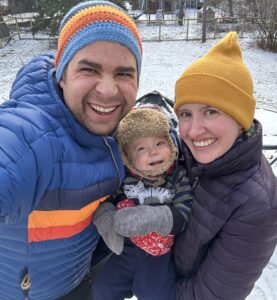
Jake, Mason, and Katharine Kaczmarowski

Do you like what you see at DifferentDream.com? You can receive more great content by subscribing to the monthly Different Dream newsletter and signing up for the daily RSS feed delivered to your email.

Image courtesy of Katharine and Jake

By

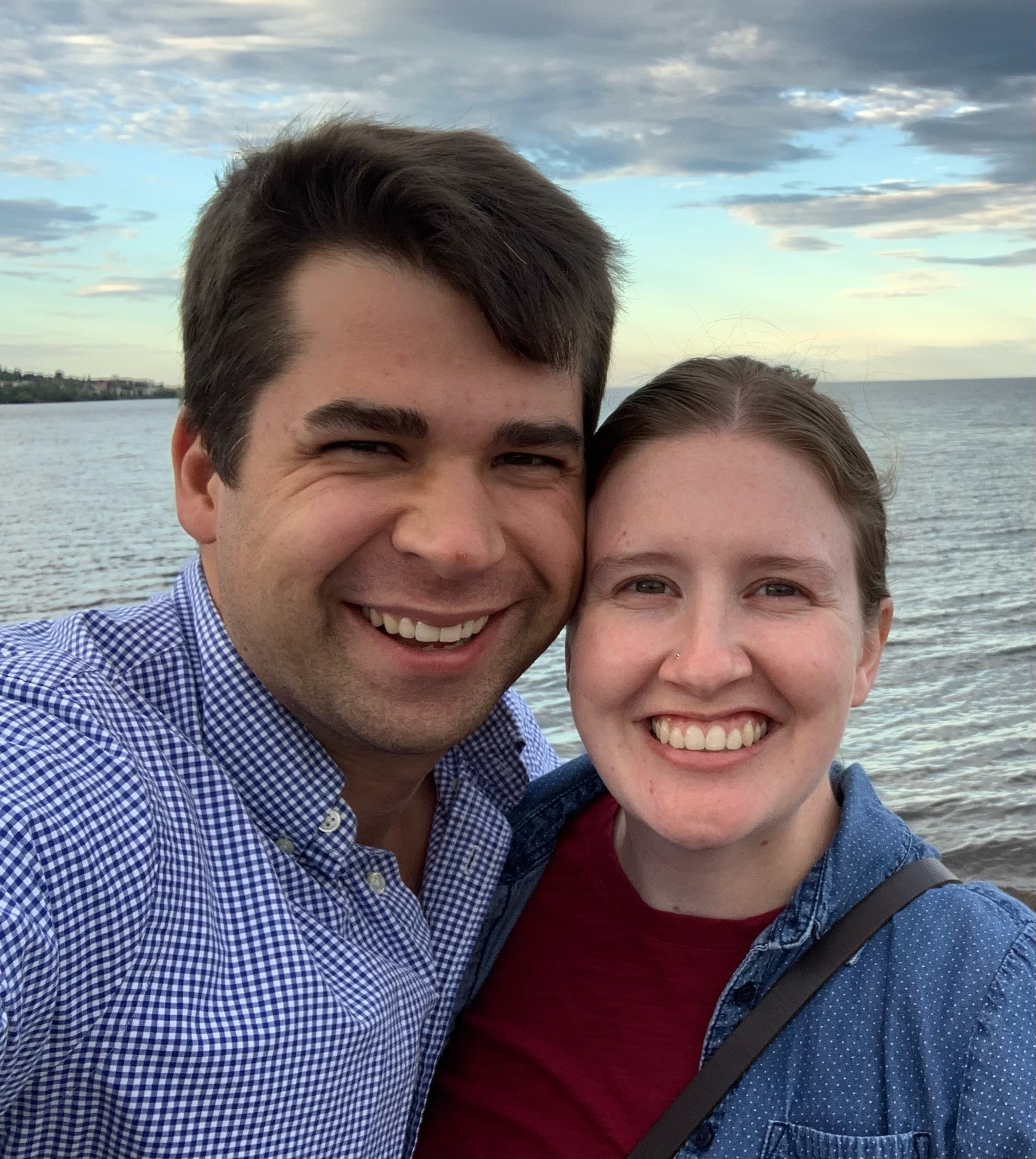
Katharine and Jake are young professionals living in Minnesota with their son, Mason. He was born in early 2023 with congenital hydrocephalus and TEF/EA (associated with VACTERL). He also has a chromosome 6q26-q27 deletion. They have been married for two and a half years and each day strive to parent as a team. As a family, they enjoy strolling along Lake Superior’s shore with their dog.

Author Jolene Philo

Archives

Categories

Subscribe for Updates from Jolene

Related Posts

EA/TEF Awareness Month 2024

EA/TEF Awareness Month 2024

EA/TEF Awareness Month 2024

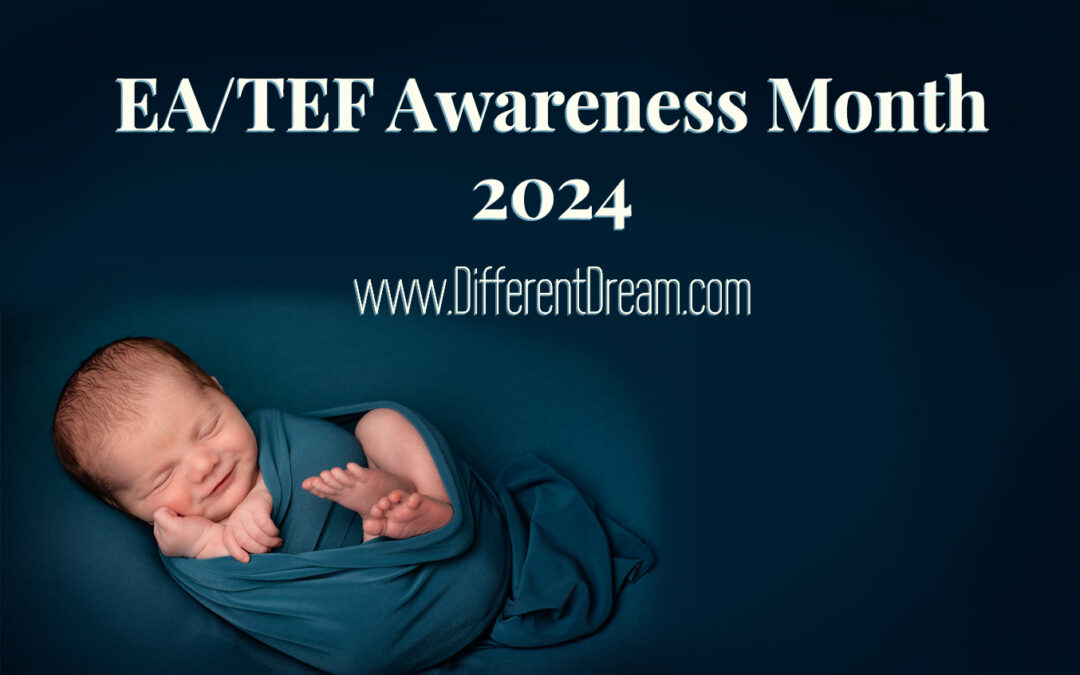
EA/TEF Awareness Month, 2024 is here. Once again Different Dream is raising awareness by featuring stories written by or about families impacted by EA/TEF. Some parents are telling their child’s story for the first time. Others are providing updates on kids featured here in the past. And then there’s me, the parent of a son born with EA/TEF in 1982, who will wrap up the month with a post about our family’s experience.

Different Dream is a blog for parents raising kids with a variety of disabilities and special needs, so not all of our readers are familiar with EA/TEF. If that’s the case for you, here’s a quick summary.

EA/TEF is short for esophageal atresia with or without tracheoesophageal fistula. No wonder it goes by its initials, right? It’s a congenital anomaly in which the esophagus is not a completely open tube. It has a number of variations which are described and illustrated at this link.

The condition is fatal unless newborns receive immediate treatment, which requires surgery and a NICU stay. Each child’s treatment and recovery are unique, as you will see when you read this month’s posts.

Different Dream devotes all of January to raising awareness for many reasons, the most important being to reach families dealing with this birth anomaly so they feel supported. My hope is that when new EA/TEF parents search the internet, they’ll find this website and be encouraged by the stories shared here. I also hope that whether or not your child lives with EA/TEF, these stories will encourage you and equip you to support parents and kids who do.

Do you like what you see at DifferentDream.com? You can receive more great content by subscribing to the monthly Different Dream newsletter and signing up for the daily RSS feed delivered to your email.

Photo by Adele Morris on Unsplash

By

Jolene Philo is the author of several books for the caregiving community. She speaks at parenting and special needs conferences around the country. Sharing Love Abundantly With Special Needs Families: The 5 Love Languages® for Parents Raising Children with Disabilities, which she co-authored with Dr. Gary Chapman, was released in August of 2019 and is available at local bookstores, their bookstore website, and Amazon. See Jane Dance!, the third book in the West River cozy mystery series, which features characters affected by disability, was released in October of 2023.

Author Jolene Philo

Archives

Categories

Subscribe for Updates from Jolene

Related Posts