Life with a Rare Disease in 20 Enchanting Moments

Life with a Rare Disease in 20 Enchanting Moments

Life with a Rare Disease in 20 Enchanting Moments

Life with a rare disease is often portrayed as a series of challenges. But these 20 word pictures from guest blogger Laura Spiegel show the enchanting life of a little girl who happens to have cystic fibrosis. 

Sometimes, I think my daughter’s cystic fibrosis is the least rare thing about her. She dazzles brighter than a thousand suns and lives with a gusto entirely her own. Here are 20 enchanting moments of her seven-year-old life with a rare disease.

  1. She parades down the street in heart glasses and a ladybug umbrella, but only when the sun is shining.
  2. Her Dairy Queen order is unfailingly consistent. A rainbow popsicle with a unicorn on top. To date, DQ has yet to stock this delicacy.
  3. She delivers flower petals and small notes to our neighbors. Not the kids, but the adults. Doesn’t matter if she just met you. You’re getting a doorstep delivery.
  4. She wrote a book about a boy named Smyth. Everything in Smyth’s life came up roses…until he was snatched from his room by a blob.
  5. She recently told me that her brain hid under the covers at night with a flashlight and a scary story. That’s how bad dreams are made. 
  6. She’s developed a newfound love of plant maintenance. Watering is her jam. Lest we forget, a sign reminds the rest of us to “keep out.” P.S. She “means it.”
  7. She wants to sell the lawnmower. Moving forward, she will be plucking the grass by hand.
  8. Her favorite outfit is a red Minnie Mouse shirt, magenta pants, and orange knee socks adorned with spiders. Beware the socks. They bite.
  9. Last Christmas, she gave me the best gift I’ve ever received. It was a book by Lisa Wingate. She found it on Amazon by searching for “chapter books for moms.”
  10. She has requested a twin sister named Ellie. The sole purpose is for playing tricks on others.
  11. She makes Unicorn Squad videos on the regular. Most feature hulahooping or other amazing feats. One was a 45-minute tutorial on how to dust a barstool.
  12. She went wild with the temporary hair color while I was out. It’s not so temporary, but she sports her blue patch with pride.
  13. She spent all her money on a globe, then made a list of places she wants to travel. First up: Alashankou, China.
  14. Six months ago, she wrote a song about a mermaid and a big, bad bee. It had several verses and matching moves. I am routinely pop quizzed on what I can remember. (I have yet to pass). 
  15. She runs a cafe in our kitchen called Cookies. Cookies does not serve dessert; just honey sandwiches with a healthy dose of red pepper seasoning. The fare is surprising…spicy.
  16. Her favorite show is The Bachelor. It’s not so age-appropriate, but she’s committed to seeing if her top pick will win. 
  17. She sleeps with a lamb perched atop her head at night. It protects her from nightmares, presumably by selecting the stories her brain gets to read.
  18. She likes to transcribe my phone calls on the driveway in chalk. “Mommy is talking to the doctor.” “Mommy is mad at So-and-So.” Let’s hope So-and-So isn’t local…
  19. She takes 213 pills each week to help her manage her with a rare disease. The bigger the fistful, the better, in her eyes. Choking hazards be damned.
  20. To avoid respiratory therapy the other day, she told us that she “didn’t have CF anymore.” Mad points for creativity. 

Cystic fibrosis is a big part of my daughter’s life, but it does not define her. Sure, there are days where treatments get in the way of what she’d rather be doing. Where we have to turn down an invitation because the germs aren’t worth the risk. But seven years in, my daughter’s life bursts with a vibrancy that soars well beyond a diagnosis code. 

Like all of our children who live with special medical, developmental, or behavioral health care needs, she deserves to be celebrated for her hopes. For her dreams. For all the colors of her personality. 

And like all of our children, she leads a life with a rare disease in a way that is entirely her own.

Do you like what you see at DifferentDream.com? You can receive more great content by subscribing to the monthly Different Dream newsletter and signing up for the daily RSS feed delivered to your email inbox. You can sign up for the first in the pop up box and the second at the bottom of this page.

By

Laura Spiegel spent 12 years at the world’s largest biotech company, partnering with professionals and care teams to help people with special needs and disabilities lead full and happy lives. In 2013 her daughter was diagnosed with cystic fibrosis. Laura now hosts Paint Her in Color, a website that offers emotional support to parents of children with special medical, developmental, or behavioral health care needs. When she isn’t reading, writing, or soaking up time with her husband and kids, Laura can be reached at Paint Her in Color, by email at laura@paintherincolor.com, and on Facebook and Twitter.

Author Jolene Philo

Archives

Categories

Related Posts

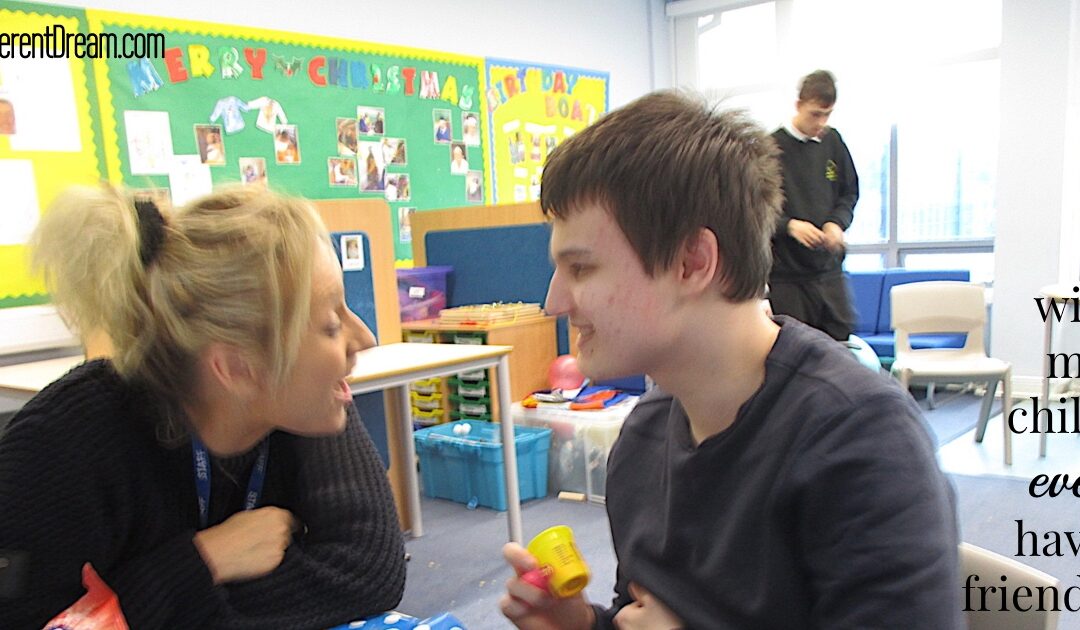
Would Someone Be Friends with My Autistic Child?

Would Someone Be Friends with My Autistic Child?

Would Someone Be Friends with My Autistic Child?

The viral story of a young autistic boy who recently asked his parents a similar question led Mark Arnold to ask the same about his son, James. In today’s post, Mark shares the answer he found.
Our son James has autism, a learning disability and epilepsy. He’s never had the kind of friendships that most children and young people have. He’s never had friends round to the house or gone to someone else’s house. He stopped being invited to children’s parties when he was about six or seven.
When James was unable to leave the house due to severe anxiety, no friends visited  him. Nobody called. It’s been a similar story during the COVID-19 lockdowns.

But is that the full story? Would someone be friends with my autistic child if they knew him? Are there already young people who like my son James?

I remember that once James was able to go out again, one of the first places we visited was the farm shop where he loves to go. They sell things that James enjoys, and it is also a safe place for James. Many of the staff are kind to him. They know him by name, ask him how he is doing, and don’t mind if he eats what he has chosen before we pay for it! But are they his friends?
I remember how when James was at church, people interacted with him. They asked how he was doing, cared for him. But these lovely people are all adults. None of them are his age. None of them are what might be understood as friends.

I remember when James was about to start re-engaging in school through short visits. The weekend before his first visit I bumped into Brendan, a student in his class, and his mum at the supermarket. When I mentioned that we were bringing James in for a school visit the following week, Brendan literally jumped for joy. He and kept repeating James’ name and was delighted to see James again!
When James is back at school regularly, three short days a week, he interacts with other students. Arya is one of them who regularly asks about James and seems genuinely pleased to see him. Maybe James does have some friends of his own age after all.

The viral story of a young autistic boy who asked his parents if he would ever have friends brought attention to the often lonely world of children and young people with autism. Perhaps this post will help us ask a question to help all children be included: What can I do today to make a difference for someone I know?

Do you like what you see at DifferentDream.com? You can receive more great content by subscribing to the monthly Different Dream newsletter and signing up for the daily RSS feed delivered to your email inbox. You can sign up for the first in the pop up box and the second at the bottom of this page.

By

Mark Arnold is the Additional Needs Ministry Director at Urban Saints, a leading national Christian children’s and youth organization. He is co-founder of the Additional Needs Alliance, a national and international advocate for children and young people with additional needs or disabilities. Mark is a Churches for All and Living Fully Network partner, a member of the Council for Disabled Children and the European Disability Network. He writes an additional needs column for Premier Youth and Children’s Work (YCW) magazine and blogs at The Additional Needs Blogfather. He is father to James, who has autism spectrum condition, associated learning disability, and epilepsy. To find out more about how Mark’s work can help you, contact him at: marnold@urbansaints.org or @Mark_J_Arnold.

Author Jolene Philo

Archives

Categories

Related Posts

EA/TEF Awareness Month Has Arrived

EA/TEF Awareness Month Has Arrived

EA/TEF Awareness Month Has Arrived

EA/TEF Awareness Month has arrived. Before writing the introduction for January 2021, I looked at last year’s introduction. It was refreshingly lacking in anything COVID or pandemic-related. It was, however, replete with mentions of a medical condition that caught families totally off guard and changed the course of their lives. It happened to my husband and I in 1982 when our first child was born in 1982 with Type C, the most common kind of EA/TEF. 

Since the pandemic began in March of 2020, my thoughts have often returned to the difficult days and months after our son was born. What we experienced then was similar to what our country is experiencing now. I think the stories other EA/TEF parents share this month will give readers hope as the pandemic continues. Because these stories make clear some truths I learned as an EA/TEF parent and as I interact with other EA/TEF parents.

Life is fragile.
Life is precious.
Life is hard.
Life can be good even when it’s hard.
You can endure more hard stuff than you think you can.
You are more resourceful than you know.
You are more blessed than you realized.
You can be changed for the better once you know that life is fragile, precious, hard, and good even when it’s hard.

If you’re an EA/TEF who believes these truths, please share your story in the comment box below. If you’re in the thick of the hard stuff and can’t imagine anything good coming from what you’re experiencing, share your story, so we can cry with you and lift you up. Because EA/TEF Awareness Month has arrived, and that’s how EA/TEF parents roll.

Do you like what you see at DifferentDream.com? You can receive more great content by subscribing to the monthly Different Dream newsletter and signing up for the daily RSS feed delivered to your email inbox. You can sign up at the bottom of this page.

By

Jolene Philo is the author of the Different Dream series for parents of kids with special needs. She speaks at parenting and special needs conferences around the country. She’s also the creator and host of the Different Dream websiteSharing Love Abundantly With Special Needs Families: The 5 Love Languages® for Parents Raising Children with Disabilities, which she co-authored with Dr. Gary Chapman, was released in August of 2019 and is available at local bookstores, their bookstore website, and at Amazon.

Author Jolene Philo

Archives

Categories

Related Posts

Strategies to Meet the Needs of Typical Siblings

Strategies to Meet the Needs of Typical Siblings

Strategies to Meet the Needs of Typical Siblings

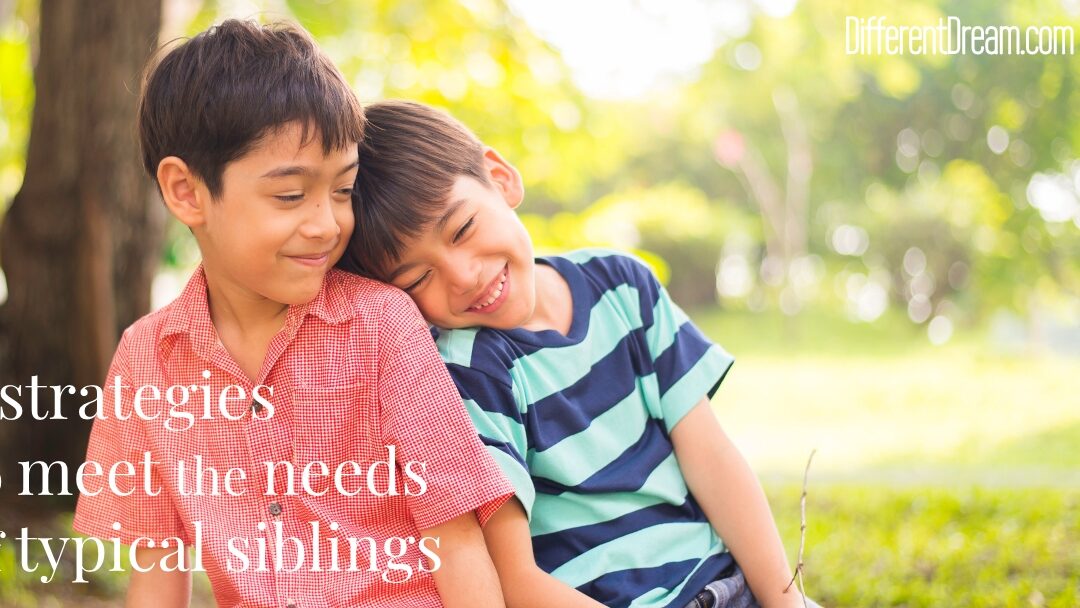
Strategies to meet the needs of typical siblings are the focus of this post by clinical neuropsychologist and special needs parent Jessica Temple. She shares 6 ways to show typical siblings how much they matter to your family.

My husband and I are working on balancing the needs of our two children. These are some of the strategies we are using.

Strategy #1

Ensure that all children are physically and emotionally safe. This means every child needs a safe place in the home and is not at risk of being hurt. 

Strategy #2

Communicate with typical siblings. In age-appropriate language, discuss the condition your child with special needs lives with, what it means, how it affects your family, and if typical siblings can catch it. Provide time for questions. 

Strategy #3

Acknowledge and praise milestones and accomplishments of typical siblings. Thank them for their help, understanding, patience, and the time they put in. 

Strategy #4

Give typical siblings time with friends. Also provide time with other kids who “get it” through in person and online sibling support groups. 

Strategy #5

Make sure to spend quality alone time with typical siblings. Be creative. Offer snuggle time in the morning, have secret jokes or rituals, present a special meal or ice cream time, go on an outing, or have special reading time. Be sure you are fully present and in the moment with just that one child. 

Strategy #6

Help your child develop coping strategies. These are a few favorite mindfulness and meditation strategies to try with your child:

  • Breathe in like an expanding balloon and exhaling as if blowing out a candle.
  • Create a mental/visual bubble that blocks out stress and lets all their favorite things inside.
  • Picture stress drifting down a stream on a leaf or floating away on a cloud.
  • Take mindful walks.  

Our family has made some positive strides using these strategies to meet the needs of typical siblings. It’s a process, but we are confident that we can raise both children to be happy and well-adjusted humans. 

Do you like what you see at DifferentDream.com? You can receive more great content by subscribing to the monthly Different Dream newsletter and signing up for the daily RSS feed delivered to your email inbox. You can sign up for the first in the pop up box and the second at the bottom of this page.

By

Jessica Temple, PsyD, ABPP-CN, is a board-certified adult clinical neuropsychologist. She has two children who have special needs. She and her husband, Lewis, host a podcast called Thriving in The Midst of Chaos, where they talk about all aspects of special needs including getting a diagnosis and treatment, self-care, relationships, transitioning to adulthood, school, and finances. They created Thriving in The Midst of Chaos to offer support to others in the special needs world as well as to provide an easy way to find the most useful resources. They aim to share helpful resources with others, advocate for improvement, change in the special needs world, and offer a different perspective on parenting.    To find out more about how Jessica’s work can help you, contact her at fubarpod@gmail.com or @midstofchaospod on all social media platforms.  

Author Jolene Philo

Archives

Categories

Related Posts

Concerns of Siblings of Children with Special Needs

Concerns of Siblings of Children with Special Needs

Concerns of Siblings of Children with Special Needs

Concerns of siblings of children with special needs are often overlooked by parents overwhelmed by caregiving needs. In this post Jessica Temple, a clinical neuropsychologist and special needs parent, addresses sibling concerns head on.

Our oldest child began to exhibit aggression around the time his younger brother was born. He was later diagnosed with autism. We tried  to protect the new baby from being hit, pinched, smacked, but it wasn’t always possible. I felt guilty whenever something happened to the baby Now the kids are 2 and 4, and I feel guilty for other reasons. Such as focusing my attention on the sensory needs of older boy while coordinating and participating in therapies at the expense of time with his brother. This got me thinking. What do siblings of children with special needs need? How do they see things? What can we as parents do to better support typical siblings?  

Concerns of Siblings of Children with Special Needs

It is helpful to be aware of the concerns siblings of children with special needs may have. They see their parents spending time and effort on the child with special needs, and they see parents struggling to meet their own needs. They see the stress their parents are experiencing. This can make typical siblings strive for perfection so they won’t be an added burden to their parents. They become mini-adults to relieve the load on their parents. In some cases, parents ask siblings to help with the care of their sibling throughout the day. Some children are expected to be their siblings’ primary caretakers once they reach adulthood or their parents have passed away, without input about their wants, needs, and desires. 

They may believe they can’t share feelings common to special needs siblings like these:

  • Inadequate time with parents.
  • Their parents don’t care as much about them as they do the other child.
  • Anger or resentment toward the sibling who receives more attention. 
  • Embarrassed by the behavior of a special needs sibling.
  • Their parents brush off their problems or concerns. 
  • Isolated from friends because of their siblings’ behaviors or embarrassed when friends ask questions.

Even though their issues may appear small compared to those of the child with special needs, they are valid and important and should be approached as such. 

Managing Parental Expectations in Light of Sibling Concerns

Parents aren’t always aware of their expectations regarding their typically-developing children. Neither expectations are too low or too high are fair. It is important to set and convey realistic expectations of each child along with unconditional support. Parents also need to allow typical siblings to work through their feelings by implementing these practices:

  • Provide patience, understanding, time, and guidance. 
  • Validate their concerns. 
  • Model ways to cope and manage emotions. 
  • Allow them autonomy to choose how involved they want to be with their sibling, both on a day-to-day basis and in the future. 

It’s unfair to require the assistance and participation of typical siblings without involving them in the decision-making process. They have a right to their own lives.

Jessica will be back in a few weeks with more helpful strategies for parents who want to address the concerns of siblings of children with special needs.

Do you like what you see at DifferentDream.com? You can receive more great content by subscribing to the monthly Different Dream newsletter and signing up for the daily RSS feed delivered to your email inbox. You can sign up for the first in the pop up box and the second at the bottom of this page.

By

Jessica Temple, PsyD, ABPP-CN, is a board-certified adult clinical neuropsychologist. She has two children who have special needs. She and her husband, Lewis, host a podcast called Thriving in The Midst of Chaos, where they talk about all aspects of special needs including getting a diagnosis and treatment, self-care, relationships, transitioning to adulthood, school, and finances. They created Thriving in The Midst of Chaos to offer support to others in the special needs world as well as to provide an easy way to find the most useful resources. They aim to share helpful resources with others, advocate for improvement, change in the special needs world, and offer a different perspective on parenting.    To find out more about how Jessica’s work can help you, contact her at fubarpod@gmail.com or @midstofchaospod on all social media platforms.  

Author Jolene Philo

Archives

Categories

Related Posts

Consider, Respect, and Honor: 3 Words for 2 Parents with 1 Goal

Consider, Respect, and Honor: 3 Words for 2 Parents with 1 Goal

Consider, Respect, and Honor: 3 Words for 2 Parents with 1 Goal

Consider, respect, and honor. Guest bloggers Tom and Julie Meekins believe these 3 words are foundational as 2 parents who have 1 goal of doing what’s best for their daughter with special needs. In today’s post, they explain how you can use them, too.

Making medical, therapy, social, and educational decisions for a child with challenges is daunting for moms and dads who are co-parenting them. When you add to the mix 2 parents with different ways of looking at life, processing information, coming to and implementing a decision, the task can be difficult. We encourage you to take into account 3 things as you interact with your child’s other parent: consider, respect, and honor.

Consider the viewpoint of the other parent. In most cases each parent wants what is best for the child. Therefore, it’s important to ask them what they think and how they feel. They may process the information and how it will impact all the rest of life differently than you. They may be quick to make decisions and be ready to act almost immediately. You may want to roll it around in your mind longer. You may want to factor in a bigger picture; or maybe you are the one who is itching to act and you feel held back. This can be frustrating. For example, in most cases Julie was often ready to jump on a plan before giving Tom the chance to express his concerns. It was important to Tom that he have a chance to look at the idea from every angle–financial, practical, spiritual, timing, and its impact on the family. Julie learned to give Tom the time to process and share his thoughts. Often, he came up with ideas that Julie never thought of and that were important for the situation.

Respect the co-parent’s feelings and methods. Remember to interact with grace and validate their ideas and feelings even when you don’t agree. Be a team player. Each of you brings an important component for the best of the child. Listen to each other well. Remember this isn’t a competition. The child wins when parents respect each other.

Honor one another’s role of co-parent. Whether you are co-parenting under the same roof or from separate households, remember that the other individual is also a parent to your child. In most cases, they have just as much of a right to make decisions for this child as you do. Their ideas are worthy of your consideration. We are not saying that you shrink back from sharing your convictions. We are saying that while you are making decisions, remember, as parents, you are a team.

In addition to the consider, respect, and honor, we suggest that you individually start each decision process with a deep breath, a time of prayer, and a commitment to listen carefully for God’s answer. Then, come to the table ready to execute your game plan having considered, respected, and honored the other parent.

Make my joy complete by being like-minded, having the same love,
being one in spirit and of one mind. Do nothing out of selfish ambition or vain conceit.
Rather, in humility value others above yourselves. (NIV)
Philippians 2:2-3

Do you like what you see at DifferentDream.com? You can receive more great content by subscribing to the monthly Different Dream newsletter and signing up for the daily RSS feed delivered to your email inbox. You can sign up for the first in the pop up box and the second at the bottom of this page.

By

Tom and Julie Meekins have been married for 41 years and are the parents of four adult children, the youngest of whom was diagnosed with CHARGE Syndrome. They are the directors of Champions4Parents which is a ministry dedicated to bringing hope, encouragement, and empowerment to parents–all parents–and especially those raising a child who has challenges. They invite you to visit their website at Champions4Parents.com and email them at champions4parents@gmail.com.

Author Jolene Philo

Archives

Categories

Related Posts