Empowering Kids with Disabilities, Part 1: Meet Basic Survival Needs

Empowering Kids with Disabilities, Part 1: Meet Basic Survival Needs

Empowering Kids with Disabilities, Part 1: Meet Basic Survival Needs

Empowering kids with disabilities is important, right? I mean, parenting is about empowering and equipping our kids to self-advocate to the best of their abilities, right?

And yet.

If my experience of raising a child with special needs is anything like yours, empowering my kid with disabilities rarely reached the top of my parenting priority list. For a long time, we were too busy keeping our son alive. Once he was healthy, we were too busy recovering from the trauma of keeping him alive.

You know what I mean.

Many years later, during my career as an elementary teacher, I took a professional development course based on William Glasser’s Choice Theory. The name of the course is long forgotten, but it revolutionized my teaching. It changed my relationships with students because it showed me how to empower them, whether or not they had disabilities, by addressing their basic human needs every single day.

It was powerful stuff.

Even after I left teaching, Glasser’s principles found their way into my books. They now inform my work with adult learners and parents raising kids with disabilities. They shape how I interact with my adult children and my four amazing grandchildren. The principles work because they focus on the needs common to humans of all ages. So what are those needs?

I’m so glad you asked!

As identified by Glasser, the five basic human needs, all powerful motivators in children and adults, are survival, love and belonging, power, fun, and freedom.

To read the rest of Empowering kids with disabilities, visit Key Ministry’s blog for special needs parents.

Do you like what you see at DifferentDream.com? You can receive more great content by subscribing to the monthly Different Dream newsletter and signing up for the daily RSS feed delivered to your email.

Image by Sally Wynn from Pixabay 

By

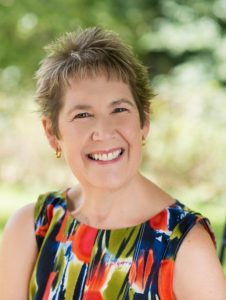
Jolene Philo is the author of several books for the caregiving community. She speaks at parenting and special needs conferences around the country. Sharing Love Abundantly With Special Needs Families: The 5 Love Languages® for Parents Raising Children with Disabilities, which she co-authored with Dr. Gary Chapman, was released in August of 2019 and is available at local bookstores, their bookstore website, and Amazon. See Jane Sing!, the second book in the West River cozy mystery series, which features characters affected by disability, was released in November of 2022.

Author Jolene Philo
Archives

Categories

Subscribe for Updates from Jolene

Related Posts
The Joy of an Unexpected Breakthrough

The Joy of an Unexpected Breakthrough

The Joy of an Unexpected Breakthrough

The joy of an unexpected breakthrough is worth waiting for. Guest blogger Mark Arnold felt that joy when his son James recently overcame his anxiety and did something he hadn’t done for five years.

Most of the time, a change of plan is inconsequential. It may be hard in that moment, but the effect of the change is minimal. Occasionally, though, a change of plan can be transforming and have a lasting, life-altering impact.

This is the story of the joy of an unexpected breakthrough.

James is twenty. A little over five years ago, epilepsy arrived, adding to diversities and additional needs that include autism and learning difficulties. The onset of epilepsy was more profound than we imagined at the time, as it sparked overwhelming feelings of anxiety. For fourteen months, James was unable to go outside. A breakthrough helped him to return to some familiar places that held positive memories, but nowhere new.

Last week that changed.

We took James to his weekly craft session at the local community center, a routine that’s been in place since September. Due to James’ anxiety, he won’t leave the car when we get there, so the team brings the craft to him. Since September we’ve made collage pictures of dinosaurs, elephants, Christmas trees, lions, sharks, and hedgehogs. But in the car, not in the classroom.

Until last week. Until the breakthrough.

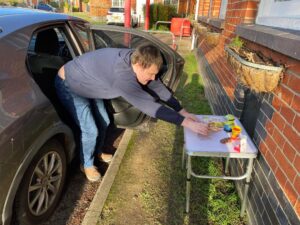
That day we parked near the entrance to the community center and used a new technique to coax James out of the car. We put a small folding table about three feet away from James’ door and put things James likes on it—iced gingerbread, crisps, his Minion nightlight, Play-Doh. Our hope was that James would step outside, collect something, and return to the car. We’ve had some positive results.

Last week James took us all by surprise.

Donna, a team member, passed the tray with the craft activity into the car, but there had been a mistake. She brought the craft from the week before. Donna and my wife Clare returned to the classroom to find a new craft activity. While we were waiting, I encouraged James to collect something from the table.

To my delight, he did so three times!

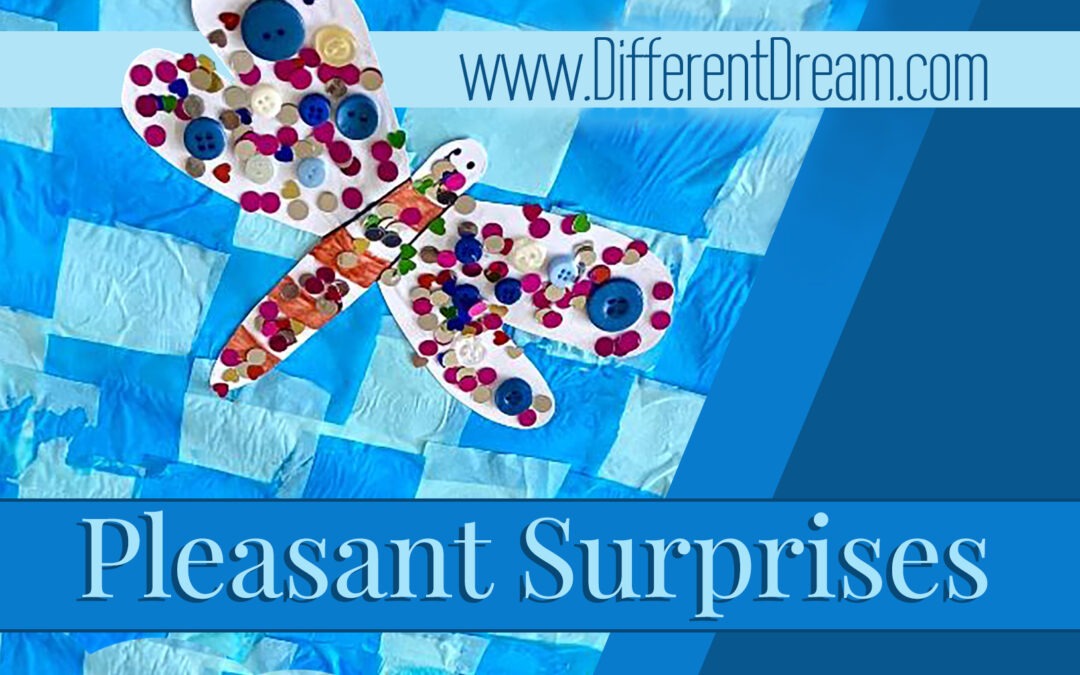
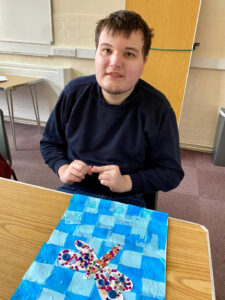
The third time, he stood by the table looking toward the entrance to the community center. I had to pull myself together and act fast. I slid out of the car on James’ side and gently encouraged him to walk to the entrance. Soon we were at the automatic doors. On we went into the foyer area where the sight of Clare helped him to move on again. Before we knew it, James was sitting at a table in the classroom. He sat at a table! He had a wonderful time creating a dragonfly picture. He was happy and engaged throughout. The challenge was getting him to stand up and return to the car an hour later. We were amazed, thrilled, proud of James, and slightly shocked. This was a mountain top. There will be valleys again.

But the view from that mountain top was magnificent!

Many families like ours have children who have been housebound for years. If that is you, let James’ story gives you hope. Hope that your child will be supported and have the joy of an unexpected breakthrough too. Hope of a mountain top moment sooner than you think.

Do you like what you see at DifferentDream.com? You can receive more great content by subscribing to the monthly Different Dream newsletter and signing up for the daily RSS feed delivered to your email.

By

Mark Arnold is the Additional Needs Ministry Director at Urban Saints, a leading national Christian children’s and youth organization. He is co-founder of the Additional Needs Alliance, a national and international advocate for children and young people with additional needs or disabilities. Mark is a Churches for All and Living Fully Network partner, a member of the Council for Disabled Children and the European Disability Network. He writes an additional needs column for Premier Youth and Children’s Work (YCW) magazine and blogs at The Additional Needs Blogfather. He is father to James, who has autism spectrum condition, associated learning disability, and epilepsy. To find out more about how Mark’s work can help you, contact him at: marnold@urbansaints.org or @Mark_J_Arnold

Author Jolene Philo

Archives

Categories

Subscribe for Updates from Jolene

Related Posts

Off the Beaten Path

Off the Beaten Path

Off the Beaten Path

Guest blogger Lisa Pelissier relates her struggles with her children’s differences and wonders why it is so hard to accept life just as it is.

I’m an experienced mom. I’ve been one for twenty-two years. I’m also experienced at parenting children with invisible disabilities. I’ve been that for twenty-two years as well. But most of the time I’m still floundering, wondering what to do, how to cope, and how to help my children move forward.

Mental illness and autism are similar in that they both remove a person from the expected path of life—high school, college, job, marriage, babies—and into something completely different. And they do this behind the scenes. To look at my children, it’s not apparent why they are struggling. They look fine.

But sometimes they just can’t do the thing.

Every time we come to a roadblock, a place where one of my children balks at progressing, I feel panicked. I don’t know what to do. I don’t know how to help. Do I let them play video games around the clock because it helps them feel better? Do I force them to go outside and play, knowing that they’ll come back in 20 minutes with a severe headache because it was more than they could do? Do I seek answers in medication? Therapy? Prayer? Special diets? Vitamins?

The truth is, there are not always answers. Whatever solution I come up with is not going to be the right one because I can’t fix this. I can’t. I can’t make my kids not be autistic. I can’t make them not be depressed. I can’t make them free from anxiety. I can’t make them think clearly when their minds just can’t do it.

Can medication help? Of course. Can therapy help? Certainly. And so can prayer, special diets, vitamins, and a host of other solutions that people apply to make things better. All of those things have been helpful.

So why do I still feel frantic every time one of my children goes off the rails?

1) Because I long for them to “do the thing”—I want their lives to follow that expected pattern. I want them to grow up and happily leave home for jobs and families of their own. I don’t want them to be on this alternate path where everything is strange and unknown to me.

2) Because I think I need to fix everything—Taking care of my children is my job. When there are things I can’t fix, I’ve obviously failed.

3) Because I hate to see them hurting—Mental illness is more than just a nontraditional path through life. It’s a nontraditional path through a bed of nails while drowning in an acid sea. Embracing their differences is hard to do when those differences are torture for my kids.

So what can I do? How can I approach my children’s disabilities without losing my mind?

I can respond to each of the above points in turn. Stop expecting them to “do the thing.” Stop trying to fix everything. Love them in the midst of their pain instead of panicking about it. But the bottom line is that I need to trust God. He is the One who allowed these disabilities and illnesses to beset my children, just as he allowed Paul a thorn in the flesh and allowed Job to lose his livelihood and family. He is their Creator, and He has a right to do with us all as He pleases. He is also our Redeemer, the lover of our souls, and our Father who gave His only Son to buy us back from Hell.

Shouldn’t that be enough?

Do you like what you see at DifferentDream.com? You can receive more great content by subscribing to the monthly Different Dream newsletter and signing up for the daily RSS feed delivered to your email.

Photo by Mael BALLAND on Unsplash

By

Lisa Pelissier lives in Oregon where she is a homeschooling mother of four (three with disabilities) and author of four middle-grade fiction novels as well as a YA fantasy novel. Lisa owns SneakerBlossom Books, offering Christian, classical homeschool Study Guides and curriculum. She blogs at Eleventh Willow, offering encouragement for Christians parenting the mentally ill. She also works as a freelance copy editor, an artist, and a substitute teacher. In her spare time Lisa enjoys playing the piano and fretting about things over which she has no control. 

Author Jolene Philo

Archives

Categories

Subscribe for Updates from Jolene

Related Posts

The Days Are Long, but the Years Are Short

The Days Are Long, but the Years Are Short

The Days Are Long, but the Years Are Short

“The days are long, but the years are short.”

I repeat this phrase while I sit on the couch listening to my 7-year-old grandson read for a half hour every evening.

Each time he turns a page, he says something like, “Wow, Grammy! What do you think that is?” or “I wonder what will happen next?” He ignores the words on the page and launches into several winding, imaginative explanations.

My grandson really, really likes to talk. And use his imagination. As for the reading part? Not so much.

Which is why I eventually have to suggest, “Read the page and find out.”

He follows my suggestion—he can read more fluently than he believes—and finds out. Then he turns the page and begins the same process all over again.

To contain my impatience, I whisper to myself, “The days are long, but the years are short.”

One evening as we read, my mind wandered back to when our son was young and medically fragile. When complications arose—maybe he had a fever, refused to eat because of an oral aversion, or vomited his food because of an esophageal blockage—our days were very, very long.

Should we wait to see if he got better? Or worse?

Could we wait until morning to go to the doctor? Or call him right now?

Should we race to the emergency room in our car? Or should we call the ambulance?

Not only were the days long, but also the nights.

When our son turned four, I told my mother, “The years since he was born feel like a lifetime. Maybe it’s because we haven’t gotten a complete night of sleep since he was born.”

Mom smiled and said, “The days are long, but the years are short.”

To read the rest of The Days Are Long, but the Years Are Short, visit the Hope Anew website.

Do you like what you see at DifferentDream.com? You can receive more great content by subscribing to the monthly Different Dream newsletter and signing up for the daily RSS feed delivered to your email.

Image by Donnie0102 from Pixabay 

By

Jolene Philo is the author of several books for the caregiving community. She speaks at parenting and special needs conferences around the country. Sharing Love Abundantly With Special Needs Families: The 5 Love Languages® for Parents Raising Children with Disabilities, which she co-authored with Dr. Gary Chapman, was released in August of 2019 and is available at local bookstores, their bookstore website, and Amazon. See Jane Sing!, the second book in the West River cozy mystery series, which features characters affected by disability, was released in November of 2022.

Author Jolene Philo

Archives

Categories

Subscribe for Updates from Jolene

Related Posts

My Baby with EA/TEF Changed My Life in 5 Big Ways

My Baby with EA/TEF Changed My Life in 5 Big Ways

My Baby with EA/TEF Changed My Life in 5 Big Ways

My baby with EA/TEF changed my life in big ways, says guest blogger Karena Skibinski. The same is true for any parent of a child born with EA/TEF. It’s the ways our babies change us that varies. You’ll discover how Karena’s story is the same and what’s different from yours. For those who aren’t EA/TEF parents, Karena’s story will raise your awareness of this rare birth anomaly.

The day after my son Lincoln was born was the day I learned about Esophageal Atresia (EA)/Tracheoesophageal Fistula (TEF). We had some yellow flags during pregnancy that were being monitored but never did we envision an 87-day NICU stay. The night that he was born, Lincoln was transported to the NICU at Cincinnati Children’s Hospital. As it turned out, it’s one of the best in the nation with one of the best doctors in the world for Lincoln’s condition.

Those initial days were an indescribable fog. I spent hours scouring the internet, trying to find as much information as I could about his prognosis. The best way to summarize my findings is to say that each EA/TEF child’s journey is unique; the best thing to do is to take it one step at a time.

Lincoln is 15 months this month (January 2023), and that feels incredibly special. Every day deserves a celebration. I’d be lying if I said this journey was easy. This past year has been the most challenging of my life and one of the absolute best. It’s given me a different, more colorful perspective on life, one that I’m still trying to find the words to describe.

One thing I know is that my baby with EA/TEF changed my life in big ways. I’d like to share 5 of those ways with you here.

  1. I didn’t return to my full-time job once my maternity leave was over. Lincoln was still in the NICU once my 12-week leave passed by, and I couldn’t imagine having to go back to work while he was still in the hospital. Extending my leave wasn’t an easy option so I submitted my resignation. We had to adjust our priorities over this past year to make it work financially for our family, but I am incredibly lucky for my supportive partner and the means to be able to stay home. It’s been a busy year, full of follow ups with numerous doctors, therapy appointments, outpatient procedures (dilations), and trips to the ER. Despite the challenges, I am so grateful for being with him, day in and day out.
  1. I view self-care differently nowadays. Prior to becoming a stay-at-home mother, I enjoyed the typical self-care of an afternoon at a coffee shop, dinner out, or treating myself to some new moisturizer and makeup. Now my self-care looks different—an uninterrupted shower, a sunny afternoon walk with my boys, or a solo Target run for the essentials. I once thought that basic activities like taking a shower or running an errand should not be considered self-care for moms, and maybe that’s true; for now, in this season of my life, it can be.
  1. I’m familiar with the medical team and the role of each doctor in Lincoln’s plan of care. I’m much more confident with speaking up for and advocating for my baby. I’m comfortable with asking enough questions to get a good understanding of his plan of care. Parents are an integral part of the treatment team; we know our babies best. The confidence I’ve gained from this experience has spilled over into other areas of my life.
  1. I’ve adjusted my views on developmental milestones. Given my background as an occupational therapist (OT), I used to be anxious about Lincoln’s delays. I worried I wasn’t doing enough to get him “on track”. As time passed, I realized that life can be fully enjoyed regardless of Lincoln’s developmental timeline. One of my physical therapist friends reminded me that it’s not so much the age that’s so important, but the progression of skills. That perspective helped a lot.
  1. I find greater joy in the mundane. It’s important to note that a lot of things have remained comfortably the same. We experience the typical squabbles that any family with 1 and 3-year-olds have. We still love our nature walks, going to the park, story time, and cooking dinners together. I’m still growing my own OT practice.

My baby with EA/TEF changed my life in big ways. Our family is finally finding a good rhythm. This is our journey, and I wouldn’t change a thing.

Do you like what you see at DifferentDream.com? You can receive more great content by subscribing to the monthly Different Dream newsletter and signing up for the daily RSS feed delivered to your email.

Image by arodsje from Pixabay 

By

Karena Skibinski is a mother, occupational therapist, and host of the what about the mama? podcast. After taking a year off to be home with her children, Karena recently started facilitating baby-and-mom circles to provide education and support during the fourth trimester and beyond. When she’s not busy running around with her two toddlers Lenny (3) and Lincoln (15 months) or working, you can find her in the kitchen trying new recipes, going on long walks, or taking an afternoon nap. Through her work, her mission is to bring more awareness to EA/TEF and to provide reassurance to EA/TEF families that they aren’t alone.

Author Jolene Philo

Archives

Categories

Subscribe for Updates from Jolene

Related Posts

God Authored our Disability Story

God Authored our Disability Story

God Authored our Disability Story

God authored our disability story. It took a while for guest blogger Valeria Conshafter to say that about her daughter’s birth and EA/TEF diagnosis. In this post, she traces the journey from what she wanted her daughter’s story to be to what it is. For those of you struggling to accept your child’s story, may her words grant you perspective and faith to know that it is good.

We can’t change history. We can’t tell our life story differently. Things just had to happen this way.

My daughter was born with a birth condition known as Esophageal Atresia/Tracheoesophageal Fistula (EA/TEF). I didn’t plan for that. I didn’t want that for her. Or us. I had no idea that was coming. But it did.

The unexpected news of your baby being born with a rare birth defect and multiple other congenital anomalies was shocking. She was right there within arm’s reach, but we were not able to hold her until weeks later after her birth. Everything went wrong.

The story I believed would be mine to tell was of a perfect birth, natural, special, with mom and baby doing well announcements.

The story I wanted to tell long before she was even born was that we had a healthy and perfect baby and motherhood was amazing minus the feeding schedule and poopy diapers.

I imagined our story to be exactly like the ones I’d seen before. Mom and babies on play dates, parks, toddlers eating by themselves. I imagined us traveling with our baby to see friends and family everywhere, going oversees to meet my family in Brazil. I imagined the perfect beach vacation with my baby full of sand and those amazing first time on the beach photographs. I envisioned all the perfect first holidays, filled with family, fun, and special baby outfits. But no, that was not our story. Ours was different. One that I did not plan for, or ever imagine being possible.

It so happened that God authored our story. It had nothing to do with what I wanted or planned for. He had other plans for us and decided to bring our daughter into our world just the way she was supposed to be. Birth defects and all.

As first-time parents, bringing your newborn baby home is already overwhelming. Bringing a special needs baby home after months in the hospital was overwhelming, challenging, and scary. I remember not wanting to leave the hospital because I didn’t think I would be able to care for my daughter well enough. When I heard the nurse telling me, if she goes blue, rush back to the hospital, I thought I was living a nightmare. Parenting sounded terrifying!

Our first year was not an ordinary one.

We were back and forth to the hospital more than I can recall. We skipped play dates, traveling, and all the normal things parents do before their baby turns one. There were two major surgeries that first year and a total of 12 surgeries before she was 4.

Mealtimes took forever and were always stressful.

Most of our holidays were spent in the hospital, like her first Thanksgiving, Halloween, Valentine’s Day, and our birthdays. We left the hospital on Christmas Eve to spend Christmas at home and were back again before the New Year. Luckily, we spent her first birthday at home, but our baby could not eat solids by mouth yet.

Her birthday cake was just for the pictures.

In between hospital stays we looked for glimpses of normalcy and were grateful for the break. It was not easy. The visits to the various specialists were a constant stress followed by a multitude of instructions, tests, and daily therapies. There were critical times, scary moments, and 911 calls. There were long days and endless nights in the ICU when we did not know what to expect for the next day.

Fortunately, God always knew!

When I couldn’t see one day to the other between sleepless nights, inconclusive results, and surgery outcomes, He did. When I was at my lowest, He lifted me up. When I failed to believe, He showed me differently. When I doubted, He proved me wrong. And so, we kept on going. Praying. Trusting. Being amazed by His grace and promises.

Our story has changed over the years.

There are still challenges and the future is unknown. But so much has passed. Today, I am so grateful for all our girl has overcome. I am still in awe about God’s power, healing my daughter so she can be the teenager she is supposed to be right now. We’ve learned so many lessons from her. She is a fighter. Determined. Strong. Resilient.

Most of all, I love our story! It could not have been told differently. God authored our story, and it is our life story. Hard, broken, unique, but ours to live and to tell.

I would not change a thing.

Do you like what you see at DifferentDream.com? You can receive more great content by subscribing to the monthly Different Dream newsletter and signing up for the daily RSS feed delivered to your email.

Image by freestocks-photos from Pixabay 

By

Valeria Conshafter is native of Brazil. She has a background in Counseling Psychology and currently works for a women’s organization providing emotional and spiritual support to women all over the country. She loves writing, cooking, and praying for her family and friends. Valeria lives in Houston, Texas, with her husband, Todd, their 15-year-old daughter, Sofia, and their two Standard Poodles, Chocolate and Oreo. You can reach Valeria on Facebook, on Instagram, and on Twitter.

Author Jolene Philo

Archives

Categories

Subscribe for Updates from Jolene

Related Posts