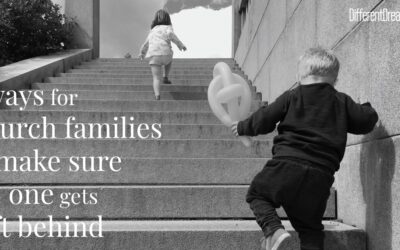
Meeting Sensory Needs with Fidgets and Fiddles

Meeting Sensory Needs with Fidgets and Fiddles

Meeting Sensory Needs with Fidgets and Fiddles

Meeting sensory needs with fidgets and fiddles is one way to make church events accessible and welcoming for children. Guest blogger Mark Arnold is here to help you better understand sensory needs and to provide ideas about what to put in a sensory box.

All of us are sensory creatures. That means our senses can be under-responsive (hyposensitive), or over-responsive (hypersensitive) at times. Because of this we regularly have to balance our sensory systems, often subconsciously. This sometimes takes the form of sensory seeking behaviors, which try to activate the senses in any way possible. In children and adults this may result in feet, finger or pencil tapping, hair twirling, nail biting, or pen clicking.

In the absence of anything to support their sensory seeking needs at school or church, children may become distracted, disengage, or even use a peer as a fidget or fiddle item!

Meeting sensory needs with fidgets and fiddles offers a safe way to assist children and young people. What to include in a sensory kit can be up to program leaders, with input from kids and their parents, too. Here are a few suggestions to get you started:
Things to twist: a string of wooden twist and lock blocks or pipe cleaners.

  • Things to stretch: stretchy snakes or stretchy people work well.
    Things that squish and squeeze: modelling clay or putty, a soft mesh ball or a cuddly toy.
  • Things with weight: a bean bag, a weighted lap pad or a weighted.
  • Things that click: pop or push sheets (similar to bubble wrap) or fidget cubes.

In addition, children sometimes need things to do with their hands while listening, ideally things themed around what’s been said. Items that can help them concentrate and focus could be a craft activity, coloring pages, or a jigsaw puzzle.

While meeting sensory needs with fidgets and fiddles, it is important that all children can choose something from the fiddles box. Initially, the excitement might be a short-term distraction, but the kids will settle down quite as the fiddles box becomes normalized.

For more examples of a fiddles and fidget box as well as a video I’ve recorded about them (scroll to the bottom of the page), visit: https://theadditionalneedsblogfather.com/fiddles-boxes/

Now, where did I put my stretchy snake…

Do you like what you see at DifferentDream.com? You can receive more great content by subscribing to the monthly Different Dream newsletter and signing up for the daily RSS feed delivered to your email inbox. You can sign up for the first in the pop up box and the second at the bottom of this page.

By

Mark Arnold is the Additional Needs Ministry Director at Urban Saints, a leading national Christian children’s and youth organization. He is co-founder of the Additional Needs Alliance, a national and international advocate for children and young people with additional needs or disabilities. Mark is a Churches for All and Living Fully Network partner, a member of the Council for Disabled Children and the European Disability Network. He writes an additional needs column for Premier Youth and Children’s Work (YCW) magazine and blogs at The Additional Needs Blogfather. He is father to James, who has autism spectrum condition, associated learning disability, and epilepsy. To find out more about how Mark’s work can help you, contact him at: marnold@urbansaints.org or @Mark_J_Arnold

Author Jolene Philo
Archives

Categories

Subscribe for Updates from Jolene

Related Posts
Working Together Wins at Church

Working Together Wins at Church

Working Together Wins at Church

Working together wins because it makes us stronger, better, successful, and more focused than when we work apart. This is true when families, children’s and youth workers, and those who work with children and young people with special needs or disabilities. Here are some examples of how working together wins.

Supporting children makes us stronger at supporting everyone

Strategies that support those with special needs and disabilities are beneficial to the wider congregation. Support can look like :

  • Learning some sign language.
  • Using a range of sensory teaching techniques to keep children’s focus and attention.
  • Providing buddies for children who need someone to assist them.
  • Thinking carefully about what we say. For example, instead of saying “Let’s stand to sing!” say, ““We’re going to sing now; let’s sit, stand or even dance, as you feel comfortable. God really doesn’t mind!”)

Collaborating makes for better transitions

Child with special needs (and their families) may find it difficult to move up from one age group to the next, especially when they move from the children’s programming to the youth group. Leaders can make the transitions easier by collaborating on a gradual transition instead of parachuting kids in on one Sunday and hoping for the best.

For example, bring a child with special needs into the older group for a short visit to the older group. Increase the length of the visits over the course of several weeks until kids are fully transitioned. This coordination results in the minimum of stress and anxiety for the children, their families, and program teams. 

Pairing older church members with kids makes successful buddies

Many children with special needs or disabilities benefit from having a one-to-one buddy who offers support at church. The role of a buddy requires empathy, love and understanding, as well as good old-fashioned common sense. Older church members are often a perfect fit for the role. They might not see themselves leading games, songs, activities and talks, but they may appreciate the role of caring for a child or young person. Many children respond well to the grandparent generation. Forming a close and meaningful bond benefits both the adult and the child. 

Teaching church-wide focus lets everyone learn together
If the vision, mission, and teaching of the church is shared in all areas of church ministry, the themes will more likely be absorbed by everyone in the family. When parents pick up their children, leaders can send notes about what was explored. Parents will see that the adult teaching was similar, so they can work through this further with their children.

Working together wins at so many levels. It makes sense for everyone and offers significant benefits for young people with special needs and disabilities and their families. It begs the question: Why not try it when we know that working together wins?

Image ©Urban Saints, used with permission.

 Do you like what you see at DifferentDream.com? You can receive more great content by subscribing to the monthly Different Dream newsletter and signing up for the daily RSS feed delivered to your email inbox. You can sign up for the first in the pop up box and the second at the bottom of this page.

By

Mark Arnold is the Additional Needs Ministry Director at Urban Saints, a leading national Christian children’s and youth organization. He is co-founder of the Additional Needs Alliance, a national and international advocate for children and young people with additional needs or disabilities. Mark is a Churches for All and Living Fully Network partner, a member of the Council for Disabled Children and the European Disability Network. He writes an additional needs column for Premier Youth and Children’s Work (YCW) magazine and blogs at The Additional Needs Blogfather. He is father to James, who has autism spectrum condition, associated learning disability, and epilepsy. To find out more about how Mark’s work can help you, contact him at: marnold@urbansaints.org or @Mark_J_Arnold.

Author Jolene Philo

Archives

Categories

Related Posts

We’ve Decided to Stop Dialysis

We’ve Decided to Stop Dialysis

We’ve Decided to Stop Dialysis

We’ve decided to stop dialysis.

Cathy delivered the news about her husband Brian with same steadiness she always displays We met Brian and Cathy we visited their church after we moved from South Dakota to Iowa. A few days later they stopped by our dumpy apartment and invited us on a walk. That’s when we learned Brian had recently undergone a kidney transplant. That’s also when they learned about our three-year-old son’s many surgeries and hospital stays. To say that we bonded is an understatement.

We became family.

We went to the same church for many years. When our kids were seven and one, we stayed with them after an ice storm knocked out our electricity for many days. We prayed for them when Brian’s kidney failed and Cathy donated one of hers. Several years later, when Brian’s kidney failed again, Hiram became his third donor.

We are family.

Brian’s sister and later his mother provided day care for our son and daughter. I was their nephew’s fourth grade teacher. Our son claims our gatherings to watch the 4th of July fireworks from our church’s lawn as fireflies flitted and winked around us to be his favorite summer memory. We mourned together at our fathers’ funerals. We rejoiced together at weddings. We wept together when children we loved made bad choices.

We are a family connected by disability.

Brian and Cathy brought a picnic to the hospital when our son had surgery. When he was fifteen and required another surgery in a city many hours away, they came to see him. They were always there for us. Brian and our son understood surgery and post-op pain and recovery and was always available to him. The tie between them and us remained strong when life took us in different directions, and face-to-face encounters were few. When Cathy told us that Brian needed a new kidney because the one she’d given to Brian had failed, my husband became his donor.

We are families affected by disabilities that are acceptable at church.

Brian’s disability and our son’s were physical conditions–easy to understand, easy to pray about, and easy to accommodate. As a result, our son has memories of growing up in an accepting and safe church environment. Brian and Cathy had a support system as he navigated life with a chronic health condition. We were able to grow in our faith. We were ready when the kidney my husband donated failed, and Cathy’s call came.

We’ve decided to stop dialysis.

We drove up and said good-bye. Brian went to be with Jesus less than 2 days later. Soon we will celebrate his life at a small graveside service. We will grieve, but not without hope. (1 Thessalonians 4:13)

As I consider the family we became because a church welcomed us, I can’t help but think about families affected by disabilities less easily accommodated. Disabilities that are mental, behavioral, or developmental. Disabilities that require great patience, acceptance of previously unacceptable behaviors, or differentiated curriculum. Disabilities that lead churches to say, You’re not welcome here.

I weep for those families.

Because unless God’s church does the work necessary to accommodate all who are affected by disabilities, too many families will be unprepared for the loss of loved ones. They will grieve without hope. They will grieve without Jesus.

We, the family of God, must do better.

Do you like what you see at DifferentDream.com? You can receive more great content by subscribing to the monthly Different Dream newsletter and signing up for the daily RSS feed delivered to your email inbox. You can sign up for the first in the pop up box and the second at the bottom of this page.

By

Jolene Philo is both parent and daughter of loved ones with special needs and disabilities, as well as a former educator who worked with children for 25 years. She’s written several books about caregiving, special needs parenting, and childhood PTSD, including the recently released Sharing Love Abundantly in Special Needs Families: The 5 Love Languages® for Parents Raising Children with Disabilties, which she co-authored with Dr. Gary Chapman. She speaks internationally about caregiving and parenting children with special needs and blogs at www.DifferentDream.com. Jolene and her husband live in central Iowa.

Author Jolene Philo

Archives

Categories

Related Posts

In the Little Town Where I Once Lived

In the Little Town Where I Once Lived

In the Little Town Where I Once Lived

In the little town where I once lived, people with disabilities contributed to the community in significant ways. The woman who ran the switchboard, one of the two remaining in the United States in 1977, had been the first baby to receive a cleft lip and palate repair at Mayo Clinic. The repair was not elegant, she was hard to understand, yet she ran the switchboard day and night with skill and dedication. 

Her husband, with whom she owned the local phone company, repaired the lines. No small feat because the lines connected not only the homes of the 92 people in town, but also those of ranchers scattered throughout the short grass prairie in western South Dakota. He was highly skilled, climbing telephone poles to restore service without hesitation even though he had been blinded in a fireworks explosion when he was a boy.

My husband and I had been married 10 months when we moved there. We stayed several years before returning to Iowa in 1985. Visits to the little town where I once lived are few and far between because it takes so long to get there. But that tiny community comes to mind often. I think about why it valued people with disabilities. The town’s inclusivity extended beyond the owners of the phone company. It embraced a man with developmental delays who worked as a hired hand for ranchers, and many other citizens with mental and physical conditions.

To read the rest of In the Little Town Where I Once Lived, visit the Joni & Friends blog.

Do you like what you see at DifferentDream.com? You can receive more great content by subscribing to the monthly Different Dream newsletter and signing up for the daily RSS feed delivered to your email inbox. You can sign up for the first in the pop up box and the second at the bottom of this page.

By

Jolene Philo is the author of the Different Dream series for parents of kids with special needs. She speaks at parenting and special needs conferences around the country. She’s also the creator and host of the Different Dream websiteSharing Love Abundantly With Special Needs Families: The 5 Love Languages® for Parents Raising Children with Disabilities, which she co-authored with Dr. Gary Chapman, was released in August of 2019 and is available at local bookstores, their bookstore website, and at Amazon.

Author Jolene Philo

Archives

Categories

Related Posts

Caregivers Fear the Future: 3 Ways to Walk Alongside Them

Caregivers Fear the Future: 3 Ways to Walk Alongside Them

Caregivers Fear the Future: 3 Ways to Walk Alongside Them

Caregivers fear the future.

I was 6 or 7 when I encountered this fear in the house where I grew up. If either my older sister or younger brother was sick, Mom would fold a white hankie into the shape of an old-fashioned nurse’s hat and pin it on my head. She would tie a white apron around my waist, hand me a tray with tea and juice, and instruct me to deliver to the sick room.

When I returned the tray to the kitchen, she would say, “Isn’t it fun to be a nurse, Jolene? Wouldn’t you like to be your dad’s nurse when you get older?”

It wasn’t. And I didn’t.

But something in her voice–the same tone she used when she was afraid there wouldn’t be enough money to pay the bills–kept me silent. I was only a little girl, but Mom’s anxiety about who would care for Dad as his multiple sclerosis progressed was palpable.

Mom’s fear of the future didn’t convince any of her children to enter a medical profession, though she made a number of wise financial decisions to ensure Dad had the care he needed until he died in 1997. More than 50 years after Mom sent me down the hall to play nurse, I realized that caregivers fear the future as much as she did.

Maybe more.

The realization came during interviews with caregiving parents about the stress they experience. Several parents said that one of their greatest stressors is anxiety about who will care for their children who outlive them and where the money they need to live on will come from.

To read the rest of this post visit the Joni & Friends blog.

Do you like what you see at DifferentDream.com? You can receive more great content by subscribing to the monthly Different Dream newsletter and signing up for the daily RSS feed delivered to your email inbox. You can sign up for both at the bottom of this page.

By

Jolene Philo is a published author, speaker, wife, and mother of a son with special needs.

Author Jolene Philo

Archives

Categories

Subscribe for Updates from Jolene

Related Posts

Belonging: The Heartbeat of Inclusion

Belonging: The Heartbeat of Inclusion

Belonging: The Heartbeat of Inclusion

Belonging is the heartbeat of inclusion. Those words from today’s guest blogger Shelly Christensen resonate with me, and I believe they may resonate with you, too. In this post she provides a biblical framework for inclusion and reminds us that inclusion is the soul of a community.

“For my house shall be called a house of prayer for all peoples.” Isaiah 56:7

Centuries ago, the Israelite people followed a shepherd from Egypt into the wilderness toward a new future. Little did they know that without God’s inclusion, Moses might never have been chosen because of his speech disability.

God made it possible for Moses to fulfill his destiny as the leader of the Israelites by providing Aaron to speak for him. This was the first recorded accommodation in history. Moses could do the work that God commanded him to do as he led the Israelites to freedom. 

God chose Moses because of the leadership qualities and strengths he possessed. His speech disability was insignificant in God’s plan.

In Numbers 12:10-15, Miriam was stricken with leprosy when she spoke out against Moses’ wife Zipporah. Moses beseeched God, “O God, pray heal her!” God demanded Miriam’s banishment from the camp for seven days. Following her solitary week, she was readmitted. When Miriam returned, all the people moved on together.

That is inclusion. We move on together as one people. As we learn from our ancestors, our community is not whole unless everyone is present. Inclusion means everyone has the opportunity to share his or her gifts and strengths, like Moses did. 

And when one person is left outside of our community, like Miriam, we are not complete. 

The prophet Isaiah laid before us a mighty opportunity to include all people in our own faith communities. Many faith communities use Isaiah’s teaching (56:7), “For my house shall be called a house of prayer for all peoples” to let people know that they are welcome.

This is a wonderful aspiration. It tells us what we can become. But it doesn’t describe why inclusion is a holy mandate in our congregations and faith-based organizations.

In the years I wrote From Longing to Belonging I continually searched the Hebrew bible to find a way to explain and understand the theology of belonging.

I returned to Isaiah 56:7. Whereas the last sentence of this verse is more well-known, it is the first part that tells us why belonging is the heartbeat of inclusion.

“I will bring them to My holy mount, and
I will cause them to rejoice in My house of prayer,
their burnt offerings and their sacrifices shall be acceptable upon My altar.”

In God’s eyes, each person contributes to this world. God doesn’t just bring us to God’s holy mount. God accepts the gifts we contribute, and we all rejoice in the holy connections we make with each other. In God’s eyes, everyone belongs. That is how our communities become houses of prayer for all people. This is God’s concept of inclusion. I knew it could become ours.

Do you like what you see at DifferentDream.com? You can receive more great content by subscribing to the monthly Different Dream newsletter and signing up for the daily RSS feed delivered to your email inbox. You can sign up for both at the bottom of this page.

By

Shelly Christensen, MA, FAAIDD, is the co-founder of Jewish Disability Awareness, Acceptance and Inclusion Month, now in its 11th year. She is an international speaker, trainer, author and consultant to faith communities. Her new book is From Longing to Belonging—A Practical Guide to Including People with Disabilities and Mental Health Conditions in Your Faith Community.  Shelly sits on the board of the Faith Inclusion Network (FIN).  For more information about how to make your faith community more inclusive, visit the Faith Inclusion Network Facebook page.

Author Jolene Philo

Archives

Categories

Subscribe for Updates from Jolene

Related Posts