Dream a New Special Needs Ministry Dream

Dream a New Special Needs Ministry Dream

Dream a New Special Needs Ministry Dream

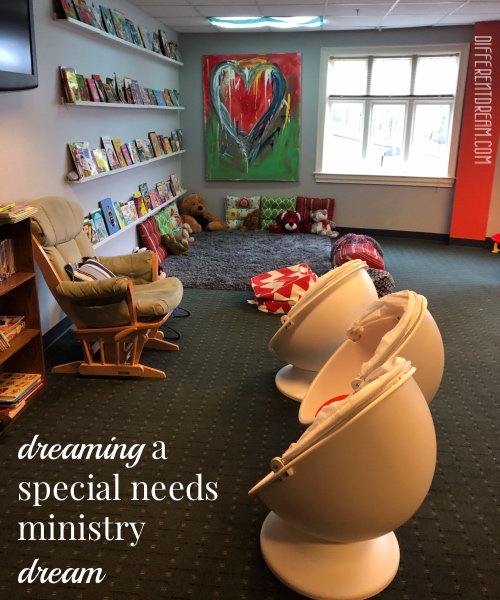
“Dream a new special needs ministry dream.” Guest blogger Marnie Witters heard God whisper those words to her at a recent conference she attended. Today’s post is filled with practical take aways she hopes will make her dream a reality.

“You are never too old to set another goal or to dream a new dream.”
C.S. Lewis

Recently, I attended the Together special needs ministry conference at Mt. Paran Church in Atlanta, and I was privileged to meet so many leaders with a heart for people with special needs. As a special needs mom, a teacher, and a volunteer, God continues to show me his vision for this ministry, who he wants to use, and how much bigger he is than me.

Special needs families hold so much knowledge, but the journey is isolating. There’s rarely time to meet and discuss the day’s meltdowns or therapies. But at the conference I was encouraged and inspired when I connected with other moms and dads who have taken leaps of faith to start ministries. Our church is in the process of starting a special needs ministry and it’s a challenge, but we’re pressing forward, being obedient, and can’t wait to see God move.

I’d like to highlight a few of my takeaways from the conference with hopes it encourages, inspires, and helps you as you dream your special needs ministry dream.

Our Past is Our Ministry

Most of the time, our past, as Christians aren’t what we care to relive. But, our past is our ministry. If you’d told me that 10 years ago, when my sons were first diagnosed, I might not be in church today. I wasn’t in a place to receive that message, nor do I think it was God’s right time. As a special needs family, we’ve been church hurt, school hurt, heard words that hurt, seen friends disappear, had friends who never asked, heard pastors whose words hurt, been rejected from schools and sports, and heard teachers who hurt.

Also, over those 10 years, God’s shown us His love, healing, restoration, His purpose, given us friends who truly care, and given me a passion for children with special needs. If I hadn’t experienced all I did, I wouldn’t be able to relate to the isolation, fear of rejection, or be equipped to help the newly diagnosed family. I wouldn’t know the questions to ask families and children when planning a new ministry.

God Is Bigger

Like Moses who told God, “I can’t speak well,” and Jonah who begged “Don’t send me,” I, too, have had many discussions with God about my current ability to think about leading a special needs ministry. You know what he says every….single….time?

“I can. Trust me.” That’s it.

That’s all I get.

At the conference, I heard testimony after testimony of a church receiving gifts that funded entire sensory rooms, a young man with CP and autism who walked for the first time, another special young man who worshipped like David in Psalms! God is on the move. He’s got purpose for these children and wants the world to see him in them.

Don’t tell me God can’t.
We can’t, but he can.
He’s so much bigger than us!
Think of your wildest dream, then multiply it a million times. That’s God’s dream!

Help My Unbelief

Like I said above, I feel inadequate, unprepared, unequipped, and overwhelmed. But, I heard many leaders say the same thing. But they trudged on, they prayed and prayed, and they were obedient to God. They stepped out of their comfort zones and believed God would do it, and he did.

Pray without Ceasing

Leaders encouraged us to pray always. To write down what we need. To write down  children’s name and what they need. We are to intercede for the special needs community around us. We are to pray and ask God for specifics and resources we need. We should continue to pray corporately, for vision, guidance, and provision. He hears us. He hears you.

Do One Thing Excellently

I had a conversation with our children’s pastor on the way home about how we want the ministry to be right and perfect. We want to be prepared. I don’t think it’s going to be perfect the first time. That’s what speakers said. They said, brainstorm, pick that one thing you can do right now, today, and work at it until it’s done with excellence. Then, move to the next thing. But start small. God provided a scripture to leave you with.

But he said to me, ‘My grace is sufficient for you, for my power is made perfect in weakness.’
Therefore I will boast all the more gladly about my weaknesses, so that Christ’s power may rest on me.

That is why, for Christ’s sake, I delight in weaknesses, in insults, in hardships, in persecutions, in difficulties. For when I am weak, then I am strong.”
2 Corinthians 12:9-11


Do you like what you see at DifferentDream.com? You can receive more great content by subscribing to the quarterly Different Dream newsletter and signing up for the daily RSS feed delivered to your email inbox. You can sign up for the first in the pop up box and the second at the bottom of this page.
By

Marnie Witters was a technical writer and editor for more than 20 years until she resigned to homeschool her sons for 8 years. Recently, they went back to public school and she now writes and substitute teaches. She’s been married for 17 years, serves in our amazing church, loves to garden, and enjoys spending time with her family. 

Author Jolene Philo
Archives

Categories

Subscribe for Updates from Jolene

Related Posts
5 Simple Ways to Make Your Church More Accessible to People with Disabilities

5 Simple Ways to Make Your Church More Accessible to People with Disabilities

5 Simple Ways to Make Your Church More Accessible to People with Disabilities

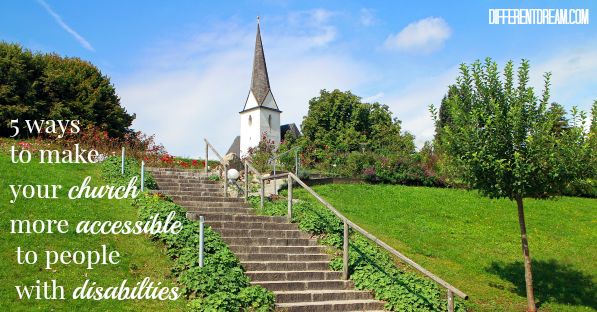
If your church wants to be more accessible to people with disabilities, there are several things that can be done immediately to jump start the process. Most of them take more time than money, but none of them require a huge time commitment. Here are 5 simple things I learned from watching Mom wheel Dad into church when I was a kid, from taking our son with special needs to church, from teaching kids with special needs, and from parents raising kids with disabilities. Each item in this list will make your church more accessible. The last one might motivate you to implement more inclusion efforts in your church and beyond.

#1: Improve Signage

From the parking lot to the foyer to the hallways, assess and upgrade signage as needed. Label the most accessible entrances as “quiet” or “family” entrances rather than “disabled” or “handicapped.” Make sure your welcome center is clearly marked so newcomers see right away where to go for information. Have signs inside entrances that indicate how to get to the nursery, the children’s programming wing, and so on.

#2: Train Greeters and Ushers

Train greeters to assess people as they arrive. Then they will know to direct families with babies and children to the nursery and children’s programming wing. They know to point out accessible bathrooms and seating to people with mobility issues, escort those with visual or hearing impairment to accommodation devices, and so on. Ushers should also be trained in case someone slips past the greeters in a crowd, and for those who come after the greeters have left their posts.

#3: Move the Furniture

Look at how the furniture is arranged in your foyers and classrooms. Is there room to maneuver a wheelchair or walker in those spaces? If not, declutter and move the furniture to create easy pathways for everyone. If your worship area has pews, cut some of them down to make spaces for wheelchairs and walkers. If your worship area has chairs, leave spaces open on the aisles for the same purpose. Intersperse these spaces throughout the worship area rather than concentrating them in the front or back row so those with disabilities feel like they are part of the congregation rather than observers on the sidelines.

#4: Open Doors

Get in a wheelchair and test every door in your church to see if it can be opened by someone who uses mobility equipment. When you discover the doors that fail the test (and there will be plenty), work to create a solution. You might prop doors open on Sunday morning or have someone positioned near the doors to open and shut them. Most important, though, is reminding your congregation members to watch for those with mobility issues so they can offer to help.

#5: Study Matthew 19:14

Encourage fellow church goers to study and meditate upon Matthew 19:14: “Jesus said, ‘Let the little children come to me and do not hinder them, for to such belongs the kingdom of heaven.’ (ESV)

Ask each other, Who is excluded from approaching Jesus in this passage? Then apply the passage to your congregation. Ask, Who is excluded from approaching Jesus at your church? Then identify what excludes them and look for ways to change that. Also ask the Holy Spirit to touch hearts to make your church more accessible to people with disabilities and special needs. And be prepared, when God answers those prayers, to seek ways to make your church more accessible to everyone who needs Jesus.

Do you like what you see at DifferentDream.com? You can receive more great content by subscribing to the quarterly Different Dream newsletter and signing up for the daily RSS feed delivered to your email inbox. You can sign up for the first in the pop up box and the second at the bottom of this page.

By

Jolene Philo is a published author, speaker, wife, and mother of a son with special needs.

Author Jolene Philo

Archives

Categories

Subscribe for Updates from Jolene

Related Posts

Why You Must Say Yes to Special Needs Inclusion {Even When You’re Afraid}

Why You Must Say Yes to Special Needs Inclusion {Even When You’re Afraid}

Why You Must Say Yes to Special Needs Inclusion {Even When You’re Afraid}

Guest blogger Sheri Dacon has a message for anyone who is afraid of special needs inclusion. If her call to action doesn’t rouse you, perhaps nothing will. So take courage and read on.

Why You Must Say Yes to Inclusion
{Even When You’re Afraid}

If you’ve ever parented a toddler, you know the drill. Your days are filled with the word “no.”

Parenting experts say toddlers are learning independence. They’re discovering their ability to separate from their parents and make their own choices. Toddlers say “no” a lot. So do their parents.

And the days end up sounding like a broken record of negativity.

Sometimes our churches are too much like a strong-willed toddler. Because far too many of us have become a broken record of negativity when it comes to special needs.

It’s time we quit saying “no” to inclusion.

Let me tell you what it’s like when a church looks at a disabled child and his family — with all their strengths and challenges — and says no.

  • It is devastating and soul-shattering.
  • It’s traumatic and intensely painful.
  • It’s like having the faith rug pulled completely out from under you.
  • It knocks you down and leaves you breathless.

It’s not an exaggeration. This is how too many families experience church.

They are told no.

And they are left shell-shocked.

Many are shaken so turbulently by their experience that they never return.

Others want to try, but are timid and riddled with anxiety about the possibilities of being rejected again.

Some become embittered and turn from faith entirely. Why trust in the Lord of the church when the church can dish out more meanness and apathy than the secular world?

There are plenty of reasons congregations say “no” to special needs families.

  • It costs too much.
  • We don’t know how.
  • We’re just volunteers.
  • We don’t have room.
  • There aren’t any special needs families in our congregation.

But these reasons are simply excuses.

They are shallow copouts that ignore truth and choose the easier path of exclusion instead because. . . well, it’s easier.

It’s easier to close doors and hearts than it is to open them wide and not only accommodate, but welcome, anyone who walks in.

It’s easier to stay complacent and “do church” the way it’s always been done.

It’s easier to ignore people who make us feel uncomfortable.

But is it the gospel way?

Is this the kind of ministry we see played out in the Bible, in the ways of Jesus himself?

Not at all.

Why We Must Say Yes

What we see in the gospel message is an overarching message of yes.

Yes to the broken, yes to the poor, yes to the marginalized, yes to any and all who are willing to come. All are welcome at the Lord’s table.

And so it’s imperative that we — as communities of faith — learn to say yes. We simply must say yes first, then trust that God will show us the way.

  • It’s what Abraham did when God called him to leave his home and go to a new place. He said yes, and became a sojourner.
  • It’s what Noah did when God told him to build an ark. He said yes, and waited for instructions.
  • It’s what David did when God anointed him king. He said yes, then fought for his life, years before receiving the crown.
  • It’s what Mary did when an angel told her she would bear the son of God. She said yes, though she didn’t understand and she faced certain scorn.
  • It’s what Jesus did in the garden as he prayed for another way, and yet chose obedience even unto death. He said yes.

Time and again in scripture, we encounter people who had every reason to say no. Saying no would’ve been the more practical, economic, and logical choice.

And yet, each of these–and so many more–chose to say yes instead. And it made all the difference.

I challenge you today to examine your place of worship, and examine yourself as well. Where do you need to say yes?

Because saying yes might just change everything.

Will You Say Yes to Special Needs Inclusion?

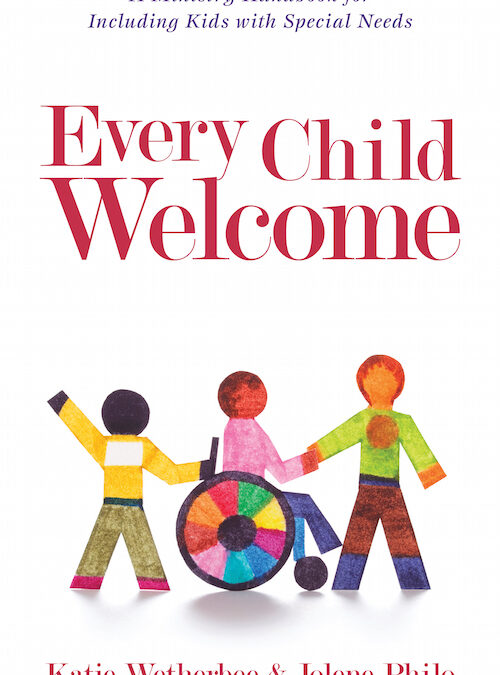
Are you ready to say yes to special needs inclusion? If so, Every Child Welcome: A Ministry Handbook for Including Kids with Special Needs at Church can help you. Whether you’re in a big church with many resources or a small one with only a few volunteers, Every Child Welcome can equip you and other volunteers to say yes with confidence.

Do you like what you see at DifferentDream.com? You can receive more great content by subscribing to the quarterly Different Dream newsletter and signing up for the daily RSS feed delivered to your email inbox. You can sign up for the first in the pop up box and the second at the bottom of this page.

By

You can learn more about Sheri by visiting her website at sheridacon.com.

Author Jolene Philo

Archives

Categories

Subscribe for Updates from Jolene

Related Posts

If Disability Ministry Feels Too Big and You Feel Too Small

If Disability Ministry Feels Too Big and You Feel Too Small

If Disability Ministry Feels Too Big and You Feel Too Small

A few months ago the Joni & Friends disability ministry announced the launch of their new blog, The Irresistible Church. I was pleasantly surprised to receive an invitation to become a guest blogger and quickly said yes. Here’s my first post, which I hope will encourage those involved in disability, special needs, and inclusion ministries to continue the work God has called them to do.

If Disability Ministry Feels Too Big and You Feel Too Small

From the outside looking in, the prospect of beginning a disability ministry feels too big. Disability ministries require big programs, big staffs, big accommodations, and big equipment. All that bigness is daunting. It’s enough to make a person feel too small for the task.

Unless that person grew up looking at disabilities from the inside out. Like my siblings and I did. Our earliest memories revolve around caring for my father, who had multiple sclerosis. Many of those memories revolve include going to church on Sundays during the 1960s and 1970s long before disability ministries came into vogue.

Our church didn’t have the big things. No handicapped parking spots. No curb cutaways. No wheelchair ramp. No elevator to the basement or the second floor. No handicapped accessible bathroom. Come to think of it, our church had so many big obstacles, it’s a wonder we didn’t quit going.

We probably would have stop attending church if it hadn’t been for the people. People who didn’t let the big things make them feel small. Instead, they found small things they could do to include our family in the life of the church.

  • The parking spot closest to the door was left open for our family.
  • Men appeared the minute we arrived to get Dad into the building.
  • Once Dad was inside, people immediately greeted him and visited without condescension or awkwardness.
  • When Dad’s disease progressed and he couldn’t go to church, adult Sunday school classmates took turns visiting him during the service so Mom could attend.
  • The pastor came over often to visit.
  • Other men from the congregation often stopped by on their way home from work in the afternoons to chat with Dad, too.
  • An elderly man took my siblings and I to the community Easter egg hunt every year.

Zechariah 4:10 says “Who has despised the day of small things?” (New American Standard). It’s my favorite Bible verse, perhaps because of the constant flow of small acts of kindness people showed to Dad and our family when I was a kid.

The Holy Spirit brings that verse to mind whenever disability ministry feels too big and I feel too small. His still, small voice prompts me to look for the little things I can do instead of dwelling on the big things I can’t accomplish. If, like me, you have a heart for disability ministry, but go to a church that doesn’t have a formal program, I encourage you to memorize Zechariah 4:10 and begin praying for the Holy Spirit to show you small ways to minister to adults with disabilities and children with special needs in your church.

By taking those two small steps, your perspective about what disability ministry is will begin to change. You will find ways to make your church more inclusive. Those ways may seem small and insignificant, but they are not. They are the life of the church, the hand of Christ, and a light upon the path for future generations who need someone to show them the value of small things.

Do you like what you see at DifferentDream.com? You can receive more great content by subscribing to the quarterly Different Dream newsletter and signing up for the daily RSS feed delivered to your email inbox. You can sign up for the first in the pop up box and the second at the bottom of this page.

By

Jolene Philo is the author of the Different Dream series for parents of kids with special needs. She speaks at parenting and special needs conferences around the country. She’s also the creator and host of the Different Dream website. Sharing Love Abundantly With Special Needs Families: The 5 Love Languages® for Parents Raising Children with Disabilities, which she co-authored with Dr. Gary Chapman, was released in August of 2019 and is available at local bookstores, their bookstore website, and at Amazon.

Author Jolene Philo

Archives

Categories

Subscribe for Updates from Jolene

Related Posts

5 Tips to Help Create an Inclusive Church Community

5 Tips to Help Create an Inclusive Church Community

5 Tips to Help Create an Inclusive Church Community

Different Dream is happy to introduce guest blogger Dan Vander Plaats to readers today. Dan works for Elim Christian Services in Palos Heights, Illinois, a ministry that exists to equip people who live with disabilities to answer God’s call on their lives. He’s also the creator of 5 Stages, a vehicle for changing attitudes about people with disabilities. Today, he’s here with some tips churches can use to create a more inclusive church community.

5 Tips to Help You Create a 5 Stages Inclusive Church Community

Over the last few years, I’ve spoken more and more often to groups of people that want to help their churches become more inclusive of people with disabilities. One of the questions I always hear afterwards is, “What do you do when your church has no interest in including people with disabilities?”

What a challenge it is to convince others to come with us on our journey, to care about people with disabilities! They have their own families, their own challenges, and their own causes. Why should they care about yours?

And there’s the rub, after all. Why should they care? And how will anything change until they do care?

Getting people to care was always a challenge for me too. I live with a speech disability, so the cause of people with disabilities has always been an important one to me. I spent many years trying to convince others to care about the issue as much as I did.

The 5 Stages was developed to allow easy self-assessment of attitudes. Used for that purpose, the tool will help users conclude that their attitudes about people with disabilities need to change. The point of The 5 Stages is that we “are all God’s handiwork, created… to do good works, which were prepared in advance” (Ephesians 2:10). And since we all have work to do for God’s Kingdom, then it isn’t optional. We all must change our attitudes. We must develop a “Stage 5 attitude” and see people with disabilities as “co-laborers” in the Kingdom.

So how can you help your church or other community become a 5 Stages community? The following is the process I’ve been pursuing in my own church, and in other places as well. The process requires patience, prayer, and persistence. But there’s one more thing. There’s also pay-off. So, here are 5 tips for creating a 5 Stages inclusive church community:

  1. Be convicted that progress only comes when attitudes get changed. Demanding rights and equality have achieved some changes to our sidewalks and buildings, but no matter how much we do on the surface, we don’t make real change unless it’s in people’s hearts. Getting a church to install a ramp can take years of convincing. How could that be different if we focused on changing attitudes first? If you are convicted that attitudes are the first priority in changing your community, then you have laid a foundation for progress.
  2. Develop a team that shares your goals. You can’t expect everyone to buy into your vision right away, but the more you share your hopes to ‘change attitudes’ in your church or community, the more you’ll find people who agree or are receptive to the idea. Help these partners capture the vision to change your community, and you are well on your way! There’s no ideal size, but it may be a good idea to get people that represent a cross-section of your community, if possible.
  3. Convince leadership of the importance of this vision. Once you have your group pulled together, enlist their assistance in helping your church or community leadership to see how this could change the church. Help your leadership understand that this does not need to compete with any other priorities, but that it can support all the community’s priorities (i.e.–if your church isn’t getting enough volunteers, what about equipping people with disabilities to participate and support what’s going on?)
  4. Identify goals. If you’ve got leadership on your team, it’s time to start addressing some specific needs. Here are some suggestions:
    •  Do an assessment of disability attitudes in your church
    •  Create more disability awareness by doing a 5 Stages presentation in your church’s education program or showing a 5 Stages video to your church council or to the education or missions team.
    •  Connect your church to a local group home or disability organization
    •  Identify specific special needs of members already in your church
    •  Investigate the creation of a Friendship group
    •  Consider including people with disabilities on your worship team or in leading prayers or scripture reading
    •  Think about the possibility of a respite group, or a support group for area families
  5. Accept setbacks and keep pressing. Okay, maybe this is two tips in one, but they go hand in hand. You won’t always succeed. A friend at Elim Christian Services, where I work, once told me that the best special education teachers aren’t those with advanced degrees or the best practicums or grades. They were the ones who were willing to try and fail. And try again. And keep trying until they made progress. You will run into obstacles, and into people who discourage you. You simply need to keep going.

I hope these tips were helpful and practical, even though they were intentionally broad. I also want you to know that there are lots of great resources out there for you. Feel free to share your favorites in the comments below. In the meantime, I hope the following resources will help you start creating an inclusive church community that sees people with disabilities as “co-laborers!”

Resources:
The 5 Stages: We provide a number of resources, including 10 different translations of The 5 Stages, from our website
Disability Concerns: Links to the disability ministries for the Christian Reformed Church in North America and to the Reformed Church in America
MNA Special Needs Ministry: Special needs resources offered by the Presbyterian Church in America
Friendship Ministries: Developers of Sunday School curriculum based on different special needs
Key Ministry: An online resource for learning more about a wide range of disability-related topics
Faith Inclusion Network: A fantastic ecumenical advocacy resource for people with disabilities
Rising Above Ministries: A phenomenal organization that helps churches build special needs ministries
All Belong (formerly CLC Network): Publishes of the GLUE manual and resources, along with being the working home of the late Barb Newman
Joni and Friends: This international ministry offers resources and lots of opportunities for your community to get involved.

What Do You Think?

Do you have questions for Dan? Or ideas of your own about creating more inclusive church communities? Leave your ideas in the comment box.

Do you like what you see at DifferentDream.com? You can receive more great content by subscribing to the quarterly Different Dream newsletter and signing up for the daily RSS feed delivered to your email inbox. You can sign up for the first in the pop up box and the second at the bottom of this page.

By

Dan Vander Plaats is the Director of Advancement at Elim Christian Services in Palos Heights, Illinois, a ministry that exists to equip people who live with disabilities to answer God’s call on their lives. He is also a member of the advisory committee for Disability Concerns for the Christian Reformed Church and the Equipping Team of the Chicago office of Joni and Friends. In 2009, he developed “5 Stages: Changing Attitudes” as a resource for Elim. The 5 Stages helps churches and individuals assess their attitudes toward people with disabilities. He is married to Denise (Hiemstra), and is father to Ben and Emma. They are members of Orland Park Christian Reformed Church in Illinois, where Dan also serves on the Disability Concerns team.

Author Jolene Philo

Archives

Categories

Subscribe for Updates from Jolene

Related Posts

Every Child Welcome: Cooking Up Special Needs Inclusion

Every Child Welcome: Cooking Up Special Needs Inclusion

Every Child Welcome: Cooking Up Special Needs Inclusion

Katie Wetherbee and I first met at a special needs ministry conference around 2010. She made a beeline to my book table and introduced herself. I attended Katie’s workshop and loved what she had to say. Before the end of the conference, we exchanged email addresses.

We quickly became good friends.

Maybe because we had a lot in common. We were both the parents of kids with special needs. We were both former public school teachers. We both had special education backgrounds. We shared a similar philosophy about inclusive education. We discovered that we had used many of the same strategies to create inclusive classrooms for our students. We also decided that if God had every granted us the opportunity to teach together, we would have been an administrator’s nightmare.

We also both loved to cook.

So we should have known, when we cooked up the idea to co-author a manual to equip children’s ministry volunteers to make every child welcome in their programs, that one of us would suggest using a dinner party theme to make the book hang together.

That someone was Katie. She’s the creative one.

After all, she explained (and I nodded my head enthusiastically), “Everybody eats. And chances are, church volunteers like Sunday school teachers and mid-week church club leaders and others who work with kids know a little bit about cooking and dinner parties.”

So the dinner party theme made sense to us.

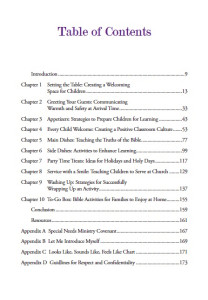
But just because it made sense to us, it might not make sense to you. At least, not yet. So in the spirit of inclusion and with my teaching-to-different-learning-styles hat firmly in place, here’s a peek at Every Child Welcome‘s table of contents:

To read the rest of this post and to see just what Jolene and Katie look like, go to the Not Alone website at www.specialneedsparenting.net.

Do you like what you see at DifferentDream.com? You can receive more great content by subscribing to the quarterly Different Dream newsletter and signing up for the daily RSS feed delivered to your email inbox. You can sign up for the first in the pop up box and the second at the bottom of this page.

By

Jolene Philo is the author of the Different Dream series for parents of kids with special needs. She speaks at parenting and special needs conferences around the country. She’s also the creator and host of the Different Dream website. Sharing Love Abundantly With Special Needs Families: The 5 Love Languages® for Parents Raising Children with Disabilities, which she co-authored with Dr. Gary Chapman, was released in August of 2019 and is available at local bookstores, their bookstore website, and at Amazon.

Author Jolene Philo

Archives

Categories

Subscribe for Updates from Jolene

Related Posts