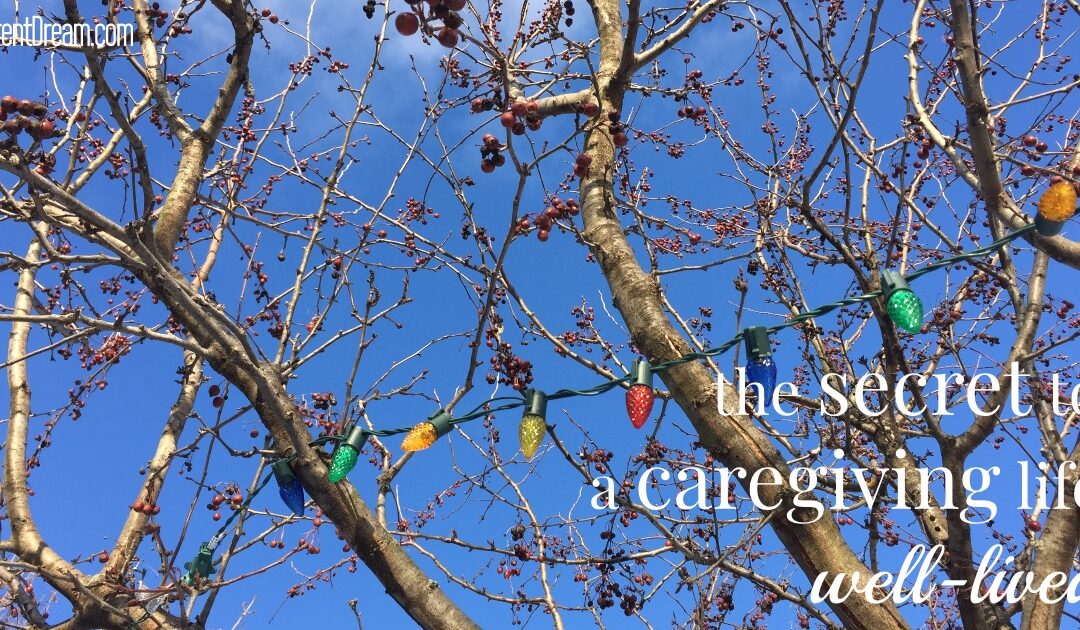
Ten Moments in a Caregiving Life Well-Lived

Ten Moments in a Caregiving Life Well-Lived

Ten Moments in a Caregiving Life Well-Lived

Ten moments in a life caregiving well-lived is a practice today’s guest blogger, Laura Spiegel is implementing this holiday season. May her ideas cause you to hunt for your own ten moments throughout December and beyond. 

As the holiday season nears, I’m finding myself in moments of reflection. This year has highlighted the fragility of life. The impermanence of it all. It’s also reminded me that a life well-lived isn’t always momentous. It’s a smattering of small moments that together weave a tapestry of love, laughter, joy, struggle, and yes, even loss. 

For parents of children with special health care needs, it can be especially important–and especially difficult–to nurture the blessings that come alongside the battles. As a mother of a young child who lives with cystic fibrosis, I know that my mind spins more readily toward what’s not going well–or what could one day not go well–rather than focusing on the here and now.

To combat that, I’m working on savoring the small things that bring joy to my family and to me. In that spirit, here are ten simple moments from last week that have infused our lives with, well, life. 

  1. My daughter stuffs the Christmas cards, her face a picture of glee. She reads each name with care and is bewildered when her stamps stick sideways. It’s not a hassle for her; it’s a delight.
  2. We read my mom’s advent book as we light the purple candles before dinner. It’s covered in grease stains, and my kids pride themselves on the little they’ve memorized. Each night, this reminds me of home.
  3. We look at a photo album from my mom’s childhood. There she is with her brothers, on the roof of the house like there’s no tomorrow. (And no helicopter parents). Her grin is as wide as the sky. 
  4. Our potted plants are inside for the winter. Maude, the hibiscus, and Doris, the canna lily, are doing well. Every morning, my husband marvels at the pink blooms. They last but a day before falling to the ground. But their hint of life helps keep the Indiana gray at bay.
  5. Speaking of Maude and Doris, did I tell you that my appliances have names? Or rather, the best ones do. There’s Ophelia the oil lamp, Olive the vacuum, and my personal favorite: Mildred, the cell phone cleaner. I find that a simple “Thank you, Mildred!” knocks the cleanliness up a notch.
  6. A package of treats arrives from the children’s hospital. They want to thank their volunteers for their service. We have caramel/cheesy corn for breakfast, lunch, and dinner.
  7. I meet old friends on the back porch. We wear Golden Girls masks as a tribute to our favorite teenage pastime. We trade memories and drink wine through straws. Finding a way to sip while masked? What could be better than that?
  8. My daughter’s best friend drops off a note to thank her for being a friend. These seven-year-olds have bigger hearts than most anyone I know. Their unabashed love and appreciation for each other is a gift. 
  9. A new family member arrives. Leo the kitty reminds me of my favorite girlhood feline. He likes to sit on my son’s lap and lick his arm. They are in love.
  10. The tree twinkles with shiny lights, but my eye is drawn to the homemade ornaments. The handprints of my kids at five months and three. The painted reindeer from preschool. The crocheted dog and cat from my grandma. Our tree reminds me of love, warmth, and life. And if my husband has his way, it will stay up well into 2021. 

This season can be tough, especially for those of us who have lost loved ones or are separated from those we love. From my family to yours, I wish you health and safety this holiday season. And I wish you ten moments in a caregiving life that bring a smile to your face and remind you, in the end, of a life well-lived. 

Do you like what you see at DifferentDream.com? You can receive more great content by subscribing to the monthly Different Dream newsletter and signing up for the daily RSS feed delivered to your email inbox. You can sign up for the first in the pop up box and the second at the bottom of this page.

By

Laura Spiegel spent 12 years at the world’s largest biotech company, partnering with professionals and care teams to help people with special needs and disabilities lead full and happy lives. In 2013 her daughter was diagnosed with cystic fibrosis. Laura now hosts Paint Her in Color, a website that offers emotional support to parents of children with special medical, developmental, or behavioral health care needs. When she isn’t reading, writing, or soaking up time with her husband and kids, Laura can be reached at Paint Her in Color, by email at laura@paintherincolor.com, and on Facebook and Twitter.

Author Jolene Philo

Archives

Categories

Related Posts

Ways We Hold to Hope Through the Loss and Grief of Disabilities

Ways We Hold to Hope Through the Loss and Grief of Disabilities

Ways We Hold to Hope Through the Loss and Grief of Disabilities

Ways we hold to hope as we parent children with disabilities become stronger through practice. Guest blogger Heather Johnson writes about 4 ways she and her husband have learned to hold to hope even as they support their adult children.

In 1997, a 6-year-old girl stood on the threshold of the room where Todd and I sat waiting, hearts beating wild with anticipation. She wore a red velvet dress with matching bow in her brown hair. Next to her stood a boy wearing a pink Lion King sweatshirt. We learned he would turn 4 the next day.

A woman, gray haired pulled back in a bun, leaned low and whispered to Anna in Russian while pointing to me, “There’s your mama.”

Anna smiled wide and broke loose. She dashed across the massive oriental rug and jumped into my arms squealing, “Mama! Mama! I’ve waited so long for you!” I had no words other than, “I love you so much!” spoken in my newly learned Russian.

Sergei, whom we renamed Zachary, also ran across the room and hopped onto Todd’s lap. After a brief hug, Zach jumped back to the floor and began bouncing all around on a big red ball with a handle.

This was bliss.

The four of us left the Russian orphanage that day for a whole new life far, far away. Todd’s and my years of grieving infertility were over. Finally, we had a family. Finally, we had an opportunity, birthed through grief, to turn loss into new life.

In 1999, Todd and I returned to the same orphanage and brought Nicholas home with us. He was 19 months-old with chubby cheeks and towhead hair. He weighed only 15 pounds, couldn’t stand, couldn’t hold a sippy cup. 

Within two years, Todd and I had heart-birthed three kids and became an over-the-moon, happy family of five. Shortly thereafter though, grief came knocking again, and again, and again—a most unwelcome and demanding intruder.

Discovering Disabilities

When our kids came into our lives, we didn’t know we were beginning a life-long journey through the often-scary territory of permanent disabilities. They all had the expected developmental delays, most dissipating with time and loving care. But we began noticing subtle signs of significant, persistent problems. We started seeking professional assessment. 

Within our first three years as a family, all our kids received multiple diagnoses, all falling under the umbrella of Fetal Alcohol Spectrum Disorder (FASD).

(Click on the link and read the list of impairments, most of which affect all our kids, most of which are invisible.) 

Every new diagnosis stretched us thin as we began juggling visits with 11 different specialists on a regular basis.

Living with Loss and Grief

Our family is far from bleak! We enjoy our lives together and are grateful for our many gifts, including close proximity. We play and laugh, hike and travel. Still, discovering our kids’ disabilities led us into close acquaintance with the common stages of grief.

We grieved when our kids grieved the impact of their invisible disabilities. Anna lamented aloud, “I wish I looked like I had Down Syndrome because then people could see I have disabilities.” 

We grieved with all our kids when their peers passed them developmentally and faded away from their lives.

We grieved when we moved Anna into a group home because, even though we’re a forever family, our home can’t be her forever home. There’s that constant nag of our mortality.

Todd and I have spent much of our living thinking about our dying. We’ve made arrangements so all our kids will have their basic needs of food, shelter, and safety met, as well as financial management and continued therapies.

So here we are today. Anna, Zach, and Nick are now 29, 27, and 22. Todd’s 66. I’m 61.

We’ve all been through many turbulent times. We’ve been sad, mad, and scared. Sometimes, we still are. We’ve felt isolated. Sometimes we still do. I’ve asked myself too many times to count, “What if we’d done this? Or that?” Sometimes, I still wonder. 

Growing through grief isn’t a linear progression. The stages are actually quite fluid. They’re a back-and-forth, up-and-down, swirling whirlpool of emotions that often take us by surprise because we think we’ve moved on from the neatly defined categories. But then they bubble up again, begin swirling again, threaten to pull us under again and again. But we keep going.

Ways We Hold to Hope 

It’s necessary to grapple with loss and grief if we want to hold hope—to live and not just survive. Here are five constants that have helped us survive and thrive in our lives. I hope they might help you, too:

First, it’s okay, even good, to give yourself permission. Look at your losses/your kids’ losses and honestly assess how you feel. No sugar-coated, Christian platitudes. What bubbles up? Is there grief needing a voice, an ear, a heart, a shoulder? Trust your gut. Don’t judge or compare. Grieving losses is key. 

Second, it’s ok, even good, to wrestle with God. Cry your grief. Scream your grief. Question. Voice your frustrations. Wrestling is connecting and we are hard-wired for connection. Staying connected with God is key.

Third, it’s okay, even good, to be vulnerable with others. True, being vulnerable might mean losing relationship. But don’t let those losses stop you from seeking caring connection. Seek and find those who can listen, empathize, encourage and can be vulnerable with you, as well. Being and staying connected with caring, vulnerable others is key. 

Fourth, give thanks for something in everything, in everyone, every day, no matter the grief. Gratitude grounds us and elevates us, especially when grieving. Giving thanks is key.

Last and best, hold God to His promises. God’s promises are the keys to abundant life.

I gave this promise to all three of our kids before I knew all we’d go through.

“For I know the plans I have for you,” declares the Lord, “plans to prosper you and not to harm you, plans to give you hope and a future.” Jeremiah 29:11 NIV

Perhaps the greatest part of God’s promise to prosper us is to walk with us through desolation, being our consolation.

After all we’ve been through as a family, I’ve come to think there’s a holy healing when we come to the end of ourselves—when we finally find, after all our wrestling, the great gain inside every bit of loss in the ways we hold to hope.

Grief might just be the best gateway to glory.

Do you like what you see at DifferentDream.com? You can receive more great content by subscribing to the monthly Different Dream newsletter and signing up for the daily RSS feed delivered to your email inbox. You can sign up for the first in the pop up box and the second at the bottom of this page.

By

Heather MacLaren Johnson and her husband have three kids, all five and under when adopted from Russia. Now 29, 27, and 22, all need regular help with their multiple, permanent, invisible disabilities stemming from prenatal exposure to alcohol (FASD).

Heather has B.S. in Education and a doctorate in Clinical Psychology. She is the author of Grace, Truth, & Time: Facilitating Small Groups That Thrive and has published personal essays in The Wonder Years: 40 Women Over 40 on Aging, Faith, Beauty, and Strength (Kregel Publications) and Your Story Matters: Finding, Writing, and Living the Truth of Your Life (NavPress). She’s writing a memoir about her family’s journey through hidden disabilities and mental illness to encourage others to greater intimacy with God and each other through times of desolation and lament.

Heather and her husband of 27 years live with two horses, two dogs, two barn cats, and a bunch of silk plants she just dusts. Heather writes and photographs at www.truelifewithgod.com.

Author Jolene Philo

Archives

Categories

Related Posts

Basic Love Language Concepts to Ease Stress and Increase Joy in Caregiving Families

Basic Love Language Concepts to Ease Stress and Increase Joy in Caregiving Families

Basic Love Language Concepts to Ease Stress and Increase Joy in Caregiving Families

Basic love language concepts are tools caregiving families can use to ease stress and increase  joy. And who doesn’t want that? Here are three basic love language concepts that can help you get less of the first and more of the second.

Basic Concept #1

Dr. Gary Chapman, with whom I co-authored Sharing Love Abundantly: The 5 Love Languages® for Parents Raising Children with Disabilities, developed his love language theory in the 1990s. He believes that humans express love in five different ways.

  • Words of Affirmation: This language uses words, spoken or written, to affirm and encourage people.
  • Quality Time: A person with this love language want your undivided attention and time.
  • Receiving Gifts: Individuals with this love language feel most loved when they receive gifts.
  • Acts of Service: People who appreciate actions more than words gravitate to this love language.
  • Physical Touch: For these people, nothing speaks love more deeply than appropriate touch.

Basic Concept #2

The second basic love language concept consists of 3 simple statements.

  • Everyone has a primary love language, and many people have a secondary one.
  • We feel most loved when others use our love language.
  • To make others feel loved, we have to know their language and learn to use it.

So how can you discover your primary language and the languages of others? By taking the short and easy love language quiz. They are included at the end of the first chapter of Sharing Love Abundantly and in online versions at the 5 Love Languages website.

Basic Concept #3

The final concept to explore is the love tank. We are all born with a love tank that requires filling for our emotional to develop and mature. Heavy doses of love spoken in our primary and secondary languages can keep our love tanks full. When our tanks are full, we’re better able to use the love languages of other people and fill their tanks.

These basic love language concepts are discussed in greater detail in the first chapter of Sharing Love Abundantly. Other chapters in the book explain strategies for determining the love languages of kids who who have conditions that make the quizzes hard to use with them. So hang tight! I’ll be blogging about those strategies as this series continues. Or you can purchase the book at your favorite bookstore or on Amazon if you want to learn about them right away.

Other posts in this series:

The Love Languages and Special Needs Families: A Good Combination

Threats to Caregiving Marriages and How to Fight Them

Fostering Communication and Connection Between Caregiving Parents

Love Is a Child’s First Language

Determining the Love Language of a Child with Special Needs or a Disability 

Ways to Speak Words of Affirmation and Quality Time to Kids with Special Needs

Speaking Healthy Physical Touch to Kids with Special Needs

Using the Love Languages with Siblings of Kids with Special Needs and Disabilities 

Extended Family Members Can Use the Love Languages to Encourage Caregiving Parents

Communicating Your Child’s Love Language to Medical Professionals

Do you like what you see at DifferentDream.com? You can receive more great content by subscribing to the monthly Different Dream newsletter and signing up for the daily RSS feed delivered to your email.

By

Jolene Philo is the author of the Different Dream series for parents of kids with special needs. She speaks at parenting and special needs conferences around the country. She’s also the creator and host of the Different Dream websiteSharing Love Abundantly With Special Needs Families: The 5 Love Languages® for Parents Raising Children with Disabilities, which she co-authored with Dr. Gary Chapman, was released in August of 2019 and is available at local bookstores, their bookstore website, and at Amazon.

Author Jolene Philo

Archives

Categories

Related Posts

Creating a Joyful 2020 Holiday Season

Creating a Joyful 2020 Holiday Season

Creating a Joyful 2020 Holiday Season

Creating a joyful 2020 holiday season during a pandemic will be challenging but not impossible. Check out guest blogger Jessica Temple’s suggestions for a memorable and happy holiday for you and your kids with special needs and disabilities.

“Holidays will be weird,” I said to my mother.

“What do you mean?” she asked.

“COVID.”

Mom hadn’t expected to go the whole year without being able to have the whole family together during any holidays. She was shocked and that got me thinking. As much as we hoped and prayed that the pandemic would be behind us, it is not. What does this mean for the holidays? How can we manage this scenario, and still create a wonderful holiday season?

The first thing to understand is that during this pandemic, our safety needs are not being met. This leads to fear that our security and well-being are at risk. Therefore the first step to creating a joyful 2020 holiday 2020 is to focus on our safety needs. After that the focus can shift to establishing a sense of normalcy, a proper perspective, and intentional mindfulness.

Creating a Joyful 2020 Holiday Season: Safety Needs

For goodness sake, please take care of yourself! This may take the form of fun activities with the family. Or engaging in self-care such as a walk, exercise, eating and sleeping well, listening to music, playing a game, or reading. The more self-care we engage in, the less stressed we are and the happier our family is. Take breaks every day. Remember that children need breaks too, so plan them into their days. Lastly, pace yourself. During the holidays allow yourself to slow down and forgive yourself if things do not go according to plan.

Creating a Joyful 2020 Holiday Season: Normalcy

Stick with the familiar as much as possible to create some sense of normalcy. Keep a comfortable routine. Cook meals similar to those of previous years. Decorate the house as usual. Practice beloved at-home traditions and rituals to make the holidays feel more normal. We are often overloaded and overwhelmed during the holidays even without the stress of COVID. So keep it simple! Try not to over-do it or make elaborate plans. Remember what is important: yourself, family and friends, love, fond memories, and good health. Focus on that rather than purchasing elaborate gifts or stressing about how to see distant family members.

Creating a Joyful 2020 Holiday Season: Perspective

We need to keep a proper perspective during the upcoming holiday season. Collaborate with your immediate family about what COVID safety measures are comfortable for you. Many children with special needs are at a higher risk for complications from the disease. We need to protect them and ourselves. This may mean no visits or setting necessary boundaries with families coming from afar. You might have a Zoom holiday or a socially distanced meal outside if you live in a warmer climate. Limitations of the pandemic mean we can’t run on automatic. We need to stop, think, plan, and adapt. Think about what you want your family to remember and hold dear 20 years in the future and be open to change. Perhaps this is a time to incorporate what you and your children love into new, fun, and manageable traditions.

Creating a Joyful 2020 Holiday Season: Mindfulness

Principles of mindfulness are key to a happy life. We can choose to focus on the joyous and the positive in each day and to create small moments of joy: snuggles with the kids, driving to see Christmas lights, playing in the snow, cooking together, watching a favorite movie, playing games, or anything that makes your family happy. We are all struggling. We cannot perform perfectly. When things don’t go as hoped, we need to practice compassion, view ourselves or our children with understanding and kindness. This can improve the moment and the season instantly. The 2020 holiday season will look different than ever before, but it may be our best one yet!

Do you like what you see at DifferentDream.com? You can receive more great content by subscribing to the monthly Different Dream newsletter and signing up for the daily RSS feed delivered to your email inbox. You can sign up for the first in the pop up box and the second at the bottom of this page.

By

Jessica Temple, PsyD, ABPP-CN, is a board-certified adult clinical neuropsychologist. She has two children who have special needs. She and her husband, Lewis, host a podcast called Thriving in The Midst of Chaos, where they talk about all aspects of special needs including getting a diagnosis and treatment, self-care, relationships, transitioning to adulthood, school, and finances. They created Thriving in The Midst of Chaos to offer support to others in the special needs world as well as to provide an easy way to find the most useful resources. They aim to share helpful resources with others, advocate for improvement, change in the special needs world, and offer a different perspective on parenting.    To find out more about how Jessica’s work can help you, contact her at fubarpod@gmail.com or @midstofchaospod on all social media platforms.  

Author Jolene Philo

Archives

Categories

Related Posts

I Won’t Forget Your Faithfulness

I Won’t Forget Your Faithfulness

I Won’t Forget Your Faithfulness

I won’t forget your faithfulness. God used the lyrics of a song to prepare guest blogger Sandy Ramsey-Trayvick for what she didn’t know was coming. In this post she explains how they can help us as special needs parents respond differently when our children are hurting.

I woke up with song lyrics running through my mind on repeat:  

Great is Your faithfulness … I won’t forget, how great Your faithfulness…

I recognized the song as one from my worship playlist that I hadn’t listened to in awhile. I sang it that morning as part of my devotions. As I read Scripture that same morning, my eyes fell on 2 Thessalonians 3:3.

“But the Lord is faithful;
He will strengthen you and guard you from the evil one.” 

The Lord was going out of His way, it seemed, to remind me of His faithfulness. For the remainder of the morning and into the afternoon, I sensed the Lord wanting me to rehearse–over and over–the lyrics:  

I won’t forget Your great faithfulness.

Because of the strength and persistence of the exhortation, I began to suspect that the Lord was preparing me for something to come. So I obeyed His promptings and thanked Him throughout the day, promising Him, 

I won’t forget Your faithfulness.

That evening when I called my family to dinner, one of my daughters yelled back that something was wrong with my son. My husband and I ran upstairs to find him lying on our bedroom floor—awake but unresponsive. We surmised that he’d had a seizure. He’d had them before but he’d been seizure free for months so this one had caught us off guard. Because of COVID, we were reluctant to take him to the ER, or even to call for paramedics. However, as we cared for him ourselves, he had another seizure. His breathing ceased and his lips began turning blue. We called 911.

Later that night, after our son was stabilized and resting, my husband and I reflected back on the Lord’s words to me earlier in the day—and we thanked Him for His faithfulness. I’d been in situations before when my son’s health took a sudden negative turn. In my distress and confusion, I had questioned God.

Why are you allowing this to happen…again?  

But this time, the Lord Himself had prepared me to respond differently. Because He had whispered those song lyrics in my ear, I did not forget His faithfulness.

I’m guessing there are many reading this post who’ve found themselves, in times of confusion or pain, questioning God. While I won’t pretend to understand why He allows certain things, I’m convinced that He knows and understands our suffering–and stands ready to help us through it. As He reminded me of His faithfulness this time, I was reminded of the countless other times that He’d been faithful—to protect, to heal, to provide, to counsel, to empower, to restore, to comfort—the list goes on. How, then, had I allowed myself to forget?

I lift my eyes; I won’t forget,
How great Your faithfulness.

Do you like what you see at DifferentDream.com? You can receive more great content by subscribing to the monthly Different Dream newsletter and signing up for the daily RSS feed delivered to your email.

By

Sandy is wife to Terry, mom to 3 young adult children, a Bible study teacher, an encourager to those who are weary, a fitness enthusiast, a lover of books, and a certified professional coach. She and her husband are also marriage mentors. Twenty years ago, after her son was diagnosed with multiple disabilities, Sandy became his full time caregiver and advocate. She knows that living in the world of special needs or disabilities can lead to a “disabled life” mindset that focuses on limitations and settles for less life, less joy, less fulfillment. She coaches parents of children with special needs to help them see their circumstances from a perspective of hope, purpose, and opportunity. She helps them choose actions that create a life for themselves and their families that is joyful, fulfilling and fruitful. You can learn more about Sandy, her work, and her blog at www.UNDisabledLIVES.org.

Author Jolene Philo

Archives

Categories

Related Posts

Moving from COVID Craziness to Mindful Delight

Moving from COVID Craziness to Mindful Delight

Moving from COVID Craziness to Mindful Delight

Moving from COVID craziness to mindful delight sounds impossible. With time and practice, guest blogger Jessica Temple and her husband Lewis dialed down their crazy and upped their delight even while raising two boys with special needs during a pandemic. Today she describes how mindfulness gives them life and joy.

In the last two years we found out that our younger son Alex had a stroke to learning our older son Benji has autism. We have learned to juggle working, raising special needs children, and countless appointments, treatments, school meetings, and home therapies. My husband Lewis and I were stressed out. We were angry, had trouble coping, and were completely burnt out I.’m sure you have felt that way too.

Then COVID-19 turned our lives upside down.

Before COVID, we typically had four adults in the house at any given time to care for two kids. Now it was just me and Lewis 24/7. We felt like we were losing our minds. At some point during the second month of quarantine, it hit me that I was being given a second chance at maternity leave. I could spend long stretches of quality time with my children. Something I hadn’t had since Benji was a baby. That leave was broken up with appointments. Now there were no obligations, but how could I enjoy it when all I saw was screaming and fighting, hitting, hair pulling, glasses breaking, head banging, and toys being thrown?

The answer was mindfulness.

By moving from COVID craziness to mindful delight, I could improve and enjoy even those moments and make the most of the time I had with these children before the pandemonium of real life started again.

We started walking around the neighborhood with the kids. Those times were, and still are, full of whining and screaming and kids dragging their feet. Even so I loved every second–

feeling the air blow against my skin,
seeing the blossoms of spring and summer flowers,
being curious about why and how they grew the way they did,
rediscovering the joy of blowing dandelion fuzz,
delighting in the search for the motorcycles and pickup trucks my kids adore,
grabbing the youngest and chasing the garbage truck through the neighborhood, so he could see it eat the trash,
watching our toddler learn to walk and run and frolic through the grass and rocks.

Moving from COVID craziness to mindful delight with with my kids means–

watching the gears turn in their mind as they try to solve a problem,
cherishing their humor,
listening to the funny ways Benji scripts the things he’s heard,
gazing into their shiny sparkling eyes,
holding their soft hands and kiss their silky chubby cheeks,
analyzing their growth over these quarantine months,
seeing how they are stretching out and growing into kids, not babies or toddlers,
listening to them figure out how to use new words in conversation,
watching them do new fine and gross motor activities,
seeing my youngest run for a second before taking off, just like the Road Runner,
observing them  learn to use their utensils and try new foods,
witnessing Alex looks at Benji with love and try to do everything Benji does.

Moving from COVID craziness to mindful delight around our kiddos makes good moments better and bad moments shorter. It can make you appreciate the time you have with your kids, even if it isn’t as much time as you desire. We are at our best when we are present and mindful.

Life is when we are present and mindful, even in the upside down days of 2020.

Do you like what you see at DifferentDream.com? You can receive more great content by subscribing to the monthly Different Dream newsletter and signing up for the daily RSS feed delivered to your email inbox. You can sign up for the first in the pop up box and the second at the bottom of this page.

By

Jessica Temple, PsyD, ABPP-CN, is a board-certified adult clinical neuropsychologist. She has two children who have special needs. She and her husband, Lewis, host a podcast called Thriving in The Midst of Chaos, where they talk about all aspects of special needs including getting a diagnosis and treatment, self-care, relationships, transitioning to adulthood, school, and finances. They created Thriving in The Midst of Chaos to offer support to others in the special needs world as well as to provide an easy way to find the most useful resources. They aim to share helpful resources with others, advocate for improvement, change in the special needs world, and offer a different perspective on parenting.    To find out more about how Jessica’s work can help you, contact her at fubarpod@gmail.com or @midstofchaospod on all social media platforms.  

Author Jolene Philo

Archives

Categories

Related Posts