When Caregiving Doesn’t Spark Your Joy

When Caregiving Doesn’t Spark Your Joy

When Caregiving Doesn’t Spark Your Joy

When caregiving doesn’t spark your joy, what can you do about it? That’s a question I’ve been mulling over lately. Ever since I posted a survey about stress and compassion fatigue in caregivers. Within 2 days, the survey had been completed 500 times. Less than 3 weeks later, that number has risen to 1,313, and the results of the survey were disturbing.

  • 98% of survey participants said their caregiving duties add stress to their lives.
  • 80% said their caregiving duties cause sleep deprivation on a regular basis.
  • 91% said stress has negatively impacted their mental health.
  • 92% said stress has negatively impacted their physical health.
  • Overwhelming demands and isolation are the 2 greatest causes of the additional stress.

To borrow a phrase from Marie Kondo’s book, The Life-Changing Magic of Tidying Up, caregiving is sparking as much stress as joy in parents raising kids with special needs. Which is why I’ve been pondering the question posed at the beginning of this post: when caregiving doesn’t spark your joy, what can you do about it?

My pondering led to 4 strategies designed to reduce stress and respark joy in parents caring for kids with special needs and disabilities. Strategies I wish I’d had the wisdom to implement when our little boy was very, very ill and my stress level was through the roof. When caregiving doesn’t spark your joy, I hope these strategies help rekindle it.

To read the rest of this post, visit Key Ministry’s blog for parents.

Do you like what you see at DifferentDream.com? You can receive more great content by subscribing to the quarterly Different Dream newsletter and signing up for the daily RSS feed delivered to your email inbox. You can sign up for the first in the pop up box and the second at the bottom of this page.

By

Jolene Philo is a published author, speaker, wife, and mother of a son with special needs.

Author Jolene Philo

Archives

Categories

Subscribe for Updates from Jolene

Related Posts

Self Care Is Important for Special Needs Parents

Self Care Is Important for Special Needs Parents

Self Care Is Important for Special Needs Parents

Self care is important for parents raising kids with special needs. Guest blogger Laurie McLean is here to explain why self care is important and how to make it a priority in your busy life.Ā 

Chances are if you are a parent of a child with a disability, you have felt burn out at one time or another.Ā Perhaps you feel a chronic state of stress and you carry a heavy burden that seems too much to bear.Ā You may have bouts of anxiety or even depression. After all, many of us live in a state of hyper-vigilance and the PTSD associated with this has been compared to that of combat soldiers.Ā So the very notion of self care for special needs parents may seem impossible and not likely to occur any time soon.

The key to improving self care, particularly for special needs parents, is to shift one’s mindset.Ā Self care is not an all or nothing endeavor. Every little bit helps.Ā Remember, it is precisely because you are a caretaker to your precious child with special needs that it is even more imperative that you take care of yourself.Ā Then you can be around and able to provide the best possible care for your child for a good, long time.

Following are some simple mindset shifts to help special needs parents learn to make self care a priority.

Physical Needs

Our physical needs are perhaps the most straightforward when it comes to self care. We all know we should eat nutritious foods, hydrate and move our bodies.Ā What we need to remember as special needs parents is that exercise and good nutrition are not additional chores. They are not tasks to check off of our to do list.Ā We all are consumed by the incredible needs of caring for our children and do not need to feel pressured to add any more responsibility to our days.

One way to change our mindset is to think about that feeling when we are finished.Ā Visualize how you will feel when you have stretched your body or completed an aerobic workout.Ā Think about the satisfaction you will feel after you fuel your body with nutritious food and drink some refreshing water.Ā That can serve as your motivation. We rarely regret the exercise we get or the nutritious meal we consume once we are finished.

Mental & Emotional Needs

Often our emotions can feel like they are consuming us. We feel mentally burnt out from the chronic stress of worrying.Ā This hyper-vigilance may lead to a state of anxiety that we just cannot shake or a sense of hopelessness that seems endless.Ā It is essential that we allow ourselves mental breaks. There are many forms these can take, but the reality is that we need to honor the fact that we cannot ignore our mental and emotional needs.

One key to improving our mental state is to connect with people. Many special needs parents feel isolated and alone.Ā If your situation makes it nearly impossible to get out and meet other parents, then virtual support groups are also an option.Ā Just talking to others who ā€œget itā€ and having a community that will support you and understand your struggles lifts some of the emotional burden.Ā Please do not try to walk this path alone. You are invited to join this Facebook GroupĀ to make connections, get support, and experience a true camaraderie.

Remember to be gentle with yourselves. Self care is not an exercise in perfection.Ā We all know that our children are beautifully and wonderfully made.Ā It’s just as important to remember that we, as their parents and caregivers, are as well. Ā We are worth honoring our physical and emotional needs and allowing ourselves self-care.Ā The little steps you take today to improve your self care will pay off when you are healthy, strong, and around longer to care for your children.

Do you like what you see at DifferentDream.com? You can receive more great content by subscribing to the quarterly Different Dream newsletter and signing up for the daily RSS feed delivered to your email inbox. You can sign up for the first in the pop up box and the second at the bottom of this page.

By

Laurie McLeanĀ is a blogger, special needs parent, coffee fiend, dog lover, special education advocate and recovering perfectionist interested in balance, humor and self-care. She helps women learn to give themselves grace while they simplify their lives and make the most of their motherhood journey, no matter what unexpected things may come their way. You can visit her blog, Life with a Side of the UnexpectedĀ or check out her page on Facebook.

Author Jolene Philo

Archives

Categories

Subscribe for Updates from Jolene

Related Posts

How Wheel of Fortune Changed Our Lives…Really!

How Wheel of Fortune Changed Our Lives…Really!

How Wheel of Fortune Changed Our Lives…Really!

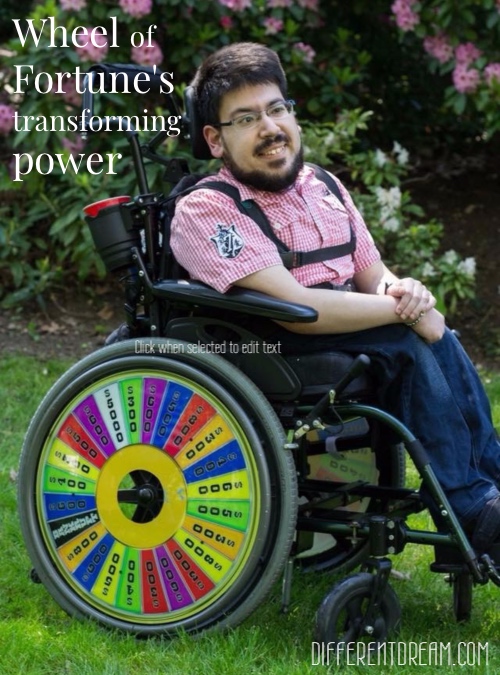
Wheel of Fortune transformed life in public for guest blogger Rachel Olstad and her family. Today she tells the amazing, delightful, and funny story of how it happened.

Our son has spina bifida and is a wheelchair user. You can probably guess how going to the mall or the grocery store goes for us. Lots of staring. People see someone who uses mobility equipment and has body features that don’t fit the norm, and they stare.

A lot.

We tried teaching our son, Bryce, to wave and smile at the starers, but to no avail. All the gawking usually put me in a bad mindset, unfortunately. I’m not sure how Bryce feels about it, but it can’t feel great.

Then one day we happened upon a web page with hundreds of cool wheel covers.* Out of all the choices, Bryce selected ones that looked like the wheel from the Wheel of Fortune game show. We were a little hesitant about his selection, because it was kind of over-the-top, in our opinion.

But, it was his chair and his choice.

Christmas Day the covers appeared under the tree. Bryce was thrilled with his new look. We spent most of the week at home, and I kind of forgot about his snazzy wheels. Then I decided to take Bryce to the mall while I made some returns.

It was the weirdest thing.

People were staring. More than usual. What was going on? And they were smiling while they stared. And waving. And saying hi. What on earth?Ā Then a big tatted motorcycle dude walked by and said, ā€œBig money! Big money!ā€

I got it.

They were responding to his Wheel of Fortune wheel covers in a new and different way. It was as if they were seeing him as a real person who must have a great sense of humor to rock those wheels. We got quite a few thumbs ups and ā€œCool chairsā€ that day.

I went home in a great mood.

Bryce now responds to all the noticing and comments with a big smile and two thumbs up. Honestly, those silly wheel covers have changed our lives. It’s amazing how something so simple can make such a profound change.

He now sports a Christmas wreath during December and an American flag on patriotic holidays.

He’s got his eye on a cool frog wheel cover. Or maybe he’ll create his own unique design. But take it from Bryce, if you are a wheelchair user and tired of all the stares, Wheel of Fortune might just be your jackpot!

*Bryce’s treasured wheel covers were found at CoolHubCaps. Another site across the pond with beautiful, artsy covers is www.izzywheels.com.

Do you like what you see at DifferentDream.com? You can receive more great content by subscribing to the quarterly Different Dream newsletter and signing up for the daily RSS feed delivered to your email inbox. You can sign up for the first in the pop up box and the second at the bottom of this page.


By

Rachel Olstad began her journey into the world of disabilities in 1990 when her oldest child was born with spina bifida and subsequently diagnosed with autism. She volunteers with Joni and Friends Southern Oregon, helping to meet the physical, emotional and spiritual needs of individuals and families affected by disability and encouraging churches to include all people. She was a contributing writer for both Special Needs Smart Pages and Nursery Smart Pages (Gospel Light), has been published in the Journal for Religion, Disabilities & Health, and was an assistant editor on Beyond Suffering: A Christian View on Disability Ministry. (Christian Institute on Disability)

Author Jolene Philo

Archives

Categories

Subscribe for Updates from Jolene

Related Posts

My Special Needs Mom Worries Never End

My Special Needs Mom Worries Never End

My Special Needs Mom Worries Never End

Of course not, you may have thought to yourself after reading the title of this post. My special needs mom worries never end either.

But there’s a difference between your special needs mom worries and mine. You are most likely either raising a child with special needs under the age of 18 or caring for an adult child with special needs. In either case, you deal with a host of legitimate concerns every day.

I, on the other hand, do not. My son was born with a rare condition known as esophageal atresia with tracheoesophageal fistula (EA/TEF).Ā I had plenty to worry about during his first 4 years until a series of surgeries and procedures fixed what ailed him.Ā Many children born with EA/TEFĀ have other physical disabilities or developmental delays. Our son does not. He’s a college graduate with a job, wife, a family, and a farm. Did I mention he was born in 1982, which makes him 36 at the time this post was written? Even so, my special needs mom worries never end. Here’s a frank look at what I worry about.

  1. Esophageal cancer.Ā People with EA/TEF often have recurring issues with gastroesophageal reflux disease (GERD),Ā a condition that can lead to esophageal cancer. I combat this reality by thanking God for the years our son has lived, when in another day and age he would have died at birth.

To read the rest of this post, go to Key Ministry’s blog for special needs parents.

Do you like what you see at DifferentDream.com? You can receive more great content by subscribing to the quarterly Different Dream newsletter and signing up for the daily RSS feed delivered to your email inbox. You can sign up for the first in the pop up box and the second at the bottom of this page.

By

Jolene Philo is a published author, speaker, wife, and mother of a son with special needs.

Author Jolene Philo

Archives

Categories

Subscribe for Updates from Jolene

Related Posts

Something Is Wrong with Your Baby: 5 Things I Wish I’d Known

Something Is Wrong with Your Baby: 5 Things I Wish I’d Known

Something Is Wrong with Your Baby: 5 Things I Wish I’d Known

Something is wrong with your baby. I remember, as though it happened yesterday and not in 1982, the day our doctor sat down beside my hospital bed and uttered those words. Something is wrong with your baby.

I reach through the decades at the young mother and wish I could go back in time and sit beside her. I wish I could tell her what we learned between then and now about raising the baby we both love. I wish I could calm her anxiety with these 5 nuggets of wisdom our baby taught us through the years.

  1. One day you will meet other parents of children with your baby’s rare diagnosis,Ā EA/TEF, and it will be wonderful.Ā Thanks to the internet, which will come into its own when our son is in his 20s, you will meet families who understand the challenges of caring for your baby. They will validate your hunches and applaud your advocacy on behalf of your son.
  2. You are the expert about how your baby’s condition is manifested in your child. Surgeons and pediatricians will know more about the condition your child has. But you know more about your child than the professionals do. Therefore, your expertise is equal to that of the professionals, and you deserve to be heard. When you find a doctor, a therapist, a nurse, or a caregiver who treats you as such, rejoice and make them part of your child’s care team. They are golden.
  3. You must be the keeper of your baby’s medical history. The details of your child’s early medical history will be seared in your memory. Your baby will not remember the details at all, though the experience will be stored in your child’s brain in a different way. You must document the early medical history so your child has it to refer to as an adult.
  4. Reach out and ask for help. People care about what you and your baby are going through. Most of them have not raised a child with special needs and have no idea of how to help. So when they say, ā€œLet us know what we can do,ā€ have some practical suggestions ready for them. Things like picking up your grocery order, bringing a meal, driving you to an appointment, bringing your mail or clean clothes to the hospital, or specific prayer requests. You’ll be surprised how quickly they’ll say yes.
  5. You’ll adjust to your new normal. Your life will never go back to the normal it was before your baby was born. But you will adapt to your new normal more quickly than you think. You will become stronger. You will mature. You will grieve, but you will also rejoice in the gift of each moment with your child. You will one day be able to encourage young parents in similar circumstances who need to know what you wished you had known when the doctor sat beside you and said, ā€œSomething is wrong with your baby.ā€ You will discover the beauty of your new normal and be comforted by it.

Do you like what you see at DifferentDream.com? You can receive more great content by subscribing to the quarterly Different Dream newsletter and signing up for the daily RSS feed delivered to your email inbox. You can sign up for the first in the pop up box and the second at the bottom of this page.

By

Jolene Philo is a published author, speaker, wife, and mother of a son with special needs.

Author Jolene Philo

Archives

Categories

Subscribe for Updates from Jolene

Related Posts

Laughter and How It Heals Us

Laughter and How It Heals Us

Laughter and How It Heals Us

Laughter is a gift frequently given to Mark Arnold by his son James. Though he is mostly non-verbal, James’ laughter is healing balm for his parents, something Mark has come to appreciate more with each passing year.

Laughter and How It Heals Us

James has an infectious laugh; it starts as a chuckle and build into a raucous belly laugh that barely gives him opportunity to take breath. All sorts of things can set him off, like the other day when James was enjoying being with the rest of the family. A look of pure joy spread across his face and, as his laugh emerged, our almost non-verbal autistic son said, ā€œAppy!! Appy!!ā€ Indeed he was!

It reminded me of the words spoken to Job by his friend Bildad the Shuhite: ā€œHe will fill your mouth with laughter. Shouts of joy will come from your lips.ā€ Job 8:21 (NiRV)Ā Life was hard for Job, and yet here was the promise of joy and laughter to cut through the hard times. Things can be hard for James too, and seeing him truly happy, filled with joy and laughter was such a precious moment for us, one that we treasure.

When James laughs it takes over his whole body. He rocks with laughter, and his arms often wave in the air. He’ll almost stop, and then whatever it started him laughing passes across his mind again, and off he goes a second time. By then, whatever the initial trigger for James’ laughter was, we’re lost in the moment of collective joy and delight.

It’s good for us to laugh. There is something wonderfully therapeutic about it. The poet Byron said, ā€œAlways laugh when you can. It is cheap medicine.ā€ There is something about it that can sooth even the deepest of pain.

In his old age Solomon, one of Israel’s great kings, wrote the book of Ecclesiastes. Reflecting on his own life’s experience, he wroteĀ ā€œThere is a time to weep, and a time to laugh. There is a time to be sad, and there is a time to dance.ā€ Ecclesiastes 3:4 (NiRV)

For parents of children with special needs, there are many times to weep and be sad. But there is more to life than tears and hard times. Let us celebrate the happier times, the times to laugh, the times to dance, and cherish these times–remembering them, treasuring them, when harder times return.

Allowing the better days, the fun moments, the times of laughter–and goodness knows even dancing–to heal our souls gets noticed by others. If they only see our tears, if they only hear Ā our woes, if they only understand our sadness–and there is nothing wrong in sharing those feelings–then they don’t get to see and experience the delights of special needs parenting. Those delights might be rare and fleeting, but the treasure is still there. Therefore, we join with Ezra, who wrote in Psalm 126:2:

Ā ā€œOur mouths were filled with laughter. Our tongues sang with joy. Then the people of other nations said, ā€˜The Lord has done great things for them’.ā€

Amen!


Do you like what you see at DifferentDream.com? You can receive more great content by subscribing to the Different Dream newsletter and signing up for the daily RSS feed delivered to your email inbox. You can sign up for the first in the pop up box and the second at the bottom of this page

Ā 

By

Mark Arnold is the Additional Needs Ministry Director at Urban Saints, aĀ leading national Christian children’s and youth organization. HeĀ is co-founder of the Additional Needs Alliance,Ā a national and international advocate for children and young people with additional (special) needs or disabilities and is passionate about enabling everyone engaging with them to be inspired, trained and well-resourced. Mark is a Churches for All and Living Fully Network partner, a member of the Council for Disabled Children and the European Disability Networ. He writes an additional needs column for Premier Youth and Children’s Work (YCW) magazine andĀ blogs atĀ The Additional Needs Blogfather, He is father to James, who has autism spectrum condition, associated learning disability, and epilepsy.Ā To find out more about how Mark’s work can help you, contact him at: marnold@urbansaints.org or @Mark_J_Arnold.

Author Jolene Philo

Archives

Categories

Subscribe for Updates from Jolene

Related Posts