A Dad’s Perspective

A Dad’s Perspective

A Dad’s Perspective

Mark Arnold is Different Dream’s guest blogger this week. Please join us in welcoming Mark as he shares a dad’s perspective of parenting a child with special needs.

A Dad’s Perspective

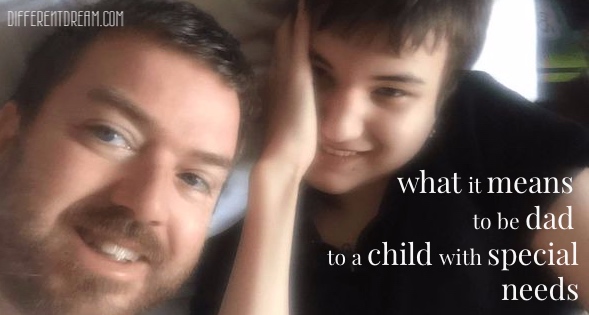
Yesterday evening, I lay on the bed next to my son for a while. James’ autism affects him significantly, he is mostly non-verbal, although he does have a few words including nomore, please, and rather embarrassingly beer–a long story for another blog! As we lay next to each other, James vocalized sounds and I repeated them. He loves this, touching my lips or teeth with his finger as I repeat his repertoire of sounds.

Time slipped by as we repeated this simple activity together, with James clearly delighting in the son/dad time we were able to spend together. His beaming face, his raucous belly laugh, his enthusiastic demands for more–thankfully, not for beer–love shining from his eyes, all mirrored in me too. I wouldn’t have missed it for the world.

I meet lots of dads of children with special needs in the work I do; dads who are all at different points on the journey with their children. Some are bewildered by what is happening to their world, trying to make sense of it all and looking for answers. Some are in denial, trying to ignore the reality that their child is different from what they expected. Some respond by putting all their energy into trying to fix their children, looking for solutions in the same way they might try to repair a car. Others simply love their children for who they are, accepting that things are different, but celebrating the differences and loving them through it all.

One thing that often unites these dads, however, happens when a group of them come together. When this happens, I’ve seen men share their stories in ways that they have never been able to before, especially with their partner.  Once these guys start releasing what’s been stored up in them for so long, while they have often been trying to keep it all together or be the strong one, all their emotions and feelings come flowing out. Sharing with other guys who understand how they feel, who are on the same journey, releases something powerful within them, sometimes allowing guys to grieve for the first time the loss of the future they expected for their children. The tears flow, there are hugs of comfort and understanding. It’s wonderful to see, and often a surprise to their partners when they are reunited afterwards.

Of course, this comes too late for some dads. Dads who for a million reasons couldn’t be a part of the family any longer and have already gone. My heart breaks for what they have lost. I cannot judge them as I don’t know their stories, but my heart goes out to them and to the families that are left behind.

What these dads have taught me is that bottling things up, trying to keep it all together, not talking or sharing about it, doesn’t help. Releasing all of that and then just living in the moment where I’m laying next to James, delighting in being with him, sharing in a simple activity, showing love to each other, that’s what being a dad to a child with special needs is all about. That’s what my son and my family need most from me.

Do you like what you see at DifferentDream.com? You can receive more great content by subscribing to the monthly Different Dream newsletter and signing up for the daily RSS feed delivered to your email.

By

Mark Arnold is the Additional Needs Ministry Director at Urban Saints, a leading national Christian children’s and youth organization. He is co-founder of the Additional Needs Alliance, a national and international advocate for children and young people with additional (special) needs or disabilities and is passionate about enabling everyone engaging with them to be inspired, trained and well-resourced. Mark is a Churches for All and Living Fully Network partner, a member of the Council for Disabled Children and the European Disability Network. He writes an additional needs column for Premier Youth and Children’s Work (YCW) magazine and blogs at The Additional Needs Blogfather, He is father to James, who has autism spectrum condition, associated learning disability, and epilepsy. To find out more about how Mark’s work can help you, contact him at: marnold@urbansaints.org or @Mark_J_Arnold.


Author Jolene Philo
Archives

Categories

Subscribe for Updates from Jolene

Related Posts

Stop Making Self-Care for Caregivers a Dirty Word

Stop Making Self-Care for Caregivers a Dirty Word

Stop Making Self-Care for Caregivers a Dirty Word

Can we please stop making self-care for caregivers a dirty word? I’m talking about the long, negative threads made in response to articles that encourage self-care. Mostly comments from overwhelmed parents of kids with special needs or time-pinched adult children looking after elderly parents. I understand where caregivers are coming from because I’ve been there, too.

For the same reason I also know self-care is essential.
Even when time is short.
Especially when caregivers are overwhelmed.

We have to stop making self-care for caregivers a dirty word. It’s not an easy task, to be sure. But these 4 strategies can help caregivers shift from blasting self-care to practicing it.

Strategy #1: Carve Out Realistic Time and Space for Self-Care

The key word here is realistic. As in a small amount of time. Perhaps only 5 minutes a day. Or 30 minutes once a week. Whatever fits into your schedule. An easily accessible place could be a corner of your bedroom or the kitchen table. Or, and I mean this sincerely, on the toilet. Which was once the only place I could get away from my very sick baby while my husband held him.

Strategy #2: Practice Self-Care that Will Feed Your Soul

Because schedules are tight and time is short, select self-care activities carefully. Stick with those that feed your soul. In other words, engage in self-care that is life-giving for you. Choose activities that give you energy and stay away from those that leave you depleted.

To read the rest of this post visit Heather Johnson’s blog, www.truelifewithgod.com.

Do you like what you see at DifferentDream.com? You can receive more great content by subscribing to the quarterly Different Dream newsletter and signing up for the daily RSS feed delivered to your email inbox. You can sign up for the first in the pop up box and the second at the bottom of this page.

By

Jolene Philo is a published author, speaker, wife, and mother of a son with special needs.

Author Jolene Philo

Archives

Categories

Subscribe for Updates from Jolene

Related Posts

I Didn’t Want a Different Dream

I Didn’t Want a Different Dream

I Didn’t Want a Different Dream

I didn’t want a different dream. How many of us have uttered those words after a child has been diagnosed with special needs and disabilities. Guest blogger Heather Johnson openly shares how she came to accept and embrace the different dream of her children’s lives.

I Didn’t Want a Different Dream

I didn’t want a different dream. I wanted my dream. Who, I wondered, finds themselves pregnant and hopes for a child born with brain damage or some other disability?  Not me.

So when the question on the adoption form asked, “Would you consider a special needs child?” 

I checked the “NO” box.

No. Absolutely not. Special needs wasn’t my dream. Special needs wasn’t my calling. I was quite certain.

I sent the videos of all three kids to the national expert in Fetal Alcohol Spectrum Disorders. He viewed them and shared his opinion that none of our kids had FASD—a concern of parents adopting children from Russia where there’s a high incidence of prenatal exposure to alcohol.

Our adoptions finalized, first in Russia and later in the U.S., we knew our three kids (Anna, Zach, and Nick, then six, four, and nineteen months) would have developmental delays. No child can spend time in an orphanage and not have some sort of delay. My husband and I were prepared. I was a clinical psychologist and a former elementary educator who knew how to help the developmentally delayed catch up. No problem. All within my wheelhouse.

But then, I began noticing things that didn’t look like just delays. They looked like possible brain damage. Getting lost in the house, over and over, despite repeated teaching. Learning numbers and letters in preschool, then suddenly looking at those same numbers and letters like she’d never seen them before. Then there were features so subtle that a video from many feet away wouldn’t show:  small head circumference, thin upper lip, no upper lip groove, lower set ears, wandering eye, neurosensory hearing loss (no auditory nerve), heart defect, fine motor problems, gross motor problems, speech & language problems, emotional problems, behavioral problems and more.

The multiple diagnoses painted a new picture than the one I had hoped for our family. Multiple therapies by multiple professionals over the next 20 years and perhaps for the rest of their lives would be our life. The hard reality? All three of our kids had “special needs”—multiple, permanent, invisible disabilities stemming from prenatal exposure to alcohol.

I didn’t sign up for this. God bless those who do—those who check the “YES” box of willingness when it comes to special needs. But me?

I knew I had a predisposition for depression and anxiety, inherited from my mother and her mother and who knows how far back. With healthy lifestyle choices and managing my stress, I lived a life free of medications. Then I found myself in a situation of no turning back. The unremittent stress of caring for three kids with so many special needs broke me.

One day, I found myself sitting on the kitchen floor hoping the hum of the running dishwasher would remove the ache from my head and my heart. All I felt was numb. When my husband came down from our bedroom and saw me sitting there, he asked me what was wrong. Without even thinking, I uttered two words.

“I’m depressed.”

Not the blues. Not the occasional bad day. But the overwhelming feeling that life is no longer worth living. Like you want to go to sleep and never, ever wake up. Like if you tried to walk you’d feel like your feet had been plunged into large buckets of wet cement and, once dried, you’d drag yourself around day after day. The gravitational pull of depression had done me in.

“Take me to the doctor. I can’t even drive,” I told him. He did. I needed him to physically support me as we walked into the office. I had no strength to support my own weight. Once in the examining room, the doctor came in and took one look at me. She knew. My countenance didn’t lie.

Thankfully, after two weeks on a prescribed antidepressant, I was able to mother again, to smile again. My normal effervescence and zeal had returned. But I was still bewildered. Why would God want me to mother not one, not two, but three kids—all with invisible disabilities that would require eleven different specialists, multiple surgeries, expensive medications? Why me, one with depression?

I don’t know the answers exactly. But I do know that sometimes our dreams need to shatter so new dreams can form. Sometimes our dreams of what we think is best is really just a glimmer of the better.

I can’t speak for you or for anyone else. We all walk our own walk and are trying to find our own way. But for me, coming to the end of myself and what I thought I could do with all my God-given gifts and capabilities taught me some things I might not have learned any other way.

I don’t have to have it all together to give love.

I don’t have to have it all together to receive love.

Embracing those with “special needs” helps us discover and embrace our own “special needs”.

Giving grace helps us accept grace.

We all need grace, don’t we?

We all need love.  Especially all our broken bits we try so hard to hold together.

Now I know, when I checked that “NO” box over two decades ago, that I needed exactly what I thought I didn’t want. How many other things, or people, come into our lives as blessings in disguise? 

Today, I’m not so quick to say “NO” to possibilities because even in the pain of disability, I’ve found greater love and meaning in life than I ever thought possible. And I have three amazing, grown kids who have a special place in their hearts for all who will let their special needs show.


Do you like what you see at DifferentDream.com? You can receive more great content by subscribing to the quarterly Different Dream newsletter and signing up for the daily RSS feed delivered to your email inbox. You can sign up for the first in the pop up box and the second at the bottom of this page.

By

Heather MacLaren Johnson lives near Wisconsin’s Lake Michigan shore with her husband of 25 years, 3 horses, 2 dogs, 2 barn cats, and a fish. She earned her B.S. in Education and her doctorate in Clinical Psychology before adopting 3 amazing kids from Russia, all now in their 20’s, all with life-long challenges stemming from prenatal exposure to alcohol (FASD). She is completing a memoir about her mother/daughter journey through hidden disabilities and mental illness. Heather’s essay about learning to ride horses at age 44 is included in Leslie Leyland Field’s The Wonder Years: 40 Women Over 40 on Aging, Faith, Beauty, and Strength(Kregel Publications). She has published devotional pieces for The Seed Company (Wycliffe Bible Translators Affiliate) You can learn more about Heather at her website www.truelifewithgod.com.


Author Jolene Philo

Archives

Categories

Subscribe for Updates from Jolene

Related Posts

Embracing My Daughter’s Special Needs Sweet Sixteen

Embracing My Daughter’s Special Needs Sweet Sixteen

Embracing My Daughter’s Special Needs Sweet Sixteen

When her daughter Abbey turned sixteen, Kimberly Drew learned to look at the milestone birthday in a new way. She’s here to explain what her new perspective revealed. 

Embracing My Daughter’s Special Needs Sweet Sixteen

We are in a new phase of life with Abbey. I can hardly believe she’s 16. She started high school last fall. I was already a junior at age 16 and head over heels in love. I remember youth group, movie nights, getting my driver’s license, and going to junior prom. A short year later I remember seeing my junior prom date with a new girlfriend who was wearing my dress. She looked better in it and with him than I did. Like most teenage girls, I pretended it didn’t bother me and then cried myself to sleep for weeks. I can laugh about it now, but teenage heartbreak is no joke!

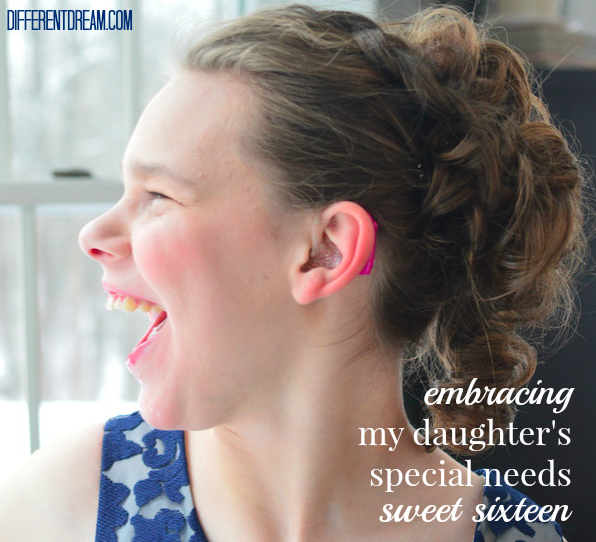
Abbey went to a prom this year, too.  Tim Tebow puts on a wonderful prom event for people with special needs called Night to Shine.  We shopped for a dress and did her hair, nails, and makeup. She had the time of her life. Guess who still cried herself to sleep? Yep, it was me.

Never once did it occur to my teenage mind that I would one day be taking care of two disabled daughters. One by birth, one by choice, and neither by chance. I just didn’t write this into my story. It’s very, very difficult to make peace with at times.

This afternoon Abbey’s diaper leaked all over the floor. She walked through it and left urine footprints all over the kitchen. I had the biggest internal sigh, not upset with her. Just disappointed that I had to deal with it. My husband Ryan and I cleaned it and her up, and the day moved on. But when I’m trying to go to sleep, I get upset that these things still bother me even though I know I’m not the only parent who wrestles with letting go of what normal looks like.

When I get weepy over the loss of that normal, I try very hard to reign in my thoughts. I know it’s okay to mourn the loss. I just can’t stay in that place. A little perspective always helps to pull me out. So instead of thinking about my sweet 16, I’m going to tell you about Abbey’s.

  • She smiles….all the time.
  • She NEVER cries herself to sleep.
  • She loves everyone, and they all love her back.
  • Every night she makes me tuck in (and kiss) her doll, and then she goes to sleep in peace.
  • She does not feel the sting of an unkind word.
  • She does not want things she cannot have or feel jealous.
  • She will never embarrass herself with poor choices or social media.
  • She is the purest form of kindness.
  • Abbey has joy that doesn’t get tainted by life’s worries.

I would go on, but I’m already over my word count! Yes, my sweet 16 was pretty sweet, but I’m pretty sure that Abbey’s is the sweetest 16 of all.

Do you like what you see at DifferentDream.com? You can receive more great content by subscribing to the quarterly Different Dream newsletter and signing up for the daily RSS feed delivered to your email inbox. You can sign up for the first in the pop up box and the second at the bottom of this page.

By

Kimberly grew up and went to college in the small town of Upland, IN. She graduated from Taylor University with a degree in Elementary Education in 2002. While at TU, she married her college sweetheart and so began their adventure! Ryan and Kimberly have three amazing kids on earth (Abigail, Jayden, and Cooper), and a baby boy waiting for them in heaven. Their daughter Abigail (Abbey) has multiple disabilities including cerebral palsy, a seizure disorder, hearing loss, microcephaly, and oral dysphagia. She is the inspiration behind Kimberly’s  desire to write. In addition to being a stay at home mom, Kimberly has been serving alongside her husband in full time youth ministry for almost fourteen years. She enjoys working with the senior high girls, scrapbooking, reading, and music. You can visit Kimberly at her website, Promises and Perspective.

Author Jolene Philo

Archives

Categories

Subscribe for Updates from Jolene

Related Posts

Beneath the Surface Is the Precious Gift of Hope

Beneath the Surface Is the Precious Gift of Hope

Beneath the Surface Is the Precious Gift of Hope

When circumstances forced guest blogger Amy Felix to look beneath the surface of her daughter’s autism, she was surprised to discover hope. Perhaps her story will encourage you to find signs of hope beneath the surface of your child’s special needs, too.

I had surgery yesterday. I knew going in that I’d be bedridden for a week. Like many moms, I believed that everything would fall apart if I wasn’t around to hold it all together. The whole thing made me cringe and sent me into a frenzy of cleaning and prepping for my recovery time. I wanted to make sure that anything that could be done before I went into the hospital was done, and then some. This situation would make any mom feel a little crazed but, as parents of kids with autism know, it translated into sheer panic.

How would I keep her routine going from the confines of my bed?
What could I do to ease her anxiety?
Could she afford to miss a few therapy appointments?
Would her babysitters be able to handle her if she had a meltdown?

As much as I wanted to prove I could go with the flow, I was anything but at peace about it all.

Then, as usual, God showed up.

I came home from the hospital to my daughter being in a mood she’s almost never in: calm. She rose above my every expectation to show that, not only was she able to handle a new routine, she was able to show she cared in ways I didn’t know she could. As I laid in bed in extreme pain, she sat by my side, quietly, with a look of concern on her face. She asked me questions about my surgery, wanting to know if the doctors had taken good care of me. She made me a get well card. She offered to help my husband bring whatever I needed to my bedside. She asked me what she could do to help me feel better.

And then she came up with her own idea.

“I know the perfect thing to help make you feel better!” she said, running out of the room. She came back carrying a stuffed Jesus doll she’d gotten at Vacation Bible School last summer. She laid him on my lap and looked at me. Really looked at me with the coveted eye contact is something we don’t take for granted around here. She shot me her trademark grin, beaming with pride. And, for the first time in a very long time, I felt connected to her.

I felt her love.

I didn’t have to just believe in it, trusting that somewhere inside she cared. It was right there for me to see. She knew, better than anyone, exactly what I needed to heal.

Jesus.

When I was choosing to worry, she chose to turn to the One who had it all in the palm of His hand. What I had made complicated, she made simple…when you’re hurting, turn to Him.

I’m ashamed to admit that I so often focus on caring for my child’s disability that I forget to focus on her abilities. Abilities that far outweigh anything that she can’t do. Abilities given to her by her Maker. Today, she reminded me that she’s in tune with the needs of others, cares in her own special way, and knows the deep need that we all have for the Healer. While God reminded me that His ways are mysterious and amazing, His plans far greater than anything I could ever come up with on my own. He reminded me to look beneath the surface. That He can use each of us, regardless of any label this world would give, to make a difference in this life.

Today, He gave me the precious gift of hope.

Do you like what you see at DifferentDream.com? You can receive more great content by subscribing to the monthly Different Dream newsletter and signing up for the daily RSS feed delivered to your email.

By

My name is Amy Felix. I’ve been married for 10 years to a guy who’s totally out of my league. I’m a homeschooling mom to 4 kids, ranging in age from 9 to 2 years. That’s really enough work on it’s own but, because I love it, I’m a photographer as well. And, in my spare time, I write. My faith is the driving force behind my special needs blog: Appointed To Hope. I’m a firm believer in being real, transparent, and using the gifts of this journey as a way to relate to others in their joy as well as their sorrow. To read more about my adventures in special needs parenting, visit my website at www.appointedtohope.com.

Author Jolene Philo

Archives

Categories

Subscribe for Updates from Jolene

Related Posts

Sometimes Caregiving Is Like Dominoes

Sometimes Caregiving Is Like Dominoes

Sometimes Caregiving Is Like Dominoes

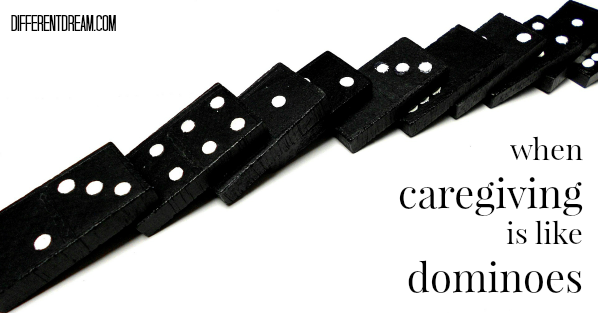
Sometimes caregiving is like dominoes. Touch even the smallest thing and everything begins to fall apart. Our lives were constantly falling apart when our baby was a bundle of complex medical needs. But once his health stabilized and we tacked life back together, I forgot about the chaos of caregiving.

But the little changes suggested by the nurse who conducted Mom’s recent annual placement assessment set the caregiving chaos in motion again. Before I knew it, a week of my life had been consumed by the changes wrought by the purchase and installation of 3 things: an electric lift chair, a toilet safety rail, and the worst offender of all, a bed safety handle.

I spent one morning calling the long term insurance company. Twice. Because the news related in the first call was so good (“Yes,” the nice lady said, “those items are covered by her policy and 100% of the purchase price will be reimbursed once you send the receipts.”) that I called a second time to hear and document the information again. I was a half day behind on my writing, but the news was so good, I didn’t much mind.

But then, I spent another morning visiting the nearest medical supply store where they said all chair sales were final. Therefore, Mom should come in to determine the right chair for her. Which meant another half day getting her there and back again. Along with an eight week wait while the factory built the chair and shipped it.

Now I was a day and a half behind, but I had eight weeks to catch up before the chair arrived and the time came to haul it to where Mom lives. Plus, my brother said he would install the toilet safety rail and the bed safety handle. So really, the task was almost done, and I would soon be able to concentrate on writing.

Except that as much as Mom loved the toilet safety rail, she disliked the bed safety handle. Because as she said and continues to say every time I visit, “It’s in the way of the night stand, so I can’t turn the light off and on. I hate it.”

Which led to a half day of fruitless research about remote control lamps that led to more fruitful research about remote control outlets. Which led to a half day trip in driving rain shopping for remote control outlets at Walmart and sales clerks who said those have to be ordered online.

Which led to me coming home soaked and discouraged and complaining to my husband who said, “Oh, I have one of those in the shop. Let me get it.” He demonstrated how it worked and said, “The remote buttons will be hard to see in the dark, so you should mark them with paint or fingernail polish or something for your mom.”

“Caregiving is like dominoes,” I complained. “Change one thing, and my schedule falls apart. Do you know how far behind I am on my writing?”

He took pity on me. “I have colored tape in my shop. I’ll fix the remote.”

His kindness freed up just enough time for two things. First, I was able to rearrange Mom’s caregivng dominoes into brief semblance of order until there’s another shift in her circumstances. Second, my appreciation grew for the caregiving parents who keep going as the dominoes fall down around them. Third, I realized that caregiving is most like dominoes, not when everything stands straight and tall, but when we train our eyes to see the beauty in the clamor, humor in the chaos, the goodness of life within the ruins of caregiving.

Do you like what you see at DifferentDream.com? You can receive more great content by subscribing to the quarterly Different Dream newsletter and signing up for the daily RSS feed delivered to your email inbox. You can sign up for the first in the pop up box and the second at the bottom of this page.

By

Jolene Philo is a published author, speaker, wife, and mother of a son with special needs.

Author Jolene Philo

Archives

Categories

Subscribe for Updates from Jolene

Related Posts