The Amazing Shrine School for Children with Special Needs

The Amazing Shrine School for Children with Special Needs

The Amazing Shrine School for Children with Special Needs

The Shrine School in Memphis, Tennessee is one of a kind. I visited it in late September of 2017 and was blown away by the building, the teachers, the staff, the parents, and most of all, by the 150 students served there.
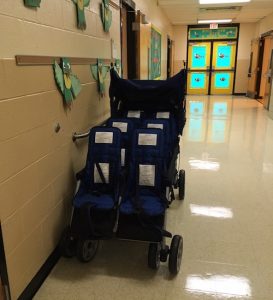
I knew this school was something special after spying this multiple child carrier in the preschool hallway.

The school, part of Shelby County Schools, has a unique history and collaboration with the Shriner Organization. The Shrine Board of Control provides funding for special services that benefit the students who attend the school. To be eligible to attend, students (who range from age 3 to 21) must have an IEP, and the need for nursing services must be written into their IEPs. The services offered are amazing. Here are pictures of a few.
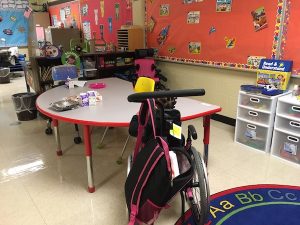
Breakfast and lunch for all students. The little girl in the chair is eating breakfast. The cafeteria provides special meals for students who require pureed food, thickened liquids, gluten-free and the like.
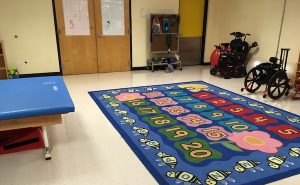
Full time, on site physical, occupational, and speech therapists who do some work in the therapy room above or in the classroom.
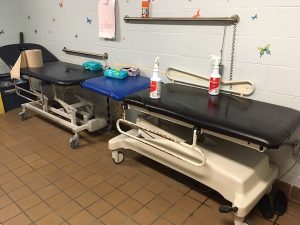
Special changing tables in the locker rooms for students whose IEPs include water therapy in the pool shown at the top of the page.

Adaptive PE equipment for tots,

tweens,

teens, and young adults.

A fully stocked library run by Ms. Posey, which I think is the best possible name for a children’s librarian.
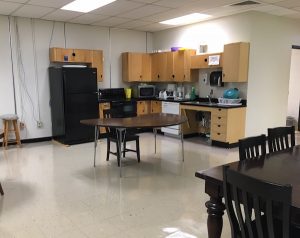
A life skills area where students learn cooking and housekeeping skills.

The Shrine School also has a full time RN who works with students and oversees numerous LPNs that serve each wing of the school (preschool, elementary, middle school, and high school). Class sizes range from 8–13 students. Each classroom has a full time teacher and at least 2 teaching assistants. The principal has been there 18 years and is passionate about the students. The full time guidance counselor, who first contacted me about speaking at their fall parent resource fair, knows every student by name and is constantly searching for resources for children and families.

Here are a few of the Shelby County resources at  the Resource Fair.

Meet Brittany, a Shrine School Alum, who now works for The Arc in the Memphis area and represented the organization at their booth.

Speaking of families, the Shrine School parents are dedicated and involved. Here are a few of the over 100 who attended the Fall Resource Fair.

The work being done by and with the students dropped my jaw more than once. In 1 classroom, a little boy operated the smart screen with his foot.
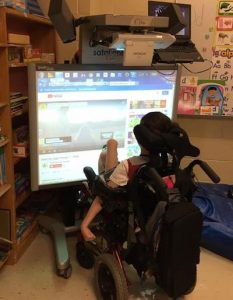
He knew exactly how to get to the channel he wanted.

At the end of the day, I visited a middle school classroom. The speech therapist wheeled one of the students into the room and announced that the young girl had “found her voice” that day. “Say hello to everyone,” she instructed a girl with dancing eyes and a radiant smile who was unable to use her limbs or speak because of cerebral palsy.

Then, for the first time in her life, the young girl used her gaze-activated communication board to say, “Hi, how are you?”
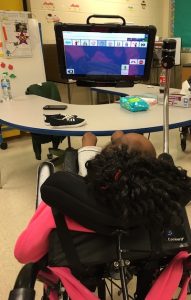
Gaze-activated communication board in use!

I watched the teachers and associates lovingly gather around her chair to chat with the student and listen to what she had to say. They kept their cool, but I was in tears.

“This school is amazing,” I told the guidance counselor later as I recounted the story.

“Miracles like that happen here all the time,” she said. “Children take their first steps, start talking, and learn to use the bathroom.”

At the end of the day, I went back to my hotel room grateful to the Shriners for their commitment to children with special needs. But my gratitude pales in comparison to that of the parents.

One after another said, “My child loves it here, and so do we. This is the best school ever.”

And do you know what I think?

They’re right.

Do you like what you see at DifferentDream.com? You can receive more great content by subscribing to the quarterly Different Dream newsletter and signing up for the daily RSS feed delivered to your email inbox. You can sign up for the first in the pop up box and the second at the bottom of this page.

By

Jolene Philo is a published author, speaker, wife, and mother of a son with special needs.

Author Jolene Philo

Archives

Categories

Subscribe for Updates from Jolene

Related Posts

5 More Ways to Build Positive Parent-Teacher Relationships

5 More Ways to Build Positive Parent-Teacher Relationships

5 More Ways to Build Positive Parent-Teacher Relationships

Are you looking for ways to build positive parent-teacher relationships as the new school year begins? This blog series is based on what I, Jolene, learned during 25 years as an elementary teacher. My classroom was inclusive, with about 1/3 of the students receiving resource room services as specified in their IEPs and 2/3 of the students without IEPs. Last week’s post looked at 5 tested tips that can build positive parent-teacher relationships. This week’s list contains 5 more.

5 More Ways to Build Positive Parent-Teacher Relationships

Tip #6: Write a Thank You Note

Sometimes teachers or other educator in the school make a spectacular difference in a child’s life. Whether that person creates a special bond with your child, advocates for more services, or creates an environment that school a safe and happy place, send a thank you note. This strategy not only gives the teacher the praise due her, but also builds good will between parent and teacher. From experience, I can say that a sincere thank you note can bring tears to a teacher’s eyes when she needs encouragement.

Tip #7: Teach Your Child to Give

Does your child get enough to eat, have clean clothes to wear, and a comfortable place to come home to each day? If your answer is yes, your child is richly blessed. But children who want for very little can begin to feel entitled rather than grateful for their blessings. One way to boost their gratitude quotient is to teach children to give. Have them sort through toys for nice ones to give away. Encourage to give some of their allowance to church. Choose a family service project or raise money for worthy causes. Children who learn to give bring that attitude to school. They help create compassion in their classroom and in their friendships. Their kindness also builds positive parent-teacher relationships.

Tip #8: Promote Independence

When children are small or not developing as quickly as their peers, it’s often easier to do things for them than to teach them to do things for themselves. But it’s crucial for parents to teach kids age- or ability-appropriate skills that lead to greater independence as soon as they’re able to learn them. Children with skills that make them more independent feel empowered and more confident. They are more likely wait to ask for help until they need it and less likely to develop an attitude of entitlement. Like children who learn to give, these children bring their healthy attitudes to school and change the climate in their classroom. Educators respect and think positively about parents who encourage age- or ability-appropriate independence in their children.

Tip #9: Offer Solutions

When problems arise at school, try to think of them as opportunities to build better and more positive parent-teacher relationships. Ask questions to find out what the problem is and about how it could be fixed. Think about the solutions offered, and you agree with them, that’s great. The problem can be solved. But if the solutions aren’t adequate, offer some of your own. This can feel intimidating, but it can be done. You are part of your child’s education team, and you are the expert on your child. Present your solutions calmly, rationally, humbly, and with a willingness to listen to the opinions of others. Working together to solve problems on behalf of the child can create positive parent-teacher relationships.

Tip #10: Follow the Biblical Model

If your best efforts at solving a problem fail and the conflict can’t be resolved, you must advocate for your child. The Bible provides a model for conflict resolution. First, go to the teacher involved about the problem one-to-one. If that is unsuccessful, ask for a meeting with the teacher and whoever is directly over that teacher–probably the building administrator or a special education administrator–and try to resolve the problem there. If that doesn’t work, ask for a meeting with the administrator at the following level. Advocate and continue until resolution is reached. To learn more about legal rights of children with special needs at school, visit WrightsLaw.com. It contains a wealth of information.

There you have them. 5 more ways to build positive parent-teacher relationships for a new school year. To check out the first 5 tips, check out Part 1 of the series. Also, leave your best tips in the comment box so readers can learn from you, too.


Do you like what you see at DifferentDream.com? You can receive more great content by subscribing to the monthly Different Dream newsletter and signing up for the daily RSS feed delivered to your email.

By

Jolene Philo is a published author, speaker, wife, and mother of a son with special needs.

Author Jolene Philo

Archives

Categories

Subscribe for Updates from Jolene

Related Posts

5 Ways to Build Positive Parent-Teacher Relationships

5 Ways to Build Positive Parent-Teacher Relationships

5 Ways to Build Positive Parent-Teacher Relationships

The other day I dashed into Walmart for deodorant, took a wrong turn, and ended up in the school supply aisle. It was teeming with moms and kids intent on filling their back-to-school lists. A little boy thrust his wrist, decorated with a slap bracelet cum 12″ ruler, under my nose and said, “See what I’m getting for school?”

Immediately my heart went out to the boy’s teacher who, if she knew what she was doing, would tell the child to put the bracelet into his backpack and take it home. My heart also went out to the boy, whose dreams of dazzling classmates with the dual purpose ruler were shortly to be dashed.

I wanted to curse the manufacturer of the bracelet for creating stupid junk that wastes parents’ money, distracts students from learning, and makes every teacher’s job harder. Instead I decided to write this blog series, based on 25 years of classroom experience, about how to build positive parent-teacher relationships as a new school year begins. These tips work well for parents of kids with special needs and for typical siblings, too. We’ll look at 5 tips today and 5 more next week.

5 Ways to Build Positive Parent-Teacher Relationships

Tip #1: Stick to the Shopping List

You’ll do your child and the teacher a great service by purchasing only what’s on the official back-to-school shopping list. Yes, your child will beg for a bigger box of crayons, the folder with the year’s hottest super hero or princess on the cover, and the slap bracelet cum ruler. Don’t give in to their begging. There are reasons those items aren’t on the shopping list: your child doesn’t need them, the teacher doesn’t want them, and your budget won’t survive if you keep giving in.

Tip #2: Watch What You Say in Front of the Kids

Your kids listen when you talk to friends and family about school. When you’re positive about your child’s teacher and school, your child is more likely to be positive, too. But if you speak negatively about those things, your child will definitely absorb what you say. Even before your child arrives at school, she’ll have a negative bias about the school year. That’s not fair to your child or the teacher. They’re the ones who’ll be working together for 6 hours a day, 5 days a week for the next 9 months. By watching what you say, you can increase the chances of a good school experience for your kids.

Tip #3: Count to Ten

Because your child is a child, he will inevitably come home with stories about things that happened at school. When those stories make you hot under the collar, step back and count to ten. Counting to ten will help you calm down and remember that you’re hearing only one side of the story. It will give you time to pray and decide if the matter is worth pursuing. If you do need to pursue it, counting to ten gives you time to frame questions to ask your child and who to contact to hear the rest of the story.

Tip #4: Check Your Attitude

Very often what someone says about school reflects their attitude about school. If your thoughts about school are generally more negative than positive, stop and think for a few minutes. Is the negativity rooted in your child’s school experiences or in your experience with school when you were a child? If the second is the root of your attitude, perhaps you are you letting your past negative experiences color your child’s present ones. If that’s the case, now is the time for you to deal with those experiences and get over them so they don’t weigh your child down.

Tip #5: Be Grateful

One way to free yourself of negative attitudes rooted in the past is to be grateful for what you have in the here and now. So make a list of things your family is grateful for as the school year begins. Did school supplies cost less than what you budgeted? Write it on the list. Do you have lunches planned and prepared for the first week? Write it down. Did your dad agree to pick up the kids after school so you don’t have to? Write it down. Is your child and his best friend in the same class? Write it down. Once you start looking for reasons to be grateful, you’ll become more grateful and much less negative.

Did you notice that the first 5 tips about how to build positive parent-teacher relationships are things you have the power to change? Isn’t that the way it is? Come back next week for 5 more tips that have the power to make this school year a great one for your child.

Do you like what you see at DifferentDream.com? You can receive more great content by subscribing to the quarterly Different Dream newsletter and signing up for the daily RSS feed delivered to your email inbox. You can sign up for the first in the pop up box and the second at the bottom of this page.

By

Jolene Philo is a published author, speaker, wife, and mother of a son with special needs.

Author Jolene Philo

Archives

Categories

Subscribe for Updates from Jolene

Related Posts

3 Ways to Take a Piece of Summer into the School Year

3 Ways to Take a Piece of Summer into the School Year

3 Ways to Take a Piece of Summer into the School Year

Guest blogger Liz Matheis wants to take a piece of summer into the school year. In fact, she’s devised a few strategies that take summer into the start of the school year and beyond.

3 Ways to Take a Piece of Summer into the School Year

I want to take a piece of summer into the school year. If you’re anything like me, you’re dreading the rush, rush, rush that happens when school starts. I love summer nights not driven by activities, homework, and the intensity that takes over once the school year begins. As I gear up for the new school year, I’m thinking about to hold onto a piece of summer breeziness in the midst of the insanity that takes over our houses and families.

Shut It Down

Designate a time of the evening that all members of the family will end the day and settle down for the night. The time may vary from night to night, but when the hour comes, ask your children to put their backpacks in their designated areas, take out clothing for the next day, prepare tomorrow’s lunch, and jump into pajamas. Once these tasks are completed, engage in electronic-free leisure time. Play a game, read a book, color, draw, or stare at the wall. The whole point is to build an end time into the day’s activities and tasks so you can wind down as a family.

Avoid Overscheduling

As I listen to parents speak about their children’s’ activity schedules, I become overwhelmed. Children and adolescents are overloaded with multiple activities and therapies. The rule at my home is one activity or therapy per child per season. I stick to this rule because as much as I want my children to have the experiences, I also want them to find balance between work and play.

By limiting children to activity or therapy, they can truly enjoy or invest their energy in it without the pressure of having multiple events each week. It also means that family dinner may be a possibility two-three times per week… at the table and with utensils!

Keep Weekends Sacred

I have always loved the weekend. For me, its a time to stay in my pajamas and slow down the pace. Use your weekends for catch up, but build in family or social time so that the weekend is not just catching up on errands. Use weekends to catch up with your family or friends. Plan movie nights, game nights, preparing dinner together, or whatever else makes you feel rested before Monday hits again.

With summer coming to an end, try not to get crazed with the upcoming business Rather build in respite so that you have time as a parent and as a family to become rested and refill your tank. That way you can take a piece of summer into the school year. If you have a way to take a piece of summer into the school year, share it in the comment box to give readers something to think about. Thanks!


Do you like what you see at DifferentDream.com? You can receive more great content by subscribing to the monthly Different Dream newsletter and signing up for the daily RSS feed delivered to your email.

By

Dr. Liz Matheis is a clinical psychologist and school psychologist in Parsippany, NJ. She offers support, assessments, and advocacy for children who are managing Autism Spectrum Disorders, ADHD, learning disabilities, and behavioral difficulties, as well as their families. She is also a contributor to several popular magazines. Visit www.psychedconsult.com for more information.

Author Jolene Philo

Archives

Categories

Subscribe for Updates from Jolene

Related Posts

11 Back to School Special Needs Posts for Parents

11 Back to School Special Needs Posts for Parents

11 Back to School Special Needs Posts for Parents

Back to school posts for parents of kids with special needs can be hard to find. And what parent has time to unearth them while caught in the back-to-school whirlwind. So Different Dream has compiled 11 of its best back to school posts for parents of kids with special needs. Here they are in chronological order of appearance on the website.

#11: Back To School, Coffee and a Little Nostalgia

Guest blogger Kimberly Drew serves up nostalgia and coffee, along with some proactive tips to help kids with special needs make a successful transition in Back To School, Coffee, and a Little Nostalgia.

#10: Eight Ways to Advocate at School for Kids with Special Needs

Mary Ashby, a consultant with All Belong, offers with tips for parents in Eight Ways to Advocate at School for Kids with Special Needs.

#9: Back To School–Eight Tips for a Smooth Transition

Different Dream’s founder, Jolene Philo, draws upon her experiences as both parent and teacher, to provide these Eight Tips for a Smooth Transition.

#8, 7, 6, & 5: How To Be Part of Your Child’s Special Education Team

This 4 part series, based on a panel discussion comprised of blue ribbon special education professionals, gives parents the inside school on how to be effective members of their children’s special education team.

Part One: 7 Ways to Advocate Before an IEP Meeting
Part Two: 4 Special Needs Obstacles to Avoid at School
Part Three: 10 Ways to Advocate at a Difficult IEP Meeting
Part Four: 3 Strategies for Good Communication after an IEP Meeting

#4: Ten Positive Ways to Advocate at School

Are you getting the idea that parental advocacy is an important component of a child’s successful school year? You are absolutely right, and this post suggests 10 Positive Ways to Advocate at School.

#3: Four After School Tips to Lower Stress in Kids with Special Needs

Child psychologist Liz Matheis shares her expertise by outlining Four After School Tips to Lower Stress in Kids with Special Needs. Her ideas are practical and doable, so take a look.

#2: Four Ways to Support Medically Fragile Children at School

Mom and guest blogger Deborah Arrona shares Four Ways to Support Medically Fragile Children at School she’s learned as the mom of a medically fragile daughter.

#1: Six Tips to Gear Up for a New School Year

Barb Dittrich, founder of Snappin’ Ministries, shares Six Tips to Gear Up for a New School Year gleaned from her years as the parent of a child with special needs.

Other Great Back to School Special Needs Posts?

Do you know of other great back to school special needs posts for parents. You’re invited to share them in the comment box. Thanks!


Do you like what you see at DifferentDream.com? You can receive more great content by subscribing to the monthly Different Dream newsletter and signing up for the daily RSS feed delivered to your email.

By

Jolene Philo is a published author, speaker, wife, and mother of a son with special needs.

Author Jolene Philo

Archives

Categories

Subscribe for Updates from Jolene

Related Posts

3 Special Needs Transition Techniques for a New School Year

3 Special Needs Transition Techniques for a New School Year

3 Special Needs Transition Techniques for a New School Year

A parent can never have too many special needs transition techniques at the beginning of a new school year. Today, guest blogger and child psychologist Liz Matheis outlines 3 special needs transition techniques that can make the start of the upcoming school easier for the whole family.

3 Special Needs Transition Techniques
for a New School Year

Transitions are tough. As a parent of a child with special needs, I am sure you are beginning to anticipate September coolness and the first day of school with a mix of anxiety and a little bit of excitement! How are you going to prepare your child for a new grade, a new school year, a new change, and a new routine? Read on for 3 special needs transition techniques to help you ease into the 2017-2018 school year.

Reel it In

If your house is anything like mine, your child’s bedtime may have become later and later as the summer went on. In August, begin to set your child’s bedtime 15 minute earlier every 2-3 days until you reach the desired bedtime again. Also set the alarm clock 15 minutes earlier each morning until you reach your child’s school wake up time. The transition will be slow and not very noticeable to your child making the change in bedtime less drastic and monumental.

So what else can you do to accomplish this goal? Begin to close the house a bit earlier each night. Dim the lights, close the blinds, slow down the pace of the house and begin to bring the day to an end. Make it a family affair by heading upstairs and putting on your pajamas and turn down your bed.

A Visit Before the First Day

Instead of waiting for the first day of school, take a walk with your child to the playground a few weeks before school starts. Find the door that your child will stand by to line up before the bell rings. Play on the playground and walk around the building so it loses its novelty. Call the building principal and ask for a walk through the building without staff and other students. This will take away the element of the unknown and make the school premises familiar, even the parts of the building that your child may not walk through.

Once your child has an assigned teacher, ask the principal if your child can visit the new classroom and teacher prior to the first day of school. They can meet without the pressure of other students, ringing bells, and the need to keep the schedule moving forward. By the time your child starts on the first day, the building, your child’s teacher, and the routine of where to go is nothing new and all good!

There’s a Visual For That

If you don’t have a visual schedule for week days and weekends, create one for the rest of the summer. If your child goes to camp, include that on the schedule. You don’t necessarily have to include times, but rather include the sequence.

Then, have your child help you create a visual schedule for the school year. Include tasks like wake up, brush teeth, get dressed, and eat breakfast. You, or better yet your child, can create it in whatever visual format you like by hand or on the computer. The more your child is able to anticipate the day’s events, the less the days feel unpredictable, but rather consistent and within her control.

As the new school year begins, these special needs transition techniques can help make it a smooth one. I’m a big summer person so, until then, I plan on enjoying the sunshine, bare feet, bathing suits and fireflies!

Do you like what you see at DifferentDream.com? You can receive more great content by subscribing to the quarterly Different Dream newsletter and signing up for the daily RSS feed delivered to your email inbox. You can sign up for the first in the pop up box and the second at the bottom of this page.

By

Dr. Liz Matheis is a clinical psychologist and school psychologist in Parsippany, NJ. She offers support, assessments, and advocacy for children who are managing Autism Spectrum Disorders, ADHD, learning disabilities, and behavioral difficulties, as well as their families. She is also a contributor to several popular magazines. Visit www.psychedconsult.com for more information.

Author Jolene Philo

Archives

Categories

Subscribe for Updates from Jolene

Related Posts