Preventing Burn Out While Parenting a Child with Special Needs

Preventing Burn Out While Parenting a Child with Special Needs

Preventing Burn Out While Parenting a Child with Special Needs

Preventing burn out while parenting a child with special needs is crucial for both parent and child. Dr. Liz Matheis, today’s guest blogger, shares 2 strategies caregiving parents can implement to stay mentally and physically strong for their kids.

As a parent of a child with special needs, you are on duty 24/7 with no sick or vacation days. Days become weeks and weeks become years and burn out becomes inevitable if you don’t take care of yourself.

I know what you’re thinking. Easier said than done.

But preventing burn out while parenting a child with special needs is just as important as caring for your child. If you are sleep-deprived, fatigued, or feeling anxious or depressed, your ability to tend to your child is compromised. So, if you need momentum and motivation to come from your child, here it is! Take care of yourself so you can take care of your child. These 2 strategies can help.

#1: Ask For Help

If you have social or family support that is available to you, I encourage you to take advantage of it. If you have a friend or family member who is offering to help in the care of your child, take it. Set up a schedule where a family member cares for your child while you care for your other children. Or take time to run errands by yourself or read a book at your local coffee shop.

I’ve heard parents say, “I don’t like to ask for help. I think I can do it all by myself,” too often. You need to leave this mindset behind and ask for help. If you do not have help from a person who lives outside your home, set up a system with your partner. Tag team who is on duty and who needs to take a break for the sake of each other’s sanity! For example, divide a task that is labor intensive, like bed time, so you are rotating each night or every two nights.

#2: Take a Daily Break

Quiet time is important for you and for your family members because it gives the physical signal that the day is coming to an end, but it also gives you time to disconnect from the day and all of the stimulation that came with it. This may be your time to process the day so that you are not waking up in the middle of the night thinking of solutions or worrying about a situation or potential situation. To make quiet time happen, decide on a time to shut down the house and set aside time to decompress every evening.

You may choose to do this as a family or as the adult(s) in the house. For example, you may decide that by 7 in the evening, you will stop making lunches and washing dishes, dim the lights, and engage in an electronic-free activity.

Your self care is just as important as the care of your child. Preventing burn out while parenting a child with special needs requires investing in yourself as much as you invest in your child. Asking for help and taking a daily break are ways of making small investments that pay big dividends for you and your child.

Do you like what you see at DifferentDream.com? You can receive more great content by subscribing to the monthly Different Dream newsletter and signing up for the daily RSS feed delivered to your email inbox. You can sign up for the first in the pop up box and the second at the bottom of this page.

By

Dr. Liz Matheis is a clinical psychologist and school psychologist in Parsippany, NJ. She offers support, assessments, and advocacy for children who are managing Autism Spectrum Disorders, ADHD, learning disabilities, and behavioral difficulties, as well as their families. She is also a contributor to several popular magazines. Visit www.psychedconsult.com for more information.

Author Jolene Philo

Archives

Categories

Subscribe for Updates from Jolene

Related Posts

Is Being a Special Needs Parent Worth It?

Is Being a Special Needs Parent Worth It?

Is Being a Special Needs Parent Worth It?

Is being a special needs parent worth it? Guest blogger Mark Arnold answers the question from his vantage point as parent to James, his son with significant special needs. Read on to see what this 17 year veteran caregiver has to say.

Is Being a Special Needs Parent Worth It?

This question lurks in the heart of every special needs parent. We keep it down, out of sight. But every now and then when we are tired beyond our ability to cope, knocked down by bad news, clearing up something we hoped to never see again, the question sneaks out of hiding and yells, “Is being a special needs parent worth it?”

Perhaps never before has humanity lived in such a self-centered, self-obsessed, self-serving, narcissistic society as we do now. Advertising is filled with slogans such as “Because you’re worth it!” and “It’s all about you!”

What does any of this have to do with parenting children with special needs?

Well, parenting is life changing. It alters everything. The focus of our lives becomes less about ourselves and more about the child we’ve brought into the world. The level of care required, the sacrifices that need to be made, the time invested, and increases exponentially.

Our son James is 17. His special needs require a level of care that would be typical for a 3-year-old. He cannot be left unsupervised, has no real sense of danger, and requires a high level of personal care. A great deal of juggling is required to get through each day. In our world the self-centered, self-obsessed advertising is irritating white noise; irrelevant and without a place in our situation. Our focus simply cannot be on ourselves. It has to be on our children, particularly James as his needs are so much greater.

However we wouldn’t have it any other way.

Jesus’ message of selflessness, putting others first, serving others, loving others, is also counter-cultural in today’s society. As Matthew puts it in his gospel, “Be like the Son of Man. He did not come to be served. Instead, he came to serve others. He came to give his life as the price for setting many people free.” Matthew 20:28 (NIV)

Serving our child, loving our child, self-sacrifice for the benefit of our child–Jesus is the model we follow as special needs parents. The narrative of Jesus is more relevant, more inspirational, more aspirational, and more needed than the cultural obsession with self that surrounds us.

What about you? Where do you see yourself in this? Are you on the same journey?

Whatever your context, the counter-cultural message of Jesus shines through. Put your children before yourself, love your children for who they are, be self-sacrificing, serve their needs.

Let’s continue to be counter-cultural, revolutionary, rejecting the narcissistic, selfish, self-obsessed, self-serving culture that society would have us embrace.

Let’s be better people, the people we should be, the people we are called to be, loving each other, serving others not ourselves. Let that be the case for the children we care for, whether they are our own or not–because they are worth it!

Do you like what you see at DifferentDream.com? You can receive more great content by subscribing to the monthly Different Dream newsletter and signing up at the bottom of the page for the daily RSS feed delivered to your email inbox.

By

Mark Arnold is the Additional Needs Ministry Director at Urban Saints, a leading national Christian children’s and youth organization. He is co-founder of the Additional Needs Alliance, a national and international advocate for children and young people with additional needs or disabilities. Mark is a Churches for All and Living Fully Network partner, a member of the Council for Disabled Children and the European Disability Network. He writes an additional needs column for Premier Youth and Children’s Work (YCW) magazine and blogs at The Additional Needs Blogfather, He is father to James, who has autism spectrum condition, associated learning disability, and epilepsy. To find out more about how Mark’s work can help you, contact him at: marnold@urbansaints.org or @Mark_J_Arnold.

Author Jolene Philo

Archives

Categories

Subscribe for Updates from Jolene

Related Posts

Bear in Mind the Need for Laughter

Bear in Mind the Need for Laughter

Bear in Mind the Need for Laughter

Bear in mind the need for laughter and take advantage of the opportunity to indulge in it while you read this post from first time Different Dream guest blogger Catherine Boyle. This post comes with an anti-beverage warning. Catherine and I would hate for you to spew hot coffee or a cold soft drink out your nose while reading.

My husband and I enjoyed many moments in our kids’ growing up years that were absolutely hilarious. Much to my chagrin, more than a handful of those things occurred because of overzealous parenting on my part.

Laughter Can Be Unexpectedly Dangerous

In spite of the aforementioned parenting zeal, my son wasn’t diagnosed with high functioning autism until his late teens. As a result of this lack of knowledge, there were several adolescent developmental milestones that I anticipated way too early.

When my son was in fifth grade, I signed up to drive carpool for a field trip to Monticello, Thomas Jefferson’s home. At the time, we had a large vehicle that could accommodate seven kids. So I drove an hour and a half with seven chattering, loud, laughing ten-year-old boys.

I was the only adult in the car, and listening to their conversation and zest for life was quite entertaining. I knew what I signed up for that day, but the truth was I could hardly hear myself think. All of a sudden, quite unexpectedly, there was deathly silence. One pre-pubescent voice cracked through the silence, uttering the punch line to a joke, “Circumcise a bear!”

Peals of laughter immediately filled the quiet. It was all I could do not to crash the car. My shoulders shook and my eyes watered from suppressing my own laughter.

Some weeks after the comment about the unfortunate bear, I gingerly launched into a carefully thought out monologue with my son. Conversations and comments about girls were no longer the same stuff of his early elementary school years. His body was changing; his mind was changing too. I informed him that very soon, he would be thinking a lot about girls.

He listened politely, with a puzzled look on his face. It was quite clear to me that he had no idea why we were having this conversation. Gently, I asked him, “When you’re by yourself, what do you think about?”

He thought seriously for a moment, then said, “I mostly think about Star Wars.”

Laughter is Necessary

There’s a lot that’s difficult in raising a kid with high functioning autism; our family has had more than our share of tears. Humorous moments do not diminish the tough times of raising a kid with some extra challenges. But enjoying life and laughter in spite of the challenges can help kids develop resilience, learn that tough days do not last forever, and keep your marriage strong.

There are actually some benefits to high functioning autism. Aspie kids are often late bloomers socially. That means there is more time to explain the nuance and subtlety that comes with romantic relationships. And the truth is, no one gets through adolescence unscathed when it comes to relationships with the opposite sex. In this way, Aspie kids and neurotypical kids are blessedly similar.

So while Aspie differences provide challenges, those very same differences can provide humor for the whole family. And parents get a little extra time to help kids learn how to handle adult issues like romance.

Or surgical procedures on wild animals.

By

Catherine Boyle is Mental Health Ministry Director, Blog Editor and Social Media Manager for Key Ministry. Catherine has been impacted by mental health issues her entire life, including her own struggles with anorexia, bulimia, anxiety and depression. Prior to joining Key Ministry in 2018, Catherine authored Hungry Souls: What the Bible Says About Eating Disorder, and helped launch a ministry home for women with eating disorders. In 2015, Catherine founded Outside In Ministries, focusing on how the church can minister to and with people with mental health issues. Follow Catherine’s work here and at www.catherineboyle.com, Facebook, Twitter, Instagram, Pinterest and Patreon.

Author Jolene Philo

Archives

Categories

Subscribe for Updates from Jolene

Related Posts

What I Regret Most about Being a Mean Girl

What I Regret Most about Being a Mean Girl

What I Regret Most about Being a Mean Girl

What I regret most about being a mean girl.

Those words are both blog post title and personal confession in the wake of a conversation with an old friend at our 45th class reunion.

“Do you remember Katya Luwamala?” he asked as he sat down beside me.

“Very well,” I replied.

“Do you remember when Katya was sent home the first week of school?” my friend asked.

I shook my head. “No.”

“She wore a jumpsuit to school. No one would even notice it now, but apparently it was taboo in 1965.” He paused. “You know, the girls in our class weren’t very nice.”

I knew.

“They ostracized her from then on. She was so different with her white-blond hair, her strange clothes, and lack of social skills.”

“She picked her nose and ate her boogers, too. Looking back, I wonder if she had high functioning autism. She was so smart, she couldn’t relate to other kids. But you should know something.” I took a deep breath. “I was one of the mean girls.”

He gave me a quizzical look. “You?”

“Me.”

I told him how Katya had been placed in my mother’s third grade classroom in the small, midwestern town where we lived. I was in a different section of the same grade, enduring a difficult school year among classmates who kept their distance because I was weirdly creative, poorly coordinated, and the daughter of the strictest teacher in the building. Mom encouraged a friendship between Katya and me the summer after third grade, and we played together often. Katya was unlike any friend I’d ever had–highly imaginative, well-traveled, brilliant, and a little odd. We spent hours dressing up and acting out the adventures she narrated. I loved playing with her.

To read the rest of this post, visit Key Ministry’s blog for parents of kids with special needs.

By

Jolene Philo is a published author, speaker, wife, and mother of a son with special needs.

Author Jolene Philo

Archives

Categories

Subscribe for Updates from Jolene

Related Posts

A Letter to Our Other Child

A Letter to Our Other Child

A Letter to Our Other Child

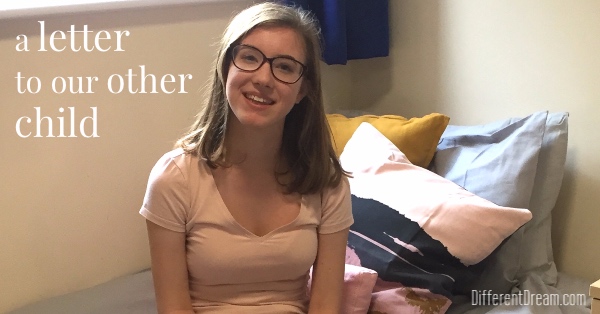
For many who parent children with special needs, they are not the only child in the family. We may have other children also needing love, nurturing, care and support. Our other child is Phoebe, who at 19 is 2 1/2 years older than our autistic son James. This is a letter to Phoebe and to the other child, the brothers or sisters of those with special needs or disabilities.

Dear Phoebe,

We love you, you are very precious to us. We are enormously proud of you for being the fine young woman that you have grown into. This letter is a small way of acknowledging all you do to support your brother and us.

You are a carer for James, helping out with a range of tasks to keep the wheels on our particular family bus. You are great at spotting when James is starting to get distressed. You’ve cleaned up stuff that you would rather not see, you’ve helped in the middle of the night when James was having a meltdown, you’ve watched endless episodes of his favorite videos with him. You call us out when we let James off for something he does that is less about autism and more about being a 17-year-old who is pushing boundaries.

But you’ve missed out on things many young people take for granted. The times we skipped going to something, or came home early because James was struggling. We can’t go out to the movies or a meal on a whim as most families can though you might have liked to go somewhere different for a change. We invite people to our house rather than visit because it’s easier for James in the familiarity of his own den, and we’ve got everything we need to support him.

We were able to understand what having a child with special needs would mean, although in reality we still had everything to learn. For you it meant your brother was a bit different than the brothers and sisters of your friends. As you grew up you noticed the differences more, asked more questions, learned more about your brother, were affected more by living with him.

In all of this, you rarely complained, although you have your moments. You got on with life and the challenges of being the sibling of a brother with additional needs. There are times when you mention that all of our time and energy seems to be focused on James, and that you don’t get enough of our time and focus. We need to do better, to learn, and to change.

We are incredibly proud of the well-rounded, caring, thoughtful, intelligent, faith-filled young woman you have become. There are thousands like you, who quietly cope while a brother or sister has a difficult day. Thank you for being a wonderful daughter, an inspiring and caring sister. We love you more than we sometime show and more than you will ever know.

“Be completely humble and gentle; be patient, bearing with one another in love.”
Ephesians 4:2

Mum and Dad
xx

Whether we are parents or the children’s and youth workers who care for the other child in other ways, let’s celebrate the contributions siblings make to the world. Let’s acknowledge how hard it can be for them, and make sure that we love, nurture, care, and thank them for all that they do.

Do you like what you see at DifferentDream.com? You can receive more great content by subscribing to the quarterly Different Dream newsletter and signing up for the daily RSS feed delivered to your email inbox. You can sign up for the first in the pop up box and the second at the bottom of this page.

By

Mark Arnold is the Additional Needs Ministry Director at Urban Saints, a leading national Christian children’s and youth organization. He is co-founder of the Additional Needs Alliance, a national and international advocate for children and young people with additional (special) needs or disabilities and is passionate about enabling everyone engaging with them to be inspired, trained and well-resourced. Mark is a Churches for All and Living Fully Network partner, a member of the Council for Disabled Children and the European Disability Networ. He writes an additional needs column for Premier Youth and Children’s Work (YCW) magazine and blogs at The Additional Needs Blogfather, He is father to James, who has autism spectrum condition, associated learning disability, and epilepsy. To find out more about how Mark’s work can help you, contact him at: marnold@urbansaints.org or @Mark_J_ArnoldImage rights: © author’s own

Author Jolene Philo

Archives

Categories

Subscribe for Updates from Jolene

Related Posts

Special Needs Caregivers: Which Parks & Rec Character Are You? Pt. 2

Special Needs Caregivers: Which Parks & Rec Character Are You? Pt. 2

Special Needs Caregivers: Which Parks & Rec Character Are You? Pt. 2

Special needs caregivers know that humor is an effective weapon in combatting stress. When I need to laugh, I watch Parks and Recreation on Netflix. After one particularly belly laugh-filled episode, I created a quiz to make the special needs caregivers who read this blog giggle. In Part 1 of this short series, I described 5 favorite characters from the show. This post describes 5 more and provides instructions about how complete the quiz.

#6: April Ludgate

In the first season, April Ludgate is a young, unmotivated, sarcastic intern in the parks department. In the second season, she falls in love with Andy Dwyer (see #7), and they eventually marry. Her love for her husband transforms her into a woman of purpose. By the series finale, she’s still on the sarcastic side but she is fiercely protective and grateful for those she loves. She reminds me of caregivers who mature into their purpose in life, which is to care for others and advocate for their best good.

#7: Andy Dwyer

Andy is a goofy, aimless moocher who dreams of rock band success when Parks and Recreation begins. His goofy, childlike perspective is consistent throughout the show’s run. He also discovers that his childlike joy allows him to connect with children. Combined with his musical talent, Andy becomes a successful children’s television show host. He resembles special needs caregivers who see life through a child’s eyes and enter into the wonder of childhood with them, filling their lives with joy and inaccurate reporting.

#8: Ron Swanson

Ron Swanson is the head of the parks and recreation department, a man’s man of few words, and fewer emotions. He’s a government employee who hates government, loves red meat, and woodworking. Ron prefers isolation to relationships and hides his alter ego as a jazz saxophonist from co-workers and friends. If he were a caregiver, he would shut himself and his loved one away to the detriment of both. Why? Because his need to project the image of self-sufficiency won’t allow him to admit his need for help.

#9: Ben Wyatt

Ben is a nerd’s nerd. He’s an accountant, grooves on spreadsheets, is into Game of Thrones, Star Wars, the Marvel Universe, and all things nerdiest. In his youth, he was the youngest mayor in the United States and led his town into bankruptcy. His failure haunts him and keeps him from taking risks. He’s also fiercely loyal, a loving husband, and a good friend. A Ben Wyatt caregiver is always there for a loved one, but may find it hard to risk leaving a child with someone else, even someone trusted for any amount of time.

#10: Leslie Knope

Leslie is a woman who is passionate about her work, her friends, and the parks in her hometown. She leaves nothing to chance. She pulls frequent all nighters, filling thick binders with plans, tabs, and color-coded pages for the initiatives she spearheads. Leslie devotes hours to choosing and creating perfect birthday gifts for those she loves. She’s also known for railroading people into doing what she thinks is right instead of listening to what they believe. Leslie Knope caregivers are outstanding in their role. They research their loved ones’ conditions obsessively and advocate relentlessly. They demand perfection from others, which can make them hard to live with.

Now it’s your turn to decide which character best describes your caregiving personality. Once you’ve made your decision, leave a message in the comment box. After a few readers spill their caregiving personality beans, I’ll leave a comment, too. If you haven’t watched the show yet, I encourage you to add it to your list on Netflix or purchase the entire Parks and Recreation DVD series. You won’t be sorry!

Part 1

Do you like what you see at DifferentDream.com? You can receive more great content by subscribing to the monthly Different Dream newsletter and signing up for the daily RSS feed delivered to your email inbox. You can sign up for the first in the pop up box and the second at the bottom of this page.

By

Jolene Philo is a published author, speaker, wife, and mother of a son with special needs.

Author Jolene Philo

Archives

Categories

Subscribe for Updates from Jolene

Related Posts