Special Needs Accommodations as Easy as 4 Tennis Balls

Special Needs Accommodations as Easy as 4 Tennis Balls

Special Needs Accommodations as Easy as 4 Tennis Balls

Special needs accommodations. Speaking as a former teacher, I can attest to the fact that those words can send shivers up the spines of educators grappling with teaching duties that exceed the time required to complete them. So it’s always fun to read about simple accommodations with a lot of bang for the buck—the kinds that make a big difference for students and are easy for teachers to implement.

Special Needs Accommodations at KIT Blog: The Inclusion Potluck

I recently ran across KIT Blog: The Inclusion Potluck, a site is packed with special needs accommodation tips and advice. The post that led me to the site was by a long-term substitute teacher working with a sophomore who couldn’t sit still. He moved his chair constantly, scraping the tile so noisily it distracted everyone in the classroom. Her repeated requests for him to sit still frustrated him so much, he threw the chair. For awhile she let him sit in the teacher’s roller chair. That stopped the noise, but resulted in him rolling the chair in a distracting manner.

Special Needs Accommodation by Tennis Balls

Thankfully, she was reading a book by inclusion specialist Paula Kluth at the time. The substitute said the book gave her “the opportunity to reflect on this situation, assess and adapt the environment to my need to stop the screeching of a metal chair on the tile, and to help Fernando resolve this problem of needing to move his chair so frequently.”

So, she went to the store and bought 4 tennis balls. Here’s what happened the next time the student asked if he could sit in the teacher’s chair:

I told him that I have something better that he can use in his other classes and gave him four tennis balls. He gave me the cutest smirk in an attempt to hide his confusion. I put the balls on the legs of the chair and demonstrated how quiet the chair became. He was so relieved and this completely eliminated all problems associated with that chair. He used the balls in the other classes and, after school, two of his other teachers thanked me profusely. I learned that he has been sent to the office several times by teachers who could not tolerate this behavior. This is the perfect example of how well assessing and adapting the environment helps students and teachers alike.

Simple Special Needs Accommodations You Love?

How about you, teachers and parents? What accommodations have you used or seen used that are easy to implement and effectively meet student needs? Leave a comment if you like.

Do you like what you see at DifferentDream.com? You can receive more great content by subscribing to the quarterly Different Dream newsletter and signing up for the daily RSS feed delivered to your email inbox. You can sign up for the first in the pop-up box and the second at the bottom of this page.

Photo Source: www.freedigitalphotos.net

By

Jolene Philo is the author of several books for the caregiving community. She speaks at parenting and special needs conferences around the country. Sharing Love Abundantly With Special Needs Families: The 5 Love Languages® for Parents Raising Children with Disabilities, which she co-authored with Dr. Gary Chapman, was released in August of 2019 and is available at local bookstores, their bookstore website, and Amazon. See Jane Sing!, the second book in the West River cozy mystery series, which features characters affected by disability, was released in November of 2022.

Author Jolene Philo

Archives

Categories

Subscribe for Updates from Jolene

Related Posts

Work Training and Placement for Young Adults with Autism

Work Training and Placement for Young Adults with Autism

Work Training and Placement for Young Adults with Autism

Employment and kids with special needs. Is there a way for the two entities to come together? That’s a question parents ask frequently as their kids with special needs get closer to adulthood. A report that aired April 22, 2013 on National Public Radio provides information about work training for those raising children on the autism spectrum.

Autism and the nonPareil Institute

The nonPareil Institute was founded by Gary Moore, the father of Andrew, who is on the autism spectrum. According to the NPR story, “Gary Moore wants to make the transition into the workforce easier for young adults on the autism spectrum.” That’s why he and his partner Dan Selic founded the institute, which is “a combination training program and software company for young adults on the autism spectrum.”

Moore says “he used to stay up at night worrying about what would happen to Andrew after graduation.” Out of that concern, the nonPareil Institute was born. “Although [Andrew] can’t tie his shoes or buckle his belt or do a lot of things independently, he can do technology,” Moore says. “He’s a digital native.”

Autism Hasn’t Stopped these Young Adults

NPR reporter Lauren Silverman also interviewed Amelia Schabel, one of the over 100 students going through work training at the company and highlights some of the two dozen company employees who land somewhere on the autism spectrum. To read or listen to the story, go to Young Adults With Autism Can Thrive In High-Tech Jobs. This is the kind of article that will give you hope or perhaps spur you on to think of ways to make the workplace more open to young adults with special needs.

Other Work Training/Employment Opportunties

Do you know of other training or employment opportunities for young adults with special needs? If so, leave a comment with a description of the organization and a link to it’s website. Your information may provide hope and direction for parents and their kids. Thanks!

Do you like what you see at DifferentDream.com? You can receive more great content by subscribing to the quarterly Different Dream newsletter and signing up for the daily RSS feed delivered to your email inbox. You can sign up for both in the upper right column on this page.

Photo Credit: www.freedigitalphotos.net

By

Jolene Philo is the author of several books for the caregiving community. She speaks at parenting and special needs conferences around the country. Sharing Love Abundantly With Special Needs Families: The 5 Love Languages® for Parents Raising Children with Disabilities, which she co-authored with Dr. Gary Chapman, was released in August of 2019 and is available at local bookstores, their bookstore website, and Amazon. See Jane Sing!, the second book in the West River cozy mystery series, which features characters affected by disability, was released in November of 2022.

Author Jolene Philo

Archives

Categories

Subscribe for Updates from Jolene

Related Posts

5 Ways to Set Realistic Goals for Kids with Special Needs

5 Ways to Set Realistic Goals for Kids with Special Needs

5 Ways to Set Realistic Goals for Kids with Special Needs

Goal setting can be a balancing act for parents of kids with special needs and educators who work with them. How do we set goals that challenge our children to reach their full potential and be realistic at the same time? Eliana Tardio offers excellent advice in a post at www.Mamiverse.com.

What Tardio Knows about Setting Realistic Goals

Eliana Tardio is the mom of two children with Down Syndrome. She currently works for the Florida State Program of Early Intervention as a Family Resource Specialist. She frequently blogs about advocating for and parenting children with special needs at Mamiverse.

5 Ways to Set Realistic Goals

Tardio offers these five tips about setting realistic goals:

  1. Remember that the most important part of school for your child is learning life skills that will help him thrive and be as independent as possible.
  2. Take small steps instead of setting big goals.
  3. Think of every experience is a learning opportunity.
  4. Be realistic about the things you can change or improve through therapies or additional services.
  5. Work closely with all the people involved in your child’s education.

She ends the article with this reminder to parents: “Celebrate those small things that others may let pass by unnoticed. And remember, your most important goal…is to find happiness in his everyday achievements and let him know that he is loved and appreciated.”

Good advice, don’t you think? Check out the entire post at Five Ways Parents of Children with Special Needs Can Set Realistic Goals. While you’re at the site, click on Tardio’s name to get a complete listing of her posts so you can read more of her sound advice.

How Do You Set Realistic Goals?

What helps you and the teachers who work with your child set realistic goals? Leave a comment about the strategies that work for you. Thanks!

Do you like what you see at DifferentDream.com? You can receive more great content by subscribing to the quarterly Different Dream newsletter and signing up for the daily RSS feed delivered to your email inbox. You can sign up for the first in the pop-up box and the second at the bottom of this page.

photo credit: www.freedigitalphotos.net

By

Jolene Philo is the author of several books for the caregiving community. She speaks at parenting and special needs conferences around the country. Sharing Love Abundantly With Special Needs Families: The 5 Love Languages® for Parents Raising Children with Disabilities, which she co-authored with Dr. Gary Chapman, was released in August of 2019 and is available at local bookstores, their bookstore website, and Amazon. See Jane Sing!, the second book in the West River cozy mystery series, which features characters affected by disability, was released in November of 2022.

Author Jolene Philo

Archives

Categories

Subscribe for Updates from Jolene

Related Posts

13 Special Needs App Picks

13 Special Needs App Picks

13 Special Needs App Picks

Special needs apps keep springing up as fast as a field of daisies in summer. The field (of special needs apps, not daisies) is growing so fast, it’s hard to pick the ones best suited to meet your child’s needs.

TeachThought.com to the Rescue

Thankfully, TeachThought.com came to the rescue. Teach Thought—a website that features what’s new in educational thought, trends, technology, and other learning-related stuff—partnered with Teachers with Apps (TWA) to list their top special need apps picks.

The Special Needs App List

Here are some of the apps that made the list:

  1. See, Touch, Learn, Pro by Brain Parade is an app with many purposes, one of which is the ability to create lessons.
  2. With Pictello by Assistiveware, families can create and share talking photo albums and stories.
  3. Dragon Diction by Nuance Communication is a speech-to-text application.
  4. The Social Express by The Language Express, Inc. teaches users with high-functioning Aspergers to think about and manage social situations.
  5. My First ACC by Injini is an iPad app for younger children with delayed speech or severe speech disorders.
  6. Conversation Builder Teen by Mobile Education Store is the teen version of Conversation Builder.
  7. Phonics Genius by Alligator Apps is a comprehensive phonics app.
  8. SoundLiteracy by 3D Literacy, LLC helps students recognize the spellings of English phonemes.
  9. Letter School by Boreaal gives kids many ways to practice letters and numbers.
  10. Social Quest by Smarty Ears engages older elementary, middle school and high school students in castle adventures while working on speech, language, and social skills.
  11. P.O.V.–Spatial Reasoning Skills Development by Binary Labs encourages spatial reasoning skills in kids and adults.
  12. Speech With Milo by Doonan Speech Therapy includes nine speech apps to build language skills.

More Special Needs App Information

More details about each app can be found at 13 of The Best Special Needs Apps of 2012. So zip on over and check them out. And if you have recommendations for more great apps, leave them (and a link) in the comment box.

photo credit: www.freedigitalphotos.net

Do you like what you see at DifferentDream.com? You can receive more great content by subscribing to the quarterly Different Dream newsletter and signing up for the daily RSS feed delivered to your email inbox. You can sign up for the first in the pop-up box and the second at the bottom of this page.

By

Jolene Philo is the author of several books for the caregiving community. She speaks at parenting and special needs conferences around the country. Sharing Love Abundantly With Special Needs Families: The 5 Love Languages® for Parents Raising Children with Disabilities, which she co-authored with Dr. Gary Chapman, was released in August of 2019 and is available at local bookstores, their bookstore website, and Amazon. See Jane Dance!, the third book in the West River cozy mystery series, which features characters affected by disability, was released in October of 2023.

Author Jolene Philo

Archives

Categories

Subscribe for Updates from Jolene

Related Posts

5 Digital Tools for Children with Special Needs

5 Digital Tools for Children with Special Needs

5 Digital Tools for Children with Special Needs

Digital tools and apps are exploding all over the electronic world. A post at Reading Rockets, an organization dedicated to teaching young children to read and supporting struggling readers, recommended 5 websites with digital tools for children with special needs that improve their reading skills.

Digital Tools Incorporate Universal Design for Learning Principles

The recommended websites incorporate Universal Design for Learning (UDL) principles. The post says that UDL principles create “learning environments that meet the needs of all types of learners—closed captioning for the hearing impaired, read-aloud capabilities for the visually impaired, for example.”

Why is universal design important to kids struggling with reading? According to the post, “children benefit enormously from the types of learning experiences that engage them on a variety of levels such as: seeing, hearing, speaking, singing, and movement.”

5 Websites with Digital Tools for Children with Special Needs

  1. UDL Tech Toolkit Wiki is packed with learning tools to aid children with handwriting issues.
  2. CAST’s UDL Book Builder helps children create and publish their own books, and it reads them back!
  3. Signed Stories allows visitors to view stories told in sign language, with subtitles and an audio option.
  4. The Mother Goose Book Club features children’s nursery rhymes sung aloud by fun characters.
  5. TapToTalk is a free app for kids with limited speech capabilities. It’s featured at Common Sense Media website.

What Digital Tools and Websites Do You Recommend?

These 5 resources are excellent, but there must be others on the web. What digital tools and websites have you and your children discovered to help them learn to read? Leave a comment to share them with the rest of us, whether or not they follow universal design for learning principles.

Do you like what you see at DifferentDream.com? You can receive more great content by subscribing to the quarterly Different Dream newsletter and signing up for the daily RSS feed delivered to your email inbox. You can sign up for the first in the pop-up box and the second at the bottom of this page.

By

Jolene Philo is the author of several books for the caregiving community. She speaks at parenting and special needs conferences around the country. Sharing Love Abundantly With Special Needs Families: The 5 Love Languages® for Parents Raising Children with Disabilities, which she co-authored with Dr. Gary Chapman, was released in August of 2019 and is available at local bookstores, their bookstore website, and Amazon. See Jane Dance!, the third book in the West River cozy mystery series, which features characters affected by disability, was released in October of 2023.

Author Jolene Philo

Archives

Categories

Subscribe for Updates from Jolene

Related Posts

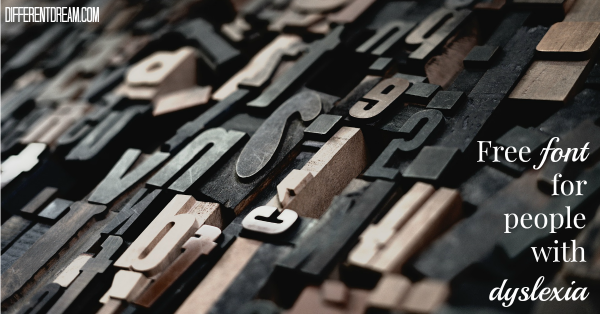
Free Font for People with Dyslexia

Free Font for People with Dyslexia

Free Font for People with Dyslexia

Dyslexia is a developmental reading disorder that occurs when the brain doesn’t recognize and process certain symbols. I taught many children with dyslexia, and they worked hard to make sense of letters that seemed to float off the page as they read. I constantly searched for tools and strategies to support their determined efforts to master written language.

Dyslexia Free Font

Donna Thomson, who blogs at The Caregiver’s Livingroom, recently provided a link to a free downloadable font for people with dyslexia. It’s registered with Creative Commons, which means that “as long as you visibly give credit, you can use this on your ebook, ebook reader, actual physical books, web sites” and so on.

The link at dafont.com has examples of the font in regular, bold, italic, and italic-bold print. In addition to the upper and lower case alphabet, the creator made weighted versions of a large variety of symbols. There’s also quiet a collection of letters with accent marks for foreign languages or perhaps phonetic symbols…I’m not sure which since my last brush with either category was way back in college.

Dyslexia Weighted Font

How does the font help people with dyslexia? According to the note from the author, it’s a “font created to help dyslexic readers. Bottom heavy and unique character shapes help prevent letters and numbers from being confused.” It makes sense that weighting would help anchor letters in place for readers with dyslexia, but the site contained no studies about its effectiveness. But since the font is a free download, it’s certainly worth a try.

Dyslexia and You

Do you have a child with dyslexia? What strategies and tools make a difference for your child? Or are you dyslexic? If so, how do you cope with your condition? What helped you learn to read when you were young? Leave a comment to share your story and resources. Thanks.

photo credit: www.freedigitalphotos.net

Do you like what you see at DifferentDream.com? You can receive more great content by subscribing to the quarterly Different Dream newsletter and signing up for the daily RSS feed delivered to your email inbox. You can sign up for the first in the pop-up box and the second at the bottom of this page.

By

Jolene Philo is the author of several books for the caregiving community. She speaks at parenting and special needs conferences around the country. Sharing Love Abundantly With Special Needs Families: The 5 Love Languages® for Parents Raising Children with Disabilities, which she co-authored with Dr. Gary Chapman, was released in August of 2019 and is available at local bookstores, their bookstore website, and Amazon. See Jane Dance!, the third book in the West River cozy mystery series, which features characters affected by disability, was released in October of 2023.

Author Jolene Philo

Archives

Categories

Subscribe for Updates from Jolene

Related Posts