Sleep Problems and Special Education Needs

Sleep Problems and Special Education Needs

Sleep Problems and Special Education Needs

Sleep problems in preschoolers may increase the likelihood of a child needing special education services later in life. That’s the finding of a study published in the September 2012 issue of Pediatrics.

Sleep Problems? What Kind of Sleep Problems?

I admit my first thought upon hearing the news was similar to my response to the study that showed regular school attendance increases kids’ learning. It took a study to prove that? Somebody could have saved a lot of money by asking teachers about the correlation between attendance and learning.

But a closer reading of the sleep problem study revealed a more complex issue. At first glance, I erroneously believed the sleep problem was kids getting too little sleep. Going to bed too late. Interrupted sleep. Stuff like that. But I was wrong. This study looked at problems like sleep apnea and snoring in infants, toddlers, and preschoolers.

Sleep Problem and the Special Education Correlation

The study, authored by Karen Bonuck, a professor at Albert Einstein College of Medicine’s Department of Family and Social Medicine, in New York City “found that kids who suffered from problems like sleep apnea and snoring in their infant, toddler and preschool years were more likely to need special education services for conditions such as speech and behavioral problems a few years later.”

The study found an association between the two factors, but it did not prove cause and effect. An article in U.S. News and World report says, “The higher risk of disabilities could be a statistical fluke, or something else besides sleep problems may explain it.” However, the article goes on to say, “Research has shown that sleep deprivation disrupts the making of memories in the brain.”

Now that’s alarming! Because, as the article states, “Sleep is not just ‘rest’ where the body needs to restore energy. The brain is active 24/7, and we now know that not only important aspects of learning and memory happen during sleep, but emotion regulation is also dependent on sleep. “No wonder pediatricians are being advised to screen for early sleep problems and address them.

Sleep Problems at Your House

What do you think of the study? Do the results surprise you? Do your young children have sleep problems or did they when they were younger? How did you deal with them? What did your pediatrician advise? Leave a comment about your reactions to this study and how the findings could impact your child.

Do you like what you see at DifferentDream.com? You can receive more great content by subscribing to the quarterly Different Dream newsletter and signing up for the daily RSS feed delivered to your email inbox. You can sign up for the first in the pop-up box and the second at the bottom of this page.

By

Jolene Philo is the author of several books for the caregiving community. She speaks at parenting and special needs conferences around the country. Sharing Love Abundantly with Special Needs Families: The 5 Love Languages® for Parents Raising Children with Disabilities, which she co-authored with Dr. Gary Chapman, was released in August of 2019 and is available at local bookstores, their bookstore website, and Amazon. See Jane Dance!, the third book in the West River cozy mystery series, which features characters affected by disability, was released in October of 2023.

Author Jolene Philo

Archives

Categories

Subscribe for Updates from Jolene

Related Posts

Parent Toolkit: Make the Most of the School Year

Parent Toolkit: Make the Most of the School Year

Parent Toolkit: Make the Most of the School Year

A parent toolkit may be just what you need with the school year in full swing and parent/teacher conferences right around the corner. Thankfully, Mary Mazzoni features the resource you’re looking for at her website, Life After IEPs wesite.

Parent Toolkit from the NCLD

The kit is a free resource created by the National Center for Learning Disabilities (NCLD). It includes the following items:

  • Building a Good Relationship with Your Child’s Teacher
  • Essential Skills for Becoming Your Child’s Advocate
  • Advocating for your School-Aged Child
  • Making the Most of Your Parent-Teacher Conference
  • Creating Great Expectations for an Effective Meeting worksheet
  • Related Resources

Sounds pretty good, doesn’t it?

Parent Toolkit Works All Year Long

My apologies for not finding this resource before school started as many of the resources would have been valuable then. But many of them can be used throughout the school year. For example, here’s a peek at what’s in the Building a Good Relationship with your Child’s Teacher section:

  • Connecting Before the School Year Starts
  • Maintaining the Connection During the School Year
  • Remembering that the Teacher is a Person First
  • Sharing Your Appreciation with Others
  • Ending the School Year on a Positive Note

Similarly, the section about parent-teacher conferences walks parents through the planning process before the conference. It then moves on to the conference and finishes at home after the conference.

Parent Toolkit Download

Just click here to download the Back-to-School Kit for Parents of Students with Learning Disabilities.

What’s in Your Toolkit?

How do you prepare for parent-teacher conferences? What kinds of tools do you use to make the most of each school year? Which items from the NCLD document are you planning to use? Leave a comment!

Do you like what you see at DifferentDream.com? You can receive more great content by subscribing to the quarterly Different Dream newsletter and signing up for the daily RSS feed delivered to your email inbox. You can sign up for the first in the pop-up box and the second at the bottom of this page.

image courtesy of www.freedigitalphotos.net

By

Jolene Philo is the author of several books for the caregiving community. She speaks at parenting and special needs conferences around the country. Sharing Love Abundantly with Special Needs Families: The 5 Love Languages® for Parents Raising Children with Disabilities, which she co-authored with Dr. Gary Chapman, was released in August of 2019 and is available at local bookstores, their bookstore website, and Amazon. See Jane Dance!, the third book in the West River cozy mystery series, which features characters affected by disability, was released in October of 2023.

Author Jolene Philo

Archives

Categories

Subscribe for Updates from Jolene

Related Posts

7 Recess Strategies to Help Kids with Special Needs

7 Recess Strategies to Help Kids with Special Needs

7 Recess Strategies to Help Kids with Special Needs

Recess can be a difficult time for kids with special needs. They may not have the physical abilities or social skills needed to participate in customary playground games. Their peers may not have skills or problem-solving skills to include kids with special needs. Today, guest blogger Esther Leung offers seven recess strategies parents can employ to help their children interact successfully.

7 Recess Strategies for Success

Recess and lunch breaks are a time that most students look forward to. It is the time of day when children get a break from all the academics and have time to play. However, this may be one of the more challenging times for your child with special needs because of the lack of structure and supervision that happens. There is increased stimulation and activity level in the recess playground. Teachers and support workers will rotate for their breaks, meaning that it may be there may be someone less familiar to your child.

Recess is a great opportunity for your children to develop deeper social relationships with their classmates. It is an opportunity to practice social skills. Facilitation from adults is often needed to support a child with special needs within these interactions. If children struggle with finding meaningful activities and peer interactions, this may impact on their behavior during class time and how they enjoy school overall.

Here are some suggestions to make the time more positive:

  1. Find out what activities are available. Is there playground equipment or games that are commonly played?  Are these activities that your child knows how to play? If not, you can practice with your child on the weekend or take your child to the schoolyard during evenings and weekends so they become more comfortable in this environment.
  2. Have the school create a visual choice board or mini-schedule about the different activities that a child can participate in. It may be difficult for them to jump into an activity with so many different things happening at once. This is something that can be shown to your child at the beginning of recess.
  3. Find out the supervision schedule for the recess breaks. If there are volunteers or lunchroom volunteers, ensure that they receive information about your child’s interests and needs. The more information they have, the more comfortable they will feel interacting with your child. This is also important for your child to learn, so he/she knows whom to seek if they require assistance.
  4. Learn about what the transition in and out of recess looks like for your child. This can be very noisy and busy as children are coming in and out of school, making it overwhelming for your child. Find out if your child uses a schedule or if staff can give additional warnings and cues to make the transition easier.
  5. Talk to the school about peer mentors or a buddy system on the playground. Children learn from each other and want to do what their friends are doing. Some children have difficulties approaching others if he/she wants to join an activity. Ask teachers to look out for students that your child gravitates towards or talks about at home. Partnering with a buddy can make playground time more enjoyable for your child and creates opportunities to deepen peer relationships.
  6. Talk to the school to see if there are any clubs or special interest groups that run at recess time. Some children have more success in a smaller group and quieter setting compared to the large, open schoolyard.
  7. If your child is taking any social skills classes outside of school, share this information with educators so they are aware of what concepts and skills to reinforce. Children may need some encouragement and practice in order generalize concepts across different environments. Recess is a great opportunity to have an educator or support staff model and reinforce some of these skills for your child.

Recess and breaks are an important part of the school day. They are not always included in your child’s Individualized Education Plan. If possible, try to set some time to discuss this with the school team can help to ensure that there are the necessary supports to increase your child’s success and confidence at school.

Your Strategies?

Thank you, Esther, for giving us ideas to help kids be successful on the playground. I’d love to hear what you do to help your kids improve their playtime interactions. Leave a comment!

Do you like what you see at DifferentDream.com? You can receive more great content by subscribing to the quarterly Different Dream newsletter and signing up for the daily RSS feed delivered to your email inbox. You can sign up for the first in the pop-up box and the second at the bottom of this page.

By

Author Jolene Philo

Archives

Categories

Subscribe for Updates from Jolene

Related Posts

Teachers Who Loves Our Kids with Special Needs, We Thank You

Teachers Who Loves Our Kids with Special Needs, We Thank You

Teachers Who Loves Our Kids with Special Needs, We Thank You

Teachers play an important role in the lives of our children. Even so, it’s sometimes easy to take them for granted. However this story about how Stephanie Ballard thanked her son’s teachers shows how our acts of gratitude can touch the hearts of the professionals who love our kids at school.

Teachers in Room 16, Thank You!

by Stephanie Ballard

Sending your child off to school for the first time can be a daunting task for any parent. I can clearly remember walking my oldest son Colin through the elementary doors for the first time and thinking, “Is he really ready to start school?” “What if he needs me?” Colin adjusted by the end of the week and I questioned why I had even worried.

Teachers Rise to the Challenge

The real challenge for me would come seven years later when it was time to send my youngest son, Braeden to kindergarten. You see Braeden is my special needs child. He was born with a severe heart defect called hypoplastic left heart syndrome, and he has undergone three open heart surgeries. He was also diagnosed with Kabuki Syndrome, which leads to a laundry list of other medical and developmental challenges. I had learned through the years exactly what signs and symptoms might warrant concern when it came to Braeden’s fragile little heart, and now I would have to entrust someone else to be just as diligent.

Teachers Thank You

Braeden was nervous about starting school initially, but in no time he was bringing home artwork, progress reports, and a contagious smile. Not only did my precocious little boy adore going to school, he was making enormous gains in his development. Braeden was able to spend two unforgettable years in Ms. Megan’s classroom before graduating. I proudly watched him don a a tiny cap and gown last May as he received a certificate of achievement. As the end of the school year drew closer, I began searching for an appropriate gift that might show Braeden’s teacher and classroom aides know just how much I appreciated their love and dedication to my son.

A candle? No.
Flowers maybe? Not exactly what I had in mind.

It finally occurred to me that it has been the hand written cards of acknowledgment that have always meant the most to me. I decided to write a poem of gratitude for the wonderful people who made room 16 a place of love, encouragement and growth. We have been blessed to have the most wonderful teachers, therapists, aides and respite workers come into our lives in the last few years… and as the mother of a special needs child, it has made all the difference.

Room 16

One day you took my child’s hand,
And led him down the hall,
I watched him go uncertainly,
To me, he still seemed small.
The backpack seemed to weigh him down,
His feet moved…slow…unsteady.
I knew this would be good for him,
But wondered…”Is he ready?”
And then he brought a picture home,

Scribbles of yellow and gray,
He smiled as he whispered,
“I made this at my school today.”
One day he cut with scissors,
And stacked four blocks with care,
He walked up the steps unassisted,
He remembered to share.
One day he kicked the ball himself,
Despite endless commotions,
He ate his snack without your help,
And learned about emotions.
One day he smiled back at you,
As if to say, “I’m known,”
And it became apparent,
Just how much he has grown.
You have made a difference…
By planting countless seeds,
Your gentle words remind me,
To embrace my child’s needs.
One day you saw my child’s strengths,
Through every struggle and strife,
One day you grasped my child’s hand,
And then…you changed a life.

Teachers, We Thank You!

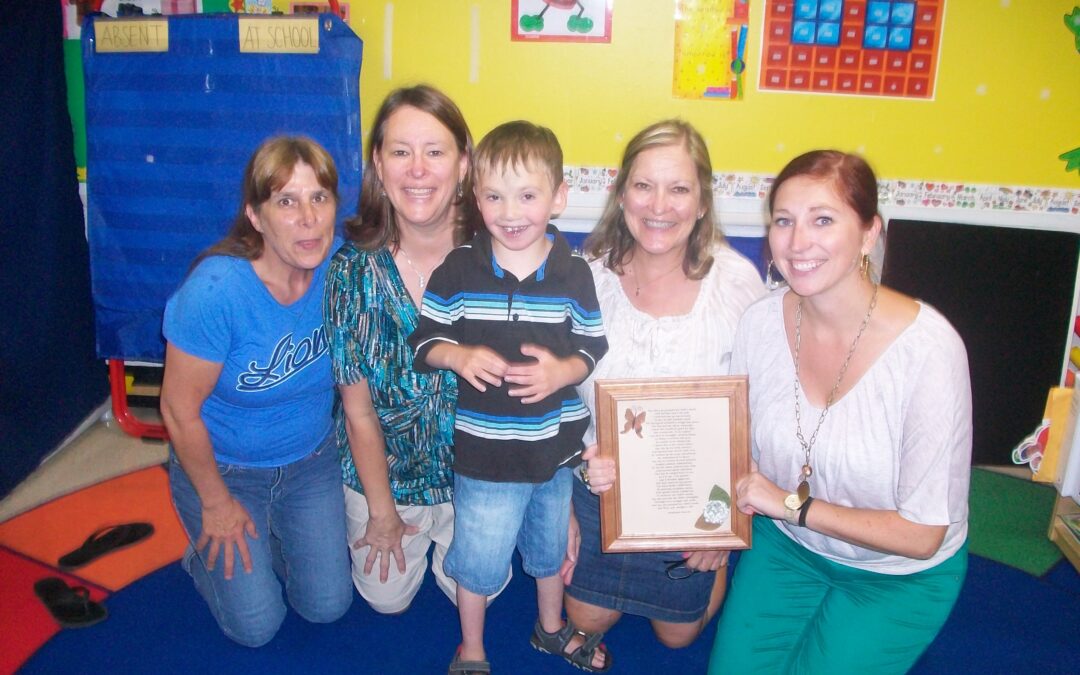
Okay, sorry about neglecting to issue a tissue warning! Now you can understand why Braeden’s teacher had the poem framed and hung it in Room 16. As a former teacher, I know many teachers are thankful for Stephanie’s poem, too.

How about you? How did you say thank you and melt the heart of your child’s teacher? Leave a comment. And check out Stephanie’s blog, www.BraedensHeartJourney.com.

Do you like what you see at DifferentDream.com? You can receive more great content by subscribing to the quarterly Different Dream newsletter and signing up for the daily RSS feed delivered to your email inbox. You can sign up for the first in the pop up box and the second at the bottom of this page.

By

Stephanie Ballard is the mother of two sons, her youngest son, Braeden, was born with Kabuki Syndrome and congenital heart defects. Her oldest son, Colin is in the military. She enjoys writing poetry and life lessons about her journey in life.

Author Jolene Philo

Archives

Categories

Subscribe for Updates from Jolene

Related Posts

Homework Survival Guide: Special Needs Edition

Homework Survival Guide: Special Needs Edition

Homework Survival Guide: Special Needs Edition

Homework can be a challenge for kids with special needs and their parents. But never fear, guest blogger Rachel Cordeiro is here with her Homework Survival Guide’s six tips to make study time easier for child and parent.

Homework Survival Guide: Special Needs Edition

Survival Tip #1: Preparation

During this past school year homework was a struggle for my daughter.  I’m not sure who began to dread it more—Cami or me!   Without fail, it was days with the most difficult start to homework that the Braille writer would become jammed while loading the paper into it. This caused an already stressful situation to escalate, and I knew something needed to change. My solution?  I decided to load the paper into the Braille writer ahead of time, which cut out a lot of unnecessary stress.  It was a small step that made a big difference.

I do realize some steps involved in the homework routine may help to reinforce a necessary skill, but sometimes you have to pick your battles (and I was tired of the jammed paper winning!).  You will have to decide what is best for your child.  Take a step back to consider which steps in your child’s homework cause unneeded stress, then prepare as necessary for the smoothest transition into homework time.

Survival Tip #2: Communication

As I already mentioned, Cami had a difficult year and we both cried many tears over the homework load.  My advice?  Communicate often with the teachers.  Be honest about any problems you are encountering during homework, and make sure they are aware of how long it took your child to complete the assigned work. Remember, as your child’s advocate, it’s important to let the teacher know how much your child can or can’t handle.

Survival Tip #3: Adaptation

Last year in science, Cami’s class had to learn the physical states of water.  There was a study sheet containing pages of facts with pictures, but the information was overwhelming for her, and she couldn’t see the illustrations. After reading it through to her several times, she was having trouble remembering it all, so I put the paper aside and tried a different approach (boiled water on the stove to illustrate water vapor, placed ice cubes in a glass of water to illustrate condensation, etc. ) to illustrate the different changes in matter.

Because Cami retains knowledge best when it’s something she has experienced, she was able to remember the different states of water much better. I made sure to send  a note explaining what we had done in place of the written assignment, and her teachers accepted that (this falls right in line with communication as well).

Survival Tip #4: Concentration

Create a homework environment most appropriate for your child.  Where exactly that will be may differs from child to child as long as it enables him to focus on his work. The key is to set aside a time and place dedicated to homework and be consistent in implementing that as part of the homework routine.

Survival Tip #5: Motivation

There are days when I wish I had the magic formula for motivating Cami to do homework. Other times I think I’ve discovered the greatest motivator for her, only to have it last for one week.  Motivate by keeping things fresh. Make it as fun and enjoyable as possible and be flexible in your approach.  The key I have found to motivating? Focus on motivation for that particular day and use a different approach tomorrow if needed.

Survival Tip #6: Relaxation

After your child has completed their homework assignment it’s a good idea to reward them for their hard work and effort.  Choose a reward that you deem appropriate for them and something they can look forward to each day (this works as great motivator as well!).  For Cami, her reward is to play with whatever she chooses, allowing her to enjoy much needed down time and relaxation.  And don’t forget yourself…now that the homework for the day has been completed it’s time for you to relax as well….at least until tomorrow!

What Tips Would You Add to Rachel’s Survival Guide?

Did reading Rachel’s survival guide bring your favorite homework survival tips to mind? If so, share them below. Or leave a comment about which of Rachel’s tips makes life easier for you.

Do you like what you see at DifferentDream.com? You can receive more great content by subscribing to the quarterly Different Dream newsletter and signing up for the daily RSS feed delivered to your email inbox. You can sign up for the first in the pop-up box and the second at the bottom of this page.

By

Author Jolene Philo

Archives

Categories

Subscribe for Updates from Jolene

Related Posts

Meet the Teacher Pre-Meeting? Bring Starbucks

Meet the Teacher Pre-Meeting? Bring Starbucks

Meet the Teacher Pre-Meeting? Bring Starbucks

A meet-the-teacher pre-meeting can be an excellent way to ease the anxiety a child with special needs experiences before the start of a new school year. Guest blogger Ellen Stumbo offers some useful advice about how to arrange such a meeting, what points to cover, and how to thank the teacher who is most likely using planning or after work hours time to meet with you and your child.

Meet the Teacher Pre-Meeting? Bring Starbucks

The school year is fast approaching, and I have two girls that will begin school with brand new IEPs and new teachers. While I feel confident about the IEPs, there is still one problem: neither one of my girls have met their teachers!

Meet the Teacher to Ease Anxiety

While some children do well meeting their teachers along with the many other students, both of my girls do not thrive in those situations. They need one-on-one time to meet their teacher, get to know their classroom, know where the bathroom will be, what adjustments—if any—need to be made for mobility issues, and where they will sit.

Meet the Teacher to Discuss IEPs

Neither one of the teachers were present during the IEP meetings, therefore, I have never had the opportunity to talk to them about each one of my kids respectively. By scheduling a pre-meeting, I can make sure that they have read the IEPs before school begins, but I also want to take some time to allow the teacher to ask questions, and I want to be able to ask questions too. I know this will not happen effectively if we wait until the meet-and-greet day along with 24 more students and parents.

Last year, our meeting with Nina’s teacher was extremely proactive. Nina has cerebral palsy and some other difficulties as a result of her disability. Not only did Nina get to meet her teacher, we also got to see her move within the classroom, and the teacher was able to rearrange some furniture to make sure the classroom was accessible to Nina either with her wheelchair or walker.

We tested the bathroom situation, and we were able to have Nina practice how to get on and off with the adaptive equipment that we brought from home. Nina also got to try out the different chairs and seats they had available for her. I was also able to express some concerns and her teacher was able to ask questions and concerns as well.

Meet the Teacher to Ease Transitions

Another concern I have is with my youngest daughter, Nichole, who has Down syndrome. She does not handle change very well, and this time besides having a new teacher, she will be in a different school. She needs time one-on-one with her new teacher and in her classroom so she can explore and get a little bit familiar to her new surroundings. I want the teacher to observe Nichole without other kids because once there are many little bodies in there, Nichole will be extra shy.  I want the teacher to get a little glimpse of Nichole’s personality when the environment is non-threatening and mom is there with her.

Meet the Teacher with Gratitude

I want to ensure my children have the best possible beginning to their school year. In the next few days, I will be setting up appointments for each of my girls to visit with their teachers. I only request a few minutes from the teachers, and ask them what their favorite Starbuck’s drink is. I know they are taking time out of their day to accommodate my request, and I want to make sure I am bringing in a little something to say thank-you.

How Do You Handle Meeting the Teacher?

Thanks, Ellen, for some your very sound advice. Your Starbucks suggestion would have melted my heart during my teaching days! How about the rest of you? How do you help your child prepare for a new school year? Leave a comment or a link to a helpful resource. Thanks!

Do you like what you see at DifferentDream.com? You can receive more great content by subscribing to the quarterly Different Dream newsletter and signing up for the daily RSS feed delivered to your email inbox. You can sign up for the first in the pop-up box and the second at the bottom of this page.

By

Ellen Stumbo is a writer and speaker and the mother of three girls, two with disabilities. To read more of Ellen’s writing, visit her blog at www.EllenStumbo.com.  She can also be found on Twitter and Facebook.

Author Jolene Philo

Archives

Categories

Subscribe for Updates from Jolene

Related Posts