The ACEs and Toxic Stress: Implications for Children with Special Needs?

The ACEs and Toxic Stress: Implications for Children with Special Needs?

The ACEs and Toxic Stress: Implications for Children with Special Needs?

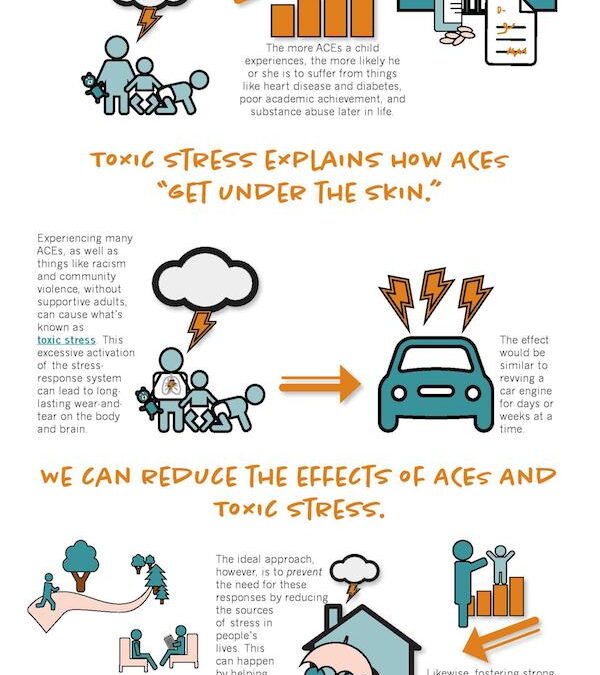
The link between the ACEs and toxic stress have been accepted by mental health experts since the ACEs study results were released in the late 1990s. The general public and members of the special needs community, however, are not equally aware of the study and its implications for children. The Harvard Center for the Developing Child recently created an infographic that explains the link clearly and thoroughly. The infographic can be found below. It is also available at The Center for the Developing Child website. Their web page includes a FAQ section, and the infographic can be downloaded as a PDF there.

My son endured numerous invasive surgeries and procedures in his early years to correct a life-threatening birth anomaly. Based on that experience, I believe the link between the ACEs and toxic stress has many implications for children who undergo invasive medical procedures, live with pain, or experience discrimination or bullying due to special needs. I encourage you to study the infographic, visit The Developing Child website, or read Does My Child Have PTSD: What To Do When Your Child Is Hurting from the Inside Out? to learn more.


Do you like what you see at DifferentDream.com? You can receive more great content by subscribing to the quarterly Different Dream newsletter and signing up for the daily RSS feed delivered to your email inbox. You can sign up for the first in the pop up box and the second at the bottom of this page.

By

Jolene Philo is a published author, speaker, wife, and mother of a son with special needs.

Author Jolene Philo

Archives

Categories

Subscribe for Updates from Jolene

Related Posts

Preventing PTSD: 11 Things To Do If Your Child Has Been Through Trauma

Preventing PTSD: 11 Things To Do If Your Child Has Been Through Trauma

Preventing PTSD: 11 Things To Do If Your Child Has Been Through Trauma

Preventing PTSD in children is an issue addressed frequently at Different Dream. Today, we welcome Lydia Jenkins, D.O. Pediatrics, whose excellent article about preventing PTSD in children first appeared on the Parenting Pod website. The article is featured here today in hopes of equipping parents of children who’ve experienced trauma promote mental healing. Without further ado, here it is.

Preventing PTSD: 11 Things To Do If Your Child Has Been Through Trauma

Knowing that your child has gone through a traumatic event is arguably one of the most stressful, devastating, and overwhelming things a parent can experience. And yet, since parents serve as a child’s strongest source of support and safety in everyday life, they must muster the courage to calmly deliver this support, especially after a child experiences a traumatic event.

If your child has experienced a trauma, you may feel anxious about what to do to help him recover.

PTSD Symptoms

Every child will likely experience some form of stress in early life, whether it be a car accident, death of a loved one, a stressful move, or another more traumatic experience like war, abuse. Most children naturally develop negative emotional reactions to aversive experiences, but those negative feelings are most often self-limited, resolving over time. In a minority of children, however, their symptoms become more severe and persistent, and eventually develop into post-traumatic stress disorder (PTSD).

A child with PTSD will experience a specific set of symptoms for at least 1-month:

  • Re-experiencing the trauma (flashbacks or nightmares)
  • Avoidance (avoiding upsetting memories and reminders)
  • Hyperarousal (persistent sleep disturbances, “jumpiness,” heightened startle reflexes)
  • Negative mood and cognition (persistent negative views of others or self, anxious/depressed affect)

To read the rest of this article, visit the Parenting Pod website.

Do you like what you see at DifferentDream.com? You can receive more great content by subscribing to the quarterly Different Dream newsletter and signing up for the daily RSS feed delivered to your email inbox. You can sign up for the first in the pop up box and the second at the bottom of this page.

By

Jolene Philo is a published author, speaker, wife, and mother of a son with special needs.

Author Jolene Philo

Archives

Categories

Subscribe for Updates from Jolene

Related Posts

More Than Words: The Freedom to Thrive After Trauma

More Than Words: The Freedom to Thrive After Trauma

More Than Words: The Freedom to Thrive After Trauma

Today I am pleased to introduce Different Dream readers to Margaret Vasquez, a gifted mental health care therapist and author of More Than Words: The Freedom to Thrive After Trauma. In her post, she explains why she wrote the book and provides a glimpse into the precepts foundational to the healing work she does children and adults living with trauma.

With the release of my book in the summer of 2018, I’ve been asked why I decided to write it. The answer is quite simple. It was in response to the continual request for my book over the last 12 years. Back at the end of 2010, I was the guest trauma expert on a week-long series of television shows and over the years since have been a radio guest numerous times. I’ve presented to clinicians, foster and adoptive parents, survivor support groups, school in-services, and churches. The case studies I use to explain trauma, its effects and treatment have been useful to viewers, listeners, attendees and clients have found useful. More Than Words: The Freedom to Thrive After Trauma is a way to pass the information on to others. 

ironically, I had writer’s block that was connected to a difficult experience of my own. As I pressed into the task, starting, stopping and restarting many times, I finally realized that I was stuck in the message of my past experience. Once day, I asked for help from a therapist trained according to the method of treatment we practice at Thrive. The very next day, writing was a completely different experience. The rest of the manuscript flowed.

I’m dyslexic and have a difficult time reading. The difficulty is compounded if the book is dry and academic. Books that are written in a more conversational style keep me more engaged and make reading easier. That’s the voice from which I wrote More Than Words. Trauma is certainly not a light topic, but I wanted to keep the presentation of it as light as possible. I also have a much easier time retaining principles when I learn them via stories. This is why I used so many real life stories to explain what could otherwise be cumbersome material. 

If you’re just looking for an interesting read, I hope you enjoy More Than Words. If you want to become more equipped as a helper, loved one, or parent of someone who has been traumatized, I hope you find the book informative and helpful. If you have been through trauma, I hope it helps you to see that there is more for you than surviving. You were born to THRIVE!


Do you like what you see at DifferentDream.com? You can receive more great content by subscribing to the quarterly Different Dream newsletter and signing up for the daily RSS feed delivered to your email inbox. You can sign up for the first in the pop up box and the second at the bottom of this page.

By

Margaret Mary Vasquez is a licensed professional clinical counselor in Ohio, a certified trauma therapist, and a certified intensive trauma therapy instructor. The founder of THRIVE Trauma Recovery and THRIVE Training Institute, Vasquez developed the Neuro-Reformatting and Integration Model for effective treatment of trauma of all kinds. She currently blogs at Culture of Connection.

Author Jolene Philo

Archives

Categories

Subscribe for Updates from Jolene

Related Posts

Trauma in Parents of Kids with Special Needs

Trauma in Parents of Kids with Special Needs

Trauma in Parents of Kids with Special Needs

Guest blogger Jonathan McGuire wants you to know that trauma in parents of kids with special needs is real. He explains how he became convinced of that truth in this post.

Trauma in Parents of Kids with Special Needs

In the fall of 2012, instead of driving to Michigan to spend time with my wife’s family at a get together, I found myself in a small plane landing at a refugee camp on the border of Sudan and South Sudan. Instead of subdivisions and snow, I was landing in a country of extremes…

Thousands of people were fleeing to this camp as their own government was bombing their homes and soldiers were killing their families. It was a place where it was uncommon to see a grandmother or grandfather because the youth were sent in their stead so there would be hope for future generations.

It was my privilege to come alongside a group of refugees, help them begin processing their trauma and to train them on how to come alongside others. As tanks were attacking 8 kilometers from us, we listened to their stories of survival and death. At first, the individuals were seemingly devoid of emotions. Not only were there no smiles, there was no grief or tears. Remembering the different concepts we taught was difficult and some of them struggled with just staying awake. Most of the participants believed they had been cursed by God. And you know what?

As the father of a son with special needs, I felt like I could relate.
I could relate to just being in survival mode.
I could relate to the numbness, to questioning God and his promises.

As time progressed, the refugees were able to share their stories with each other. They were able grieve. They shared their pain through art, drama and song. They were able to gain hope through God’s word and begin the process of healing despite a life of uncertainty.

Does any of this resonate with you? When you brush into people and they ask how you are, do you struggle with knowing what to say? Are you struggling with unexplained mood swings, constant exhaustion? Maybe you too are wondering if God’s promises are true? You are not alone. Trauma in parents of kids with special needs is common among us.

Healing will take time. It may take years or for some even decades. It will go in phases. At times, you will feel on top of the world and others, you will be in survival mode. I encourage you to find those to talk to–whether they are a friend, a counselor or a group–who gets it. Find someone who you can be real with and share your struggles with even if it seems like you are struggling with the same things day after day.

I would also invite you to look to God and his word. If his promises seem hard to swallow right now, start by holding on to one simple but profound life-changing truth…

He loves you.

Do you like what you see at DifferentDream.com? You can receive more great content by subscribing to the quarterly Different Dream newsletter and signing up for the daily RSS feed delivered to your email inbox. You can sign up for the first in the pop up box and the second at the bottom of this page.

By

Jonathan McGuire is married to Sarah and they have 2 wonderful boys. They are located in Northeast  Indiana. Jonathan and Sarah are the founders of Hope Anew, a nonprofit that comes alongside the parents of children with additional needs on spiritual and emotional level. You can follow Hope Anew on their Facebook page.

Author Jolene Philo

Archives

Categories

Subscribe for Updates from Jolene

Related Posts

PTSD in the Entire Family

PTSD in the Entire Family

PTSD in the Entire Family

PTSD in the entire family? Can it happen? Today’s guest blogger, who is writing anonymously to protect her family, describes how PTSD in the entire family is a reality at their house.

PTSD in the Entire Family

I first recognized the problem in my daughter.

After multiple surgeries and hospital admissions for emerging illnesses, my daughter understandably displayed signs of stress and anxiety related to medical traumas. She was subjected to necessary tests, blood draws, respiratory support, x-rays, and things familiar with hospital stays.

Symptoms of her PTSD came on around age 6. I first thought it was a coincidence when she had an accident upon arriving at the hospital parking garage for routine care. Then a clear pattern emerged. Being developmentally disabled, her simple messages of “doctor,” “hurt,” and “scared” clued me into what she was thinking. A few years later, she simply, but powerfully, began refusing to get out of my vehicle at the hospital. The journey from the parking lot to the hospital was strenuous for both of us for years.

I was slow to admit how my daughter’s health scares impacted me. I noticed an intense ache in my arms and hands when I arrived at the hospital for her routine appointments. I came to realize I was holding the steering wheel with such a tight grip during the drive that I was causing myself pain. My body, it seemed, went into stress mode automatically from previous traumatic drives I made to the hospital while my child was being transported via an ambulance or helicopter. At home, I experienced nightmares centered around the hospital and ICU following her admissions. Anxiety would not relent even when health scares were over.

As I tried to understand what was happening with me, my son’s struggles emerged. Being the little brother, he spent his childhood tagging along to appointments and visiting hospital rooms. My husband and I tried to shield him from certain things, but the hospital has been an inevitable part of his life too.

The reality of his situation became known after visiting his sister in the hospital at age 9. Through tears, he confessed his fear of getting sick and ending up in the ICU. At school, he couldn’t concentrate. At home, nightmares had been torturing him. He nervously bit his nails and asked when we would return home from routine appointments. He was fearful we wouldn’t come home from scheduled appointments. I failed to realize how much it weighed upon him. His mental health could no longer be ignored.

Recognition of a problem and getting help for all of us was important. I needed medication for a period of time to manage the stress and anxiety I ignored for years. My son benefited from counseling to treat his anxiety. My daughter is a little more complex but understanding the anxiety behind her behaviors has made a crucial difference.

If you see similar patterns in your family, don’t ignore them. It is tempting to put off mental health issues, especially as medical ones seem more pressing. But don’t ignore the signs of PTSD in the entire family.

Seek help.
Ask questions.
It can get better.

Do you like what you see at DifferentDream.com? You can receive more great content by subscribing to the quarterly Different Dream newsletter and signing up for the daily RSS feed delivered to your email inbox. You can sign up for the first in the pop up box and the second at the bottom of this page.

By

Author Jolene Philo

Archives

Categories

Subscribe for Updates from Jolene

Related Posts

June is PTSD Awareness Month–Again

June is PTSD Awareness Month–Again

June is PTSD Awareness Month–Again

June is PTSD Awareness Month–again. If I had my druthers, I’d do the ostrich thing and bury my head in the sand. Because PTSD Awareness Month is hard for me.

It brings back memories of the early days of my baby’s life and the medical treatment he endured as doctors and nurses labored to save him in 1982. It stirs up regret at not recognizing his mental anguish or finding the treatment he needed until 26 years later. It pains me to tell our family’s story to parents of children who are struggling with trauma and watch them turn away from a reality they aren’t yet ready to acknowledge.

But PTSD Awareness Month is not about my druthers. It is about sharing what’s known about PTSD, and in my case about PTSD in children, so information is accessible to parents when they are ready.

So this month, instead of sticking my head in the sand, I’m writing another post about PTSD in children. I’m sharing truths about a preventable mental illness that affects far too many children around the world:

  • Newborns do feel pain.
  • Infants can remember trauma.
  • Childhood trauma can develop into PTSD.
  • PTSD in children who have suffered trauma can be prevented.
  • Effective treatments for PTSD do exist.
  • Children as young as 3 can be treated.
  • If you think your child may have PTSD, seek treatment now.
  • Adults with untreated childhood PTSD can be treated, too.

To read the rest of this post visit the special needs parenting blog at the Key Ministry website.

Do you like what you see at DifferentDream.com? You can receive more great content by subscribing to the quarterly Different Dream newsletter and signing up for the daily RSS feed delivered to your email inbox. You can sign up for the first in the pop up box and the second at the bottom of this page.

By

Jolene Philo is a published author, speaker, wife, and mother of a son with special needs.

Author Jolene Philo

Archives

Categories

Subscribe for Updates from Jolene

Related Posts