by jphilo | Mar 23, 2011 | Different Dream, In Children, PTSD
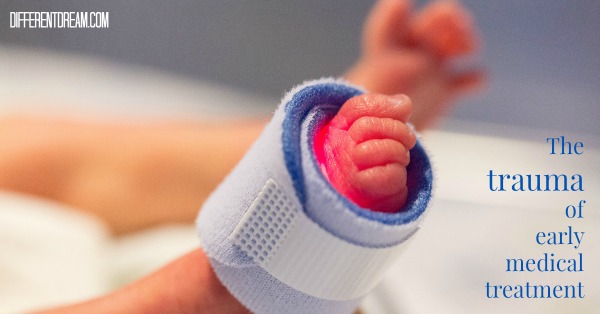
Can You Imagine Infant Surgery Without Anesthesia?
Warning! This post is not for the faint at heart!
At best, it will show you how far pediatric surgery has advanced since the 1950s. At worst, it will make you sick to think of the trauma endured by tens of thousands of babies before 1986.
What Happened in 1986?
1986 was the year the Academy of Pediatric Surgeons changed their infant surgery protocol. Finally, they added pain medication to the paralytic drugs administered to infants going into surgery.
Yes, you read that correctly. Before 1986, babies going into surgery were given a paralytic drug so they would hold still. But they weren’t given pain medication.
Why Not?
Before 1986, the standard belief was that babies didn’t feel pain like adults do. My husband and I know this was their belief because we heard it often from the neonatal intensive care doctors and nurses in 1982. During Allen’s recovery, we knew he received no pain meds. Still, we assumed they’d been administered during surgery. That assumption was wrong.
How About Now?
These days, if your infant or child has surgery, pain medication is in the mix. But there are three decades worth of babies born in the 1950s through 1986 who were deeply traumatized during surgery. Many of them suffer from post-traumatic stress disorder (PTSD), and their lives are in shambles. Our son avoided a ruined life, thanks to the treatment he received at Intensive Trauma Therapy Institute in Morgantown, WV. One of the therapists at the clinic, Dr. Louis Tinnin, recently started a blog about Infant Surgery Without Anesthesia. You can read what he has to say at this link.
What About Those Babies?
If you or someone you know went through infant surgery during the decades of the 50s, 60s, 70s, and early 80s, please pass this information on to them. A life that began with searing pain doesn’t need to be consumed by it. Help is available. I’d be glad to talk to you more about it, so leave a comment if you have questions.
Do you like what you see at DifferentDream.com? You can receive more great content by subscribing to the quarterly Different Dream newsletter and signing up for the daily RSS feed delivered to your email inbox. You can sign up for the first in the pop-up box and the second at the bottom of this page.
Subscribe for Updates from Jolene
by jphilo | Oct 20, 2010 | Advocacy and Research, Different Dream, PTSD

Whenever the words “special needs” are spoken, I automatically picture a physical or medical condition. Mental health needs always come to mind later, if they come to mind at all. And I’m saying that as the parent of a child who has been treated for both physical and mental conditions.
Dr. Harold Koplewicz
According to Dr. Harold Koplewicz, a leading child and adolescent psychiatrist, my response is fairly common. In a September 19 Huffington Post article he says, “It is easy to empathize with suffering we can see: a child who lost hair in chemotherapy, for instance. The suffering of a child with psychiatric issues is far less obvious. Many children and teens with emotional problems keep their pain secret. Others express their feelings in risky or offensive ways. Due largely to stigma–fear, shame and misunderstanding about mental health disorders–the majority never receive clinical care.”
7 Common Child Mental Health Myths
In the same article, he debunks 7 myths about child mental health. They are:
- A child with a psychiatric disorder is damaged for life.
- Psychiatric problems result from personal weakness.
- Psychiatric disorders result from bad parenting.
- A child can manage a psychiatric disorder through will power.
- Therapy for kids is a waste of time.
- Children are overmedicated.
- Children grow out of mental health problems.
To learn how Koplewicz debunks these myths, read the entire article at www.huffingtonpost.com. And if you have more mental illness myths to debunk, leave a comment. It’s time to approach treatment for mental illness with the same respect given treatment for physical illness, don’t you think?
Do you like what you see at DifferentDream.com? You can receive more great content by subscribing to the quarterly Different Dream newsletter and signing up for the daily RSS feed delivered to your email inbox. You can sign up for the first in the pop up box and the second at the bottom of this page.
Save
by jphilo | Jun 9, 2010 | Different Dream, In Children, PTSD

The first post in this series explored how invasive medical procedures can cause PTSD in children. The post listed four factors that increase the likelihood of PTSD developing. The factors are:
- Timing
- Anesthesia
- Age of patient
- Previous Trauma History
As promised in Part 1 of the series, this post will address the general principle behind the occurrence of PTSD and how it can be successfully treated.
General PTSD Principle
Linda Gantt, who spoke at the 2010 Linking PTSD and Medical Trauma national conference, said the risks of developing PTSD increase according to this general principle: The more unexpected the procedure, the younger the patient, the more numerous the previous traumas, and the more urgent the need for the procedure, the greater the possibility that there will be psychological effects.
No Wonder Our Son Had PTSD
When Dr. Gantt’s explained the four factors and the general principle behind them, the burden of guilt I carried about our son’s PTSD no longer weighed upon me. Our son’s medical treatment was completely unexpected, within 24 hours of his birth, and immediately necessary for him to live. With three of the four factors involved in his trauma, no wonder he developed PTSD. And since medically induced PTSD wasn’t even on the radar screen when he had surgery in 1982, no wonder it went undetected for so long.Prevent
How to Prevent PTSD
In 2010, the vast majority of kids can avoid developing medically induced PTSD. Depending on the age of the child and the circumnstances, it can be prevented by:
- having the hospital’s child life specialist help prepare your verbal child for scheduled medical procedures or surgeries.
- having the the child life specialist remediate trauma caused by an emergency medical procedure or surgery in a verbal child.
- having someone rub a pre-verbal child’s arm and talk quietly to him during procedures or surgeries.
- having soft music or a tape recording of the parent’s voice playing during procedures or surgeries.
How to Treat PTSD
Of course, not all PTSD can be prevented. But children can be successfully and easily treated for it. One great treatment resource is Peter Levine and Maggie Kline’s books, Trauma Through a Child’s Eyes: Awakening the Ordinary Miracle of Healing and Trauma-Proofing Your Kids: A Parents’ Guide for Instilling Confidence, Joy and Resilience.
If your child needs professional therapy, I highly recommend the Intensive Trauma Therapy Institute in Morgantown, West Virginia. You can learn more about their clinic at their website www.traumatherapy.com. If you know of other successful treatment centers, please leave a comment. I want every child with PTSD to receive treatment as quickly as possible!
Do you like what you see at DifferentDream.com? You can receive more great content by subscribing to the quarterly Different Dream newsletter and signing up for the daily RSS feed delivered to your email inbox. You can sign up for the first in the pop up box and the second at the bottom of this page.
by jphilo | Jun 7, 2010 | Different Dream, In Children, PTSD

When our son was born in 1982 and flown 750 miles away for life-saving surgery, we asked the medical professionals if the surgery and recovery would somehow affect him later on. “No,” we were told repeatedly, “he’s too young to remember. Besides newborns don’t feel pain.”
Even though the opposite has been proven true since our son’s surgery, the news hasn’t reached segments of the greater medical community. In fact, a mom whose newborn was in a major hospital’s neonatal intensive care (NICU) in December of 2009 was told the same thing we were. “She won’t remember. She’s too young.”
A recent national conference hosted by the Intensive Trauma Therapy Institute in Morgantown, West Virginia focused on the topic. One of the therapists from the institute, Linda Gantt, said the likelihood of PTSD developing after invasive medical procedures during childhood depends upon several contributing factors.
Factor #1: Timing
PTSD is less likely to occur if a medical procedure is scheduled and there’s adequate time to prepare the child beforehand. PTSD is much more likely to occur in emergency situations. Also, if the child’s preparation is age-appropriate, PTSD is less likely to occur.
Factor #2: Anesthesia
The kind of anesthetic used is a major factor. General, local or topical anesthetic should be selected based on the procedure and age of the patient. A patient’s inability to go under increases the likelihood of PTSD developing, as does “coming light” or “partial awakening” during the procedure.
Factor #3: Age of Patient
The younger the patient, the greater the risk of PTSD developing.
- The risk is greatest when kids are non-verbal, birth to age 3. Even when they become verbal, they are unable to access their non-verbal memories using words.
- Children who are verbal, but still in the concrete thinking stage (ages 4 – 10) are also at risk because their reasoning skills are very literal. They can’t yet think abstractly.
- Children from the ages of 12-18 are least likely to develop PTSD if their abstract thinking skills are in place.
Factor #4: Previous Trauma History
Children who have experienced previous significant trauma (sexual abuse, physical abuse, life-threatening situations) are more likely to develop PTSD after medical treatment.
The next post in this series will explore the general principle behind the occurrence of PTSD and how it can be successfully treated.
Do you like what you see at DifferentDream.com? You can receive more great content by subscribing to the quarterly Different Dream newsletter and signing up for the daily RSS feed delivered to your email inbox. You can sign up for the first in the pop up box and the second at the bottom of this page.
by jphilo | May 7, 2010 | Different Dream, Prevention/Treatment, PTSD

For 26 years, my son lived with PTSD caused by early medical surgeries and invasive procedures. Since was successfully treated at the Intensive Trauma Therapy Institute in December of 2008, I’ve been researching the topic. There’s good news and bad news concerning the topic.
Bad News, Good News about How to Trauma Proof Your Child
When our son was born in 1982, we asked doctors and nurses about how the separation from family, surgery, post-op pain, and countless medical procedures would affect him. Over and over, we were told, “He’s so young, he won’t remember.” Research has proven those words to be untrue, but here’s the bad news. Parents of newborns are still being told their children won’t remember early medical treatment. Medical professionals who say that are wrong. What they should be saying is the good news.
Enter, Peter A. Levine and Maggie Kline
The good news is that much medical trauma can be prevented and the rest can be treated early, and in most cases, easily. Two good resources for parents are Trauma-Proofing Your Kids and Trauma Through a Child’s Eyes, both by Peter A. Levine and Maggie Kline. They not only help parents view trauma from a child’s point of view, but also provide ideas about how to prevent trauma and remediation exercises to do with kids when trauma occurs. The second book provides a wealth of information about avoiding trauma at birth, at school, during natural disasters and during medical procedures. They also advise parents about when trauma is serious enough to require professional treatment.
However, neither book deals with the cutting edge theory and treatment coming out of the Intensive Trauma Therapy Institute. If your child is dealing with long-standing trauma issues, visit their website for more information. The healing they do in one week can be miraculous.
If you know of other good trauma therapy resources, please tell us about them.
Do you like what you see at DifferentDream.com? You can receive more great content by subscribing to the quarterly Different Dream newsletter and signing up for the daily RSS feed delivered to your email inbox. You can sign up for the first in the pop up box and the second at the bottom of this page.
by jphilo | Apr 30, 2010 | Books and Resources, Different Dream, PTSD

When most people think of post-traumatic stress disorder (PTSD), they think of returning war veterans. If they think of PTSD in kids at all, it is associated with children in war zones or kids who are victims of sexual or physical abuse. But new research shows that the crippling mental health effects of PTSD can also be caused by medical procedures, divorce, adoption, and natural disasters.
National Institute of Mental Health
The National Institute of Mental Health’s website provides a wealth of information about PTSD in kids. You could spend an afternoon at the site and not get through everything it offers. Many of the brochures and articles can be downloaded from the website or ordered by phone.
National Child Traumatic Stress Network Brochure
One of the most informative and readable publications is the brochure put out by the National Child Traumatic Stress Network (NCTSN). It can be downloaded at the website. Because finding it at the site takes quite a bit of time, you can also download it here:
NCTSN Brochure
If your child has endured medical trauma, you should download the brochure and visit the website for more information. While they don’t address medical trauma specifically, what you learn there could be a first step in restoring your child’s emotional and mental health.
Do you like what you see at DifferentDream.com? You can receive more great content by subscribing to the quarterly Different Dream newsletter and signing up for the daily RSS feed delivered to your email inbox. You can sign up for the first in the pop up box and the second at the bottom of this page.