When We Fill Our Minds with Beautiful Things

When We Fill Our Minds with Beautiful Things

When We Fill Our Minds with Beautiful Things

What happens when we fill our minds with beautiful things? Guest blogger Sharon Cargin writes about the relationships her grandchildren have forged with their uncle who lives with cerebral palsy. They are beautiful things indeed.

When We Fill Our Minds with Beautiful Things

After almost 30 years of caring for my son Tim who has cerebral palsy, it is still a battle to keep my mind on the beautiful things in his life. Tim is number 3 of 4 children. He now lives 30 miles away in a beautiful residential facility for adults with special needs. His caregivers do the very intense total care he requires. They also give him a life full of activities and friends. I didn’t see that coming in the thick of his care when he was young.

I didn’t think his life could ever be beautiful.

My husband and I bring Tim home on Sundays to join our 2 older sons, their wives, and their children for church. I never expected the beauty of the deep bond he has with his nieces and nephews. The 6 children who call him Uncle Tim range in age from 1 to 8. Each child is around 2 before they are not afraid of him and his oversized, custom-fitted wheelchair with the oxygen concentrator. To add to their discomfort and confusion, Tim’s speech is hard to understand. It takes great patience to wait for him to finish a sentence. The children learn to painstakingly listen and then ask him to repeat himself if necessary. Emily, the oldest, led the way in pursuing a relationship with Tim. Once she became old and brave enough, she began climbing into his lap. Today she can stand beside him for his hug and kiss, as is their ritual. Tim then grills her about what she did the previous week and what her plans are for the next one. 

Who knew such an authentic, gracious relationship would occur with these very young children?

A couple months ago Emily asked if she could give Tim his wafer and juice for communion. Carefully and diligently, she let us show her how to accomplish this not-so-easy task. Do you have a picture in your mind of this act of graciousness? 

Does it bring tears to your eyes like it does mine?

My husband and I live in a large Victorian home with 2 sets of double doors. Both doors must be open to accommodate Tim’s large wheelchair. The grandchildren have watched the process of unlocking one side of each set of doors, opening them fully, and then locking them in place with a foot lever. Several Sundays ago Emily organized the grandchildren to open the doors before Rich, Tim, and I arrived. In a masterpiece of teamwork, the children stood on chairs to reach the locks near the top of each set of doors. The children made a bothersome inconvenience, in the eyes of most adults, into a game, and they won.

What a blessing!

Scientific studies tell us negative thoughts make pathways in our brain and it takes hard work to change those pathways. A verse in the Bible tells us how to change those pathways by thinking continually on the beautiful things.

Summing it all up, friends,
I’d say you’ll do best by filling your minds and meditating
on things true, noble, reputable, authentic, compelling, gracious—
the best, not the worst;
the beautiful, not the ugly;
things to praise, not things to curse.
Phil 4:8 MSG

When my grandchildren see Tim their focus is on the best, not the worst, the beautiful not the ugly and that which is worthy of praise, not of cursing. Their minds are fixed on the beauty of Tim’s life and that sentiment is implanted in their hearts.

Do you struggle as I do to stay focused on the best, not the worst; the beautiful, not the ugly; things to praise and not to curse?

Science and the Bible tell us we will do best by filling our minds with the beautiful things.  I invite you to join me in choosing to fill your mind with the best, which can only be done with the help of a God who has the power to transforms our minds.

Do you like what you see at DifferentDream.com? You can receive more great content by subscribing to the quarterly Different Dream newsletter and signing up for the daily RSS feed delivered to your email inbox. You can sign up for the first in the pop up box and the second at the bottom of this page.
What happens when we fill our minds with the beautiful things in the lives of our children with special needs? Sharon Cargin shares her answer in this post.

By

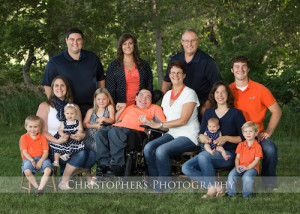
Sharon (wearing white shirt above) is a wife, mother, mother-in-law, and grandmother. She has taught elementary school and homeschooled. Teaching and mentoring children and teens has been a joy in her life. Life was fairly normal for Sharon but pretty much blew up at the birth of her third son who was born 3 ½ months premature with quadriplegic cerebral palsy. Sharon has a passion to encourage others and share some of the lessons she has learned over the years.

Author Jolene Philo
Archives

Categories

Subscribe for Updates from Jolene

Related Posts
The Lord Was With Joseph and the Lord Is With You

The Lord Was With Joseph and the Lord Is With You

The Lord Was With Joseph and the Lord Is With You

The Lord was with Joseph.

The phrase caught my attention as I read Genesis 39 during my morning devotions.

That’s pretty bold, I thought. Joseph’s been sold to slave traders by his brothers, sold again to Potiphar, and the narrator of the story has the gall to say “the Lord was with Joseph.” How can that be?

One verse later, there it was again.

The Lord was with Joseph.

This time the observation came after a description of how Joseph gained his master’s favor and trust by running his house efficiently and well. That one makes more sense, I admitted while adding the caveat, but he’s still a slave.

Near the end of the chapter, the phrase popped up again.

The Lord was with Joseph.

The phrase was harder to swallow this time, coming as it did after his master’s wife falsely accused Joseph of attacking her. You’ve got to be kidding, I thought. The Lord can not be with Joseph in those circumstances.

But in the final verse of the chapter, the narrator describes Joseph being sent to prison, followed by–you guessed it–

The Lord was with him.

Not only was the Lord with Joseph in prison, but in whatever he did, the narrator went on to say, the Lord made Joseph prosper.

In my head, I did a quick recap of the plot points.

Sold into slavery.
The Lord was with Joseph.
Working hard and making his master rich.
The Lord was with Joseph.
Falsely accused.
The Lord was with Joseph.
Unjustly imprisoned.
The Lord was with Joseph.
And the Lord made him prosper.

To read the rest of this post, visit the special needs parenting blog at KeyMinistry.org.

Do you like what you see at DifferentDream.com? You can receive more great content by subscribing to the quarterly Different Dream newsletter and signing up for the daily RSS feed delivered to your email inbox. You can sign up for the first in the pop up box and the second at the bottom of this page.

By

Jolene Philo is a published author, speaker, wife, and mother of a son with special needs.

Author Jolene Philo

Archives

Categories

Subscribe for Updates from Jolene

Related Posts

9 Characteristics of Parents Raising Kids with Special Needs

9 Characteristics of Parents Raising Kids with Special Needs

9 Characteristics of Parents Raising Kids with Special Needs

At the beginning of June, I spent a long weekend at camp with 40 sets of parents, their kids with special needs, and their typically-developing children, too. During 3 days of observing and interacting with families and interacting, I noticed several common characteristics common. Whatever their children’s ages or diagnoses, these 9 characteristics of parents raising kids with special needs rang true for every family I met.

  1. They are isolated. Not by choice, but by circumstances that make getting out of the house difficult. Such as lack of understanding by the general public, hard to manage behaviors, medical conditions that require oodles of equipment, obstacles due to mobility, and financial hardships.
  2. They are problem-solvers. Even though the camp was handicapped accessible and every child with special needs had a one-on-one buddy, challenges popped up now and then. But dads and moms found creative ways to overcome them. Even better, other parents stepped in and brainstormed solutions with them.
  3. They are sleep-deprived. Many of their kids sleep poorly or need medical monitoring, so parents haven’t had an uninterrupted night of sleep in years. Somehow they keep going, but I came away from the weekend thinking that a perfect Christmas present would be for someone to volunteer for night duty so they could sleep nonstop for 12 hours.
  4. They are hopeful. Not Pollyanna hopeful, but realistically so. They believe their kids have a valuable and necessary purpose in this world. They may not know what the purpose is yet, but they believe it exists. And they parent their children in the sure and certain hope that the world is a better place because their kids are in it.
  5. They are grieving. During the morning speaker sessions, grief was defined as the space between what we think life will be like and what life is really like. Heads nodded vigorously at this statement as each parent in the room realized that they will always live in that space. Tears were shed, and plenty of them, but the mood of the room was not one of despair. Rather it was one of shared understanding and compassion.
  6. They are persistent. These parents do not quit. Ever. They keep looking for a way forward. They keep looking for resources. They do not stop. They do not give up.
  7. They are effective advocates. Partly because they are persistent (see #6), but mostly because they love their children. Their love is fierce and unending, sacrificial and holy. They know they are their children’s voices and that their children deserve to be heard.
  8. They are transformed. Over and over parents said they have been transformed by their children with special needs. They said they were stronger, sadder, more resourceful, more grateful for the small things, and more compassionate toward others who struggle in life.
  9. They are living the gospel. No one said that in so many words. But by their constant acts of service for their children, they were being the hands and feet of Christ. Their hope, perseverance, joy in suffering, and sacrificial love for their children testifies of the Holy Spirit at work within them and of the world yet to come when all things will be made right. Now, I wonder, how can I be the hands and feet of Christ to them?

Do you like what you see at DifferentDream.com? You can receive more great content by subscribing to the quarterly Different Dream newsletter and signing up for the daily RSS feed delivered to your email inbox. You can sign up for the first in the pop up box and the second at the bottom of this page.

By

Jolene Philo is a published author, speaker, wife, and mother of a son with special needs.

Author Jolene Philo

Archives

Categories

Subscribe for Updates from Jolene

Related Posts

How I Planted a Garden of Joy

How I Planted a Garden of Joy

How I Planted a Garden of Joy

Today guest blogger Heather Johnson relates how she and a terminally ill friend celebrated joy through the simple act of gardening.

How I Planted a Garden of Joy

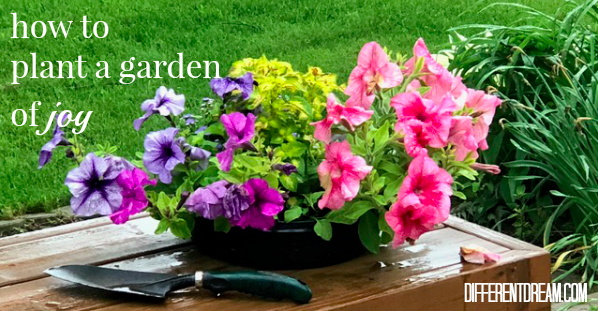
I planted a garden last week. Not just any garden. Not a garden for me. But it ended up being for me in a way. Maybe for you too?

I have this friend around my age. Except for an uncooperative gall bladder demanding removal right before Christmas, she’d been healthy and vibrant. Once the scalpel opened her, the shock began. Her surgeon discovered a very aggressive stage-four cancer.

I’ve prayed. But I’ve wanted to do something more, something tangible to bless her. Because the “D” word has taken up residence in my mind—that five-letter word we don’t even want to whisper lest it extinguish the last flicker of hope we have left.

The question nagged me.

How do you show someone you care, that you really care, when such devastating news is delivered and they’re so sick that survival becomes the greatest goal of every day?

My answer came quickly.

Be there.

So that’s what I did.

Last week, we met at her front door. We hugged for the first time since her diagnosis. Chemo has reduced her body to a bag of bones. Her hair is gone, her eyebrows drawn on.

“How can I help you right now?” I asked as we walked past the dining room, clean laundry beckoning hands to fold. She needed to eat, she said. So as I tended to intimate clothes like underwear and pajamas, we talked about her illness—her chemo, her physical pain, her fear, her faith, her unknown, and her known.

We both know God, and we both know God is good no matter what. Still, there’s anxiety and sadness standing right beside determination and hope. Because God doesn’t always heal. Not in the ways or in the time we always want. A peace settled upon us, I believe, as we talked openly, honestly, without fear of what the other might think or feel.

After finishing the folding, she asked for something surprising.

“Would you clean out my garden? You’re so good at gardening, and I’d really like to look out and see some flowers.”

Of all I thought I could do, would do, wanted to do, cleaning out and planting a garden hadn’t even crossed my mind. Why, I don’t know.

Gardening is a special gift I’ve given to people for years, sharing of fresh cut flowers in clean canning jars with a ribbon. I had only thought of cooking or cleaning or just sitting and listening to my friend. But to do something so easy and enjoyable? To just be my best me? How in the world could that bless?

“Of course! I’d love to help you with your garden!”

She took me to the garage, showed me the tools, and led me to her garden—one of the most overgrown I’d ever seen. She asked me to save the perennials if possible and went inside to rest.

I went to work.

The moment I plunged the spade into the earth and examined more closely, the diagnosis became grim. The bed had become completely overrun with quack grass—that invasive, intrusive, aggressive killer of all things good that spreads by underground runners. After two hours of digging and excavating, I delivered the bad news. Her bed was too far gone. I couldn’t save her perennials.

But there was good news! I could bring her garden back to life!

I explained the three phases, already underway:

  • excavate the invasive grass & roots
  • bring in topsoil, peat moss, and composted horse manure from our farm
  • plant all new perennials

I told her I would share some of my Autumn Joy sedum, black-eyed Susan, purple coneflower, yellow daylilies. She liked the idea. But I had a grander plan—a plan I didn’t want to tell her about because I wanted her to wake up one day, look out, and see a garden beyond her wildest dreams.

My mom always told me, “Flowers should be given to the living, not to the dead.”

I took Mom’s motto as enthusiastic support for a garden center shopping spree. I picked out perennials and annuals that would give the most color quickly. One never knows how many tomorrows we have.

My husband, son, and I brought in the soil, the composted manure, the peat moss. We planted the whole garden while she was gone to an afternoon wedding and evening reception with her husband. I finished off her new garden with a towering obelisk and a brilliant red climbing mandevilla right in the center. (Oh, and I couldn’t pass up the shepherd’s hook with a new wren house! Because even the birds need love.)

Next morning a grateful, joyous text came early. She thought a fairy gardener had visited during the night.

The garden is now full of vibrant life, blessing one who may soon lose hers, overrun as she is with her own inner spread. Will she see the Autumn Joy bloom in September?

God only knows.

But whether she sees the blooms from here or from heaven, there will be joy. Always, there is joy! So catch it while we can! And like every flower with life-giving seed, we must scatter joy generously and watch it grow.

There’s an awful lot of loss in this life. Still, there’s always the hope of gain.

I’m thankful my friend asked for what I had never imagined giving. All because I showed up and stepped into her invitation to be my best self in a garden that needed tending.

You can do the same. You can start a new “garden” of life today. Plant yourself right where you’ll thrive and bloom best and spread your seeds of joy to another. This is enough. More than enough.

For all.
For God.
For you.

Do you like what you see at DifferentDream.com? You can receive more great content by subscribing to the quarterly Different Dream newsletter and signing up for the daily RSS feed delivered to your email inbox. You can sign up for the first in the pop up box and the second at the bottom of this page.

By

Heather MacLaren Johnson lives near Wisconsin’s Lake Michigan shore with her husband of 25 years, 3 horses, 2 dogs, 2 barn cats, and a fish. She earned her B.S. in Education and her doctorate in Clinical Psychology before adopting 3 amazing kids from Russia, all now in their 20’s, all with life-long challenges stemming from prenatal exposure to alcohol (FASD). She is completing a memoir about her mother/daughter journey through hidden disabilities and mental illness.

Heather’s essay about learning to ride horses at age 44 is included in Leslie Leyland Field’s The Wonder Years: 40 Women Over 40 on Aging, Faith, Beauty, and Strength(Kregel Publications). She has published devotional pieces for The Seed Company (Wycliffe Bible Translators Affiliate) You can learn more about Heather at her website www.truelifewithgod.com.

Author Jolene Philo

Archives

Categories

Subscribe for Updates from Jolene

Related Posts

The Puzzle of Parenting a Child with Special Needs

The Puzzle of Parenting a Child with Special Needs

The Puzzle of Parenting a Child with Special Needs

The puzzle of parenting a child with special needs is something we all grapple with. Guest blogger Stephanie Ballard is here with a poem that explains where she found the missing piece of her puzzle and the peace it brings to her. Maybe what she wrote will help you find the piece and the peace you’ve been searching for, too.

The Puzzle

Today I felt a little sad
about the things we face;
Today I guess it slipped my mind
in all things there is grace.
The pieces of my life don’t seem
to fit the way they should.
My Guide to Life went missing.

(I know that can’t be good.)

And if I had a pickup truck,
then it would not be long
before I turned my life’s story
into a country song.
Tired…wasted…empty–
convictions seem diluted.
Life is a complex puzzle.
No instructions included.

I just collect the pieces
while knowing His plan is concealed,
and have the faith that someday
all things will be revealed.
When the storm clouds head our way,
and I am left spinning and guessing;
life’s ordinary moments
become my own encrypted blessing.

Sometimes I lose momentum.
Sometimes I fall behind.
My attitude takes two steps back,
and I fear I’ll lose my mind.
I wonder, can I do this?
I wonder, am I strong?
I thought I was so capable,
But what if I was wrong?

The puzzle lays before me
all scattered where I sit.
I pray God gives me wisdom
to make the pieces fit.
What if life’s most precious gifts
don’t fit with sheer perfection?
What if we must prepare the way
for such an intersection?

I look at all the puzzle pieces
scattered in my hand,
and whisper ever silently,
Please help me understand.
The image comes together,
the picture grows more clear.
It’s only through adversity
that we can face our fear.

And when each piece has found it’s place,
I’ll sigh in sweet reflection.
Life’s purpose can be clearly seen
in silent imperfection.

So I will face this day with hope,
not give into defeat.
I’ll trust this puzzle called our life
will someday be complete.

Does Stephanie’s poem resonate in your heart? Leave  a comment for her in the box below if you like.

Do you like what you see at DifferentDream.com? You can receive more great content by subscribing to the quarterly Different Dream newsletter and signing up for the daily RSS feed delivered to your email inbox. You can sign up for the first in the pop up box and the second at the bottom of this page.

By

Stephanie Ballard is the mother of two sons, her youngest son, Braeden, was born with Kabuki Syndrome and congenital heart defects. Her oldest son, Colin is in the military. She enjoys writing poetry and life lessons about her journey in life.

Author Jolene Philo

Archives

Categories

Subscribe for Updates from Jolene

Related Posts

First Pain then Strength

First Pain then Strength

First Pain then Strength

First pain then strength. That’s become the motto of guest blogger Kimberly Drew as a therapist helps her daughter restore strength to her legs. Not unlike how the book of Isaiah describes the restoration of his people and of our weak and feeble hearts.  

Strengthen the feeble hands, steady the knees that give way…
Isaiah 35:3

A very expensive delivery came today.  After 7 months of waiting, our daughter Ellie finally received her new therapeutic equipment. The price tag before insurance was almost $8,000 for two pieces of equipment. Pretty steep price tag if you ask me.

As we were fitting Ellie into her new prone stander, her physical therapist explained the importance of getting her knees to be supported properly. Her body is not used to bearing her own weight. Her knees give way. This equipment will hopefully strengthen and stretch her legs and prepare her body to transition to a walker. There is a lot of pain in stretching those muscles that needs to happen before then.

First pain then strength.

In Isaiah 34, the Lord talking about His judgement against the nations. It’s kind of dark stuff, filled with the pain described in in verse 4.

All the stars in the sky will be dissolved
and the heavens rolled up like a scroll;
all the starry host will fall
like withered leaves from the vine,
like shriveled figs from the fig tree.

However, Isaiah 35 is a beautiful picture of restoration titled “Joy of the Redeemed.” I get chills when I read verses 4-6.

Say to those with fearful hearts,
“Be strong, do not fear;
your God will come,
he will come with vengeance;
with divine retribution
he will come to save you.
Then will the eyes of the blind be opened
and the ears of the deaf unstopped.
Then will the lame leap like a deer,
and the mute tongue shout for joy.
Water will gush forth in the wilderness
and streams in the desert.”

If you have a disabled child, as I do, these verses are a balm. Jesus spent a lot of his earthly ministry healing the disabled. He restored their bodies completely. The deaf heard, the blind saw, the leper’s skin transformed right before his eyes, the paralyzed and lame walked away. Amazing. But all the time, the message of Jesus was not about physical healing. He used these miracles to show himself as the son of God and to point to the need for spiritual healing.

Apart from holy judgement, there is no redemption story. 

My daughter’s feeble hands and weak knees are a reminder of the greater story of the world’s desperate need for a Savior. Our culture that desperately wants God’s grace and mercy and yet we reject his holiness. God’s judgement is fair. He is holy, and we will never be good enough.

So in comes Jesus.

A radical, kingdom of God-preaching, table-turning, passionate God-man who came to shine a light on sin. He was holiness, judgement, and he was also forgiveness. First judgement, then redemption. This redemption came with a steep price tag. Christ died to pay the price for our sin. Redemption comes at a cost. First Isaiah 34, then Isaiah 35.

First the pain of acknowledging my sin, then the strength to live for Christ.

But only the redeemed will walk there,
 and those the Lord has rescued will return.
They will enter Zion with singing;
 everlasting joy will crown their heads.
Gladness and joy will overtake them,
 and sorrow and sighing will flee away.

First pain then strength.

Do you like what you see at DifferentDream.com? You can receive more great content by subscribing to the quarterly Different Dream newsletter and signing up for the daily RSS feed delivered to your email inbox. You can sign up for the first in the pop up box and the second at the bottom of this page.

By

Kimberly grew up and went to college in the small town of Upland, IN. She graduated from Taylor University with a degree in Elementary Education in 2002. While at TU, she married her college sweetheart and so began their adventure! Ryan and Kimberly have four amazing kids on earth (Abigail, Jayden, Ellie, and Cooper), and a baby boy waiting for them in heaven. Their daughter Abigail (Abbey) has multiple disabilities including cerebral palsy, a seizure disorder, hearing loss, microcephaly, and oral dysphagia. She is the inspiration behind Kimberly’s  desire to write. In addition to being a stay at home mom, Kimberly has been serving alongside her husband in full time youth ministry for almost fourteen years. She enjoys working with the senior high girls, scrapbooking, reading, and music. You can visit Kimberly at her website, Promises and Perspective.

Author Jolene Philo

Archives

Categories

Subscribe for Updates from Jolene

Related Posts