Confessions of a Special Needs Parent

Confessions of a Special Needs Parent

Confessions of a Special Needs Parent

Confessions of a special needs parent should be made once in a while and today is guest blogger Mark Arnold’s day to tell all. How many of these are true of you, too?

Parents of children with special needs experience many highs and lows along their parenting journey, but what are the secrets? What never gets mentioned, what never gets talked about, what are the confessions of a special needs parent? Well, it’s time to shine a light on the secrets, time to say to other special needs parents “Yep, if this is you too then you’re not alone.” Here are a few of mine…

Confession #1

We never saw it coming. Never in a million years did we expect to have a disabled child. A normal full-term pregnancy had been followed by a slightly difficult birth. But when James hit 2 and wasn’t talking or responding to his name, wasn’t giving us eye contact, was in his own private bubble, our worries strengthened into fears. A few months later we received the news that James is autistic with complex learning difficulties. We had no idea what that meant and were cut loose to figure it out for ourselves. We never saw it coming and were in total shock.

Confession #2

I grieved for the lost future I had imagined for my child. We all have dreams for our children. When a child is diagnosed with special/additional needs or a disability, those dreams are shattered. They might be selfish dreams, but we don’t have time to process that they are lost. They are snatched away in the time it takes for someone to deliver a diagnosis to us.

The loss of those dreams for James were hard to bear. The unknown of what the future held meant new dreams were impossible. We were dreamless, grieving, hurting. Yes, it was selfish. Yes, it was wrong to think that James without those dreams was somehow less. But in the rawness and pain we experienced, with nobody to inform and encourage us, it is easy to see how it happened.

Confession #3

I prayed for my child to be “healed.” Of course I did…I beat on heavens gates to make God hear me.

“Why my child?”
“Please, take this away from him!”
“Why our family?”
“Please, let this not be true!”

And in my deepest, darkest moments…

“Why me?”
“Why do I have a disabled child?”

Judge me if you like, but most if not all special needs parents have been in that dark place.

Confession #4

Do I pray these prayers now? Of course not. I know more now, I understand James much better now. I celebrate his neuro-diversity instead of fearing it, I pray for James to have the future God has planned for him, not the one I might once have wanted for him. The future’s bright, just a little different.

Confession is good for the soul. There is something liberating about sharing these thoughts. It is sobering to reflect on where we once were, but encouraging to recognize where we are now, where James is now.

For special needs parents in that dark place, perhaps our journey can encourage and help you hope for a better tomorrow. Our secrets are out, but if more special needs parents share them, perhaps they won’t be so secret after all!


Do you like what you see at DifferentDream.com? You can receive more great content by subscribing to the quarterly Different Dream newsletter and signing up for the daily RSS feed delivered to your email inbox. You can sign up for the first in the pop up box and the second at the bottom of this page.

By

Mark Arnold is the Additional Needs Ministry Director at Urban Saints, a leading national Christian children’s and youth organization. He is co-founder of the Additional Needs Alliance, a national and international advocate for children and young people with additional (special) needs or disabilities and is passionate about enabling everyone engaging with them to be inspired, trained and well-resourced. Mark is a Churches for All and Living Fully Network partner, a member of the Council for Disabled Children and the European Disability Network. He writes an additional needs column for Premier Youth and Children’s Work (YCW) magazine and blogs at The Additional Needs Blogfather, He is father to James, who has autism spectrum condition, associated learning disability, and epilepsy. To find out more about how Mark’s work can help you, contact him at: marnold@urbansaints.org or @Mark_J_Arnold.

Author Jolene Philo
Archives

Categories

Subscribe for Updates from Jolene

Related Posts

How To Find Joy in Every Season of Your Special Needs Parenting Journey

How To Find Joy in Every Season of Your Special Needs Parenting Journey

How To Find Joy in Every Season of Your Special Needs Parenting Journey

How to find joy in every season of the special needs parenting journey is a challenge for all of us. Different Dream guest blogger, Jenn Soehnlin encourages parents to intentionally seek and find joy even with the hard bits of parenting all around.

How to Find Joy in Every Season of Your Special Needs Parenting Journey

After a long, dark, and snowy winter, I’m excited to see signs of spring all around me. New buds and blossoms and leaves unfurling. Birds chirping and building their nests. And yes, some rain too, all which bring hope of new life and sunnier days.

There is something beautiful about each and every season, though we always have a favorite (or two).

Life itself has many seasons. I’m reminded of the wise Solomon, who in Ecclesiastes 3 said:

“There is a time for everything,
And a season for every activity under heaven:
A time to be born and a time to die,
A time to plant and a time to uproot,
A time to kill and a time to heal,
A time to tear down and a time to build,
A time to weep and a time to laugh,
A time to mourn and a time to dance,
A time to scatter stones and a time to gather them,
A time to embrace and a time to refrain,
A time to search and a time to give up,
A time to keep and a time to throw away,
A time to tear and a time to mend,
A time to be silent and a time to speak
A time to love and a time to hate,
A time for war and a time for peace.”

This special needs parenting journey is full of seasons. Seasons where we are overwhelmed with grief or anxiety, and seasons where we experience hope and joy. Seasons of stress and never ending appointments, and seasons where we choose to cut back on some obligations and find more rest for ourselves and our families. Seasons where we see our child make no or very little progress, and other seasons where we watch our child flourish in a certain area or several.

Seasons have a purpose

There is a purpose and reason for every season. Our challenging life circumstances may make us feel we’re in an endless winter, but we always have hope that God will use our season and that spring will come. Yes, there’s challenges in every season. Even in the much awaited spring, we experience those April showers which bring May flowers. But there’s always hope and God’s love and His purpose in every season.

I remember a season where I was overwhelmed with the endless therapies and specialists and calls to insurance for my two young boys and I felt it was never going to end. I struggled with alternating bouts of anxiety and depression. But now, the boys are getting a lot of the therapies and support they need at school and I’m finding myself in a season where though we still have plenty of challenges, I have more breathing room. And when I asked God what He wanted me to learn from that season of stress and anxiety and grief, He told me to write about my experiences to encourage other special needs parents in the same place. It wasn’t what I expected or planned of my life, but God has a plan and a purpose for every season, especially our hardest ones, and we may not see it all when we’re in the middle of it, but God will not let it go to waste. He is growing you. Teaching you. And He will use you because of what you are learning in your current season.

A new season unfolds slowly, reminding us that we aren’t supposed to rush ahead to the next season (as much as we may want to) and miss all the blessings and the purpose God has for us right now. But a new season will come, and bring with it a new life, hope, and purpose for you and your family.

Seasons are to be savored

I love that God Himself gives us permission to sit in our season without guilt. We are allowed a time to mourn and a time to dance. A time to embrace and to refrain from embracing. A time to keep and to release. God is doing something in our lives in every season. There is always something to be grateful for. We cannot always control the circumstances in our seasons, but we can control our perspective and our response to our season. We can choose to see the good, the beauty, the blessings in each and every day.

I find the beginning of each new weather season a beautiful time to take some time to evaluate our lives and what I want out of the upcoming season. I encourage you to take a little time to:

Make a list of things you are grateful for in your current season.

  • Evaluate what goals you want to set for yourself, your family, and your children in this upcoming season.
  • Evaluate what things you need to let go of in your life to find a healthier season for you and your family. What things can you remove from your to-do list so that you and your family have more time to rest, to enjoy life and each other? What things are you carrying that God wants you to let go of?
  • Evaluate what things you need to embrace in your life so you can experience all that God has for you and your family in your current season. What good things has God given you that you want to be more intentional about enjoying?
  • Evaluate what life-giving things you can incorporate into the season you are in so you can live fully present.

Contemplate these things with God, with your spouse or a good friend, and/or in a journal. Your mindset is powerful and a major contributing factor into what will help you step into and savor a season of growth and new life and purpose.

Do you like what you see at DifferentDream.com? You can receive more great content by subscribing to the monthly Different Dream newsletter and signing up for the daily RSS feed delivered to your email inbox. You can sign up at the bottom of this page

By

Jenn Soehnlin is a mother to two young sons who are precious blessings and who both have special needs. Her heart is to share encouragement and God’s truths with moms who are also traveling the special needs parenting journey. She is the author of Embracing This Special Life: Learning to Flourish as a Mother of a Child with Special Needs. She enjoys blogging about faith and special needs parenting at www.embracing.life.

Author Jolene Philo

Archives

Categories

Subscribe for Updates from Jolene

Related Posts

The Polar Vortex and Gratitude: An Unlikely Combination

The Polar Vortex and Gratitude: An Unlikely Combination

The Polar Vortex and Gratitude: An Unlikely Combination

The polar vortex and gratitude. I never thought of pairing the two until the great polar vortex of January 2019. Even I have lived through plenty of what we called “cold snaps” until the 24/7 news cycle invented a more alarming term.

  • I was 9 in 1965, the year that held the record low temperature for January 30 until 2019.
  • I was 25 and 5 months pregnant in 1982 when the mercury dipped to -45° when we were living in northwest South Dakota.
  • I was 33 in 1989 when school was called off for 2 days before Christmas break, which meant my third grade students had their anti-climactic Christmas party when school resumed in January.

The difference between my response to previous cold snaps and the 2019 polar vortex go far beyond a name change. My response to the 1965 cold snap was delight when Mom said she would drive me to school. In 1982, my husband and I piled into our friends’ car and traveled 90 miles to go out to eat, though the thermometer was -20° at its warmest.

In 1989 our son born with medical special needs was 7, and his baby sister was a few months old. By then I was haunted by what our son’s early years had revealed. His multiple surgeries, frequent invasive procedures, and nearly constant infections and illnesses showed that bad things happen even when you follow the rules and choose wisely. Therefore, my wisest course of action was to control the situation tightly, to protect my children, and keep everyone inside until the cold snap ended, or we ran out of Kraft Macaroni and Cheese.

To read the rest of this post, visit the Hope Anew website.

Do you like what you see at DifferentDream.com? You can receive more great content by subscribing to the quarterly Different Dream newsletter and signing up for the daily RSS feed delivered to your email inbox. You can sign up for the first in the pop up box and the second at the bottom of this page.

By

Jolene Philo is a published author, speaker, wife, and mother of a son with special needs.

Author Jolene Philo

Archives

Categories

Subscribe for Updates from Jolene

Related Posts

What It Is Like To Parent an EA/TEF Child

What It Is Like To Parent an EA/TEF Child

What It Is Like To Parent an EA/TEF Child

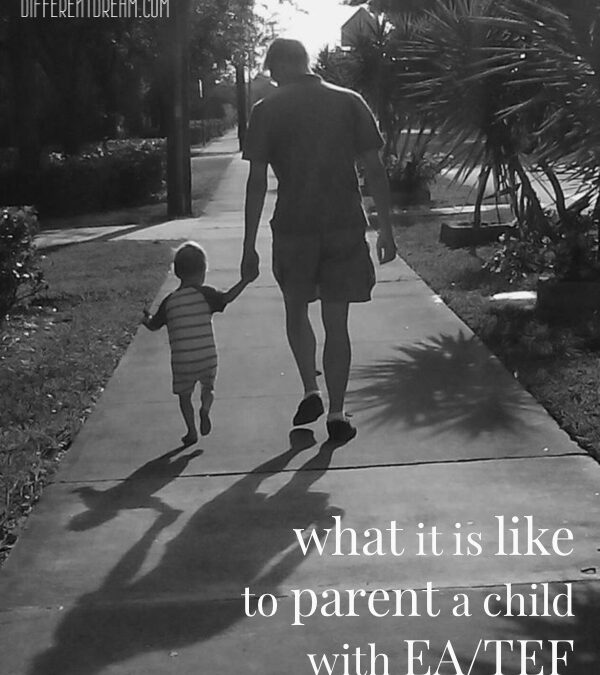
  What it is like to parent a child born with EA/TEF is unimaginable to most people. As part of Different Dream’s annual observance of EA/TEF Awareness Month, guest blogger Danielle Drummond tells what the experience has been like for her family.

What It Is Like to Parent an EA/TEF Child

I’m hoping to open the eyes of many to what it is like being the parent of a child born with EA/TEF…for my family anyway.

Like so many others, our story is a hard one. Our son was born at 30 weeks, and we thought that would be our hardest challenge at the time. A few hours later, we learned he would have more challenges than we thought possible. Six years later, life is still a struggle… just a different kind of struggle. Our trip to Italy did not end up in Holland. It went straight to Siberia.

Parenting a child with EA/TEF is like getting punched in the gut when you learn there’s something wrong with your baby.
It’s being scared to get attached or buy baby clothes while your child is in the NICU… because you don’t know if they’re gonna make it.
It’s missing half of what the doctors say because medical language is so very foreign.
It’s sleeping 30 minutes at a time so that you can feed your child in small increments to keep the food down.

It’s the realization that you can hand your child to someone you don’t like and guarantee they will get puked on because our kids puke… a lot! Did I say a lot? Because I don’t know if that does it justice.

It’s friends and family members thinking that you’re exaggerating your child’s problems because the doctors fixed everything. They don’t understand that fixed does not mean cured. Not by a long shot.

It’s the insurmountable amount of research you do to help your child – this should end with an honorary nursing degree. And the number of doctors you will have to educate about your child’s condition. You will become the teacher, but you keep having to learn new stuff, too.

It’s surgeries upon surgeries and procedures on top of the surgeries.
It’s learning how to hand your child to a surgeon and handle the nagging fear that you will not see your child alive again. It is death spells.
It’s post-traumatic stress disorder (PTSD) though it should be called constant traumatic stress disorder.
It’s being on a first name basis with the ER staff.
It’s having to quit your job because daycare isn’t safe. They aren’t equipped for the level of care your child needs. Not everyone knows CPR or the Heimlich Maneuver.
It’s becoming a proud germaphobe with good reason for Lysoling every single door handle, seat cushion, and light switch.

It’s hard.. it’s very very hard. It’s also faith strengthening.

It’s facing your worst fears and yanking up your grown-up britches and looking like an 80’s nerd.
It’s moving forward by doing whatever you need to do because your kid needs you.
It’s developing new priorities in life – like keeping your child alive.
It’s appreciating every day you get with your baby.
It’s learning how strong you are as an individual and as a parent because nobody can prepare you parent a child with medical problems.
It’s going to your car to scream it out on bad days until your neighbors think you are certifiable.
It’s spending every waking moment advocating for your child because no one else understands.
It’s being a part of more than 20 support groups online.

Finally…
It’s finding encouragement and understanding in places you never imagined.
It’s finding a second family of people just like you and discovering you are less alone than you thought.

Love to all of my brothers and sisters on this journey! May we shine brightly, especially when the world seems to be at its darkest.

Do you like what you see at DifferentDream.com? You can receive more great content by subscribing to the quarterly Different Dream newsletter and signing up for the daily RSS feed delivered to your email inbox. You can sign up for the first in the pop up box and the second at the bottom of this page.

By

Danielle Drummond is a proud wife and mommy to a special little boy. She grew up as the eldest of 4 siblings, one of whom was born with medical issues. By watching her mother sacrifice for her disabled child Danielle learned to be sensitive to those on the special life journey. She applies this lesson every day as parent to her son with special needs. She invites you to interact with her on Facebook at The Special Life.

Author Jolene Philo

Archives

Categories

Subscribe for Updates from Jolene

Related Posts

My Best Advice for New Parents of EA/TEF Babies

My Best Advice for New Parents of EA/TEF Babies

My Best Advice for New Parents of EA/TEF Babies

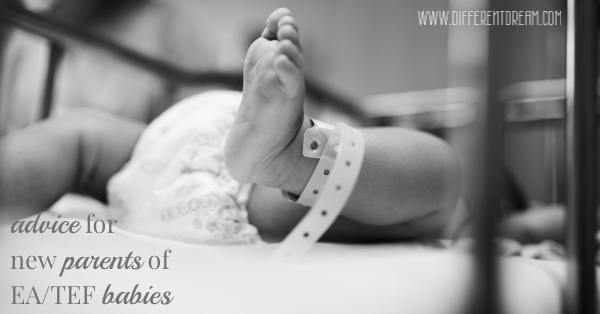
My best advice for new parents of EA/TEF babies has had plenty of time to percolate. It’s been brewing since 1982 when our first child received his diagnosis 12 hours after his birth. Until our son’s health stabilized, my husband and I longed to meet other EA/TEF parents and pick their brains. But we didn’t meet any other parents raising kids with the same diagnosis until 25 years later. By then, our baby was a young adult himself, and we were sharing what we’d learned with parents of newborns.

EA/TEF treatment has advanced exponentially in the intervening years, so what my husband and I had to offer in that arena is laughable and outdated.

But with age, I am increasingly finding to be true, comes wisdom. As I pondered my best advice for new parents of EA/TEF babies, one thought kept rising to the surface of my thoughts.

Relish every day, every minute, every second with your child.

Remember, I am speaking from long years of experience. Years when a host of concerns for our son set my mind to spinning…

What if this surgery doesn’t work?
What if our insurance doesn’t come through?
What if the doctors discover more anomalies or conditions?
What if I can’t pump enough breast milk?
Why would God do this to my child?
What if our baby won’t sleep tonight and I’m exhausted before school even starts?
What if we have to care for our son the rest of our lives?

What if?
What if?
What if?

And the biggest what if of all…What if our baby dies?

My preoccupation with what ifs about the future robbed me of relishing the present joys of his life…

of breathing in his sweet baby smell
of watching him sleep
of recording his milestones
of delighting in his smile
of counting each day of being his mommy as a precious treasure
of gratitude for the child God gave us

Had my baby died, my grief would have been compounded by regret for my lack of presence in our son’s life. My memories of his short life would have been tainted by worry. My memories of being a parent would have been wracked by guilt.

I lost much by looking too far ahead when I could have been enjoying the present. Those moments are lost forever, but they are not lost to you. So my best advice for new parents raising babies with EA/TEF is simple…

Relish every day, every minute, every second if your child’s life. 

However long or short your child’s time on earth may be, you will never regret it.

Do you like what you see at DifferentDream.com? You can receive more great content by subscribing to the quarterly Different Dream newsletter and signing up for the daily RSS feed delivered to your email inbox. You can sign up for the first in the pop up box and the second at the bottom of this page.

By

Jolene Philo is a published author, speaker, wife, and mother of a son with special needs.

Author Jolene Philo

Archives

Categories

Subscribe for Updates from Jolene

Related Posts

An Esophageal Atresia Story: Jack’s Journey

An Esophageal Atresia Story: Jack’s Journey

An Esophageal Atresia Story: Jack’s Journey

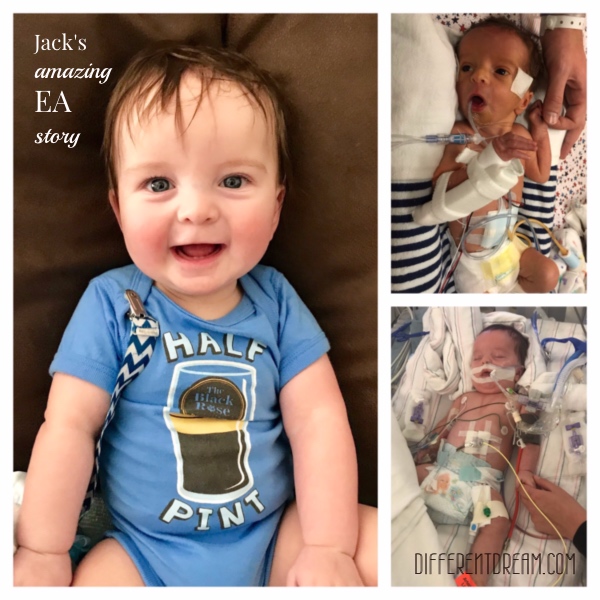
An esophageal atresia story was not when Jen Cheney and her husband Will expected when they learned they would soon be a family of 3. For EA/TEF Awareness Month, 2019 Jen shares about what life has been like for them since the birth of Jack in May of 2018. Hang on for the ride and be prepared to fall in love with their pint-sized son!

I learned of Jack’s diagnosis when I was 32 weeks pregnant. I had severe polyhydramnios and was sent to maternal fetal medicine for an ultrasound. The doctor came in and said there was no stomach detected in the ultrasound which meant my baby most likely had an esophageal atresia–a rare condition where the esophagus does not fully develop and is not connected to the stomach. I had never heard the term and could barely pronounce for several days. Through tears I asked the doctor what had caused it.

He said, “If you have hundreds of thousands of cars being made daily on an assembly line, eventually one of them is going to be defective.”

I couldn’t get the word defective out of my head for weeks. I felt defeated and that it was all my fault. I was already a bad mom and my son wasn’t even born yet.

Jack was born on May 17, 2018, the happiest and most terrifying day of my life. What started out as a routine non-stress test at 36 weeks ended with an emergency C-section. My 4 pound 12 ounce baby boy was fighting for his life. Before he was taken up to the NICU, I got a quick glimpse of him as the doctors sewed me back together. 6 hours later I finally held Jack. A nurse carefully placed him on my lap. I had to be extremely careful not pull on his IVs and replogle–a tube down the throat to suction out secretions since he could not swallow. I couldn’t hug him or hold him close to my chest. I couldn’t feed him. He screamed the entire time. I feared that he didn’t know I was his mom and that was devastating.

Jack had a g-tube placed at 2 days old and finally got real food. The goals written on his wall during his 88 days in the UC Memorial NICU in Colorado Springs were to “rest and grow.” His team did a great job of preparing Jack for surgery. There were a few bumps along the way, but Jack did well. My husband and I spent every day by his side, and the doctors, nurses, and NICU staff felt like a second family. Soon, we felt as though we had moved into our hospital room.

When Jack was big enough for surgery, we transferred his care to Boston Children’s Hospital where they have an entire team dedicated to esophageal atresia patients. His first surgery, the Foker Method, took place on August 16. 11 days and some scary moments of respiratory distress later, Jack’s esophagus had grown enough to be connected! The next several days in recovery were the hardest as my 3-month-old baby went through morphine withdrawal. He was sweating, shaking, irritable, and inconsolable. I would have given anything to switch places with him.

Once Jack had recovered from withdrawal and was healing well, he ate by mouth for the first time ever at 3 and a half months. When he sucked down 10 ml of formula for the first time. I knew Jack was going to be okay and had made it over the biggest hurdles.

After 136 days, 2 hospitals, 1 cross country air ambulance ride, 7 surgeries, and countless pokes, tests, and procedures, Jack came home! He is now 8 months old, has had 1 additional surgery to widen his esophagus, and takes most of his feeds by mouth. Although we have a long road ahead with several more surgeries and challenges, I feel hopeful for the future. I will worry for Jack for the rest of my life, but he is a fighter and will overcome any obstacles.

The best advice I can give families going through this is to celebrate the small victories. Don’t give up hope because our babies are stronger than we will ever know.


Do you like what you see at DifferentDream.com? You can receive more great content by subscribing to the quarterly Different Dream newsletter and signing up for the daily RSS feed delivered to your email inbox. You can sign up for the first in the pop up box and the second at the bottom of this page.

By

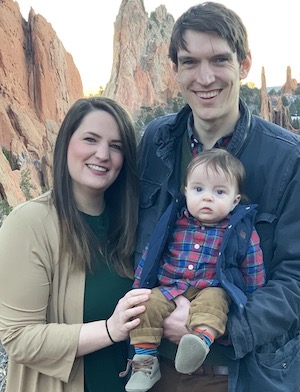
Jen Cheney is a wife and stay at home mom to her son, Jack. Jen previously worked as a teacher’s aid in an elementary classroom for students with special needs. Jen, Jack, and her husband, Will, live in Colorado Springs, CO where they enjoy hiking, skiing, and spending time as a family. Jen is inspired by Jack’s strength and hopes to spread awareness of EA/TEF by telling Jack’s story and giving families in similar situations hope.

Author Jolene Philo

Archives

Categories

Subscribe for Updates from Jolene

Related Posts