The Viewpoint of the Rock

The Viewpoint of the Rock

The Viewpoint of the Rock

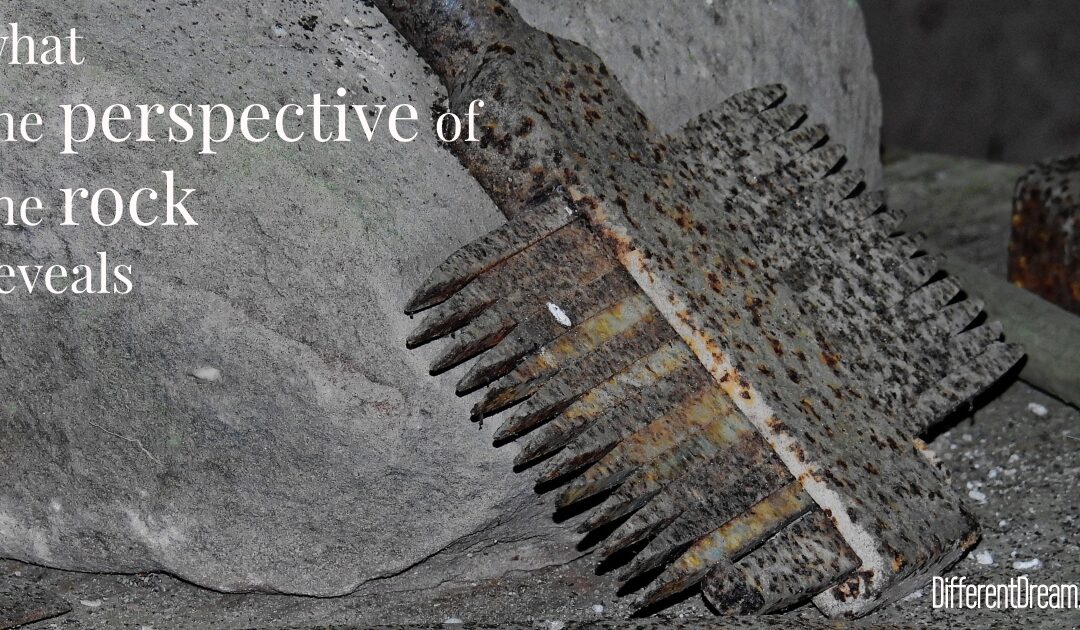
The viewpoint of the rock is one we don’t consider when watching a sculptor wield hammer and chisel. It’s a perspective guest blogger Lisa Pelissier has come to appreciate as God shapes her spirit while she cares for her children with special needs and disabilities.

When we see a beautiful stone sculpture, we marvel at the sculptor. The artist was able to take a block of stone and extract from it the image of a person or an animal. Where did the inspiration originate? Did the artist impose his own vision on the raw material? Or did the raw material somehow direct his hands to bring out the shape that was lurking beneath the surface all along?

What we rarely consider is the viewpoint of the rock.

Being attacked by a chisel and hammer is downright painful. Does the rock feel a sense of loss as huge portions of it are lobbed off and cast away? As tiny flakes of its being are chipped off by the artist? Even after the worst is over, after the incessant pounding and cracking of the chisel and hammer have ceased, there remains the sandpaper, painfully refining and polishing.

Like the sculptor, God is in the process of creating. He sees the raw material that needs to be eliminated in his creatures. He sees our tendency to sin. He sees the work of building that I have done on myself, the attempts I’ve made to build myself up. And the hammer and chisel come out.

Thwack!

This is the universal experience of the believer. God’s discipline is always worked through suffering and pain.

Thwack!

Your child has autism. Off comes the piece of me that longed for good grades, a phenomenal college experience like the one I had, a professional job, a life in ministry, all of it. Gone. In its place was the solemn notion that all my child could be was what God intended for my child. Only that.

Thwack!

Your child is dyslexic and dysgraphic. Reading is what I love best. I wanted to share a love of books with my children. My dyslexic kid is never going to love the written word like I do. I have to find another way to connect with my child. Only true, human connection counts, not a feverish love of books. If all this child has is THE book, God’s book, then it should be enough, right?

Thwack!

Your child has selective mutism. Will this child ever have friends? Will she ever give a speech? Will she ever be in a play? Will she ever speak to Grandma? My child is recovering now, praise be to God – He is refining her as well as me.

Thwack!

Your child has PANS (autoimmune encephalitis). Four years of sickness and OCD made homeschooling a nightmare. I loved homeschooling. I loved the process. It was fun. It’s not anymore, even though my PANS kid is no longer homeschooling, it’s not what it once was. Was it an idol for me? Did that piece of me, that large piece of me, really need to go? But God knows best.

In C.S. Lewis’ Voyage of the Dawn Treader, Eustace, the annoying young hellion, is turned into a dragon due to his own covetous greed and nasty temperament. Despite his own efforts to shed his dragon’s skin, it only comes off when Aslan, the great lion and Christ figure in the analogy of Narnia, reaches deep within him and painfully rips the roots of dragonishness out of his heart.

Like Eustace, I am being stripped of my sinful, dragonish, crusty exoskeleton. The first layers of rock have been removed. How much more will I lose? How badly will it hurt when I lose it? Will I, like Eustace, emerge as naked as a peeled switch, my skin stinging joyfully, exulting in the loss of the excess baggage? Will God succeed in making me into his vision for the unformed piece of stone I was? Will I be more like the Venus of Willendorf, my rough stone still apparent in a tribute to the physical body and the material world? Or will I be like the Pieta, so real it is practically alive and so infused with emotion it’s almost spiritual?

God alone knows.

For now the viewpoint of the rock must be enough for me.

May I learn to love God’s plan more than my own. It is good.


Do you like what you see at DifferentDream.com? You can receive more great content by subscribing to the monthly Different Dream newsletter and signing up for the daily RSS feed delivered to your email.
By

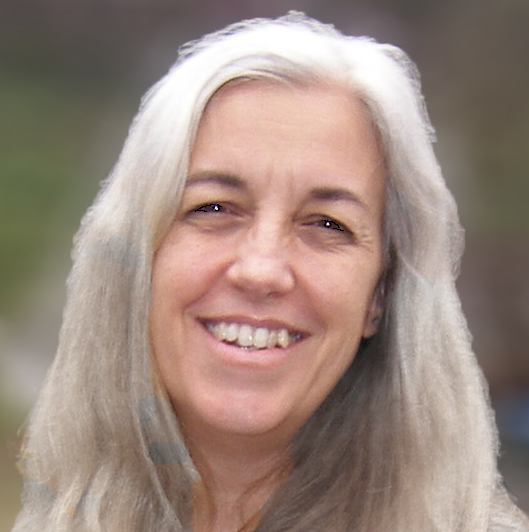
Lisa Pelissier lives in Oregon where she is a homeschooling mother of four (three with disabilities) and author of two middle-grade fiction novels. Lisa owns SneakerBlossom Books, offering Christian, classical homeschool Study Guides and curriculum. She also works as a freelance copy editor, an artist, and a tutor. In her spare time Lisa enjoys playing the piano and fretting about things over which she has no control. Email Lisa at sneakerblossom@yahoo.com or connect on Facebook.

Author Jolene Philo
Archives

Categories

Subscribe for Updates from Jolene

Related Posts
A Person of Influence in Her World

A Person of Influence in Her World

A Person of Influence in Her World

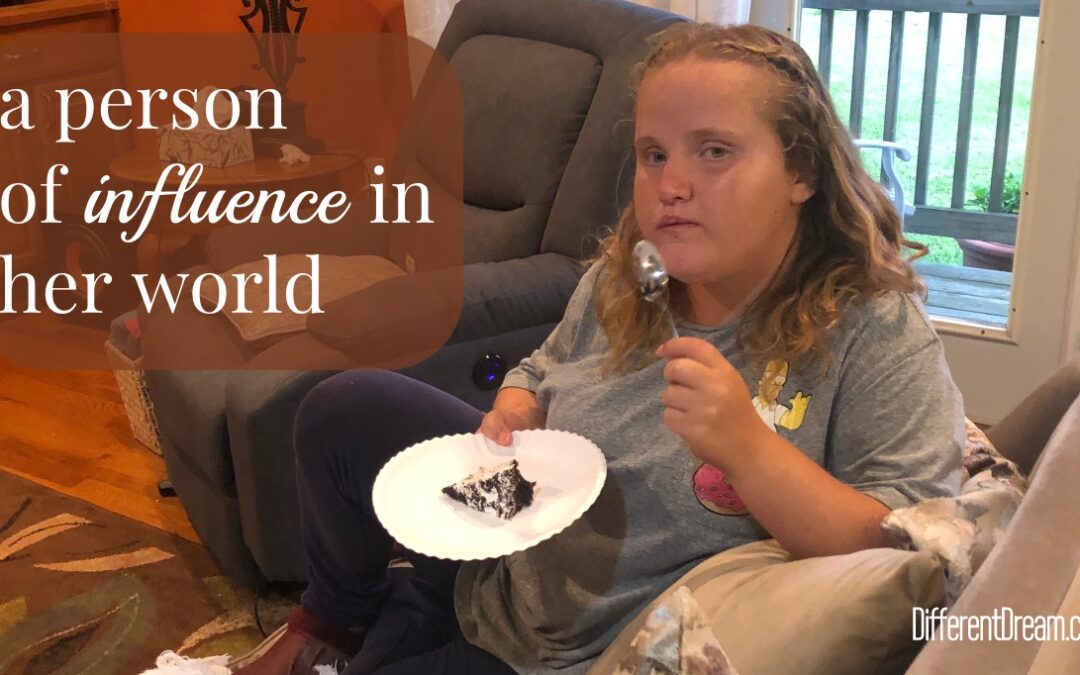
A person of influence means something different for guest blogger, Karen Jackson. She reflects on the influence her daughter Samantha, who lives with autism, has been in the lives of many.

At dinner the other night, my husband and I were talking about social media influencers. The conversation got me thinking about what it means to be a person of influence in our society and about my daughter, Samantha, who turns 24 in a few days.

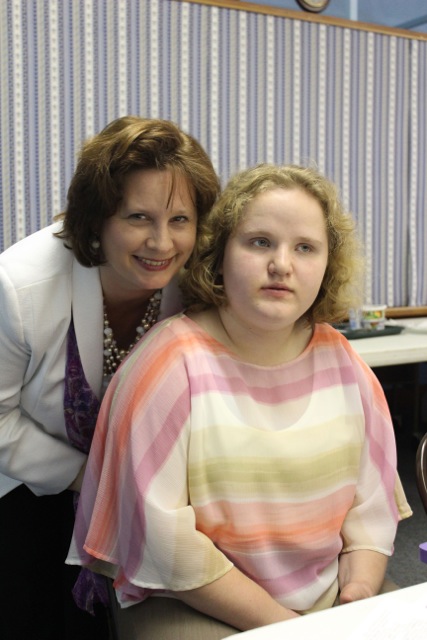
Samantha is our middle child. She has autism and needs 24/7 supervision. She is also a person of influence in my life, as well as others. This may seem incongruent with having a disability, so let me explain.

Samantha has a team of caregivers that support her everyday living and help our family so that my husband and I can work outside the home. Since she is not able to hold a job right now and her circle is quite small in comparison to many others, the questions surface in my mind; “What is Samantha’s role in this world?”.  As a Christian, I ask, “What are the good works (Ephesians 2:10) that God has planned for Samantha?”

I recognize that these may seem to be lofty questions regarding a person who is primarily non-verbal and requires significant care and supports. Yet, I know I am not the only parent of a child significantly affected by disability who has asked these questions.

I do not have the answers. But I have something to contribution to the conversation because I have raised Samantha for 24 years thus far and am involved in the faith and disability community as the founder of Faith Inclusion Network.

Since Samantha was quite young, we have had the assistance of caregivers in our home. We started with training local college students. When Samantha turned 14, she started to receive in-home care through Medicaid. We have had dozens of different people in our home ever since, sometimes only for a few weeks or months. Others have worked for a year or more. One young woman is practically family, and comes every so often to provide overnight respite.

Transitioning to a new caregiver is difficult for Samantha, especially if she really liked the previous one who was with us for a significant amount of time. Still, Samantha does it well. I used to be sad for my daughter when a caregiver she had grown close to had to leave. I have learned something about resiliency from the way Samantha accepts the situation, new people in her life, and their departures.

In pondering Samantha’s gifts and God’s role for her, I realize the important and even profound effect she has on the people in her life. From family members and friends to people paid to be a part of her caregiving team, Samantha shares her generous spirit. She humbly allows people to help with the intimate care of bathing and dressing. She shares her love of the outdoors and community events, swimming, the zoo, and museums. She is a faithful, Catholic woman, attending Mass regularly and participating at her church as she is able. Samantha does not accept others lightly, but quietly evaluates their sincerity and gradually lets them into her life. Once she does, she is loyal and loving.

In Samantha’s room is a bulletin board filled with pictures of people that are or have been a part of her life. I am pretty sure that, if I could ask them, they would say she has been a person of influence who impacted them in a significant way. The caregivers pictured would say they remember her well, that she was an important part of their lives for a time. Samantha’s brothers, who are pictured on the board, have written beautifully about their sister’s influence in their lives. Samantha has of course, made a monumental impact on my husband and me.

As my beautiful daughter turns 24, I am confident that God has a plan for her life, that He has always has had a plan for her. The world’s view of what it means to be successful and contribute to society may be wildly different from what my daughter has to offer, but she is a person of influence.

Happy 24th birthday, Samantha!

Do you like what you see at DifferentDream.com? You can receive more great content by subscribing to the monthly Different Dream newsletter and signing up for the daily RSS feed delivered to your email.

By

Karen Jackson is the Executive Director of Faith Inclusion Network (FIN) of Hampton Roads where she lives with her husband and three children in Norfolk, VA. She is also the author of Loving Samantha. You can connect with Karen at the Faith Inclusion Network page.

Author Jolene Philo

Archives

Categories

Subscribe for Updates from Jolene

Related Posts

It Is Only for a Season

It Is Only for a Season

It Is Only for a Season

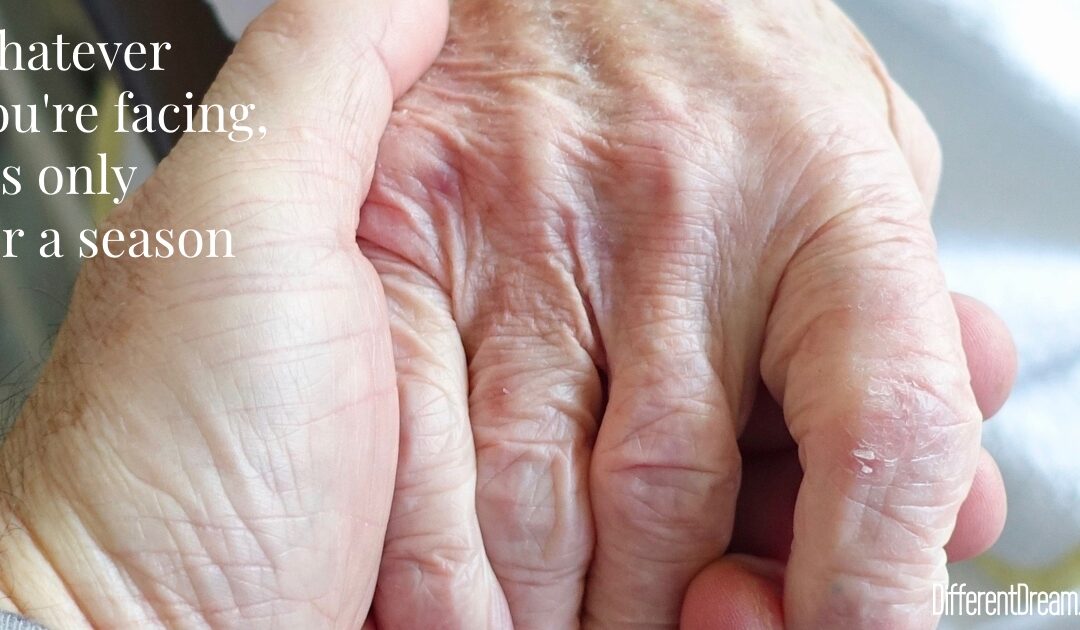
It is only for a season, though it may feel like forever. That’s a truth I cling to in hard times. Maybe it’s a word of hope you need to hear today, too.

Our son came down the driveway yesterday pulling a huge gooseneck flatbed trailer behind his gigantic work truck. I took his dramatic arrival in stride, it being 1 in a long string of dramatic arrivals that began with his birth in 1982.

My response to his first arrival wasn’t nearly as calm. I cried for hours after our baby was diagnosed with a life-threatening birth condition and flown 750 miles away for surgery. I cried at the first glimpse of him in NICU. I cried often as he endured surgery after surgery and procedure after procedure until his condition stabilized. I worried that my husband and I weren’t doing enough for our son.

That I wasn’t a good mom.
That he might die.
That our lives and his would always be wrapped up in caregiving and hospital stays and setbacks.

With time and distance, I can see that not only were my worries baseless, they obscured the truth.

That my husband and I were doing all we could for our baby.
That I was a good mom persevering during difficult circumstances.
That our son was alive and growing.
That this was a just a season of his life and of ours.

It was not forever.

Then I didn’t know that one day my son would park his gigantic truck and gooseneck trailer in a grassy spot in our acreage.
Then I didn’t know he would be sporting a bushy beard, a ponytail, and a farmer hat.
Then I didn’t know he would give me a big hug and say, “Are you ready to visit grandma?”
Then I didn’t know he would greet my mother, who’s health began failing a few months ago with great tenderness.
Then I didn’t know that after an hour of showing her pictures of his kids and his farm and playing Uno, he would notice that she was tired.
Then I didn’t know that he would kiss her with great tenderness and say, “I love you, Grandma. I love you.”

Now I do know—and he knows too—that his grandma’s illness is only for a season. A season, not for crying and worrying, but for loving well. For playing Uno. For sharing old memories and making new ones. For laughing and smiling. For hugs and kisses. For holding hands.

Whatever the difficult circumstances you are, whatever the reason for your tears and your worries, whatever loss you are facing, I want you to cling to this truth.

It is only for a season.
It may be a hard season.
It may be an unwanted season.
It may be a season of loss.
But it is only for a season.

Right now, you can’t imagine what waits on the other side of this season. 

But it will come.
It may be totally unexpected. 
But it will come.
It will be the fruits of seeds being planted in your present hardship. 
It will come.
And it will be good.

For our momentary, light affliction is producing for us an eternal weight of glory 
far beyond all comparison, 
while we look not at the things which are seen, 
but at the things which are not seen; 
for the things which are seen are temporal, 
but the things which are not seen are eternal.
2 Corinthians 4:17-18

Do you like what you see at DifferentDream.com? You can receive more great content by subscribing to the monthly Different Dream newsletter and signing up for the daily RSS feed delivered to your email.

By

Jolene Philo is the author of the Different Dream series for parents of kids with special needs. She speaks at parenting and special needs conferences around the country. She’s also the creator and host of the Different Dream websiteSharing Love Abundantly With Special Needs Families: The 5 Love Languages® for Parents Raising Children with Disabilities, which she co-authored with Dr. Gary Chapman, was released in August of 2019 and is available at local bookstores, their bookstore website, and at Amazon.

Author Jolene Philo

Archives

Categories

Subscribe for Updates from Jolene

Related Posts

When Life Gets Really Crazy I Dream about our Vacation

When Life Gets Really Crazy I Dream about our Vacation

When Life Gets Really Crazy I Dream about our Vacation

“When life gets really crazy, I dream about our vacation.”

Those who know me well would surmise those were my words. I make such statements often. But in actuality they came from my husband Hiram, a calm man who rarely becomes stressed by either hard work or obstacles.

When he uttered those words in March of 2021, life was really crazy.

  • We were in month 13 of a home addition project which was supposed to take about 8 months.
  • We were filling out the paperwork related to turning 65 this year.
  • The grandchildren, ages 6 and 3, who live with their parents in the lower level of our house, were going through a less-than-endearing phase.
  • We were unable to go out for a meal or to a coffee shop because of the pandemic and a cold spring that put the kibosh on dining outdoors.

Not quite what he expected for his last year before retiring on June 30. He had every reason to dream about our upcoming month long vacation–on the rare occasions when we’re not occupied with the addition, paperwork, or grandkids.

I smiled at him on that crazy day. “I do the same thing. I can’t wait.”

The next day my mother’s health took a turn for the worse. April and May became a blur of phone calls and advocacy, along with emails and texts to my siblings about the excruciatingly slow ordeal of locating a residential facility able to meet her increased care needs.

To read the rest of When Life Gets Really Crazy I Dream about our Vacation, visit the Key Ministry website.

Do you like what you see at DifferentDream.com? You can receive more great content by subscribing to the monthly Different Dream newsletter and signing up for the daily RSS feed delivered to your email.

By

Jolene Philo is the author of the Different Dream series for parents of kids with special needs. She speaks at parenting and special needs conferences around the country. She’s also the creator and host of the Different Dream websiteSharing Love Abundantly With Special Needs Families: The 5 Love Languages® for Parents Raising Children with Disabilities, which she co-authored with Dr. Gary Chapman, was released in August of 2019 and is available at local bookstores, their bookstore website, and at Amazon.

Author Jolene Philo

Archives

Categories

Subscribe for Updates from Jolene

Related Posts

Joyful

Joyful

Joyful

Joyful celebrations were hard to come by for many during the pandemic. Though increasing health challenges and isolation affected Sandy Ramsey-Trayvick’s son, he not only found joy but also found ways to express it.  

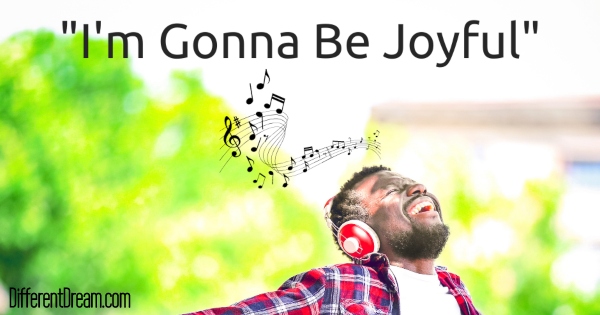
My son has a new favorite song that he’s been singing a lot lately. It’s called Joyful. When he hears it, he lights up. He laughs and dances and grabs my hand to join him as he sings,

This is the day that the Lord has made
And I ain’t gonna let it slip away
I’m gonna be joyful
I’m gonna be joyful today today.

He laughs, dances and sings even though the past several months have been hard for him. His time at home during the pandemic has been marked with increasingly challenging health issues that have resulted in greater pain and more discomfort.  

Early in the pandemic, I wrote about how the Lord had reminded me to not forget His faithfulness. I shared that His prompting turned out to be preparation for an unforeseen health event for my son. At the time, I’d realized that the Lord wanted me to respond to this event by remembering that He was faithful—to not allow the circumstances to tempt me to question Him.

What I didn’t realize at the time was how many more opportunities I’d have during COVID to remember His faithfulness in the face of worsening health challenges for my son. Throughout this season, I’ve watched my son endure more suffering and distress than he’s had to endure for years. However, despite the increased health difficulties, my son’s joy has not wavered or diminished.  He continues to laugh and smile—singing and dancing and happy. He’s still joyful.

For my son, joy seems to come easily. It has been a source of great strength for him throughout his life. It continues to be one of God’s most precious gifts to him. The unstoppable joy that he has received from the Lord has helped him to persevere through the many challenges that disability and special needs have thrown his way (James 1:2-3). Even when he’s having a bad day, or enough has gone wrong that might make him feel like giving up, he instead proclaims—in his own way—how great his God is by choosing to “rejoice in the Lord.” By remaining joyful, he makes God bigger than his problems.

I have to work a little harder for my joy. I know we’re called to choose joy, but during tough seasons, that’s hard to do on some days. I’m tempted at times to let difficult circumstances bring me down, rather than relying on my joy to help me persevere. I’m so thankful that God’s faithfulness during this season has included reminders—through my son—to be joyful always, in every circumstance.  

So, as my son laughs and sings and grabs my hand to dance and sing along, I join him every time. I pat my heart alongside him and declare for myself,

I got the joy joy down in my heart
Down in my heart
Down in my heart
I got the J-O-Y down in my heart today today.

And we experience that joy together.

Do you like what you see at DifferentDream.com? You can receive more great content by subscribing to the monthly Different Dream newsletter and signing up for the daily RSS feed delivered to your email.

By

Sandy is wife to Terry, mom to 3 young adult children, a Bible study teacher, an encourager to those who are weary, a fitness enthusiast, a lover of books, and a certified professional coach. She and her husband are also marriage mentors. Twenty years ago, after her son was diagnosed with multiple disabilities, Sandy became his full time caregiver and advocate. She knows that living in the world of special needs or disabilities can lead to a “disabled life” mindset that focuses on limitations and settles for less life, less joy, less fulfillment. She coaches parents of children with special needs to help them see their circumstances from a perspective of hope, purpose, and opportunity. She helps them choose actions that create a life for themselves and their families that is joyful, fulfilling and fruitful. You can learn more about Sandy, her work, and her blog at www.UNDisabledLIVES.org.

Author Jolene Philo

Archives

Categories

Subscribe for Updates from Jolene

Related Posts

Milestones, Transitions and Rites of Passage

Milestones, Transitions and Rites of Passage

Milestones, Transitions and Rites of Passage

,Milestones, transitions and rites of passage are events parents anticipate and cherish. In this post, guest blogger Mark Arnold describes how he reframes those events as he and his wife parent their son who lives with additional needs.

 Milestones, transitions and rites of passage are part of every childhood and adolescence. Many of these events can be fraught for all families. For families of children with special needs they can also be a time of significant worry and sadness. We make unhealthy comparisons and are thrown into a cycle of grief as our children are shown to be different from what society understands as normal.

My own son was 18 last summer. Because of his various additional needs, his path of was never going to be the one of a typical 18-year-old. I have long understood this and love him for who he is. Even so, last August was hard. There was news coverage of 18-year-olds jumping excitedly in the air, celebrating their end of school exam results, and looking forward to heading to University. I realized that in a different world, my son might have been one of them. 

Did he mind not having any exam results? No, he has no concept of them. I was the one who was briefly but significantly affected. I was the one who temporarily felt a profound sense of loss.I realized what unhealthy comparison was once again doing to me and I chose to stop.

 A few moments later my sons’ laughter filled the room, and the cloud was lifted. I didn’t need to make comparisons. I could celebrate my son for who he is.

For all he brings to us.
For all we have learned by him being a part of our family.
For all that is different and better about us because of him. 

He doesn’t need a piece of paper to earn our love. He has it unconditionally. He has his own personal milestones, transitions and rites of passage on his own life journey. We’re right alongside him, helping him through them, celebrating them with him when they come along.

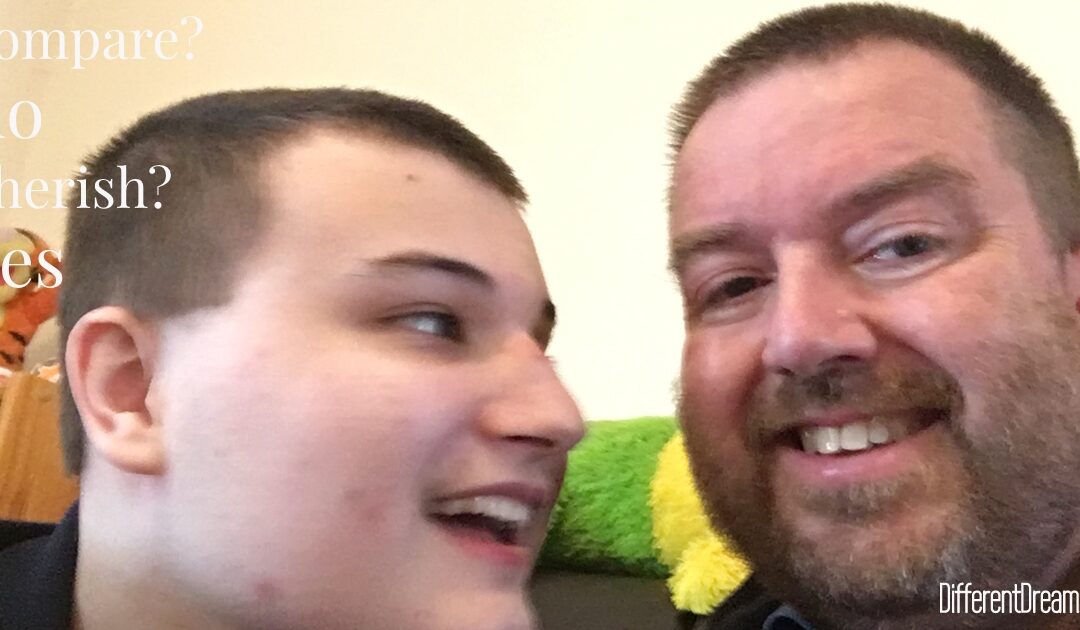
There’s a well-known TV ad in the United Kingdom—I live across the pond—where an opera singer uses the catchphrase Go Compare! When the ad comes on, I look at my son and smile. Whatever your reason for reading this post, maybe as a family member, a friend, a church children’s or youth team member, or a church leader, you can learn to smile too. You can go cherish the kids with additional needs in your world instead of go compare.

Do you like what you see at DifferentDream.com? You can receive more great content by subscribing to the monthly Different Dream newsletter and signing up for the daily RSS feed delivered to your email inbox. You can sign up for the first in the pop up box and the second at the bottom of this page.

By

Mark Arnold is the Additional Needs Ministry Director at Urban Saints, a leading national Christian children’s and youth organization. He is co-founder of the Additional Needs Alliance, a national and international advocate for children and young people with additional needs or disabilities. Mark is a Churches for All and Living Fully Network partner, a member of the Council for Disabled Children and the European Disability Network. He writes an additional needs column for Premier Youth and Children’s Work (YCW) magazine and blogs at The Additional Needs Blogfather. He is father to James, who has autism spectrum condition, associated learning disability, and epilepsy. To find out more about how Mark’s work can help you, contact him at: marnold@urbansaints.org or @Mark_J_Arnold.

Author Jolene Philo

Archives

Categories

Subscribe for Updates from Jolene

Related Posts