Would Someone Be Friends with My Autistic Child?

Would Someone Be Friends with My Autistic Child?

Would Someone Be Friends with My Autistic Child?

The viral story of a young autistic boy who recently asked his parents a similar question led Mark Arnold to ask the same about his son, James. In today’s post, Mark shares the answer he found.
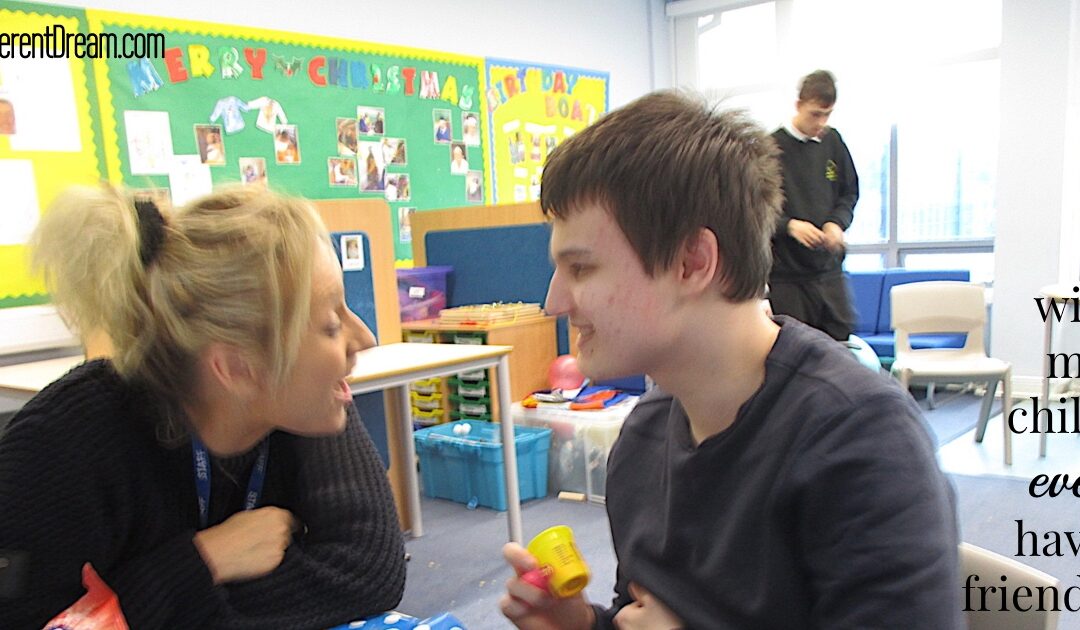
Our son James has autism, a learning disability and epilepsy. He’s never had the kind of friendships that most children and young people have. He’s never had friends round to the house or gone to someone else’s house. He stopped being invited to children’s parties when he was about six or seven.
When James was unable to leave the house due to severe anxiety, no friends visited  him. Nobody called. It’s been a similar story during the COVID-19 lockdowns.

But is that the full story? Would someone be friends with my autistic child if they knew him? Are there already young people who like my son James?

I remember that once James was able to go out again, one of the first places we visited was the farm shop where he loves to go. They sell things that James enjoys, and it is also a safe place for James. Many of the staff are kind to him. They know him by name, ask him how he is doing, and don’t mind if he eats what he has chosen before we pay for it! But are they his friends?
I remember how when James was at church, people interacted with him. They asked how he was doing, cared for him. But these lovely people are all adults. None of them are his age. None of them are what might be understood as friends.

I remember when James was about to start re-engaging in school through short visits. The weekend before his first visit I bumped into Brendan, a student in his class, and his mum at the supermarket. When I mentioned that we were bringing James in for a school visit the following week, Brendan literally jumped for joy. He and kept repeating James’ name and was delighted to see James again!
When James is back at school regularly, three short days a week, he interacts with other students. Arya is one of them who regularly asks about James and seems genuinely pleased to see him. Maybe James does have some friends of his own age after all.

The viral story of a young autistic boy who asked his parents if he would ever have friends brought attention to the often lonely world of children and young people with autism. Perhaps this post will help us ask a question to help all children be included: What can I do today to make a difference for someone I know?

Do you like what you see at DifferentDream.com? You can receive more great content by subscribing to the monthly Different Dream newsletter and signing up for the daily RSS feed delivered to your email inbox. You can sign up for the first in the pop up box and the second at the bottom of this page.

By

Mark Arnold is the Additional Needs Ministry Director at Urban Saints, a leading national Christian children’s and youth organization. He is co-founder of the Additional Needs Alliance, a national and international advocate for children and young people with additional needs or disabilities. Mark is a Churches for All and Living Fully Network partner, a member of the Council for Disabled Children and the European Disability Network. He writes an additional needs column for Premier Youth and Children’s Work (YCW) magazine and blogs at The Additional Needs Blogfather. He is father to James, who has autism spectrum condition, associated learning disability, and epilepsy. To find out more about how Mark’s work can help you, contact him at: marnold@urbansaints.org or @Mark_J_Arnold.

Author Jolene Philo

Archives

Categories

Related Posts

2 Mental Health Red Flags for Caregiving Parents

2 Mental Health Red Flags for Caregiving Parents

2 Mental Health Red Flags for Caregiving Parents

2 mental health red flags for caregiving parents? Are you kidding me? I’m waving at least a dozen red flags every day!

That would have been my reaction to the title of this post when I was in the thick of caring for a medically-fragile kid. In fact, that would have been my reaction as recently as a month ago. But I had a lightbulb moment between then and now.

The lightbulb moment came while I facilitated a class for teachers about post-traumatic stress disorder (PTSD) in kids. We were discussing childhood symptoms, also known as behaviors, displayed by traumatized children. The class members wanted to know what kinds of behaviors are indicators that the trauma has evolved into PTSD.

“It’s not so much the kind of behavior,” I explained, “because most kids display these kinds behaviors at one time or another. Red flag indicators for me are the intensity and duration of the behavior. An example would be what happens after telling 2-year-olds they can’t have a cookie. More than likely, a 2-year-old will throw a tantrum. However, 2-year-olds living with unresolved trauma and PTSD will pitch magnificent fits that are long and loud. That’s intensity.

Similar tantrums continue to occur whenever these 2-year-olds are denied anything long after the child should have moved past the terrible 2s. That’s duration.” 

The words had barely come out of my mouth before the lightbulb turned on: Intensity and duration of behaviors can be 2 mental health red flags for caregiving parents, too.

I mean, let’s face it. Parents raising kids with special needs and disabilities face plenty of attacks on their mental health, including traumatic stress. Such as thee stress of overwhelming, unrelenting caregiving demands. The trauma of sending a child off to surgery or hearing the heart monitor flatline. The stress of trying to manage unmanageable behaviors. The trauma of a receiving a difficult diagnosis. 

To read the rest of 2 Mental Health Red Flags for Caregiving Parents, visit the Hope Anew website.

Do you like what you see at DifferentDream.com? You can receive more great content by subscribing to the monthly Different Dream newsletter and signing up for the daily RSS feed delivered to your email.

By

Jolene Philo is the author of the Different Dream series for parents of kids with special needs. She speaks at parenting and special needs conferences around the country. She’s also the creator and host of the Different Dream website. Sharing Love Abundantly With Special Needs Families: The 5 Love Languages® for Parents Raising Children with Disabilities, which she co-authored with Dr. Gary Chapman, was released in August of 2019 and is available at local bookstores, their bookstore website, and at Amazon.

Author Jolene Philo

Archives

Categories

Related Posts

Transitioning Between Rhythms and Tempos

Transitioning Between Rhythms and Tempos

Transitioning Between Rhythms and Tempos

Transitioning Between Rhythms and Tempos is the brainchild of music therapist, Jim Gavin. In this post he explains what transitions are, what’s included in the class he’s developed, and who can benefit from it.

We are creatures of habit, and routines are key to being the best version of ourselves. This is why transitioning can be difficult for the both the neuro-typical person and a person with special needs or disabilities. Difficult transitions could be from one activity to the next (arts and crafts to lunch time), from one day to the next (Tuesday night into Wednesday morning), or from one holiday to another (such as Valentine’s Day to St. Patrick’s Day). Other transitions could be from season to season or going from 5 years old to 6. 

During 10 years of being in the human services field, I’ve found that the more we prepare and make a plan for what we intend to do next, the better off we are if something goes awry. With planning, we can adapt to a situation in real time in a calm, cool, and collected way. If we do this successfully, we not only keep the situation under control for ourselves, but also for those around us.

This is one way I build trust with those I serve and support.  

It is the main reason I created music-related activities to practice rhythm, melody, and harmony, as well as how to deal with out-of-control, chaotic situations. Instead of flying off the handle, practice helps my clients take a deep breath, realize that this too shall pass, through the difficult time with more ease and peace. 

The class I’ve created, Transitioning Between Rhythms and Tempos which is available on Udemy, takes the idea of transitioning between activities and occasions in life and applies it to actual music making at a basic rhythmic level.

Before I end in-person or virtual individual/group classes, I give those I serve a head’s up to help them transition. Something to the effect of:

This is the last song before I say goodbye.
Thank you for letting me spend time with you today.
It’s been so much fun!
Looking forward to the next time we see each other.

Phrases like these that make people feel comfortable knowing that what we’re doing is about to end, and that’s okay.

Do you like what you see at DifferentDream.com? You can receive more great content by subscribing to the monthly Different Dream newsletter and signing up for the daily RSS feed delivered to your email.

By

To learn more about Jim and his business which exists to improve the quality of life for those in a time of need, head to Key of Awesome Music. You can follow and share Key of Awesome Music’s on Instagram and Twitter here: @keyofawesomemusic. You’ll find free daily Facebook Live programs geared towards and children and those with developmental disabilities at his Facebook page. To sign-up for the monthly newsletter go to http://eepurl.com/dwPEGH. To contact Jim, email him at jim.gaven@gmail.com.

Author Jolene Philo

Archives

Categories

Related Posts

Love Is a Child’s First Language

Love Is a Child’s First Language

Love Is a Child’s First Language

Love is a child’s first language. This truth is the title of the fourth chapter in Sharing Love Abundantly in Special Needs Families. The chapter explores two child development concepts that can help parents better understand how to express love to their kids with disabilities and special needs.

The first concept is attachment categories. Attachment equals love in mental health care jargon. Professionals in the field have identified 4 attachment categories to identify how very young children learn to love, or bond, with primary caregivers.  

Secure attachment happens when the child has consistent, emotionally appropriate interactions with parents. Secure children feel empowered to explore the world as they develop and grow.

Avoidant attachment occurs when parents are unavailable or rejecting. As a result, children also avoid closeness and emotional attachment.

Anxious attachment is the result of inconsistent interactions with parents. Lack of consistency causes children to exhibit anxious and unreliable behaviors.

Disorganized attachment happens when contact with parents is so inconsistent and unpredictable that children are repeatedly disoriented or terrified. Their lives are so chaotic and their needs are so frequently unmet that they are unable to rely on or attach to anyone.

Many children with special needs develop avoidant, anxious, or disorganized attachment. Reasons include early, invasive medical treatment, separation from birth mother for medical treatment or adoption, repeated trauma, extreme sensory sensitivity, or unpredictable medical conditions like seizure disorders. Parents can use the love languages to fill these kids’ with the security they didn’t receive earlier.

The second concept is stages of cognitive development. This is a term used by educational psychologists to describe how thinking and learning develops in children. All kids go through these 4 stages in the same order, but not always at the same speed.

The sensorimotor stage runs roughly from birth to age 2. In this stage, children learn about the world by manipulating and observing physical objects.

In the pre-operational stage goes from age 2 to 7. At this age, children start using symbols while thinking, but they still need to manipulate symbols. They also asked lots of “why” questions and are very curious.

The concrete operational stage runs from about age 7 through age 11. This is where children begin to think logically in their heads. They can’t apply what they’ve experienced to unfamiliar situations because they can’t yet think abstractly.

The formal operational stage can start at age 11 and runs through adulthood. Some adults never reach this stage, which can only be achieved in an enriched and intentional environment. Those who reach this stage can think abstractly about things they haven’t personally experienced.

Many children with developmental delays or attachment issues progress through these stages slowly. By identifying what stage children are at, parents can speak their love languages in developmentally appropriate ways. 

Chapter 4 of Sharing Love Abundantly is filled with the stories of families who have adapted and used the love languages with their kids who have special needs and disabilities. Assuring our children that they are loved is what parenting is all about!

Other articles in this series:

The Love Languages and Special Needs Families: A Good Combination

Basic Love Language Concepts to Ease Stress and Increase Joy in Caregiving Families

Threats to Caregiving Marriages and How To Fight Them 

Fostering Communication and Connection Between Caregiving Parents 

Determining the Love Language of a Child with Special Needs or a Disability 

Ways to Speak Words of Affirmation and Quality Time to Kids with Special Needs

Speaking Healthy Physical Touch to Kids with Special Needs

Using the Love Languages with Siblings of Kids with Special Needs and Disabilities 

Extended Family Members Can Use the Love Languages to Encourage Caregiving Parents

Communicating Your Child’s Love Language to Medical Professionals

Communicating Your Child’s Love Language to Educators 

Do you like what you see at DifferentDream.com? You can receive more great content by subscribing to the monthly Different Dream newsletter and signing up for the daily RSS feed delivered to your email.

By

Jolene Philo is the author of the Different Dream series for parents of kids with special needs. She speaks at parenting and special needs conferences around the country. She’s also the creator and host of the Different Dream websiteSharing Love Abundantly With Special Needs Families: The 5 Love Languages® for Parents Raising Children with Disabilities, which she co-authored with Dr. Gary Chapman, was released in August of 2019 and is available at local bookstores, their bookstore website, and at Amazon.

Author Jolene Philo

Archives

Categories

Related Posts

EA/TEF Is All in the Family for this Mother and Son

EA/TEF Is All in the Family for this Mother and Son

EA/TEF Is All in the Family for this Mother and Son

EA/TEF is all in the family for this mother and son. Mom Corrin Ponte, who was born with this rare condition and whose son has it too, recounts both stories. From her unique vantage point, she also shares her best tips for parents raising their own EA/TEF babies.

I was transferred to Stanford NICU at 2 days old where scans showed a connection between the trachea and the distal esophagus and proximal esophagus ending in a blind pouch–EA/TEF. I had surgery to repair the defect and was discharged home at 3 weeks of age. 

After a few weeks at home, I stopped breathing and turned blue. My mom pounded on the neighbor’s door. No answer. A teenager parked nearby noticed and performed CPR, resuscitating me. 

Back at Stanford they found the repaired site had narrowed to the size of a pinhole. I spent the next 2 months in the hospital with life-threatening episodes. Eventually, they inserted a g-tube (feeding tube) so I could go home. 

Fast forward to adulthood and my first pregnancy.

Between weeks 18-20 I had a routine ultrasound. The technician saw a tiny “stomach bubble” and had the radiologist take a look. I was referred to a perinatologist who said, “it’s probably fine; come back in 8 weeks.”

Knowing my own history, I wasn’t comfortable with the wait and self-refer to University of Washington perinatology. They saw a tiny stomach bubble and increased amniotic fluid and said there was a 90% + chance that my baby had EA/TEF. I left the appointment feeling confident that my child would be born with the same defect and that he would come home after a successful surgical repair or with a feeding tube. After all, EA/TEF is all in the family for me.

As I was a nurse, I requested my medical records from birth. Soon a 4-inch stack of records arrived! I poured through them. They gave me a glimmer of what my non-medical parents dealt with and gave me the reassurance that I needed to prepare for my son.

Mason was delivered via c-section at 35 weeks. He was evaluated and confirmed to have EA/TEF and Down syndrome. That was a complete surprise! He was transferred to Seattle Children’s Hospital within 4 hours. His surgery was the next day and was successful! He spent 2 weeks in the NICU and was discharged after 3 weeks – including modified feedings and a wedge to sleep on. 

The first 12 years of his life were filled with appointments, therapy, hospitalizations, illnesses, and surgeries. He is now 18 and doing much better. Because EA/TEF is all in the family for us, I created these tips to help other parents.

  • Take a breath! You can do it!
  • Make a binder to organize notes about medication, treatments, and doctors. 
  • Create an “About Me” handout for school personnel.
  • Create a “babysitting guide” with important health information for emergency medical situations and tips for dealing with stuck food.
  • Encourage caregivers and family to learn CPR and Heimlich.
  • Have a list of banned foods that are choking hazards for your child.
  • Work with your child to learn his or her choking hazards.
  • Send only safe foods to school. 
  • Work with your child’s school nurse to create a 504, Individual Health Plan, or Emergency Care Plan. If your child needs adult support during school, make sure it’s written and make sure back-up staff are trained. Remember parties/field trips/special events. 
  • Provide information from TOFS and EATEF: ‘Tracheomalacia and the TOF cough’, ‘Chest infections and wheeze’, and ‘A Guide for Teachers and Caregivers’ for school nurses and educators.
  • Create an “About Me” presentation for your child’s class. Explain why your child has eating restrictions, what those restrictions are, and go over typical EA/TEF sounds like noisy breathing and a barky laugh.

Do you like what you see at DifferentDream.com? You can receive more great content by subscribing to the monthly Different Dream newsletter and signing up for the daily RSS feed delivered to your email inbox. You can sign up for the first in the pop up box and the second at the bottom of this page.

By

Corrin Ponte lives in Washington state with her two children: Lauren and Mason and their pets. Aside from TEF/EA, Mason also has Down syndrome, dysphagia, tracheomalacia, asthma, hypothyroidism, and obstructive sleep apnea. Corrin has been a nurse 24 years and received her Master of Science in Nursing Education in 2019. She has been published in ‘Individualized Healthcare Plans for the School Nurse’ (2017) and in ‘Immunology and Allergy Clinics of North America: Comprehensive Care in the Allergy/Asthma office’ (1999). She also served as a board member for the IDEA project which provides interactive disability education awareness at schools. Corrin works as a school nurse and helps integrates students with complex medical issues and students with disabilities.

Author Jolene Philo

Archives

Categories

Related Posts

The Questions Every EA/TEF Parent Asks: Why Him, Why Me, Why Us?

The Questions Every EA/TEF Parent Asks: Why Him, Why Me, Why Us?

The Questions Every EA/TEF Parent Asks: Why Him, Why Me, Why Us?

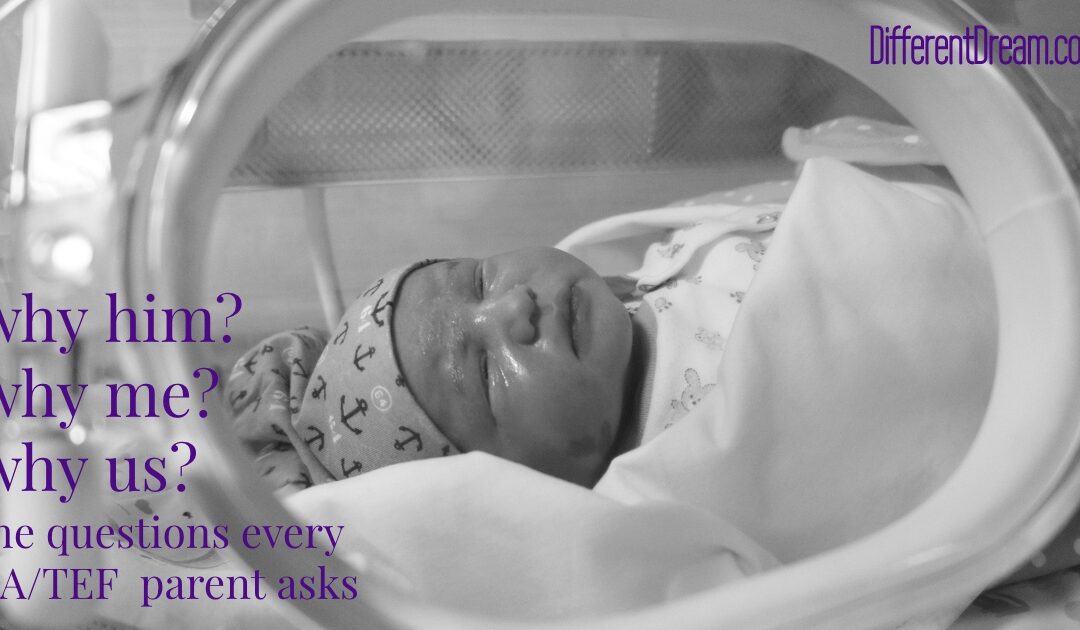
The questions every EA/TEF parent asks after their child’s diagnosis are the same–Why him? Why me? Why us? Guest blogger Wendy Vermillion recounts her struggle and reveals the weapon that helped her parent well during her son’s early days.

I’m sure I heard the phrase, “God doesn’t give you more than you can handle,” a hundred times in the first 24 hours after delivering my firstborn baby boy.  Most new mothers are living their dream of holding their newborn baby for the first time, and sharing the joy with family and friends.  But for me, this day was filled with more tears than smiles, with a lot of fear in our world.  All I could do was ask God the questions every EA/TEF parent asks– Why my son, why me, why us?

The words of my godly grandmother still ring in my head 33 years later:  “God will show you why; be still and be patient.”  At the time, I had no understanding of what she meant.

My dream of being a mom started to come true on a summer evening in 1987. I was barefoot, pregnant, and fancy-free walking into a hospital complaining of a little back pain at 36 weeks. It was just a little back pain; I almost didn’t even go to the hospital. Thankfully, I went—it turned out I was dilated to a 7 and we were about to have a baby boy.  I was hooked up to monitors and nurses kept asking how my pain was. What pain?  There was no pain, not even the back pain anymore. One of my nurses said she had never heard of such a thing as no pain in all the 15 years she had been in delivery. Can you image how happy I was? No pain with childbirth—God, was this a joke? 

That happiness did not last long when I heard the words, “Your baby is in distress.”  We were rushed to delivery room within an hour of arriving at the hospital. Three pushes and he was out! All I saw was a beautiful baby boy with a round face, lots of black hair, and all 10 fingers and toes. What more could a mom want? I had prayed for each finger and toe and God had delivered. However, I guess my prayers weren’t enough because our baby boy, Cory, was rushed away without even a first touch from his mom. 

After what seemed like an eternity, doctors told us Cory was born with a birth defect. Can you imagine telling a 22-year-old, first time mom that her baby has a birth defect? Those poor doctors—I bet I asked some of the dumbest questions. I couldn’t comprehend what they were saying; he looked healthy. After they explained in terms I could understand—Cory had no esophagus—the anger set in. I was mad at God, and mad at my doctor.  Then many other emotions came rushing in. Did I need to pray specifically for an esophagus? What did I do wrong? Why couldn’t I have my dream? Why him, why me, why us?

Our rollercoaster ride of hospital visits began. We spent seven weeks in the neonatal unit and on most days I was sure I couldn’t bear it any longer. But somehow we did. We carried on. 

We finally brought our baby home, and we were so excited yet scared to death we would do something wrong. And we did.Our first week home was a disaster. I was an awful mom. The first day, as I was putting him to bed, I pulled his G-tube out. I freaked out, but he slept right through having it put back in. 

Two days later, I was sterilizing bottles on the stove and fell asleep. I woke up to find the house filled with smoke and the smell of melted plastic I scooped up Cory and ran outside to my neighbor’s house with only a nightgown on.  The fireman gave me a blanket to wrap around myself—my neighbor had not been so kind. The gown my have been somewhat see through. Yikes! 

Our 33 years with Cory have been filled with many surgeries, hospital stays, and unknowns. However, they also have been filled with many blessings and so much joy. 
I no longer ask the questions every EA/TEF parent asks after diagnosis. Instead I ask why not us?  

Why not us—getting to experience a journey we never imagined we could handle?  
Why not us—watching God’s miracles play out right before our eyes?  
Why not us—living a dream we thought would not be possible?  
Why not us?   

There will always be times we are not sure we can handle what comes. Be patient and be still; you will see the blessings.  

Do you like what you see at DifferentDream.com? You can receive more great content by subscribing to the monthly Different Dream newsletter and signing up for the daily RSS feed delivered to your email inbox. You can sign up for the first in the pop up box and the second at the bottom of this page.

By

Wendy and her husband have 5 children and 6 grandchildren.  Their oldest son was born with a birth defect and is autistic. Wendy works at a Functional Medicine Clinic as a Health Coach in Oklahoma, where she loves having the opportunity to walk alongside clients, collaborating with them in their journey toward healing.  In her free time, you will find her spending time with family or curled up with a book. 

Author Jolene Philo

Archives

Categories

Related Posts