When Universal Design Fits into God’s Design

When Universal Design Fits into God’s Design

When Universal Design Fits into God’s Design

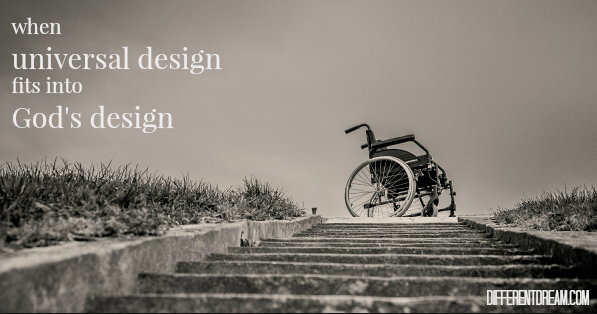
Universal design became part of my life in 1965, the year my parents moved into the only house designed for someone in a wheelchair in our small town of 8,500 people. Because of it’s universal design, Dad could wheel anywhere in our home without assistance. More importantly, he could wheel outside in good weather, park in the driveway, and engage in conversation with anyone who came along.

“Hello,” he boomed to pedestrians on our street. “Grab a lawn chair from the garage and sit with me for a spell.” More often than not, they did. Many came back the next day and the next, throughout the summer, until Dad had converted strangers into friends. All because our home’s universal design afforded him a rare freedom in a day and age when every church, library, school, store, and governmental building in town was closed to him and many others unable to navigate curbs, climb stairs, or enter narrow doorways.

By the time I left my parents’ home in 1978, Dad was too weak to visit my husband and me. A small blessing since he couldn’t have entered any of the homes we lived in unassisted. That undeniable fact niggled at me for decades. “If Dad could still travel,” I told my husband, “he wouldn’t be able to enter our house. He couldn’t use the bathroom or stay over night.”

My husband would nod at my proclamations. We knew that lack of universal design was excluding friends, family members, or church family with mobility issues from our home. Lack of universal design was also thwarting God’s design for His church, excluding the very people Jesus actively ministered to. But lack of funds kept us from making modifications to change the situation, a reality that made me feel sad, frustrated, and guilty in turn.

In 2017 when we moved into the home where we live now. A home we chose in part because it could easily incorporate universal design, something we could finally afford to do. As soon as we were settled, we hired a concrete contractor to pour an accessible porch and ramp in front of our house. It required investments of time and money to find a contractor able to create a ramp with the right incline and the porch we envisioned.

“It’s going to be expensive,” my husband warned, well aware of my penny-pinching mentality.

I opened the checkbook without complaint for two overriding reasons. First, our commitment to universal design was an obedient response to God’s command. Second, making our home accessible to the entire body of Christ and to the lost we are called to love was an act of good stewardship.

With the new ramp in place, my elderly mother can more easily and safely enter our home with her walker. Meetings for a ministry board whose members include a woman in a wheelchair can be held at our home. I’m less anxious about transporting my husband after he has hip replacement surgery in the near future. We can welcome families of children with special needs and anyone with mobility issues into our home without hesitation.

As so often happens in God’s economy, this act of obedience and love produced more good than expected. The new porch is a favorite place to sit in the cool of the morning. Our 3-year-old grandson loves to send toy cars racing down the ramp and careening into the flowerbeds on either side. “Stay on the porch,” we say when he wants to play outside but we don’t, it’s edges creating a visual boundary he understands.

My husband and I have more modifications in mind as we can afford them. “Which one comes first?” he asked with a twinkle in his eye. “The bedroom addition to accommodate wheelchairs and a handicapped bathroom with a walk in shower for when we’re older? The ramp from the house into the garage or the kitchen remodel?”

“Whichever we can afford the soonest,” I answer, smiling as we admire the porch and ramp. I imagine how pleased my father would have been to navigate the entrance on his own.

“Let’s sit on the porch,” I can hear him saying, “and ask the neighbors to sit a spell when they walk by.”

In the same moment, I sense my heavenly Father’s pleasure in our act of obedience and stewardship, something I could not have imagined or conceived had universal design not been part of God’s design for my father’s disability and my parents move into a their home in 1965.

Do you like what you see at DifferentDream.com? You can receive more great content by subscribing to the quarterly Different Dream newsletter and signing up for the daily RSS feed delivered to your email inbox. You can sign up for the first in the pop up box and the second at the bottom of this page.

By

Jolene Philo is a published author, speaker, wife, and mother of a son with special needs.

Author Jolene Philo
Archives

Categories

Subscribe for Updates from Jolene

Related Posts
Bringing The Darkness Of Mom Guilt Out Into The Light

Bringing The Darkness Of Mom Guilt Out Into The Light

Bringing The Darkness Of Mom Guilt Out Into The Light

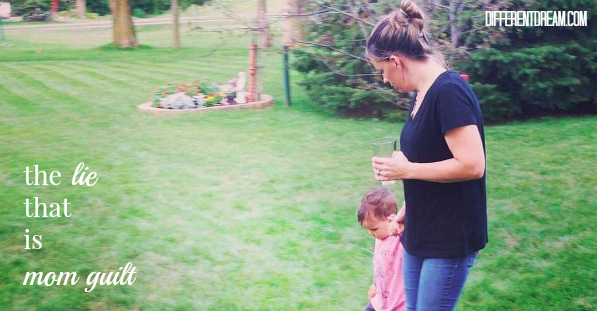
Amy Felix has been experiencing an uptick in the mom guilt that plagues many special needs mothers. She explains how God is using recent unexpected and disappointing events to help her overcome it.

A year ago, my family joined a team in planting a new church. God had been clear that we should leave the comfort and security of our home church in pursuit of His mission which, we were sure at the time, was for me to start a special needs ministry. Yet, a few days ago, we notified the church plant team that we were leaving the church we’d helped build…before my ministry ever left the ground. It was a painful decision for our family and I felt as though people would see me as either a failure or a quitter. Yet, we strove to be obedient to God as He made it very clear that this was no longer His plan for us. It was time to move on.

This experience brought to light the mom guilt I didn’t even know I was carrying, the belief that being a special needs parent means I need to carry all the weight, all the time. Not just my own struggles, but the struggles of others who share a similar journey. If I don’t, I’m not living out my calling.

God has used this transition to speak into one of the dark places in my heart; the place where I hide my “mom guilt”. Mom guilt tells me that I’m not enough. Though I give my all to champion my children, this ugly lie I’ve been holding onto said that living out loud the love, acceptance and support I felt for the special needs community in my daily life didn’t count. I was convinced that being transparent about our family’s struggles and joys on this journey had no power to impact the world. I believed that I needed to be over-extended, weighed down and treading water, or I wasn’t making a difference.

The truth is, I am enough. We moms are enough. Sometimes, we are called to go above and beyond to advocate, educate or support. Other times, we are simply called to navigate this journey the best that we can. In the way that parent our children, in our interactions with those society deems “different”, in how we respond to trials along the way…God can use all of these and more to influence our communities in a positive way.

So, if you’re like me, and you’re hanging on by a thread right now…don’t believe the lie that you’re not enough. Don’t count yourself out. Your purpose can be found in the little, daily things just as much as it can be in the grand gestures. God can use it all.


Do you like what you see at DifferentDream.com? You can receive more great content by subscribing to the quarterly Different Dream newsletter and signing up for the daily RSS feed delivered to your email inbox. You can sign up for the first in the pop up box and the second at the bottom of this page.

By

My name is Amy Felix. I’ve been married for 10 years to a guy who’s totally out of my league. I’m a homeschooling mom to 4 kids, ranging in age from 9 to 2 years. That’s really enough work on it’s own but, because I love it, I’m a photographer as well. And, in my spare time, I write. My faith is the driving force behind my special needs blog: Appointed To Hope. I’m a firm believer in being real, transparent, and using the gifts of this journey as a way to relate to others in their joy as well as their sorrow. To read more about my adventures in special needs parenting, visit my website at www.appointedtohope.com.

Author Jolene Philo

Archives

Categories

Subscribe for Updates from Jolene

Related Posts

Empathy and Autism

Empathy and Autism

Empathy and Autism

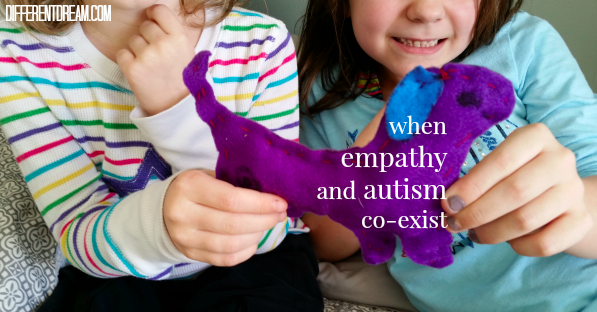
Parents are often told that empathy and autism don’t go together. Guest blogger, Amy Felix, is here with quite a different story, one that’s sure to warm your heart and give you hope.

The dog ate one of my six-year-old’s, favorite stuffed animals. Not just any stuffed animal, but one that can’t be replaced; one she handmade herself. A little, red and purple puppy that had been so well-loved it was barely recognizable. She rarely went anywhere without it so, of course, the dog ate it.

There were a lot of tears.

When the sobbing started, I instantly transformed into two mothers: A typical mother, who wanted to make her second born feel better…and an atypical mother who cringed and braced for impact as her first born who lives with autism emerged from her room to react.

Emotional outbursts from her siblings tend to set my oldest off on one of two paths: anxiety or indifference. Autism can make it hard for her to understand why others may be upset, which either intensifies her anxiety or causes her to walk away, seemingly having no emotional reaction at all to someone else’s feelings. When she goes down the more common path of anxiety, it combines with her inability to tolerate sudden, loud noises and easily pushes her to her breaking point. The mix of both kids’ emotions usually causes a ripple effect. Soon, the whole family is on edge. I suddenly find myself overwhelmed and scrambling to find many solutions for what started out as only one problem. It’s in these stressful moments when I hear the whispers in the back of my mind; the temptation to buy into a common myth about individuals with autism…a myth about my child:

She isn’t capable of empathy.

Here’s where God stopped me in my tracks, before my mind could fully toy with the idea of believing the lie. This time, my daughter’s response to her sister’s sadness wasn’t one of anxiety or indifference…

She sat down next to her sister. She asked her why she was upset. She paused for a moment and, as she was considering her own reaction, I was already in a state of awe. Then, she did it! She stepped into her sister’s pain and out of her mouth came words that brought me to tears, “I could make you a new puppy with the sewing kit in my room to make you feel better.”

Not only can autism and empathy co-exist, my child feels empathy.

She displays it. And, through the gift that is being a part of a special needs family, we never take it for granted. Which is why my second born’s response to her big sister’s offer was so perfectly precious: “Yes, I would love that so much! That’s one of the nicest things you’ve ever done for me!”

Everything within me wishes that I could lift the fog of myths and labels surrounding autism, revealing the endless gifts and possibilities of those who, although different, are definitely not less. I may not be able to change the whole world in this way, but I can start with simply changing myself. I can break free of any doubt in the back of my mind that empathy and autism are incompatible. I can also stand in the truth that, through hard work and God’s grace,

There’s nothing my child can’t do.


Do you like what you see at DifferentDream.com? You can receive more great content by subscribing to the quarterly Different Dream newsletter and signing up for the daily RSS feed delivered to your email inbox. You can sign up for the first in the pop up box and the second at the bottom of this page.

By

My name is Amy Felix. I’ve been married for 10 years to a guy who’s totally out of my league. I’m a homeschooling mom to 4 kids, ranging in age from 9 to 2 years. That’s really enough work on it’s own but, because I love it, I’m a photographer as well. And, in my spare time, I write. My faith is the driving force behind my special needs blog: Appointed To Hope. I’m a firm believer in being real, transparent, and using the gifts of this journey as a way to relate to others in their joy as well as their sorrow. To read more about my adventures in special needs parenting, visit my website at www.appointedtohope.com.

Author Jolene Philo

Archives

Categories

Subscribe for Updates from Jolene

Related Posts

The One in One Hundred Child

The One in One Hundred Child

The One in One Hundred Child

Valentine’s Day is an opportunity to remember the one in one hundred child born with a heart defect. In her heartfelt poem, guest blogger Stephanie Ballard profiles some of the one in one children born with heart disease and the families who are their advocates.

The One in One Hundred Child

You came home with a big red heart
That you had made at school
You wrote your own name in the middle
You asked me, “Mom isn’t it cool?”

“It’s beautiful,” I said to you
As pride swelled in my chest.
“When it comes to paper hearts
Yours really is the best.”

The glitter and lace
A mirrored reflection
So carefully placed
In sincere perfection.

I think about your real heart
On the inside, where others can’t see.
It won’t ever be perfect.
You have a CHD.

You are that one in one hundred–
We’ll never know what to expect.
Our lives have been forever changed
By the words heart defect.

A precious baby girl was born
In nineteen eighty-four
Her mother surely held her
Not knowing what was in store.

Her hopes and dreams were shattered
By the words that would be spoken.
Her tiny, brand new baby girl
Was born with a heart that was broken.

Things were different in that time.
Options weren’t as clear.
Although the baby did not live,
She is a pioneer.

Her mother named her Stephanie–
You can still read her story today.
She received the first baboon heart.
We call her “Baby Fae.”

She was the one in one hundred
Her family decided to give
So medical science could progress
And future heart children might live.

A mother and father get out of their car,
Taking their son’s tiny hand.
The little boy shifts restlessly,
Too young to understand.

Mommy has fresh flowers
Dad has a shiny new balloon
He doesn’t know they’re for his brother
Whose young life was taken too soon.

His small hands touch a well worn stone.
He says, “Wish you were here.”
His parents kneel beside him
Wiping away every tear.

Their child was one in one hundred,
And now they are living apart,
Countless children die each year,
Due to a broken heart.

The technician tells her to relax
The gel should still be warm
She rubs her pregnant belly
Discomfort is the norm.

Her husband smiles back at her
As she gives him a quick wink
Soon they will have their answer
Will it be blue? Or will it be pink?

The tech starts to look a bit nervous
In a flash there are doctors and chatter
She looks at her husband with tears in her eyes
Asking, “What do you think is the matter?”

They are the one in one hundred
How could they ever expect
The child they have been waiting for,
Would have a heart defect?

We are the one in one hundred,
We did not make this choice,
We share, reflect…remember,
We are our children’s voice.

Do you like what you see at DifferentDream.com? You can receive more great content by subscribing to the quarterly Different Dream newsletter and signing up for the daily RSS feed delivered to your email inbox. You can sign up for the first in the pop up box and the second at the bottom of this page.

By

Stephanie Ballard is the mother of two sons, her youngest son, Braeden, was born with Kabuki Syndrome and congenital heart defects. Her oldest son, Colin is in the military. She enjoys writing poetry and life lessons about her journey in life.

Author Jolene Philo

Archives

Categories

Subscribe for Updates from Jolene

Related Posts

Our Bittersweet EA/TEF Symphony

Our Bittersweet EA/TEF Symphony

Our Bittersweet EA/TEF Symphony

A bittersweet EA/TEF symphony. That’s how guest blogger Janae Copeland describes the life of her daughter who was born with EA/TEF in 2010. In today’s post, Janae explains how she learned to read the music of her daughter’s life. What a fitting and rousing finale to EA/TEF Awareness Month, 2018.

All my life, I trained for sound. Specifically, I was trained to make musical sounds and improve the musical sounds of others. Until that day in August, I never dreamed I would be thrust into a small pod of a room, surrounded by sounds that could no longer be shaped by my words or gestures, but that were completely at the command of my daughter’s tiny body and its ability to function despite the many EA/TEF challenges she faced, minute-by-minute.

The first time I saw her, about 48 hours after she had been rolled out of the NICU in our local hospital to take her first life-saving flight, she was fully sedated, a few hours out of surgery. My only instinct was to sing, standing on tiptoes to lean over the plastic bedside. Was it to comfort her or me? I’m still not sure. But the semi-tonal melodies produced by the monitors invaded the space and provided an accompaniment that mirrored the cacophony that would come to define the next few weeks.

As the hours passed in the pod, the lack of rhythmic synchronicity became my nemesis. I longed for a strong pulse that each bing and beep would willingly follow, but finally began to accept that the polyrhythms were reminiscent of the elite drumming ensembles of West Africa. They could be enjoyed, or at least appreciated, even if they never settled into my Western ear.

Perhaps the most humbling part was the realization that I, the teacher, had become student again, with an entirely new vocabulary to learn. I figured if I had once learned the meanings of sforzando and Sprechstimme, I could begin to understand tracheomalacia and brachycardia. Unfortunately, my teachers weren’t even aware of their roles, so the instruction was quick, mumbly, and often happened a little after 5 am, when my brain was barely even aware of its surroundings. Failure was not an option, so Google was my textbook, other parents led my online tutoring sessions. Using available resources meant standing close enough to the door during rounds to hear the “real talk” before the medical students came in to present their monologues, obviously intended more as an audition for the longer coats than as information for us.

Now, 6 ½ years later, I reflect and realize that every day in the hospital was a rehearsal of the bittersweet EA/TEF symphony that is our life. These days, we usually agree on a moderate tempo, plugging through each of our countermelodies with near-mastery. There are moments of difficulty, where a new challenge presents itself, and we go back into rehearsal mode. Sometimes it’s an all-night coughing sessions, or a few hours of wondering if there’s a stuckie causing her discomfort and difficulty breathing. Or, like this past weekend, we endure a 3-night stay in the PICU for pneumonia, after catching an illness that, to her classmates and sister, was just a cold.

Even so, we couldn’t be more grateful for this composition of ours. Each challenge simply serves to make this bittersweet EA/TEF symphony more beautiful and interesting. My daily prayer is that I will always remember to stop and listen to the beauty around me and never take one measure for granted!


Do you like what you see at DifferentDream.com? You can receive more great content by subscribing to the quarterly Different Dream newsletter and signing up for the daily RSS feed delivered to your email inbox. You can sign up for the first in the pop up box and the second at the bottom of this page

By

Janae Copeland is a wife and mother of 3 daughters. She lives in Jacksonville, NC where she is a K-5 music educator. She became a Different Dream mom when her oldest daughter, Jayda, was born in 2002 with hydrocephalus and cerebral palsy. Nine years later, her daughter Clark was born with EA/TEF and right microtia/atresia. Janae is grateful to have been entrusted with the care all 3 of her special daughters and seeks out opportunities to help other young mothers who may need support as they begin these same journeys with their own blessings from God.

Author Jolene Philo

Archives

Categories

Subscribe for Updates from Jolene

Related Posts

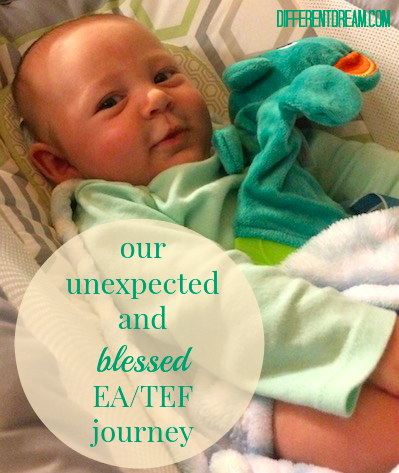
Our Unexpected but Blessed EA/TEF Journey

Our Unexpected but Blessed EA/TEF Journey

Our Unexpected but Blessed EA/TEF Journey

A blessed EA/TEF journey? Who could possibly say such a thing? Guest blogger and new EA/TEF mom, Kristen Horton, that’s who.  She’s participating in EA/TEF Awareness Month by sharing her story with Different Dream readers today. Enjoy! 

Our Unexpected but Blessed EA/TEF Journey

The Anticipation

In mid-February of 2017, I took a pregnancy test. It said “pregnant,” and our lives forever changed. Over the next 8 months, the prenatal appointments went perfectly: the harmony test revealed no chromosomal abnormalities and the sex (a boy), no hypertension, or gestational diabetes.

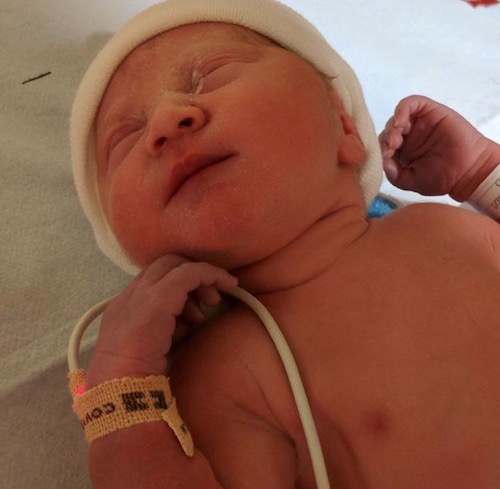
However all that changed when I was at 33 weeks, 6 days into our “babymoon.” We were vacationing in Florida, and all was fine when unexpectedly my water broke five hours from home. We decided to drive as far as possible to be home for a premature labor. Thankfully, God’s plan was to delay my labor just long enough for us to be admitted to our home labor/delivery ward prior to our son’s arrival. I spent 24 hours in labor. Our son came out perfect, weighing 5 pounds, 9 ounces. He was 19.25 inches long, and born at 34 weeks and 2 days gestational age.


The Shock of Diagnosis

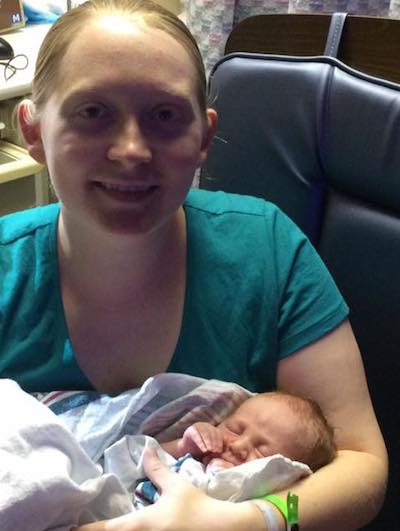
In the span of a day, I experienced the best and worst moments of my life. One minute my baby was in the nursery, and the next he was transported in an incubator to a Level IV NICU at a hospital 30 minutes away, while I remained where I was for 2 more days. The diagnosis was esophageal atresia with tracheoesophageal fistula (EA/TEF). My perfect baby boy’s esophagus had formed improperly, and he could not eat without surgery. At 3 days old, he had an EA surgical repair. Thank God he had Type C EA/TEF, the most common and simplest to repair. Prayers were answered on surgery day, as well as a week later during the swallow test. After 18 days in the NICU, we were home!


The Stricture

All appeared to be going well, until he turned 6 weeks old. He was fine on Friday, but by Tuesday he couldn’t eat anything without choking. Then I experienced the most terrifying day of my life; my newborn son stopped breathing. I started CPR in my living room, praying to God that he would breathe again.  Again, prayers were answered, and God brought my baby back to me! This convinced me that every parent must know how to do CPR on an infant.

Later in the emergency room, a severe stricture at the repair site was discovered. The surgeon performed a balloon dilation to widen the site. The surgeon said the first dilation was “gnarly,” but also successful in widening the site. Four additional dilations later, the surgical procedure only takes 10 minutes total. Our son will probably need to visit the hospital at least 3 or 4 more times. Therefore as his parent, I will do whatever it takes to give my son a mostly normal life so he can eat “real” food in the future.

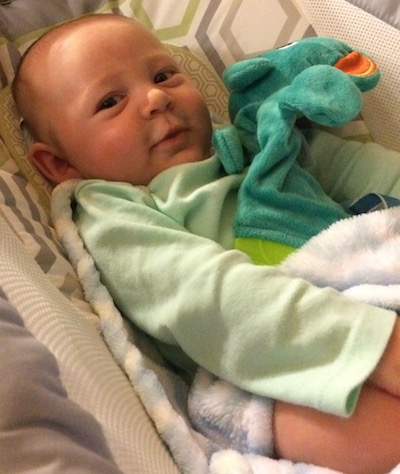
Even now, while I sit typing at the Children’s Hospital during our latest overnight stay, I am thankful that our baby has come this far. He’s now able to eat 4 ounces at a feeding, and we are blessed.


Do you like what you see at DifferentDream.com? You can receive more great content by subscribing to the quarterly Different Dream newsletter and signing up for the daily RSS feed delivered to your email inbox. You can sign up for the first in the pop up box and the second at the bottom of this page.

By

Kristen Horton lives in Georgia with her husband, Nathaniel, son, Christopher and dog, Winston. In 2010, she received her Bachelor of Science in Electrical Engineering from Clemson University in 2010 where she participated in the ROTC program and was commissioned as a Second Lieutenant. She holds a 2012 Master of Science in Electrical Engineering from the Air Force Institute of Technology. Since her son’s birth, she’s made it her mission to ensure that he receives the best care possible while she becomes as educated about EA/TEF as she can.

Author Jolene Philo

Archives

Categories

Subscribe for Updates from Jolene

Related Posts