From a Special Needs Grandpa

From a Special Needs Grandpa

From a Special Needs Grandpa

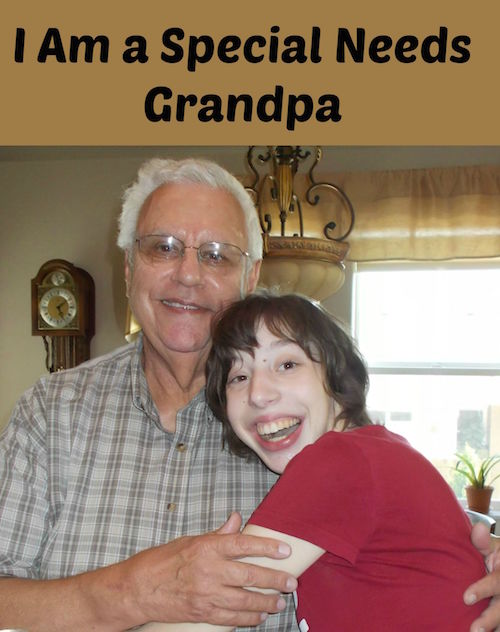
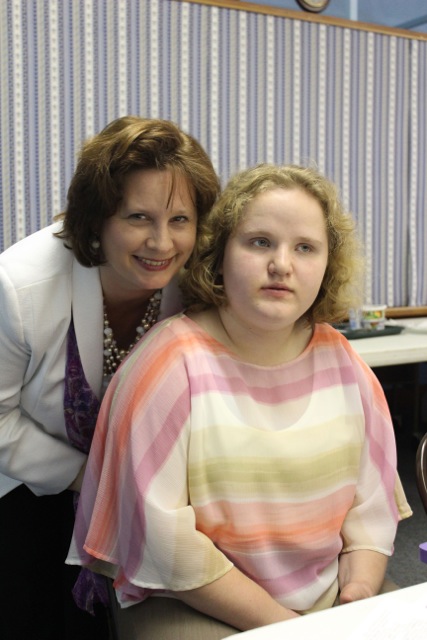
Welcome to Different Dream’s continuing series about grandparenting children with special needs. Last week, you heard from Brielle Stull’s grandmother. In this post, you’ll hear the perspective of a special needs grandpa who happens to be Brielle’s grandparent, too.

From a Special Needs Grandpa

The Special Needs Grandpa is There from the Start

I was there when my daughter was born, when she rode her first bike, when she finished college, when she walked down the aisle, and when she had her first baby.

I remember her calling me to announce she was pregnant again and that she also had chicken pox.

I told her she should have an abortion. Why would she risk her health and the baby not being healthy like their first daughter?

I was angry when she and her husband decided to continue the pregnancy. And I worried. A lot.

I celebrated with the other grandparents when Brielle was born healthy. We expected her to look different or act different. She looked perfect. I was so relieved.

I got angry when we found out months later that she really wasn’t healthy. Brielle had cerebral palsy.

And I became a special needs grandpa.

A Special Needs Grandpa Can’t Fix Things

My daughter didn’t listen to me when she was pregnant. But, I learned to listen to her after Brielle was born.

I watched and asked questions. I watched at therapy when we went along. I listened as my daughter’s husband told us what the doctors told them.

I watched my daughter. I watched her struggle being a good mother to Brielle. This wasn’t the life I wanted for any of them. It was painful for a long time.

And I thought there was nothing I could do.

A Special Needs Grandpa Can Help

At first, I was afraid I would do something wrong. There were different ways to hold her, prop her up, play with her, bathe her, and put her to bed.

But, I learned what I could do.

I fed Brielle and sang to her. I could always make her laugh.

I set the table, cut the roast, and washed the dishes.

Mostly, I was just there to listen to my daughter. I was her sounding board.

A Special Needs Grandpa Can Celebrate

Having a special needs grandchild is a sad thing. I am sad for my daughter, her husband, their oldest daughter, and for Brielle. Their lives could have been so different.

I worry about all of them.

But I love watching how Brielle has made such great strides. Even more so, I love her joy.

She has amazing joy. That is when I learn something from Brielle. Have more joy.

Advice from a Special Needs Grandpa

Everyone’s situation is different. So, my only advice is this:

  • Figure out what you can do and do it.
  • Make sure you have a relationship with your special needs grandchild, whatever that means to them.

Here’s what worked for me:

  • I went to therapy sessions so I could understand about my granddaughter as well as what my daughter went through.
  • I went to activities like Special Olympics and Miracle League baseball to be my granddaughter’s biggest cheerleader even though I hate sports and going was inconvenient.
  • I figured out what I could do to help my granddaughter.
  • I did what I can to ease my daughter’s burdens.
  • I built a relationship with my granddaughter on her terms.
  • I will continue to be a positive influence on my granddaughter’s life in whatever way I can.

Give a Shout Out to the Special Needs Grandpa in Your Child’s Life

Thank you, Joe, for sharing your experience so honestly. Now’s your chance to give the special need grandpa (or grandma) in your life a shout out in the comment box.

Part 1: Different Dream’s Special Needs Grandparenting Series Begins
Part 2: Special Needs Grandparenting 101
Part 3: Special Needs Grandparenting–The First Word Is Never the Last Word
Part 4: The Special Needs Grandparenting Tug of War
Part 5: Special Needs Grandparents Are Part of the Village
Part 6: What’s It Like to Be a Special Needs Grandparent?
Part 7: From a Special Needs Grandpa

Do you like what you see at DifferentDream.com? You can receive more great content by subscribing to the quarterly Different Dream newsletter and signing up for the daily RSS feed delivered to your email inbox. You can sign up for the first in the pop up box and the second at the bottom of this page.
By

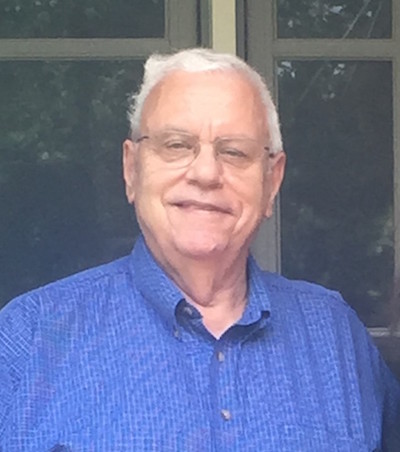
Joe Zaccaria has a PhD from Columbia University and taught Educational Psychology at the University of Illinois until he retired in 1992. He was also a consultant and published eight books. He currently lives with his wife in the Atlanta area close to his daughter, Kerith Stull, and her family including his special needs granddaughter, Brielle.

Author Jolene Philo

Archives

Categories

Subscribe for Updates from Jolene

Related Posts

How I Became an Aspergers Advocate for Teens

How I Became an Aspergers Advocate for Teens

How I Became an Aspergers Advocate for Teens

 Photo Via Flickr – by Kentucky National Guard Public Affairs Office

Different Dream is pleased to welcome today’s guest blogger, Kathleen Carter. She’s here to explain how she became an Asperger’s advocate for teens around the country. Her story is fascinating, encouraging, and convicting as her perseverance and creativity on her road to advocacy puts many of us to shame. See what you think.

How I Became an Aspergers Advocate for Teens

I remember being in elementary school when I realized that I was different from my classmates. I was paired up with another student, and I just couldn’t figure out how to get him to understand me. Frustrated, I began wringing my hands—a motion I used to do often because it would calm me—which led him and his friend to make fun of me.

As I got older, I learned more about my Aspergers. And though it has taken me a while to reach this conclusion, today I don’t think having Asperger’s is a bad thing. Not at all. In fact, in recent years, I’ve developed a sense of pride when it comes to my AS. I know that it makes me different from some other kids, but it also gives me something in common with the other wonderful people on the autism spectrum.

I wanted to help other kids with Aspergers to feel the same pride that I did while also educating my peers about it, but I wasn’t sure how to get started. Through trial and error, I figured it out. If you’re a teen with Aspergers, I highly encourage you to follow in my footsteps. It’s important that everyone on the autism spectrum know what they can achieve. Here’s how I became an Aspergers advocate:

I became an Aspergers advocate by becoming more independent.

When I started high school, my mom thought it was time for me to learn skills that would make me more independent. In this article from Autism Aspergers Digest, the writer provides tips for teaching independence skills and touches on the positive results that come with those skills. For example, in addition to learning the skill, the child with Aspergers gets a confidence boost from being able to do the new task and also has a great sense of wellbeing because they’re learning to take care of themselves in all aspects of life.

My mom and I placed a big focus on cooking. We went through many of her best recipes and now I can make each one. As I conquered those challenges, it made me think about what else I could achieve, and that gave me the spark I needed to create a plan for becoming an Asperger’s advocate.

I started swimming to become an Aspergers advocate.

Building self-esteem has always been a problem for me. Bad experiences with bullies in elementary and middle school really took their toll. That is, until I started swimming. Swimming became a part of my life when I started high school. I started it as a way to become more physically healthy—it’s actually a great form of exercise, in general, for people on the autism spectrum. As this article shows, people with autism can see many benefits when they swim—improved health, better attention spans, improved social skills, and so on.

And while I did certainly get more fit, the real bonus was the boost in confidence it gave. It turned out to be something I was good at and enjoyed. It also gave me a chance to work on interacting with people my age. As I got more comfortable around them, I began to realize that if I worked hard I could get better at communicating with my peers and adults. Without swimming, I don’t think I would have had the confidence to move forward with my plan to become an advocate.

I became an Aspergers advocate by working with an occupational therapist.

As I mentioned above, I’ve always had difficulty communicating with my peers. Especially in elementary and middle school, I’d be so desperate for my classmates to like me that I would experience extreme anxiety whenever I was in social situations. To help me become a better communicator, I worked with an occupational therapist. The Asperger/Autism Network explains how occupational therapy (OT) benefits people on the autism spectrum. Essentially, OT helps develop every day skills—in work, leisure, school, etc. My therapist and I worked on developing my communication skills in different settings. It has helped me immensely as I’ve started to speak to people more and more about what it’s like to be a teen with Aspergers.

Of course, each of these steps points to one achievement—building my confidence. Without that boost, I don’t think I’d be doing what I’m doing today. And I’m incredibly grateful to my parents and everyone else who has helped me make this happen. I love telling people about what it’s like to have Aspergers, and I hope I can keep doing it for a long time to come.

Leave a Comment for Kathleen

Did Kathleen’s story impress you? Feel free to leave a comment to encourage her or a question generated by her story. And of course, your ideas about how to become a special needs advocate are always welcome. Thanks!

Do you like what you see at DifferentDream.com? You can receive more great content by subscribing to the quarterly Different Dream newsletter and signing up for the daily RSS feed delivered to your email inbox. You can sign up for the first in the pop up box and the second at the bottom of this page.


By

Kathleen Carter is a teen living with Asperger’s Syndrome. She enjoys educating her peers and others about AS. She does so by writing proudly about how her life differs from other people her age. She is so grateful to have the opportunity to write for EducatorLabs.

Author Jolene Philo

Archives

Categories

Subscribe for Updates from Jolene

Related Posts

What’s It Like to Be a Special Needs Grandparent?

What’s It Like to Be a Special Needs Grandparent?

What’s It Like to Be a Special Needs Grandparent?

DifferentDream.com’s series about grandparenting kids with special needs continues with a second guest post from Kerith Stull, who contributed last week’s installment also. The post below was written by Kerith and her mother,  Manthia Zaccaria, about being grandmother to Brielle, Kerith’s daughter with special needs.

What’s It Like to Be a Special Needs Grandparent?

What is it like to be a special needs grandparent?

It is an entire range of complicated emotions. Emotions felt not only for my grandchild, but also for my own child who bore my grandchild. It is…
…hard
…wonderful
…sad
…joyful
…emotional
…trying
…difficult
….rewarding
….so many things

I am a special needs grandparent because my granddaughter is special.

The term “special” really defines her because that is what she is to me….very, very special. Life would be so empty without her.

Would I wish my granddaughter hadn’t been born? Never. Would I wish she were different? Never. This is who she is. And who she is helped make me, her grandfather, her parents, and her sister who we all are.

Before I was a special needs grandparent,

I grew up in in the 1940’s, an era when disabled people were rarely seen. And if they were seen, they were ignored. Not due to something they did, but rather because we did not know how to react or interact with them.

I, too, was guilty of this, and for that, I am truly sorry.

We were ignorant and didn’t know any better. But, most importantly, we now should know how to interact and should do and be better.

I understand my special needs grandchild.

I have been a very fortunate special needs grandparent. Early on, my daughter was able to explain and show me in detail what my granddaughter’s condition was and what she could and could not do. Over the years, I went to many therapy sessions with many different therapists. I’ve attended an IEP meeting. I’ve been to a few doctor’s appointments.

Because of my daughter’s willingness to include me, I have a very good understanding of her condition and can interact with her appropriately. I also know what my daughter goes through, so I can support her in ways she needs me most.

Advice from a special needs grandparent.

I’ve learned through the years that there are a few important things a special needs grandparent (or any grandparent) can do:

  • Balance being a parent and a grandparent. We sometimes find ourselves torn between trying to do what is best for our grandchild and what is best for our children. Sometimes we just want to say “Move over and I will take over”. Wrong! Know when it’s time to be a parent, time to be a grandparent, and time to be a friend.
  • Ask permission to offer advice to your children and ask it gently. You might say, “I have a thought on this and, if you would like me to share it with you, I will.” If they say yes, tell them what you have on your mind and let that be the end of it. Always respect them and their decisions.

 What I need as a special needs grandparent.

Frankly, I don’t have a lot of unmet “needs” as a special needs grandparent. Maybe because I have always accepted and loved who my granddaughter is plus I have a really good relationship with my daughter. But here are two things I know most grandparents need:

  • It is so important to be included and feel I have a role to play. I like being included in my daughter’s life including everything about my grandchildren. When she includes me in family activities, including those for my special needs granddaughter, I feel connected. When she asks me my opinion, I don’t expect her to always take my advice, but it certainly makes me feel appreciated to be asked. I want to help and try to offer that, but I know sometimes I can’t be and do what they need and that’s OK, too.
  • I need others to understand and appreciate my granddaughter. When I meet someone new and tell them about myself and my family, I always tell them about my granddaughter the same way I tell them about my other grandchildren. If they have questions, I try to present myself as being open to their questions and answer them as accurately as I can.

This special needs grandparent has worries.

I don’t have any concerns for my granddaughter because she is so well taken care of by her parents that I don’t have to worry about her. She is happy, active, and loved. Perhaps I worry for her when we are all gone, but I can’t do much about that.

If I have any really true concern, it is always for my daughter. I know what effort she has put forth to accomplish everything for my granddaughter. I admire and respect her so much. But, I know it is constant and not easy. I worry for her and my son-in-law, for their happiness and peace in life.

I have always felt the hand of God on my shoulder, guiding and sustaining me at times when I really needed Him. He helps ease my worries.

How can a special needs grandparent help?

There is plenty a special needs grandparent can do. They can (and should)…
….examine your own unique situation
…analyze what is needed
…step up to the plate
…be accepting
…be respectful
…be supportive
and above all…
…be loving to both to your grandchild and your child. I’m never sure who needs our support more.

A few more things…

Be sensitive and on the alert at all times to situations and frustrations that can occur. We need to know when to back off and when to be there.

We need to be there not only emotionally, but physically. Maybe your child and his or her spouse need a night out. Maybe your grandchild needs a special treat or one-on-one time with you. Be there for them.

Ask your child to empower you. If your child has taught you well, you’ll know what to do for your grandchild and for your child. Just follow your heart.

Part 1: Different Dream’s Special Needs Grandparenting Series Begins
Part 2: Special Needs Grandparenting 101
Part 3: Special Needs Grandparenting–The First Word Is Never the Last Word
Part 4: The Special Needs Grandparenting Tug of War
Part 5: Special Needs Grandparents Are Part of the Village
Part 6: What’s It Like to Be a Special Needs Grandparent?
Part 7: From a Special Needs Grandpa

Do you like what you see at DifferentDream.com? You can receive more great content by subscribing to the quarterly Different Dream newsletter and signing up for the daily RSS feed delivered to your email inbox. You can sign up for the first in the pop up box and the second at the bottom of this page.

By

Thia Zaccaria graduated from Cazenovia College, was a homemaker, and worked for her husband’s consulting business until they retired in 1992. She currently lives with her husband in the Atlanta area close to her daughter, Kerith Stull, and her family including her 19-year-old special needs granddaughter, Brielle.

Author Jolene Philo

Archives

Categories

Subscribe for Updates from Jolene

Related Posts

Special Needs Grandparents Are Part of the Village

Special Needs Grandparents Are Part of the Village

Special Needs Grandparents Are Part of the Village

The special needs grandparenting series is back with installment number five. Today, Different Dream is happy to welcome guest blogger Kerith Stull. She previously blogged about 12 Things Special Needs Parents Need to Do. In this post she shares what she’s learned about how to involve special needs grandparents in the lives of their grandkids who have disabilities or other conditions.

Special Needs Grandparents Are Part of the Village

The saying “It takes a village to raise a child” is even more poignant when raising special needs children. The needs of our children as well as our needs can be so much greater. That’s certainly been our experience over the years as we’ve raised our two daughters, now ages 21 and 19.

Grandparents can add so much to your special needs child’s experience.

  • They understand you and your story.
  • They are fully invested in you and your child.
  • They can simply love on your child.
  • They can spoil your child.
  • They can give you some respite.

How to Help Special Needs Grandparents

  • Let them grieve, too. They need space to grieve for the loss of the “typical” grandparenting experience and for watching their own child (you) go through the pain of being a special needs parent. Don’t underestimate their pain.
  • Understand their perspective may be very different based on the decade and culture they grew up in. Simply put, times have changed, but maybe they haven’t had a chance to catch up. Give them a chance to learn and shift their thinking. Be patient and give them a little extra forgiveness.
  • Involve them in your family’s everyday life, not just the special need child’s life. Share the other details of your lives because there is more to life than your special needs child.
  • Make sure they understand your child’s diagnosis and needs. They may need to read about it, hear about, and talk about it many times. Give them plenty of time to digest that information.
  • Give them the tools they need to care for your child. This means the knowledge, skills, and equipment. Teach them and let them practice. Perhaps you should have some duplicate equipment at their house as well as toys and feeding items.
  • Accept their offers of help, even if it isn’t quite what you need. If you continually turn their offers away, they will probably stop offering. And ask for the specific help you need and want!
  • Let them do it their way. Assuming it doesn’t put your child at risk, differences in care giving and interacting with your child are ok and may even benefit your child.
  • Bring them to events (therapy, doctor appointments, activities, school events, IEP meetings, etc.). Experiencing all of what you experience will really provide them with insights into your lives.
  • Encourage them to spend individual time with your other children. Encourage them to talk to your other children about their sibling experiences. Your other children might need an understanding ear to share worries, frustrations, and questions.
  • Encourage the special needs grandparents to talk with their friends about their experiences with your children. They need support from their friends, too.

If the Special Needs Grandparents Live Far Away

We’ve never lived closer than over three hours away from our kids’ grandparents since the first years of our marriage (25 years ago). We’ve done the best we could over the years to keep them connected to our children, but it’s certainly been a challenge. My parents recently moved to our area and it has been the start of a whole new life for all of us. Connecting when special needs grandparents who live far away can be a challenge, but here are some ideas:

  • Exchange letters, drawings, or art by snail mail. My parents did this almost weekly when they lived far away.
  • Send photographs often (by email or mail). Doesn’t everyone love to see candid pictures?
  • Talk using the speaker phone. That way, you can help them connect in a way your child can understand.
  • Use video chatting. Don’t wait for a special event. Video chat just for the fun of it! Try doing it at activities so they can see your child in action.
  • Videotape the special needs grandparents telling stories or reading books and share them with your child often. My girls loved when my mother did this and it is now a precious heirloom they might be able to show their children.
  • Visit in person when possible. You might find that meeting somewhere halfway between where you live for vacation might make it more convenient and affordable.
  • Lean on them by sharing details of your life. They will always be your parents and would probably love to be there just to support you.
  • Ask them to point out developmental changes when they do see your child. It always surprised me when they pointed out big changes in our special needs daughter in between visits. It might just be the encouragement you need to hear.

If There Aren’t Any Special Needs Grandparents

Grandparents may be missing from your child’s life because of death or relationship strife. Here are some ideas to still include them and find a surrogate grandparent:

  • Share stories, photographs, and video of the special needs grandparents, even if they never met your child. We lost my husband’s mother in 2001 when our youngest was only five years old. We aren’t sure what she remembers about her grandmother. We often watch home videos and have many pictures of her in our digital picture frame.
  • We continue to talk about her and remind them of how much she loved them.
  • Find grandparent figures for your child at church, in the community, or through other connections. They don’t have to be old!
  • If the special needs grandparents don’t want to be involved, let it go. I realize this is easier said than done. However, there are some things you can change and this might not be one of them.

Final Thought: The Dollar and Cents of Special Needs Grandparents

Helping your family financially might be something your parents offer to do for you. They may offer regular financial help, one time gifts, or a special fund outlined in their wills.  Make sure you and the special needs grandparents understand the consequences of financial gifts to you and your special needs child. Be sure that “gift” doesn’t prevent your child from getting government funding. You may want to consult an accountant, lawyer, or financial planner.

How do YOU involve the special needs grandparents with your child? Leave a comment!

Part 1: Different Dream’s Special Needs Grandparenting Series Begins
Part 2: Special Needs Grandparenting 101
Part 3: Special Needs Grandparenting–The First Word Is Never the Last Word
Part 4: The Special Needs Grandparenting Tug of War
Part 5: Special Needs Grandparents Are Part of the Village
Part 6: What’s It Like to Be a Special Needs Grandparent?
Part 7: From a Special Needs Grandpa

Do you like what you see at DifferentDream.com? You can receive more great content by subscribing to the quarterly Different Dream newsletter and signing up for the daily RSS feed delivered to your email inbox. You can sign up for the first in the pop up box and the second at the bottom of this page.

By

Kerith Stull earned a Master’s Degree in communication and worked in marketing before becoming a stay-at-home mother when her children were little. She has been married to her high school sweetheart for the last 24 years and is a recent semi-empty-nester since her 20-year-old daughter moved out to go to college. Kerith blogs about special needs parenting issues at Brielle and Me with her uniquely positive perspective. You can also find her on Facebook, Twitter, and Pinterest. She recently published a book, Brielle and Me: Our Journey with Cytomegalovirus and Cerebral Palsy, about her experiences with their 18-year-old special needs daughter and their family’s journey of hope, determination, love, and faith.

Author Jolene Philo

Archives

Categories

Subscribe for Updates from Jolene

Related Posts

Why Pediatric X-Rays Aren’t Something to Laugh About

Why Pediatric X-Rays Aren’t Something to Laugh About

Why Pediatric X-Rays Aren’t Something to Laugh About

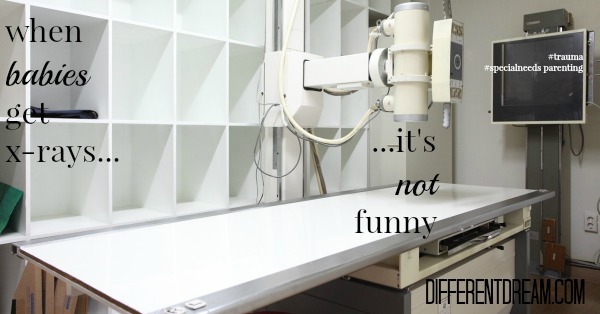
Like so many other parents of kids with special needs, I have a good sense of humor. Not because I’m innately funny but because, like as so many other parents in the special needs community have learned, humor is a powerful coping mechanism. Much as we like to laugh, not many of us found an IJReview website post about a contraption used for pediatric x-rays very funny. Even though the post was tagged in the categories of health, humor, and weird news.

Why Pediatric X-Ray Pictures Aren’t Funny to Me

The pictures on the site, all of them with tongue-in-cheek captions, brought back memories of one of my hardest nights ever as a mom. Our five-month-old’s feeding tube was looking funky, so we rushed him to the Rapid City hospital (120 miles from home). When we got there, the Rapid City Regional Hospital was in the middle of its move from an old, outdated building to a brand spanking new one. All but one of the rad techs was moving equipment to the new hospital. So the tech showed me how to strap my baby into the contraption featured in the IJReview pictures.

My son screamed hysterically throughout the procedure, which the tech said was good because his lungs would inflate and produce a better x-ray. My burning memory is of my son sobbing and looking accusingly at me, his mommy who was supposed to protect him, strapping him into a cold, hard contraption and walking away. Never mind that Mommy came back and calmed him down. That memory is trapped deep inside both mother and son forever.

With that in mind, here are 3 reasons pediatric x-rays shouldn’t be funny. To anyone. Ever.

3 Reasons Why Pediatric X-Rays Aren’t Funny

    1. Pediatric x-rays are only ordered if the doctor thinks something is very amiss for a child–serious injury or illness amiss. That’s not funny.
    2. Pediatric x-rays are traumatic for children. Contrary to popular belief, children do remember very early memories like pediatric x-rays. Those memories can contribute to mental health conditions like PTSD and anxiety later on in life.
    3. Pediatric x-rays and other pediatric medical procedures can be traumatic for parents as Different Dream’s recent series about PTSD in parents of kids with special needs shows.

What to Do Instead of Laughing at Pediatric X-Rays

Instead of laughing at pictures of pediatric x-rays and videos parents need to become educated about how to prepare children for pediatric x-rays and how to process and diffuse any resulting trauma for both child and parent. The last two chapters of Does My Child Have PTSD? (Familius, October 2015) address those issues in detail. The book also contains lists of resources so parents can find professional treatment for their children, if need be.

What’s Your Experience with Pediatric X-Rays?

What pediatric x-ray experiences have you and your child had? You are welcome to share them in the comment box, along with ideas about how to make the experience less scary for kids. Thanks!

Do you like what you see at DifferentDream.com? You can receive more great content by subscribing to the quarterly Different Dream newsletter and signing up for the daily RSS feed delivered to your email inbox. You can sign up for the first in the pop up box and the second at the bottom of this page.

By

Jolene Philo is the author of the Different Dream series for parents of kids with special needs. She speaks at parenting and special needs conferences around the country. She’s also the creator and host of the Different Dream website. Sharing Love Abundantly With Special Needs Families: The 5 Love Languages® for Parents Raising Children with Disabilities, which she co-authored with Dr. Gary Chapman, was released in August of 2019 and is available at local bookstores, their bookstore website, and at Amazon.

Author Jolene Philo

Archives

Categories

Subscribe for Updates from Jolene

Related Posts

3 Lessons for Special Needs Parent Advocates

3 Lessons for Special Needs Parent Advocates

3 Lessons for Special Needs Parent Advocates

Karen Jackson is the mother of 3 children, one of whom has special needs. She’s also the director of Norfolk, Virginia’s Faith Inclusion Network (FIN). She has lots of special needs experience and was surprised recently to learn these 3 lessons for special needs parent advocates.

3 Lessons for Special Needs Parent Advocates

As mom to a 17-year-old who has severe autism, I consider myself a seasoned advocate, in charge of IEP meetings, managing home care and medical care for my daughter. It isn’t often that I need to step up to advocate for my other two children, both intelligently gifted boys who are confident and successful at school and extracurricular activities.

But yesterday, I had to speak with my younger son’s teacher about some issues at school, trying to strike a balance between acceptable behavior in the classroom and the teacher’s understanding of his unique giftedness.

What my son’s teacher did not factor in, I am fairly sure, is that I am an experienced advocate. I walked into that meeting with research, notes and copies of emails. I was ready to protect my son from unfairness in the classroom and knew how to be prepared.

What did I learn? Well, mainly I learned that there is not much difference between advocating for my child with special needs and for my child who is exceptionally gifted. But here are 3 lessons for special needs parent advocates I learned in the process:

  1. Some teachers just do not see things the way we parents do, especially if they do not share our parenting experience.
    My mama bear instincts are just as developed for my children who are gifted as with my child with a disability, maybe more so. During the whole meeting I wanted to scream: My son is amazing-he is thriving at home and school and also has the responsibility of being the sibling of a person with severe autism. His mom is usually very busy taking care of his sister, but even at 12 years old, he understands. He loves his sister unconditionally and deals with a lot of craziness at home.
  2. Being different can take on many forms. We all need to be understanding, tolerant, and search out the best for our children. Educating those we feel do not understand our children is important and will pave the way for mutual respect. Once this mutual respect is established, critical and instructive comments will be more effective in any situation.
  3. As a parent and caregiver of a child with a disability, I often think that special needs parents like us are different. But maybe not so much. And perhaps we should take more opportunities to invite into our circle parents who have more typical parenting experiences. Because really, all parents need to advocate for their children at some point. We who parent children with disabilities may have a lot more experience and opportunities to advocate, but most parents love their kids and want to protect them at all costs.

As for our situation, all is well. I believe the classroom environment will be fine and hopefully the school year will end on a good note. I actually appreciated the chance to support my youngest son in this way, even though the meeting was slightly stressful. And I am thankful, upon reflection, for the opportunity to remember that we parents, regardless of our child’s strengths, challenges or differences are all just parents.

I am blessed with three wonderful, very different children whom I love very much. I know hundreds of other parents, some who have children with disabilities and some who do not. They would do just about anything for their children, just like me. I God’s blessing on all of us as we continue our parenting journeys.

All parents are advocates at some point, some of us just have more experience than others.

What Advocacy Lessons Have You Learned?

What do you think of Karen’s 3 lessons for special needs parent advocates? Have you learned other lessons about advocacy from both your typical and special needs children? Share them in the comment box.

Do you like what you see at DifferentDream.com? You can receive more great content by subscribing to the quarterly Different Dream newsletter and signing up for the daily RSS feed delivered to your email inbox. You can sign up for the first in the pop up box and the second at the bottom of this page.

By

Karen Jackson is the Executive Director of Faith Inclusion Network (FIN) of Hampton Roads where she lives with her husband and three children in Norfolk, VA. She is also the author of Loving Samantha. You can connect with Karen at the Faith Inclusion Network page.

Author Jolene Philo

Archives

Categories

Subscribe for Updates from Jolene

Related Posts