When Parenting a Child with Special Needs Stinks

When Parenting a Child with Special Needs Stinks

When Parenting a Child with Special Needs Stinks

Long time guest blogger Scott Newport joins us today with straight talk about what he learned to do when parenting a child with special needs stinks. Here’s the tale of his latest stinky adventure at C. S. Mott’s Children Hospital at the University of Michigan.

When Parenting a Child with Special Needs Stinks

“Scott and Penni, I know this is hard. It stinks even having to say this, but Evan may not make it to his first birthday. You guys may want to think about getting a burial site for him.”

The doctor who told us that many years ago was in his second year as a fellow, training to be a children’s hospital intensivist. He was partially correct. We did eventually bury Evan, but it wasn’t till he had lived seven pretty happy years.

Even though Evan is gone he left me a gift, sort of a legacy. I now help mentor new parents of terminally ill children. I also engage staff and faculty on strategies in working with these families. Last week I was reminded of the doctor’s comment and when parenting a child with special needs stinks.

One afternoon I was given a referral to a family about to leave the hospital when I heard someone say, “Scott, I just finished a twenty four-hour shift. I really smell!”

“That’s okay,” I said coaxing the voice closer. “I still want a hug.”

“Okay then,” she shrugged. “It’ll have to be a proper one.”

Carolyn wove around other staff members filling the sterile hallway. As placed her charts on the Formica counter, my eyes took in the “Wall of Courage” displaying the glowing faces of children from days past. Evan’s photo is right in the middle.

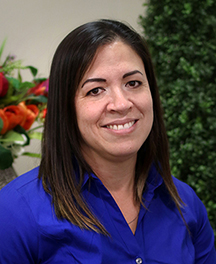
Carolyn is a spunky, young doctor at C. S. Mott Children’s Hospital at the University of Michigan. She is starting her second year of a fellowship in the Intensive Care Unit. The fellowship is for the best of the best doctors in the country, physicians who have already completed pediatric residency training and are pursuing a sub-specialty in critical care. We met for the first time last year in July at a boot camp for new hires facilitated by Dr. Tim Cornell. I represented the patient and family side of medicine in a high stress, pediatric intensive care environment at the boot camp.

After our embrace we stood there for a moment and smiled at each other.

“Was there one thing from last year’s boot camp training you put into practice that impacted the way you do medicine?” I asked her.

Carolyn didn’t hesitate. “Yes there is. When you talked to the doctors, it gave me a sense that I may not have to be afraid to talk to parents with critically ill kids.”

Before she could say another word a nurse, who had obviously been listening to our conversation at the check-in desk, came closer and leaned in to hear the latest gossip on the floor.

Carolyn continued, “When I go into talk to parents about bad news now, I’m more confident. I’m also aware that many of the families already know what I am going to say.”

After saying good-bye I walked passed the same conference room where the boot camp was held a year ago. I couldn’t help but remember her face at the table that day.

I know from experience many of the new doctors have two fears. One is how to give bad news and the other is to find a way to offer hope in dire situations. After talking to Carolyn, I know she’s got the first one down. I bet if I ask her the next time we meet, she’ll have an encouraging answer about the hope part, too.

That evening I thought about the trainings I do with nurses, medical students, and first years fellows like Carolyn. You see, I’m just a carpenter and never had a higher education. My hands are callused. I have irremovable stains under my finger nails. I often wonder if the work I’m doing with these highly intelligent folks stinks to them.

If I did stink last year, Carolyn never noticed. When she gave me that proper hug, I never noticed her smell either. And maybe just maybe that nurse who listened in got a bit of inspiration and training from two stinky people. I’m okay with that, too.

Reminiscing about the second-year fellow from fourteen years ago, I wondered if the way he said our son was going to die was the best approach. It did stink, but it was a special moment in our journey because he really cared. Second year fellow Dr. Carolyn Vitale cares too. She has a hope that will last a lifetime. It will surely be a sweet aroma passed down to those who will one day train under her and inherit her passion—all the sick kids and families at C.S. Mott Children’s Hospital, families just like mine, who know that sometimes parenting a child with special needs stinks.

Do you like what you see at jolenephilo.com/? You can receive more great content by subscribing to the quarterly Different Dream newsletter and signing up for the daily RSS feed delivered to your email inbox. You can sign up for the first in the pop up box and the second at the bottom of this page.

By

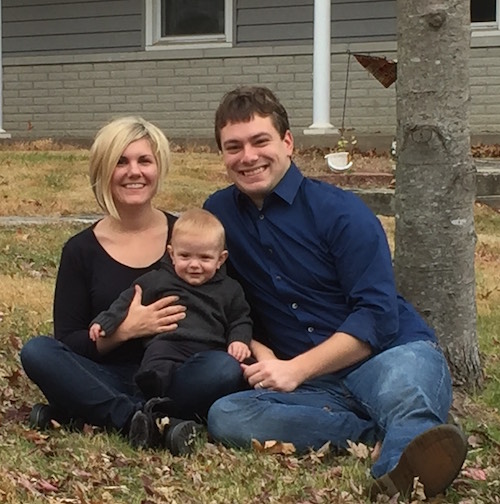
Scott Newport is a carpenter who has a vision for unwanted, damaged wood. His finds are treasures to his soul. Each discovery he makes unfolds into a beautiful piece of furniture for which he finds a home, usually with a child or caregiver of a child with special needs. He writes about the life lessons he learns from his 3 children, especially from Evan who died in November of 2009 after 7 years of joyful life. To access all of Scott’s guest posts, click on the magnifying glass at the top of the page and type “Scott Newport” in the search box.

Author Jolene Philo

Archives

Categories

Subscribe for Updates from Jolene

Related Posts

Lost in Translation

Lost in Translation

Lost in Translation

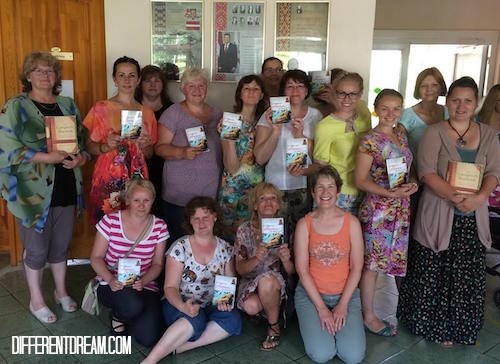
A little more than a year ago, a friend took a few of my books to a special needs family camp in Pelchi, Latvia. Partway through the week, she sent a text. “They love what you write about. Can you come next year to work with the moms?”

“YES!” I immediately texted back. “Count me in.”

From that moment on, my resolve to attend remained firm. It was bolstered when the fundraiser organized by dear friends in my church Connection Group raised the exact amount needed to cover expenses. It grew stronger when someone donated money to purchase copies of A Different Dream for My Child for all the moms attending camp. The only time my resolve wavered was when the little naysayer voice in my head whispered, “How are you going to communicate? They speak Latvian. You speak English.” But my friend, who was attending the camp again, said a translator would be assigned to us for the entire camp.

So I shushed my personal naysayer and packed my bags.

We made it to camp without a hitch. Our personal 24/7 translator, on the other hand, did not. Many people pitched in to fill the gap. A young woman with spina bifida who has attended the camp for several years and just graduated from the university in Riga with a degree in media communication. The pastor who has helped plan and grow the camp for several years. His wife and two teen-aged daughters.

Still, the language barrier made our morning support group slightly awkward.

Some things were lost in translation. Maybe because the moms’ support group translator wasn’t a mom, but a man. Maybe because I overcompensated by talking louder, smiling too much, and gesturing frantically. Maybe because my ability to put faces to names and to pronounce names correctly was an epic failure. Maybe because these Latvian moms had been twice burned by a culture that holds women in low regard and mothers who give birth to children with special needs even lower.

To read the rest of this post, visit Key Ministry’s blog for parents of kids with special needs.

Do you like what you see at jolenephilo.com/? You can receive more great content by subscribing to the quarterly Different Dream newsletter and signing up for the daily RSS feed delivered to your email inbox. You can sign up for the first in the pop up box and the second at the bottom of this page.

By

Jolene Philo is the author of the Different Dream series for parents of kids with special needs. She speaks at parenting and special needs conferences around the country. She’s also the creator and host of the Different Dream website. Sharing Love Abundantly With Special Needs Families: The 5 Love Languages® for Parents Raising Children with Disabilities, which she co-authored with Dr. Gary Chapman, was released in August of 2019 and is available at local bookstores, their bookstore website, and at Amazon.

Author Jolene Philo

Archives

Categories

Subscribe for Updates from Jolene

Related Posts

Adopting a Child with Special Needs

Adopting a Child with Special Needs

Adopting a Child with Special Needs

Guest blogger Kimberly Drew and her husband are adopting a child with special needs. This baby girl will be their second child who lives with disabilities. Today Kimberly shares what she’s learned about what kids with special needs truly need.

Adopting a Child with Special Needs

My husband and I are in the middle of the process of adopting a child with special needs, baby girl, from an extended family member. Because our daughter, Abbey, is thirteen and has multiple disabilities we are aware that to some people this pretty much sounds insane. We’ve even had close friends question our decision.

The truth is, we’ve been talking about adoption for years. We’ve prayed about it many times. When this need came up, we just knew God was asking us to step out in faith. I blog and write all the time about how much raising Abbey has changed my life for the better. It is by far the most difficult, and occasionally painful, journey I have ever been on. At the same time, it’s a beautiful and rewarding one too.

I started thinking about what it really means to have a child with special needs. I often define that by Abbey’s limitations and what we have to do in order to care for her. But as I was lying in bed and thinking about how to respond to those people how aren’t on the “I support you, I believe in you” bandwagon it occurred to me.

Yes. I am going to have two daughters with special needs. While I don’t know exactly what that’s going to look like, I know what I have learned so far about having a daughter with special needs.

My daughter has a SPECIAL NEED to be loved.

She requires extra hugs, kisses, and post-appointment cuddles. She can’t leave for school or home without hugging and signing, “I love you” multiple times to every person.

My daughter has a SPECIAL NEED to try new things.

We vacation differently and seek out new spots and activities that are friendly to her physical needs. We join different sports groups like therapeutic riding and have been wanting to try a local dance classes for the disabled. We even try new foods for her when we are ordering at a restaurant based on their consistency!

My daughter has a SPECIAL NEED to have amazing people in her life.

She attracts compassion and kindness. We have made some amazing relationships because it takes a special kind of person to befriend our family…people who “get it” and love us through the variables and chaos. They even tell us they are the ones who are blessed…

My daughter has a SPECIAL NEED to be a child.

She is not your typical teen. She still loves baby dolls and coloring. She laughs at silly things, and still pretends. You can keep your teen daughter’s iphone and sass…I will take a Bitty Baby and pack of crayons over those every time! I can’t wait to take her to Disney World for the first time…we will probably get to cut every line. Ha ha!

My daughter has a SPECIAL NEED to live life in light of eternity.

Every day is a gift. Every day is a reminder that this world is not our home, and the brokenness of this life is redeemed through the cross. We live with a truer hope, peace, and joy because what she has taught us about the love of God.

Yes, I’m going to have two daughters with special needs. Lucky me.

Any Advice for Kimberly about Adopting a Child with Special Needs?

Have you adopted a child with special needs or do you know someone who has? Share your advice with Kimberly if you like.

Do you like what you see at DifferentDream.com? You can receive more great content by subscribing to the quarterly Different Dream newsletter and signing up for the daily RSS feed delivered to your email inbox. You can sign up for the first in the pop up box and the second at the bottom of this page.

By

Kimberly grew up and went to college in the small town of Upland, IN. She graduated from Taylor University with a degree in Elementary Education in 2002. While at TU, she married her college sweetheart and so began their adventure! Ryan and Kimberly have four amazing kids on earth (Abigail, Jayden, Ellie, and Cooper), and a baby boy waiting for them in heaven. Their daughter Abigail (Abbey) has multiple disabilities including cerebral palsy, a seizure disorder, hearing loss, microcephaly, and oral dysphagia. She is the inspiration behind Kimberly’s  desire to write. In addition to being a stay at home mom, Kimberly has been serving alongside her husband in full time youth ministry for almost fourteen years. She enjoys working with the senior high girls, scrapbooking, reading, and music. You can visit Kimberly at her website, Promises and Perspective.

Author Jolene Philo

Archives

Categories

Subscribe for Updates from Jolene

Related Posts

An EA TEF Parent Is Born

An EA TEF Parent Is Born

An EA TEF Parent Is Born

When an EA TEF baby is born, so is an EA TEF parent. Different Dream is ending EA TEF Awareness Month with a post from Kamaile Hiatt. She’s the mother of Kanani, born in 2001. Kanani’s EA TEF was diagnosed and repaired on the day of her birth. Today Kamaile tells about her rebirth as an EA TEF parent and what’s she’s learned in this new role and new life.

An EA TEF Parent Is Born

I’ve had a recurring thought that we typically congratulate families, focusing the attention one the new babe, when in reality, with each new child born, so is a new mother and a new father.

An EA TEF Parent in the Early Years

With Kanani’s early arrival, our lives were completely up-ended. Not only were we first time parents, we learned within hours that we were brand-new-first-time-parents-of-an-infant-with-immediate-medical-needs. What a scary prospect that was.
Within hours of delivery, our new infant daughter was transferred to the neonatal intensive care (NICU) because her oxygen levels kept dipping. Her EA TEF was discovered when they tried to suction her and the suction tube would not go down as far as normal.

Not knowing any better, we assumed that the surgical correction when she was one day old would be a minor speed bump. Business, our lives, and our family would proceed as usual. We would carry on without a care in the world. Looking back, recovery from the corrective procedure seemed straightforward. But Kanani’s feeding and growth was problematic from the start and proved to be chronic. We sought the advice of a feeding clinic and they recommended g-tube placement. After carefully looking at our options and long term goals, we decided to follow that recommendation in hopes of eventually establishing good oral eating habits.

When Kanani was four months old, we learned her esophageal tissue was not as robust as is seen in healthy children. She suffered an injury during surgery when her paper-thin esophagus tore. The second repair to her esophagus took considerably more time to heal and additional stitching due to a pinhole leak that would not close.

An EA TEF Parent in the Toddler and Early School Years

One day, I watched Kanani let spit pour out of her mouth, not something she typically did. I gave her a drink from a water bottle and after a few swallows, the water came right back up. I waited a little while and offered her more water. When the same thing happened again, I took her in to the hospital. This was the first time we had something lodged in her esophagus above her repair stricture that required removal along with a dilation, or stretching of the stricture. From then on, she needed weekly dilations from October through December until food and liquid could pass without pooling and funneling through her narrowed scar tissue.

An EA TEF Parent in the School Years

Eventually the frequency of Kanani’s dilations slowed to once every six months, and then to once a year until she was eight. She had one foreign body removal at age 11, but the surgeon opted not to do a dilation due to the poor integrity of her esophagus. She will be 15 years old this year.

Future Expectations of an EA TEF Parent

We have learned the complications of repeated injury and chronic reflux early on means that Kanani has poor esophageal motility with flaccid and over-stretched tissue in the top half of her esophagus. In the lower portion, spasms that occur during peristalsis which can sometimes stop the movement of food down her esophagus.

We’re teaching her to take good care of her esophagus by sitting straight up when she eats and by chewing her food well so that she can reach adulthood with the her esophagus intact. There are not many options available if her esophagus continues to be injured.

On paper, this may sound tragic and scary and more. But, as a mother of a child with EA TEF, I have learned, and am continuing to learn how to be a good parent. I have learned that esophagoscopy and dilations are minor procedures. I’ve learned how to encourage good meal time behavior. My hope is to see her happy, eating a broad range of foods, intuitively and proactively using strategies to help food move through her esophagus so she is comfortable and healthy.

Your Response?

Depending on whether you are or aren’t an EA TEF parent, your response to Kamaile’s story is either one of instant familiarity or amazed bewilderment. Either way, your comments are most welcome in the comment box.

Do you like what you see at DifferentDream.com? You can receive more great content by subscribing to the quarterly Different Dream newsletter and signing up for the daily RSS feed delivered to your email inbox. You can sign up for the first in the pop up box and the second at the bottom of this page.

By

Kamaile is a speech and language pathologist and mother of a daughter with EA-TEF.

Author Jolene Philo

Archives

Categories

Subscribe for Updates from Jolene

Related Posts

So You’re a NICU Parent

So You’re a NICU Parent

So You’re a NICU Parent

EA/TEF Awareness Month is moving full steam ahead at Different Dream throughout January. This week’s post comes from guest blogger and EA/TEF and NICU parent Brianna Lennon. Ryan, her baby boy, turned 1 in December of 2015, so her observations about how to advocate for your NICU baby are fresh and field tested. Here’s what she learned during her little boy’s hospital stay.

So You’re a NICU Parent

When you first saw those two little lines on the pregnancy test, you probably didn’t imagine a premature and heavily medicated birth coupled with a long hospital stay and several surgeries. For new parents-to-be, the Neonatal Intensive Care Unit is never in the birth plan.

Our story began at the 20-week ultrasound when our regular obstetrician was unable to see our baby boy’s stomach. For the next two months, we had follow-up scans with an MFM that finally broached the potential of esophageal atresia. We delved into research–on hospitals, surgeons, EA, insurance–came up with plans for each  scenario we might face since we couldn’t diagnose the severity of his EA.

We hoped and prayed that I’d make it to 34 weeks. At 34 weeks and 1 day, Christmas Day, we welcomed our 4 pound, 5 ounce baby boy into the world. Our research paid off in terms of understanding Ryan’s EA, but we were still totally unprepared for the NICU stay. Throughout the five months we spent at two different hospitals, I reflected on what we wished we’d known and what we could tell other parents. As a first-time parent who’s way too familiar with the NICU, I hope these tips provide some guidance to the uninitiated.

First, NICU Parent, Be a Big, Brave Dog

I remember encountering the Very Confident Doctors and Very Confident Surgeons in NICU. I had no self-confidence at all and passively accepted what was happening. A few days in, I realized that all the research I’d done and all the knowledge I’d gained wasn’t doing my son any good if I didn’t show my confidence. We started questioning more, engaging more, and asserting our decisions. We learned that sometimes the doctors don’t mention when they’ve changed your child’s plan and that you should definitely call them on that. We had to be extra-confident when our surgeon removed Ryan’s replogle tube without asking when we wanted it replaced. Finally, we learned that we had to have confidence that we knew our son the best and were ultimately responsible for his care. It’s very easy in a NICU environment to feel helpless, confused, and lost. The good news is that once you assert yourself the first time, the second, third, and tenth times get that much easier.

Second, a NICU Parent Must Become an Encyclopedia

A lot of medical jargon and surgical decisions arise in the course of treatment of an EA baby. Only four basic ways exist to fix an esophageal gap, but there are countless complications, variations, and related defects to consider. Familiarize yourself with them. Find medical journals, blog posts, support groups, and Facebook pages to solicit as much information at possible. Ask questions of your doctors. I prepared lists of questions to ask the surgeons before and after Ryan’s birth. Feel free to email me if you want them. The more information you have, the better. But be prepared to find some gaps in it.

One caveat, though. There were times during pregnancy when I became obsessed with research and suffered from  information overload. That’s when you need a sounding board–another parent, a spouse, a sibling–to bring you back from the edge.

Third, a NICU Parent Must Find the Helpers

Fred Rogers used to say that when he saw disasters on the news as a child, his mother told him to “look for the helpers. You will always find people who are helping.” In my hospital experience, the helpers were the nurses, the chaplains, and the lactation consultants. We had our core group of nurses that we counted on everyday for support, extraordinary care for our son, and levity. I found that the physical and emotional capability of NICU nurses was virtually endless. Find the ones who can get you through the day and get them on your child’s rotation as much as possible. We had a crazy-good tag team of nurses that figured out a novel way of g-tube feeding Ryan when he wasn’t gaining weight. One nurse could be trusted to keep the tape on Ryan’s replogle every night. Seek out the on-staff social worker or chaplain when you’re experiencing overwhelming stress. These are the helpers.

Finally, NICU Parent, It’s All about Perspective

I count my husband and myself lucky. Sure, we cried hours a day every day for the first few months. Sometimes it still seems like only yesterday we ended a 100-plus-day stint in two different NICUs across 4 holidays 1,000 miles from home. But, as Cormac McCarthy so eloquently penned, “you never know what worse luck your bad luck has saved you from.”

With that mindset I knew we were lucky every day we walked into the NICU and continued our ritual of learning to be parents while navigating the emotional landmines of the NICU. Lucky because we had each other to lean on, lucky because we truly believed our son would come through with flying colors, and lucky because he was diagnosed with only one out of hundreds of possible birth defects.

For the uninitiated, lucky is probably the last word that comes to mind, but I think it’s important that people recognize it can play a part in a long hospital stay. NICU parents come in all shapes and sizes. They’re there for different reasons, they’re facing different struggles, and their children’s outcomes may be different. It’s an overwhelming, all-consuming and emotionally raw time. Thoughts and prayers go a long way in grappling with stress, but it’s equally important for parents to find those little lucky parts of the day, if only to hang onto their sanity. Sure, my son was septic after a central line infection. I knew what that meant and I knew it wasn’t good, but how lucky that it was a treatable infection. How lucky that after two weeks of IV drugs, he was no worse for wear. And how lucky that the need to treat that infection sped up the timeline for the swallow study and his first bottle.

Perspective is everything in the NICU. You don’t need to feel lucky or blessed or thankful every day, but seek out the times when you do. Cling to those moments and remember that you don’t know what you were spared. No parent chooses to raise a child in the NICU. It’s a crap deal and there’s no getting around it. But it’s also a time of growth and of amazing resilience. NICU parents and their babies wear badges of strength and humility. It’s an experience I wouldn’t trade for anything.

Are You a NICU Parent? What Do You Have to Say?

Are you the parent of a child who spent time in NICU as a newborn? What advice do you have to add to Brianna’s? Leave a comment.

Do you like what you see at DifferentDream.com? You can receive more great content by subscribing to the quarterly Different Dream newsletter and signing up for the daily RSS feed delivered to your email inbox. You can sign up for the first in the pop up box and the second at the bottom of this pa

By

Brianna Lennon is an attorney, political junkie, wife, and Ryan’s mom. She spends her time working in public service and trying to survive life with a toddler that was born with esophageal atresisa. Brianna lives in Missouri with her husband, son, and two dogs.

Author Jolene Philo

Archives

Categories

Subscribe for Updates from Jolene

Related Posts

10 Positive Ways to Advocate at School

10 Positive Ways to Advocate at School

10 Positive Ways to Advocate at School

Advocacy at school.

For many in the special needs community, that phrase conjures images of parents breathing fire while toting armloads of files and folders into an IEP meeting or annual review.

Not a pretty picture.

And, if the truth be told from my vantage point as a former teacher, it’s not the most effective way to advocate at school either. During my 25 years in public education, the parents who did the most good for their children were those who took President Theodore Roosevelt’s advice to heart.

They spoke softly and carried a big stick.

For special education parent advocates who are Christians, the big stick part involves research and understanding of special education law. (Wrights Law is a great place to begin that research.) For those same believing advocates, the speaking softly component involves cultivating fruitful relationships with school personnel. Here are ten ways I saw parents advocate at school positively and fruitfully on behalf of their kids.

  1. Pray for those involved in your child’s life at school. Your prayers make a huge difference in the lives if educators. For ideas about how and why to pray, check out the post Mid-September Is a Good Time to Pray.
  2. Volunteer. Sign up to be a room parent or to supervise class parties for younger kids or as a chaperone for older ones. Or volunteer to use a special skill to make life easier for your child’s teachers. The best volunteer I ever had was a mom who was a court reporter. She came once a week to type and format my students’ stories into the computer. The kids were thrilled to have professional looking writing samples, and I was thrilled to have time to devote to other teaching tasks.

To read the rest of this post visit the Not Alone website at specialneedsparenting.net.

Do you like what you see at DifferentDream.com? You can receive more great content by subscribing to the quarterly Different Dream newsletter and signing up for the daily RSS feed delivered to your email inbox. You can sign up for the first in the pop up box and the second at the bottom of this page.


By

Jolene Philo is the author of the Different Dream series for parents of kids with special needs. She speaks at parenting and special needs conferences around the country. She’s also the creator and host of the Different Dream website. Sharing Love Abundantly With Special Needs Families: The 5 Love Languages® for Parents Raising Children with Disabilities, which she co-authored with Dr. Gary Chapman, was released in August of 2019 and is available at local bookstores, their bookstore website, and at Amazon.

Author Jolene Philo

Archives

Categories

Subscribe for Updates from Jolene

Related Posts