When Forgiving a Child with Special Needs Is Difficult

When Forgiving a Child with Special Needs Is Difficult

When Forgiving a Child with Special Needs Is Difficult

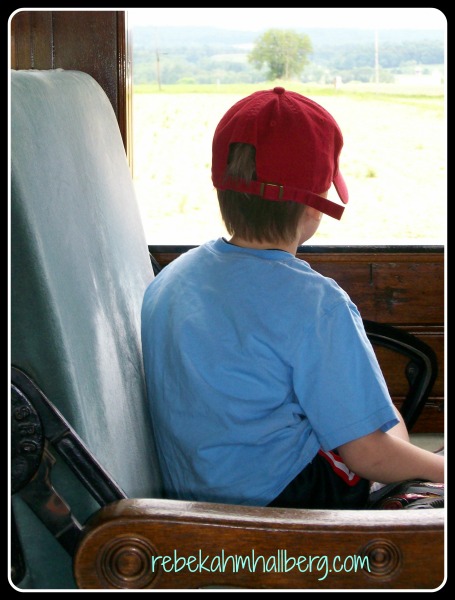
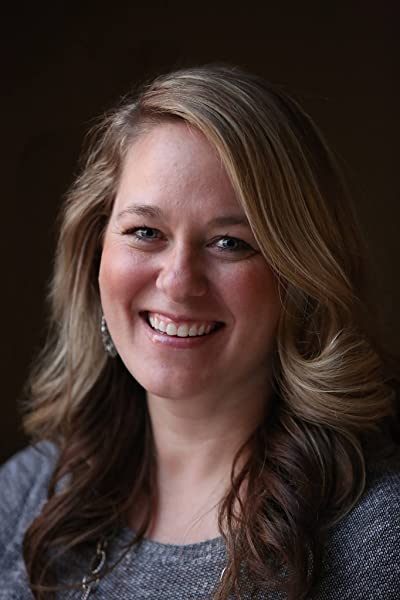
Forgiveness is a required skill for parents raising kids with special needs. Today, guest blogger Becky Hallberg talks about her struggle to forgive her son who’s been going through a hard patch lately.

When Forgiving a Child Is Difficult

There have been many opportunities for forgiving a child in our home this week, which means so many things going wrong. Our son has been struggling again, and it all came to a head this week. He recently finished another intensive—10 days of occupational therapy in a row. Along with the turmoil that can cause, there is evidence of spring everywhere, and that may be causing his allergies to bother him. There are many possible reasons for his tough week—and I would take away every single one of them, if I could.

But I can’t.  And that’s where life gets messy for all of us.

I wouldn’t trade anything about who my son is, but sometimes, I wish things were easier for him. I know that if his struggles are maddening to me, they must be so difficult for him.  He’s not able to verbalize just what the problem is in the middle of a meltdown.

I Wish It Was Easier for Him to Forgive

This week was worse than most, though. His actions were far over the top. His emotions were in full swing, and I was back to just making sure he was safe. While his emotions and meltdowns are difficult, and often leave me feeling at a loss, the inability to help him in times like this is frustrating. As a parent, you want to help your child, and when you cannot, it’s awful.  And when things get difficult like they have been, it’s hard to forgive. I’m sure it’s hard for him to ask for forgiveness—humility doesn’t come easily to many people.

But there was more. This week he spoke some of the most harsh and unkind words he’s ever uttered to me. Insult to injury. And in those moments, I’m convinced he had no idea what he was saying, yet it caused me so much pain.

And so I watched and I waited. I protected him from himself. I tried to remain emotionless through it all so as not to feed his frenzy. For almost an hour, the noise, the shouting, the meltdown continued. The words hurt, the attitude and actions hurt, and by the end of it all, my frustration was building.

He calmed down for a class he had to attend, and later we went back to those words. When I told him that his words hurt me so badly, he had a look that seemed to indicate that he had no idea what he had said. He immediately said, “I’m sorry. I didn’t mean to hurt you. You’re such a good mommy.”

I Wish It Was Easier for Me to Forgive

That made me mad—but not mad at him. I was so thankful that his immediate response was to apologize.

It made me mad at my unforgiving spirit. I wanted to be mad at that child. No one would have blamed me.

But as I gave him a hug and kiss and offered my forgiveness (begrudgingly!), I was immediately convicted.  When I go to God with my sin or disobedience and ask His forgiveness, does He offer it begrudgingly to me, His child?  No, not at all.  Instead, His forgiveness is immediately granted and freely given.  That is my benefit as God’s child. That is the benefit for any of us who ask God’s forgiveness.

Yet here I was, unable to pass along the same gift to my own child.  My attitude changed. It had to. That’s the thing about conviction—you can feel the conviction and do nothing, or you can let it help change you to who you need to be.

When Is Forgiving a Child Hard for You?

Is it ever hard for you to forgive your child? If you like, leave a comment about what happens to change your attitude.

Do you like what you see at DifferentDream.com? You can receive more great content by subscribing to the quarterly Different Dream newsletter and signing up for the daily RSS feed delivered to your email inbox. You can sign up for the first in the pop-up box and the second at the bottom of this page.

By

Author Jolene Philo
Archives

Categories

Subscribe for Updates from Jolene

Related Posts

How To Respond to a Special Needs Calling

How To Respond to a Special Needs Calling

How To Respond to a Special Needs Calling

Do you think of parenting your child with special needs a calling from God? Do you ever struggle about how to respond to his call? It’s sometimes a struggle for guest blogger Rebekah Benimoff as this post shows.

How to Respond to a Special Needs Calling

Today I read a word from God via the heart of a mother: “Life is not an emergency. Life is brief and it is fleeting, but is not an emergency… Emergencies are sudden unexpected events—but is anything under the sun unexpected to God?”

Sigh.

My heart resonates with desire to live every moment fully, to ferret out paths of gratitude which buoy up the soul and sustain, even when life is chaotic and unclear.

What if My Life is Speckled with Emergencies?

The question: But what if life—my life—is speckled with emergencies?

The words on the page answer back, “…life is so urgent it necessitates living slow.”

I nod. There is much in my life that I would call urgent. “In Christ, urgent means slow. In Christ the most urgent necessitates a slow and steady reverence.”

I think back across weeks and months, even years, and understanding lights. The paradox in our many emergencies is this: these sudden unexpected events require me to slow down. To watch carefully. To live fully in the moment. Yes, there is the flurry and the fear and the lightning trip to the hospital, the ER, the children’s medical center. But what follows is always time to wait.

Is it my Calling to Keep My Baby Alive?

When I am so still, anxiety billows up, and I have to pray away fear. I take seriously this caregiving, this challenge to do my part in seeking after ways to help a not-big-enough boy to grow. I watch carefully the peaks and valleys of managing blood sugars and digestive issues and aiming towards balance. But sometimes I grasp more responsibility than is mine to shoulder. I think it is my job to keep my son alive. Oh, Father God! How does a mother’s heart become utterly spent? When this mother tries to claim that which is for the hands of God alone.

It is mine to love and soothe and serve and offer care in the ways that my son’s uniquely designed body and soul need. But it is not my job to keep my baby alive.

I weep with the truth of it. Mothering a child with medical needs is hard and helpless all at once. I’ve spoken the strain and struggle. “I spend my life just trying to keep him alive.” I am consumed, depleted. I pour out all I am and still it is not enough. It has been my pursuit but it is not my calling. As if I could breathe life and breath and wholeness into his body with all my striving. But there is a breath that comes only and always from heaven.

My Calling Is to Let Go

My calling is to let go. When devastating unknowns compel me to run into my prayer closet and cry out to God, his sweet whisper urges, let go. Not of the tenderness in a mother’s heart, not of prayer—for it is a most powerful weapon against the enemy. Not even of the natural desire to protect and to resolve medical struggles. Let go—but not of the desire that a precious little one JUST FEEL BETTER and GROW. The Voice seeking to calm and sustain invites, 

 “Let go of your expectations of yourself.
And I breathe hard and grasp truth, and pour out words onto a page. But can I live this way? There is risk in release. Yet I know that too often I labor under a load I was never called to carry. The true calling when faced with a season of urgent waiting is this: release the urge to control and linger in the arms of love. He is the gift within the suffering.
 

My Calling Is to Let God Equip Me

Now is the moment to walk free—to throw off fear and expectation and allow God to equip me for what He’s called me to and let go of the rest. I am certain this will be a process, a journey with many needed reminders. But I am also sure that abundant living is not possible without this letting go. So I seek the altar, the place of release. And the Voice resounds with love I need like breath: God does not expect me to be perfect, He simply asks me to be real and allow the blanket of grace to cover that which I cannot… and was never meant to. We tarry here, in this holy place, and I find rest for my soul.

What Has God Called You to Do?

Do you sense God calling you through Rebekah’s words? What is he calling you to do?

Do you like what you see at DifferentDream.com? You can receive more great content by subscribing to the quarterly Different Dream newsletter and signing up for the daily RSS feed delivered to your email inbox. You can sign up for the first in the pop-up box and the second at the bottom of this page.

photo credit: www.freedigitalphotos.net

By

Rebekah Benimoff is the wife of a husband with PTSD and the mother of two young men, both of whom grew up with medical and special needs. She blogs at In the Chaos…. and In the Calm (justmemama.blogspot.com).

Author Jolene Philo

Archives

Categories

Subscribe for Updates from Jolene

Related Posts

Special Needs Advocacy, Grief, and Faith

Special Needs Advocacy, Grief, and Faith

Special Needs Advocacy, Grief, and Faith

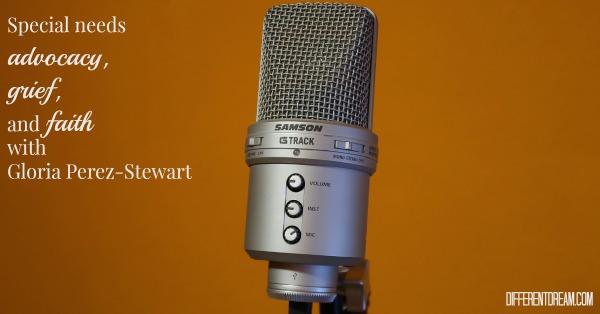
Advocacy, grief, and faith are topics parents of kids with special needs grapple with every day. Recently, Gloria Perez-Stewart of GPS Advocacy (now GPS Law) and I talked about those topics, and more, for her BlogTalk Radio series. (Other legal topics relating to special needs are discussed on the GPS Law Blog.)

Meet Gloria Perez-Stewart

Gloria is the mother of a child with special needs and a special education advocate. Gloria Perez-Stewart works with attorneys in several states on special ed and disability cases and has presented at many conferences on disability and community organizing. She hosted a weekly radio show in Austin, Texas for a decade before moving to web and podcasts to be available for audiences nationwide.

Advocacy, Grief, Faith and Special Needs

Our conversation was wide-ranging, based on topics dealt with in depth in A Different Dream for My Child and Different Dream Parenting. We planned to discuss advocacy and grief, but Gloria was very curious about the spiritual aspects of both books. Though her agency is not faith-based, she said many of the parents she works with have spiritual questions, and she has a hard time finding resources that address those issues. She was also curious about the special needs ministry movement, as she’s had personal experience with churches that didn’t welcome her son because they didn’t know how to meet his needs.

GPS Advocacy Podcast

The half-hour interview is available at this GPS Advocacy BlogTalk Radio link. At the same page, you’ll find a link to download the podcast. So have a listen if you like. 

Do you like what you see at DifferentDream.com? You can receive more great content by subscribing to the quarterly Different Dream newsletter and signing up for the daily RSS feed delivered to your email inbox. You can sign up for the first in the pop-up box and the second at the bottom of this page.

By

Jolene Philo is the author of several books for the caregiving community. She speaks at parenting and special needs conferences around the country. Sharing Love Abundantly With Special Needs Families: The 5 Love Languages® for Parents Raising Children with Disabilities, which she co-authored with Dr. Gary Chapman, was released in August of 2019 and is available at local bookstores, their bookstore website, and Amazon. See Jane Sing!, the second book in the West River cozy mystery series, which features characters affected by disability, was released in November of 2022.

Author Jolene Philo

Archives

Categories

Subscribe for Updates from Jolene

Related Posts

The Small Things

The Small Things

The Small Things

Parenting a child with special needs is a big thing—sometimes, an overwhelming thing. Those big things can keep us from seeing and appreciating the small things God uses to draw us close to him. With Easter fast approaching, may God use this devotion and your life as the parent of a child with special needs to fix your eyes upon the glory of the cross.

For who has despised the day of small things?
Zechariah 4:10a

As a young child, I daydreamed about becoming big-things kind of girl. I had big plans for a career as either a television star or a princess. Therefore, I focused on the big things like dramatic poses and tiaras rather than little things like learning to tie my shoes. Or telling time. Or making letters like b and d point the right way. Or memorizing math facts. Eventually, my parents and teachers made life miserable until I learned to pay attention to little things.

But I remained a big-things kind of girl at heart for many years—even after I became a Christian and started reading the Bible. I preferred the big, showy stories—Moses parting the Red Sea, Daniel in the lions’ den, and Jesus feeding the five thousand—to hidden, quiet events like Moses in the bulrushes, Ruth gleaning grain, or the long drudgery of rebuilding the temple in Zechariah’s day.

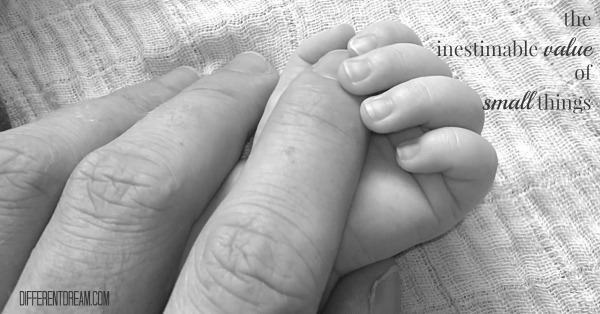
I remained a sucker for bright lights and big things until two babies entered our home six years apart. When they arrived, life became a river of small things. Tiny fingernails to clip. Itty-bitty diapers. Minuscule onesies. Little bodies asleep in my arms. The first tiny hints of toothless smiles.

The rest of this post can be read at the Not Alone website.

Do you like what you see at DifferentDream.com? You can receive more great content by subscribing to the quarterly Different Dream newsletter and signing up for the daily RSS feed delivered to your email inbox. You can sign up for the first in the pop-up box and the second at the bottom of this page.

By

Jolene Philo is the author of several books for the caregiving community. She speaks at parenting and special needs conferences around the country. Sharing Love Abundantly With Special Needs Families: The 5 Love Languages® for Parents Raising Children with Disabilities, which she co-authored with Dr. Gary Chapman, was released in August of 2019 and is available at local bookstores, their bookstore website, and Amazon. See Jane Sing!, the second book in the West River cozy mystery series, which features characters affected by disability, was released in November of 2022.

Author Jolene Philo

Archives

Categories

Subscribe for Updates from Jolene

Related Posts

When “I Love You” Is Hard to Hear…Literally

When “I Love You” Is Hard to Hear…Literally

When “I Love You” Is Hard to Hear…Literally

“I love you” is an expression parents long to hear their children say. But the wait to hear those words is often long and sometimes without end for parents of kids with special needs that include communication delays. Today, guest blogger Kimberly Drew tells when her daughter Abbey—who lives with cerebral palsy, a seizure disorder, hearing loss, microcephaly, and oral dysphagia—told her mom, “I love you.”

When “I Love You” Is Hard to Hear…Literally

Abbey was about four years old before I finally realized that she probably wasn’t going to gain a functional vocabulary. She has some vocal approximations, but overall, she is considered a non-verbal child.  At first, I was just disappointed that we wouldn’t be singing together. I grew up in a house full of music with a family that sang anytime, anywhere. I still can’t watch a children’s choir without crying. But there are some things that a parent just really, really needs to hear their child say.

When “I Love You” Seems Selfish

I can’t think of anything more moving than “I love you.” I remember praying at night, that if she couldn’t say anything else, I just wanted to hear those three words. In the early years, they didn’t come. I know it seems selfish, but when you are loving your child so desperately, and caring for their needs so meticulously, you want to know that your child feels something for you. You want to know that what you’re doing for them is getting past the physical and deep into their spirit.

When “I Love You” Is Silent

I have to say, I believe with all my heart that it does. Every time your child feels safe in your arms, every time they turn to you for comfort at a doctor’s appointment, when they stare into your eyes a few seconds longer than normal, just tell your heart that it’s “I love you.”  A smile, a laugh, a roll of the head in your direction…it comes from a place locked inside that wants to say the words but can’t.

When “I Love You” Is Necessary

My father-in-law started something with his two sons when they were younger. He never leaves them or gets off the phone without saying, “I love you.” Even now as adults with our own families, he won’t say goodbye until you’ve said, “I love you too.” It’s such a sweet thing to do, and so important for him to hear those words back. When you notice those little things, don’t forget to tell your child that you love them too. They need to know, that you know, that they love you!

When “I Love You” Finally Comes

I have to say, that after seeing us use sign language to say, “I love you” over and over, Abbey finally picked it up. At first, she would just copy-cat us doing it to her…but one night after tucking her into bed, she pulled my head down to hers. Her cerebral palsy gives her quite a grip! So after our forceful clash of foreheads, she let me go and signed “I love you.”  Of course I said, “I love you, too,” and then slipped out of the room to go cry my eyes out. At ten, she now occasionally tries to say it too.  I know how much effort she has to go through to get those words out, and they mean that much more.

If you find yourself caring for a child who has difficulty speaking, I want to encourage you. Your child knows you love them. Period. And they love you, too.

When Did Your Child Say “I Love You?”

Did you wait a long time to hear your child say “I love you?” Are you still waiting? Whatever your case may be, we’d love to hear your child’s “I love you” story if you’d like to share it in the comment box. Thanks!

photo credit: www.freedigitalphotos.net

Do you like what you see at DifferentDream.com? You can receive more great content by subscribing to the quarterly Different Dream newsletter and signing up for the daily RSS feed delivered to your email inbox. You can sign up for the first in the pop-up box and the second at the bottom of this page.

By

Kimberly grew up and went to college in the small town of Upland, IN. She graduated from Taylor University with a degree in Elementary Education in 2002. While at TU, she married her college sweetheart and so began their adventure! Ryan and Kimberly have four amazing kids on earth (Abigail, Jayden, Ellie, and Cooper), and a baby boy waiting for them in heaven. Their daughter Abigail (Abbey) has multiple disabilities including cerebral palsy, a seizure disorder, hearing loss, microcephaly, and oral dysphagia. She is the inspiration behind Kimberly’s desire to write. In addition to being a stay-at-home mom, Kimberly has been serving alongside her husband in full time youth ministry for almost fourteen years. She enjoys working with the senior high girls, scrapbooking, reading, and music. You can visit Kimberly at her website, Promises and Perspective.

Author Jolene Philo

Archives

Categories

Subscribe for Updates from Jolene

Related Posts

The Kindness of a Little Girl

The Kindness of a Little Girl

The Kindness of a Little Girl

Kindness is a gift to our children with special needs. In today’s guest post, Rachel Cordeiro describes how her mother’s heart was touched by a little girl’s act of kindness toward Cami, Rachel’s visually impaired daughter.

The Kindness of a Little Girl

After taking my seat near the front, a commotion captured my attention. Panic gripped my heart as the line of children filed quickly into the auditorium. “The children’s choir must be singing tonight,” I thought.

Nervously, I scanned the line of boys and girls, searching for Cami. I eyed the first staircase she would have to walk down, then the platform steps she would have to walk up, worrying over how she would manage to safely navigate both. I spotted her at the top of the staircase and held my breath as I watched her descend slowly down the stairs, her small hand gliding gently down the banister. That’s when I first noticed the girl walking beside her. She was holding Cami’s free hand, guiding her down the steps.

I should jump in and help, I thought. I was worried that the little girl might move too quickly for Cami, causing her to fall. A struggle waged internally as every muscle in my body ached to help, but I fought the urge to race to her side.

I stayed put.

Will she even stand still on that step? I thought as the children began to form into lines on each of the three platform steps. What if she falls? I worried.

Still, I waited.

As the children began to sing, their sound filled the auditorium, but I was too preoccupied with Cami, paying close attention to how she was handling this new environment. As I looked on at the little girl now standing confidently by Cami’s side, I noticed something else.

She was still holding Cami’s hand.

In that moment the kindness of her simple gesture was the only music I heard. Its clear melody echoed deeply into my heart, drowning out the voices of the singing children. I was touched by her thoughtfulness and thankful for her willingness to assist my daughter.

As I observed the situation that night, I had felt helpless. I was certain something would go wrong, choosing only to remember every time that it had.

By allowing myself to remember the worst, I had forgotten to hope for the best.

In parenting a child with special needs, fears often creep in whispering the what ifs of possible scenarios. Doubts cloud your focus, speaking lies that no one cares enough to help.

There are days when it’s hard to sit back and watch. But part of growing is learning, and the learning sometimes involves letting go. That night it was difficult for me to sit back and watch, but I’m so glad that I did. For if I hadn’t, I would have missed out on hearing the most beautiful song of that night, its rich melody still ringing out its unforgettable music—

the kindness of a little girl.

What Kindness Have You Observed?

Thanks, Rachel, for your sweet post. Sorry, everybody, for not issuing a tissue warning beforehand. Once you’ve dried your eyes, feel free to leave a comment about kindnesses your child with special needs has experienced.

Do you like what you see at DifferentDream.com? You can receive more great content by subscribing to the quarterly Different Dream newsletter and signing up for the daily RSS feed delivered to your email inbox. You can sign up for the first in the pop-up box and the second at the bottom of this page.

By

Author Jolene Philo

Archives

Categories

Subscribe for Updates from Jolene

Related Posts