by jphilo | May 23, 2012 | Different Dream, Self-Care and Stress, Special Needs Parenting
Many parents of kids with special needs don’t like to discuss milestones, because their children’s progress is slow and small. So they celebrate inchstones instead. Sometimes, when their kids do achieve a milestone, the parents aren’t quite sure how to react. That’s how guest blogger April Brownlee felt when her daughter’s doctor announced Catie had reached a major milestone.
The Divorce
“I think you’re done with me,” he said, as I fidgeted nervously and practically sobbed at the revelation. And just like that, our beloved doctor divorced me and graduated my 5-year-old daughter, Catie, from his care. “Graduated,” you know, usually means a child no longer has the medical need to see a particular doctor. It’s a victory, for sure, in the special needs community. However, as we sat there in that office, while he smiled kindly and remarked on how far Catie has come, it felt a lot more like a divorce.
Looking Back
I thought back to the time, 4-and-a-half years ago, when this man, this hero, agreed to see us. He’s a pediatric intensivist—a doctor who specializes in helping children with chronic medical conditions or who are medically fragile. I worked hard to get an appointment. Catie was, at that time, undiagnosed so we had little ground to go on in the often black and white medical world. Fortunately, a well-connected friend pulled some strings. When Catie was 9-months-old, it happened. From the moment he walked in, I knew he’d make things better. He just has this air about him that must bring the same sense of peace and comfort to the mother’s of all the children in his care. I struggled to absorb every word he spoke through his thick German accent. “This child has far too many doctors for someone so young.”
Too Many Doctors
I’ll never forget those words because they were so startling and true. I’d never considered she might have too many doctors. In my naiveté of having a yet-to-be diagnosed child with a multitude of quirky and complicated medical issues I thought the more doctors, the better. My heart wanted a diagnosis and my brain told me that surely, if she saw enough doctors, one of them would figure it out. But this doctor saw it differently. I learned that sometimes a flock of doctors results in the patient being treated in segments… each doctor dealing with and focusing on his own speciality. I would come to see that this doctor would treat Catie as a whole person. It may be the most profound and important lesson I’ve learned through this journey about advocating for someone.
He Is a Healer
Immediately that day he made changes in Catie’s care. And since that day, I’ve looked forward to each and every appointment with him. Within a few months Catie was a little better. In a year, she was markedly better. After two years, she was remarkably better. Today, she’s a completely different child—healed in so many ways. Many symptoms of the Noonan Syndrome that made our lives hell throughout Catie’s early years have practically disappeared… though I know the syndrome will always be there.
I also came to appreciate and marvel at his omniscient approach… he is a healer. Time and time again I would suggest something that I thought might help manage a symptom and he would explain that it would only be a Band-aid. He isn’t interested in treating patients. He wants to heal them. And, once again, I find myself knowing I’ll forever carry that knowledge with me and use it to make all future decisions regarding medical treatment for Catie, my other kids, even myself.
Only a Phone Call Away
As we sat there in his office, hearing the words I had feared for some time, I knew he was right about Catie. She has come so far. The things he was treating her for are, for the most part, resolved. Continuing under his care would only make me feel better. And yet, that’s just what he agreed to do, offering to see us one last time—a year from the day he attempted to divorce me graduate us. I know he’s only humoring me. Surely, I’m not the only mother who practically had a stroke when he released her child from his care. I’m sure when our last and final appointment rolls around, I’ll have accepted the reality and maybe even embraced having one less appointment to go to…. Or maybe not. I have 11 whole months to let it sink in. And if not, as the good doctor kindly reminded me, he’s only a phone call away.
When Did You Feel Like April?
Have you ever been thrown off-balance when your child with special needs reached an unexpected inchstone or milestone? How did you feel? How did you process it? Leave a comment about your experience.
Do you like what you see at DifferentDream.com? You can receive more great content by subscribing to the quarterly Different Dream newsletter and signing up for the daily RSS feed delivered to your email inbox. You can sign up for the first in the pop up box and the second at the bottom of this page.

by jphilo | Feb 7, 2012 | Different Dream, Self-Care and Stress, Special Needs Parenting
Guest blogger Nancy Flanders is here today to talk about how valuable special needs community involvement can be for parents of kids with special needs. Keep reading to learn more about one kind of special need community and how it helps the Flanders family. Maybe it will motivate you to become more community focused, too.
The Importance of a Special Needs Community for Parents
My daughter has cystic fibrosis (CF) and the CF special needs community is tight. I’m hoping it’s like that for other chronic health conditions too, because having that community support is life- changing. The unique factor about the CF community is that our relationships are mostly online. People with CF can’t be around each other and if they are, they should remain at least three feet apart. This is because they can spread harmful bacteria and germs to each other that can leave them sick; while you or I would never even know we encountered these germs. So every day, through blogs, Twitter and Facebook, I connect with other CF parents and adults with CF. I hear the good. I hear the bad. There are a few people in my life that think being exposed to this much information about others with CF is detrimental to my sanity. And I get that. But the good definitely outweighs the bad when it comes to immersing myself in the worldwide CF community.
Understanding
There’s nothing like being able to say or type acronyms like CFRD, and PI or words like “the vest” or “enzymes” and not have to explain what I’m talking about. I can say that it’s a bad poop day in my house and everyone gets it instantly and none of them is even the slightest bit grossed out. I can celebrate how much fat I got my kid to eat today and instead of looks of confusion and disgust, I hear “yay” and “awesome”. Quite simply, we are accepted and understood within moments of meeting a new CF friend.
Empathy
Sympathy sucks. I can’t stand when someone feels sorry for me or my daughter. Yes, CF sucks. But don’t tell me how sad it is. I’ve cried my eyes out and I will cry them out again and again. But I love my kid and I wouldn’t trade her for anything. Instead, I will work hard to keep her healthy, so be proud of us instead. Empathy, on the other hand, is good. When bad CF stuff happens, there’s an army of people who have been in the exact spot and can tell you it will be okay and actually know it. They offer hope and advice, not just an awkward silent sympathy.
Knowledge
Our CF doctors, nurses, respiratory therapists, and nutritionists are all great. But it’s the CF patients and the CF parents who tell it like it is and who have provided me with so much knowledge about this condition. Any question I ask can be answered almost instantly by someone who has experienced the same difficulties or symptoms. They’ve taught me about insurance, medications, how to handle it when your kid won’t take her medications, and about what to look for in terms of signs of complications that can arise. They are a living, breathing, CF textbook.
Hope
When you have an emotional breakdown over CF, you often lose all sight of hope. All you can feel is fear. But the CF community can lift those spirits with reminders of what we have going for us: the latest and greatest treatments, the best foundation in the world, and new drugs that may work to fix the underlying cause of CF.
Reality
When things are going great and your kid hasn’t been sick in a while, you can sometimes wonder if your child really needs all of these treatments and if maybe CF isn’t so scary. (In the beginning stages of diagnosis, this can happen a lot). But hearing about other people’s battles reminds you that it can happen to you. It’s a constant reminder to cherish life. It keeps us on our toes, battling CF with all we’ve got.
Support
News spreads fast through the CF community and when things are bad, throngs of people you have never even met will offer their prayers, love and support. Nothing beats that.
Fun
We get to work together towards a common goal. We get to throw fundraisers and parties and laugh about having to be on constant poop patrol. We attend CF conferences together. No matter who we are or where we come from, we are in it together to defeat CF. We donate to each other’s fundraisers because helping one of us reach our goal helps all of us reach our goal, which is saving CF lives.
How About You?
Are you part of a special needs community, either online or in person? What value have you found in being part of such a community? Leave a comment to second one of the perks Nancy listed or add your own. Nancy and I would love to hear from you.
Nancy Flanders is a wife and mother of two girls, one with cystic fibrosis. After her daughter’s diagnosis at just 6 days old, she altered her career path to focus on writing about raising a child with a special health need. She spends any free moment she can find fundraising for a cure for her daughter and volunteering for her hospital’s cystic fibrosis advisory group. Visit Nancy at www.chronicadmissions.blogspot.com and www.parentingsquad.com.
Do you like what you see at DifferentDream.com? You can receive more great content by subscribing to the quarterly Different Dream newsletter and signing up for the daily RSS feed delivered to your email inbox. You can sign up for the first in the pop up box and the second at the bottom of this page.

by jphilo | Dec 28, 2011 | Different Dream, Self-Care and Stress, Special Needs Parenting
Yesterday, guest blogger Nancy Flanders talked about two issues parents of kids with special needs should consider when thinking about expanding their families – level of support and finances. Today, she shares four more issues to help parents wondering about having more children gain clarity about their family’s future.
On Having More Children, Part 2
#3 – How’s Your Faith?
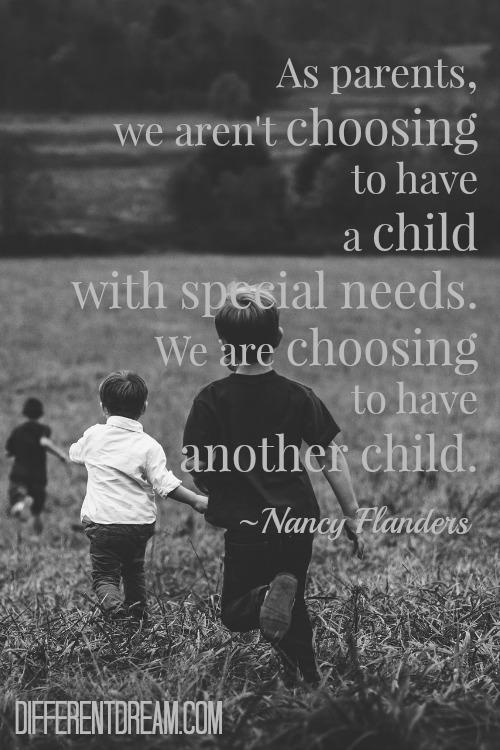
How is your faith? Seriously, faith matters. For those with faith, special needs aren’t a curse, but part of a plan. God doesn’t wish for us, especially children, to suffer. It breaks His heart too. But He finds use for our suffering, as in John 9 when the disciples ask Jesus why the man was born blind. Jesus answers, “this happened so that the works of God might be displayed in him.” We know that we as parents aren’t choosing to have a child with a special need. We are choosing to have a child. This is a gift, no matter what the future holds. We must have faith in order to survive. And your level of faith will make a difference in whether or not you could handle having another child with a special need.
#4 – How Does Your Spouse Feel?
How does your spouse feel? This is obviously important and should not be overlooked. Planning another baby on purpose when your spouse isn’t ready or is uncertain is a bad idea. You should talk to each other and listen to each other openly and honestly before making the decision.
#5 – Are You Afraid?
Are you afraid? We are all anxious at times when wondering how our decisions will affect the rest of our lives and the lives of others. But you shouldn’t let fear be the reason you make a decision. Logic and reason, trust and love should play a part. Fear should never win.
#6 – What About Adoption?
What about adoption? You don’t just have to add to your family biologically. There are thousands of children waiting for a home, and more are born every day. But this is just as big a step as having a baby and all of the above considerations must be taken into account.
Only Time Will Tell
There are plenty of other considerations when deciding if you should have another child who might have a special health need including your living arrangements and your ability to give attention to each child. But for each setback, there is a solution. You just need to be willing to find it. It all comes down to what is best for you and your family. As for mine, only time will tell.
What Would You Add to the List?
What do you think of Nancy’s list of things to consider about having more children? Does one of the items speak to you? Do you have more considerations to add to the list? Leave a comment to share your wisdom. Nancy and I would love to hear from you.
Nancy Flanders is a wife and mother of two girls, one with cystic fibrosis. After her daughter’s diagnosis at just 6 days old, she altered her career path to focus on writing about raising a child with a special health need. She spends any free moment she can find fundraising for a cure for her daughter and volunteering for her hospital’s cystic fibrosis advisory group. Visit Nancy at www.chronicadmissions.blogspot.com and www.parentingsquad.com.
Part One
Do you like what you see at DifferentDream.com? You can receive more great content by subscribing to the quarterly Different Dream newsletter and signing up for the daily RSS feed delivered to your email inbox. You can sign up for the first in the pop up box and the second at the bottom of this page.
Save

by jphilo | Dec 27, 2011 | Different Dream, Self-Care and Stress, Special Needs Parenting
Trust Nancy Flanders to face tough special needs parenting issues without flinching. Today, she begins a two part series near and dear to parents of kids whose special needs have a genetic component. Nancy tackles the issue with a list of six item that give her (and hopefully you) more clarity. In Part 1, you’ll read #1 and #2 on the list.
On Having More Children, Part 1
I always wanted a big family. And by big, I don’t mean “Duggar big”. I figured 5 kids would be good because (A) I come from a family of 4 kids and (B) I like odd numbers. But by the time I got married (at age 28) and waited for my husband to be ready (age 30), I felt like 3 would be a good number. But then our first child was born with cystic fibrosis. And when you have a child born with an incurable, life-threatening, horrible genetic condition like CF, there is an immediate sense that having more children would be wrong.
Surprise, Surprise!
Fast forward one year and three months and I was pregnant with baby #2. I still was unsure if we should have more children, but God answered back with this great surprise. And now we have two little girls, one with CF and one who is a carrier of CF like me and my husband. I should be thankful for what I have, and I am. But I still want that one more. I still feel like there is one more person that is suppose to join the family. I can’t shake it. I’ve heard plenty from the peanut gallery. The most common is, “What if that baby had CF and then you’d really have your hands full.” Plus, “Your non-CF child would be lost in the shuffle.” And there’s the, “People with CF aren’t suppose to be around each other so how could two with CF live together?” Lots of questions.
Make a List
So, how does a person like me make a decision like this? With a list.
- Do you have a support team? There needs to be people in your life who support you in more ways than the occasional phone call vent. There should be people who understand your rules and needs when it comes to your child with special health issues, and who understand the needs of that child and any other children you have. They should be well-versed in treatments and schedules and medications. They should be able to do everything that you do for your child just as well as you do. This not only offers protection for your child should something happen to you, but allows you a much needed, worry-free break from time to time.
- How are your finances? You should definitely consider your finances, and I don’t mean income. I always say that it doesn’t matter how much you make, but how you spend it. If you are strapped down with medical bills, having another child who might also have an expensive medical condition might not be a great idea. But, if you figure out ways to get rid of medical expenses and so-called “latte” purchases than you might be able to swing it. For example, my state offers great coverage for children with special needs and also for children living within certain household income ranges. If you and your spouse are both working and still falling behind because of medical expenses, you should look into the options that are available if you stay home with your child with special needs. We were advised not to put our daughter in daycare. So I stay home with them. Therefore our co-pay with our Children with Special Health Needs insurance is lower than it would be if I were working. Someday I will go back to work, but for right now it is best for our daughter’s health and for our expenses for me to stay home. To find out about the services in your state, just Google “Children with Special Health Needs” and your state name. If pride is all you have to lose, than what are you waiting for?
Come Back for More Tomorrow
The first two items on Nancy’s list are plenty to think about for now. Tomorrow, she’ll be back with four more questions for parents wondering about having more children. In the meantime, if you have thoughts to share about what you’re read so far, please leave a comment in the box!
Nancy Flanders is a wife and mother of two girls, one with cystic fibrosis. After her daughter’s diagnosis at just 6 days old, she altered her career path to focus on writing about raising a child with a special health need. She spends any free moment she can find fundraising for a cure for her daughter and volunteering for her hospital’s cystic fibrosis advisory group. Visit Nancy at www.chronicadmissions.blogspot.com and www.parentingsquad.com.
Part Two
Do you like what you see at DifferentDream.com? You can receive more great content by subscribing to the quarterly Different Dream newsletter and signing up for the daily RSS feed delivered to your email inbox. You can sign up for the first in the pop up box and the second at the bottom of this page.
Save

by jphilo | Dec 13, 2011 | Different Dream, Self-Care and Stress, Special Needs Parenting
Guest blogger April Brownlee is back with another serious-but-funny look at life as the parent of a child with special needs. Today, she talks about the special needs parenting obsessions that constantly run through her head. See if what she has sounds familiar.
Special Needs Parenting Obsessions Confessed
I think a lot about how rationally I do or don’t handle my daughter’s medical situation. I try to be proactive with her care, but in turn, am I constantly picking her over looking for something to be wrong? Sometimes I assume she can’t do certain things and then she does them and I wonder do I underestimate her too often? Or do I take it easy on her when she really doesn’t need me to cut her a break?
Finding the Right Balance
It’s so hard to find the right balance, but I feel especially challenged because my child falls into this “”gray” area. She has a syndrome and, from what I can tell, she’s somewhat mildly affected. For the most part, her symptoms can’t be seen. No one sees her spaghetti muscles. No one knows that sometimes she can’t muster the strength to walk another step and I end up lugging 40-pounds of five-year-old and curly hair around. No one sees something discombobulated in her stomach, resulting in all sorts of bizarre GI difficulties. No one sees these things but those of us who care for her. And in so many ways, I think that makes our job harder. No one is cognizant of the challenges Catie faces each day. And if I bring it up, I’m often met with confusion, because
(a) no one knows what Noonan Syndrome is and
(b) is she really that bad when she looks so good?
And since most people don’t see Catie’s issues, if I complain or cry or worry, will people think I’m begging for attention? Will they think I’m exaggerating the situation. Or worse, will those whose children are more affected think I’m pathetic and wimpy?
Questions I Obsess Over
I obsess about these questions from time to time. Not all the time. But sometimes. Like recently, when I decided Catie needs a new stroller. A bigger stroller. A special needs stroller to accommodate her as she grows. Not some ginormous contraption. Just an umbrella-type stroller that will allow us to always have a seat for her. She can walk just fine, but she fatigues easily and has chronic leg pain that often leaves her screaming in the middle of the night. I felt sheepish asking our physical therapist for a letter of medical necessity so insurance will help cover the cost of the stroller, even though I knew she would understand. I felt very ridiculous asking our pediatrician to write a prescription for a stroller. Yet, I felt empowered when I picked up the script with the words “Maclaren Major” written on it. And then, I felt deflated when other parents cautioned me about what people will say when they see a big kid in a stroller. I can read their disaproving glares now.
Good grief. Make that kid walk. I swear, parents today…
And worse, will they think I’m completely malfunctioning when they see Catie in a stroller and her little brother is walking? Probably, considering most people take one look at Catie and have no idea about her condition.
A Profound Tex-versation
Not long ago, around the same time I was contemplating having a pity party for Catie (and for me), I had a profound conversation with my husband’s cousin Leslie. By text. Because, it seems, we mom’s can’t manage to find time for actual conversations anymore. God bless Steve Jobs because I am convinced that without my iPhone I would be out-of-control-unorganized and completely devoid of friends.
Anyway, back to the text-versation. I thanked Leslie for a book she bought for me, which happens to be the original Different Dream book.(Maybe you’ve heard of it?) Leslie’s 18-month old is diabetic. I worry about them. And it was nice to know she thinks of me, too.
ME: Thanks for thinking of me! We moms of kids with issues have to stick together!”
LELSIE: I hate to put myself in the same boat as you because I don’t feel like my struggels compare to yours. I don’t know if I’m in denial about the seriousness of it or if it’s really not that bad. Maybe our struggles are just different. But equally “bad” so to speak.
ME: Oh my gosh! Diabetes is awfu!. I can’t imagine! I think you have it worse than me! But, I’ve learned that no one has the right to make you feel like your trials are trivial. Unless someone has been in your shoes, it’s unfair to judge. And I agree, our situations are different, but bad enough to change our lives forever and make it all so much harder.
LESLIE: It’s funny to me that neither of us would want to swap even though we don’t necessarily enjoy our struggles. That’s why I say each person has to deal with their own situation and can’t compare to other people. Your struggle is yours and mine is mine AND they all SUCK!
Realizations in Hindsight
Looking back on that conversation I’ve realized two things:
- I abuse exclamation points, and
- Leslie and I both shared great words of wisdom with each other, but apparently, we haven’t managed to sell it to ourselves.
That conversation was full of things I should repeat over and over and over to myself:
- No one has the right to make you feel like your trials are trivial. Especially if they haven’t walked in your shoes.
- Our struggles are different, but they’re still struggles that changed our lives forever.
- And they all suck.
But in the end, I’m still so grateful for what I’m constantly learning from all of this. For as much worrying and contemplating as I feel I do, I’ve also come to the realization that it all has made me me so much more grateful for every single minute of life.
Special Needs Parenting Obsessions Confession Time for You
I won’t ask if you can you identify with April’s propensity to obsessively question her performance as the parent of a child with special needs. Instead I’ll cut to the chase and ask what special needs parenting obsessions you grapple with? This is a place where you can share them, knowing others will understand. So comment…obsessively if you like.
Do you like what you see at DifferentDream.com? You can receive more great content by subscribing to the quarterly Different Dream newsletter and signing up for the daily RSS feed delivered to your email inbox. You can sign up for the first in the pop up box and the second at the bottom of this page.

Save
by jphilo | Nov 8, 2011 | Different Dream, Self-Care and Stress, Special Needs Parenting
What are random acts of vomit? Guest blogger and special needs mom, April Brownlee, (scroll to the very bottom of the guest blogger page to read her bio) answers that question in her first Different Dream guest post. Warning: Those with squeamish stomachs are advised to get a bucket before reading further.
Random Acts of Vomit
“You know, If she were a dog, we’d probably get rid of her. Or at least make her go outside for the day,” I told my husband not so long ago after cleaning up a variety of various excretions my daughter, Catie, left in my home and car. Of course I was kidding. I love my Catie more than anything. Humor is just how I get by. Especially, when raising a child whose GI issues mean lots of “presents” to be cleaned.
I like to call it Random Acts of Vomit. I never know when it’s coming. When she was a toddler, Catie would barf in some random place in our house and go on about her business. It might be hours before I would walk by and discover her unsavory deposit. Catie is just used to it. And now, so are we.
The Importance of Be Prepared for Random Acts of Vomit
We’ve learned to carry barf bags, paper towels and other such supplies in our car. We know when Catie says she has to “go,” she really, really means it. Really. When we travel, we pack twice as many outifts as she will need. It’s kind of funny how methodical we’ve become about it. Restaurants seem to be a popular place for one of Catie’s Random Acts of Vomit. I can almost sense when it’s about to happen. I feel like a medical alert dog sensing an impending seizure. I was so proud of myself during a recent meal at On the Border. I looked at Catie and something about her prompted me to grab my napkin and head for her mouth. I could not have been more precise in my timing. She did her business in the napkin.I disposed of it. And no one else had a clue. It was truly a shining moment for this mom. I have been well trained.
The Consequences of Being Unprepared for Random Acts of Vomit
This incident, of course, follows one particularly mortifying occurrence at the American Girl Bistro where I wasn’t nearly as on cue. If you’ve never been to an American Girl Store, let me tell you… it is wall to wall pink and red and as girly as a place can be. It is a poofy paradise of little girls, their look-a-like dolls and their moms, all dressed to the nines. As we sat in our posh, pink seats in the middle of the restaurant, Catie shot her business across the table with no warning. “Wow! That was like something out of The Exorcist,” my best friend, Delpha, remarked.
Yeah.
The Importance of a Strong Stomach
I guess every parent learns to get over themselves and develop a strong stomach. But some of us get more than our fair share. And I like to be acknowledged for it. I have my hands full. I’m not always great at juggling it all, but I keep on, because that’s what parents do. And when you have a child with special needs, there’s not many opportunities to take a break and pat yourself on the back. But I should. And so should you. Being acknowledged for your contributions as a parent is always important. Even more so when you’re challenged daily by extremes.
Which Camp Are You In?
I’m guessing readers of this post will fall into one of two camps. Those who think this post is disgusting because they don’t have kids who commit random acts of vomit and think the post is disgusting. And those who are falling off their chairs laughing because they do have kids who commit random acts of vomit. For your information, I fall into the second camp. And I can’t stop laughing. Leave a comment about which of the two camps you’re in. Or come up with a new camp and tell us about it, too.
Do you like what you see at DifferentDream.com? You can receive more great content by subscribing to the quarterly Different Dream newsletter and signing up for the daily RSS feed delivered to your email inbox. You can sign up for the first in the pop up box and the second at the bottom of this page.