How to Raise a Health Care Self-Advocate

How to Raise a Health Care Self-Advocate

How to Raise a Health Care Self-Advocate

Once upon a time, my husband and I were our son’s sole health care advocates. For the first 4 years of his life, we faced numerous life and death decisions concerning surgeries, medical tests, and treatment. After those dramatic early years his health stabilized, and our decisions about his health care were more run-of-the-mill.

When he was 15, medical tests showed another major surgery was needed. When our son, who had grown into a strong-willed, intelligent adolescent heard the news, he made clear to us and the surgeons that he expected to be part of the decision-making process. At first my husband and I were taken back by his demand. And then we did the math.

In 3 short years, our son would turn 18, at which time he would be in charge of his own health. Therefore, we made everything regarding his upcoming surgery–the pre-op tests, doctor consultations, even life and death decisions–into a self-advocacy training exercise. Here’s what we learned about raising a health care self-advocate during that experience and as our son entered adulthood.

  1. Write down your child’s medical history. You may remember what treatments (for physical, mental, and emotional ailments) your child received, but your child won’t. Our son has no explicit memories of the tests, treatments, and 7 surgeries he went through before he was 5. So when he was a young adult, I wrote a narrative that included the hospitals where the surgeries took place, the doctors and surgeons who treated him, and anything else I could remember. That medical history equips him to be a health care self-advocate.

To read the rest of this post, visit Key Ministry’s Special Needs Parenting blog.

Do you like what you see at DifferentDream.com? You can receive more great content by subscribing to the quarterly Different Dream newsletter and signing up for the daily RSS feed delivered to your email inbox. You can sign up for the first in the pop up box and the second at the bottom of this page.

By

Jolene Philo is a published author, speaker, wife, and mother of a son with special needs.

Author Jolene Philo

Archives

Categories

Subscribe for Updates from Jolene

Related Posts

Special Needs Vacation Tips and Tricks

Special Needs Vacation Tips and Tricks

Special Needs Vacation Tips and Tricks

School’s out, summer’s here, and it’s time to make vacation plans. Guest blogger Trish Shaeffer is here with field tested tips and tricks for a special needs vacation everyone in the family will enjoy.

Special Needs Vacation Tips and Tricks

Everyday life with a special needs child is full of running around like a chicken with its head cut off, but summer vacation time can bring a whole new meaning to “multi-tasking.” To make vacation time planning a little easier, here are some special needs vacation tips and tricks I have used over the years. Feel free to use one, use them all or even add some of your own in the comment box below.

We usually travel by car which brings its own sense of adventure. It’s good to note that during any car ride for longer than an hour or two, it’s good to pull over, take a break and have everyone stretch their legs. We have had some adventures at truck stops, gas stations, and rest stops along the way to our destination. But the most important tip is to always have fun. With that said, here we go!

Special Needs Vacation Beach Tips

Tired of carrying a heavy umbrella to the beach? You can buy clip-on umbrellas that work great for strollers and, yes, even wheelchairs. I found our umbrella at a beach store. No more heavy umbrella to carry to the beach and it’s adjustable.

Tired of getting sand all over your towel or blanket? Just bring along a fitted crib or bed sheet. Use coolers to hold up the corners for no more buried beach blanket. To remove sand from feet and hands, use baby powder and brush sand away.

Beach not handicapped accessible? Use a wagon or boogie board to pull your child to the water or around the beach. This will work depending on the size and balance of your child. Alex loves going for a ride to the water.

A few other beach tips.

  • Freeze water bottles or juice bottles before going to beach. By the time you get there, your drinks are just thawing out and cold to drink.
  • To keep medications cool, place them in a Ziploc or water tight bag, and tape it to the inside lid of an ice cooler. This works for epi pens too. Make sure to follow instructions for temperature storage for medication.
Special Needs Vacation Camping Tips

Need a child-size air mattress for half the cost? Use inflatable pool mats for the kids to sleep on while camping.

Have a wanderer on your hands? Have them wear bright colors so you can easily locate them. You can also hang small bells on tent zippers so you will know when the tent is being opened. Install a buddy system; have siblings pair up to keep each other safe. For extra safety, put a GPS tracker on your child. Many sync right to your cell phone and are small enough to fit on wrists or even shoes.

Too hot outside? Place wet wash cloths in Ziploc bags and place on ice in a cooler until needed. Place the cloths on the back of your child’s neck to cool them down on a hot day.

Want to avoid bathroom disasters? Make sure to get a beach or camping spot close to the bathrooms. Or bring a travel potty seat to make it easier for your child. We found one for our son that adapts nicely and has handles for him to balance.

A few other camping tips.

  • Get a campsite with electrical outlets for any equipment you bring along such as a nebulizer or feeding pump.
  • Always have a first aid kit when traveling and extra blankets. Also bring any chargers or car chargers you need.
  • Nap mats and yoga mats work great if you are out at the campsite and you child needs some tummy time.
  • Bring a spray bottle with water and mint mixture. Spray on your child to keep them cool and to keep the bugs away.
  • Test tick guards on small site to check a reaction. Always check with your child’s healthcare provider before using natural remedies and essential oils. Also ask what percentage of DEET should be in your child’s bug spray.
  • Bring noise-cancelling head phones for loud attractions or hand dryers in the bathroom. If you child is like mine, the headphones are a must against the wicked hand dryer.

Last but least, just in case you forgot….have fun with your family on your special needs vacation adventures!

Do you like what you see at DifferentDream.com? You can receive more great content by subscribing to the quarterly Different Dream newsletter and signing up for the daily RSS feed delivered to your email inbox. You can sign up for the first in the pop up box and the second at the bottom of this page.

By

Trish Shaeffer mom of 3 active boys, a 9-year-old and 5-year-old twins who were born 2 months early and have special needs. She’s a peer supporter for Parent to Parent and volunteers with the United Cerebral Palsy Network, Special Olympics, and the United Way. She’s also an equine volunteer at Leg Up Farm. She’s married to her best friend and biggest supporter, Chris Shaeffer.

Author Jolene Philo

Archives

Categories

Subscribe for Updates from Jolene

Related Posts

4 Tips for Traveling with Kids Who Have Special Needs

4 Tips for Traveling with Kids Who Have Special Needs

4 Tips for Traveling with Kids Who Have Special Needs

Is traveling with kids who have special needs on your summer schedule? Then you’ll want to check out this port from guest blogger, Alex Robbins. As the dad of a child with special needs, he’s discovered 4 tips to make family trips safe and healthy for everyone.

4 Tips for Traveling with Kids Who Have Special Needs

Traveling can be stressful no matter what the circumstances are, so it’s important to make sure you plan out any trip with thought and care. When you’re traveling with a child who has special needs, there are several things you’ll need to take into consideration, so the planning will be amped up a few notches. There’s no need to feel overwhelmed; with some preparation and organization, you can get through the trip while keeping everyone safe and happy.

Whether you’re traveling by plane, train, or automobile, there are many things to think about and plan for before the trip begins. Timing can be key for many kids living with special needs, so sit down and work out a schedule for the trip, and create some backup plans in case things don’t work out exactly the way you want.

Here are a few more of the best ways to plan for a trip with your child.

Tip #1: Do Some Research

If you’re taking a flight, try to book it at a time when your child is typically most relaxed and happy. For many kids, this is usually in the morning after a good night’s sleep. Consider how long the flight is and check to see if you can find one that includes a stopover if you think your child will need a break from sitting still. If you do stop, make sure you speak with an airline employee about hanging on to your child’s wheelchair, stroller, or medical equipment for the layover instead of having them checked through to the final destination.

It’s also important to consider what the best area of the plane is for your child. An aisle seat may be problematic if your child is overwhelmed easily by being around many people.

Tip #2: Pack Smart

No matter how you’ll be getting to your destination, it’s important to pack smart. Make a list well before the trip of all the things your child will need both during the travel part of the trip and while you’re at your destination. These might include medications, comfort items such as small toys or a special blanket, a letter from the doctor concerning your child’s diagnosis (which might be helpful when asking for assistance on a flight), and any medical equipment your child might need.

Tip #3: Plan for Any Contingency

Whether you’re flying or driving, it’s imperative to plan for anything your child might need while you’re away, and that includes ensuring that your accommodations will be able to meet your needs. Pack plenty of snacks, plan for several stops to allow your child to get out of the car for a bit, and bring along all the items your child will need to feel comfortable at bedtime. Pack extras where medicine is concerned, and do some research before the trip to make sure you’ll be able to find a doctor or emergency services on the trip should your child need it.

Tip #4: Manage Your Expectations

Family vacations and trips can be stressful when you expect everything to go smoothly at all times. Traveling is full of ups and downs, and any trip has the potential to have days where it’s difficult to please everyone. Keep your expectations manageable and plan for plenty of downtime or free time so that everyone is able to have fun in their own way.

Remember to have fun during your trip, and do things that will relax you as often as possible; schedule a massage or pedicure, and try not to get overwhelmed. Take it one day at a time and your loved ones will take their cues from you.

What Are Your Tips for Traveling with Kids Who Have Special Needs?

Have you discovered ways to make traveling with kids who have special needs easier? You’re invited to share them in the comment box below. Thanks!


Do you like what you see at DifferentDream.com? You can receive more great content by subscribing to the quarterly Different Dream newsletter and signing up for the daily RSS feed delivered to your email inbox. You can sign up for the first in the pop up box and the second at the bottom of this page.

By

Writer Alex Robbins is part of the Safety Today team, and loves having the opportunity to promote home and community safety through his writing.

Author Jolene Philo

Archives

Categories

Subscribe for Updates from Jolene

Related Posts

Top Ten Special Needs Summer Fun Posts

Top Ten Special Needs Summer Fun Posts

Top Ten Special Needs Summer Fun Posts

Special needs summer fun. Does that sound like an oxymoron? These ten Different Dream posts explain how to make summer fun for your kids with special needs and the entire family. Check them out and then, let the special needs summer fun begin!

Special Needs Summer Fun Post #10

A sensory garden adds spice to summer for kids with special needs and their families. In How to Create a Sensory Garden for Kids with Special Needs, guest blogger Trish Shaeffer gives step-by-step instructions about how to create a garden with your kids.

Special Needs Summer Fun Post #9

A little planning for summer goes a long way. Guest blogger Sheri Dacon knows this from experience and shares her best tips in Summer Planning Tips for Parents of Kids with Special Needs.

Special Needs Summer Fun Post #8

The transition from school to summer can be rough for kids with special needs and their families. Guest blogger and child psychologist Liz Matthies offers some simple tips to ease the transition in Summer Transition Tips for Kids with Special Needs.

Special Needs Summer Fun Post #7

Routines are very comforting for many children with special needs. Guest blogger Kimberly Drew runs through the summer routines she’s put in place to make her daughter feel safe and secure all summer long in 4 Special Needs Summer Routines.

Special Needs Summer Fun Post #6

Any parent who’s been in the hospital with a child over the Fourth of July, knows it won’t make their summer fun hit parade. 4th of July Hospital Red, White, and Blues offers ideas friends can employ to bring some fun to an Independence Day hospital stay.

Special Needs Summer Fun Post #5

The sounds, smells, and sights of Fourth of July are often too much for children with sensory sensitivities. Over the years, guest blogger Kimberly Drew instituted precautionary measures to make the Fourth fun for her daughters. You can read about them in Happy Special Needs Fourth of July!

Special Needs Summer Fun Post #4

Summer = Travel for many families. But the two can be a difficult combination when special needs enter the mix. Guest blogger Kathy Kuhl’s series addresses many of the challenges related to the subject. In Part 1 of Travel and Kids with Special Needs, she outlines 3 strategies to simplify the process.

Special Needs Summer Fun Post #3

Travel and Kids with Special Needs, Part 2 by guest blogger Kathy Kuhl completes her series with 3 more tips about how to simplify travel with kids who have special needs so that a good time can be had by all.

Special Needs Summer Fun Post #2

Do you want to keep your kids reading this summer? These 10 Summer Reading Tips for Kids with Special Needs can help maintain reading skills and make doing so fun. Now that’s a win-win, isn’t it?

Special Needs Summer Fun Post #1

These 12 Fun Summer Activities for Kids with Special Needs were compiled by guest blogger Sylvia Phillips. This post offers oodles of fun for every member of the family. And isn’t that what summer is supposed to be for all kids?

Did your favorites special needs summer fun posts and tips make the list? If not, leave them in the comment box. And by the way, have a great summer!

Do you like what you see at DifferentDream.com? You can receive more great content by subscribing to the quarterly Different Dream newsletter and signing up for the daily RSS feed delivered to your email inbox. You can sign up for the first in the pop up box and the second at the bottom of this page.

By

Jolene Philo is a published author, speaker, wife, and mother of a son with special needs.

Author Jolene Philo

Archives

Categories

Subscribe for Updates from Jolene

Related Posts

When the Caregiver Needs Care: How To Admit You Need Tangible Help

When the Caregiver Needs Care: How To Admit You Need Tangible Help

When the Caregiver Needs Care: How To Admit You Need Tangible Help

What happens when the caregiver needs care? Guest blogger Kimberly Drew asks and answers that question in a post that’s hitting close to home as she and her husband care for two daughters with special needs.

When the Caregiver Needs Care:
How To Admit You Need Tangible Help

Our church family and friends often ask if there is anything that they can do to help us. When I’m doing well physically, emotionally, and spiritually, I usually ask friends to pray for the current physical needs of our girls. For Ellie, that she will eat better, be able to sit up, and for a full brain healing. For Abbey that we can make progress on communication, and for specific deformities on her toes and hands that she’s dealing with right now.

Easy right? Everyone can pray!

Let us storm the gates of heaven with our prayers for these girls. I do believe in the power of unceasing prayer.

But right now, I am suffering with a sciatica problem. I’m struggling physically and am realizing how difficult taking care of things is becoming for me. Please know that for me to ask for help is extremely difficult…and doesn’t feel right. While I would do anything for a friend in need, that doesn’t make it easier to be the friend in need. Most parents of children with special needs don’t want to bother others with their problems because they feel they will be a burden or scare away friends.

So I’ve being thinking of ways to ask for help more specifically. These ideas for when the caregivers need care are somewhat specific to our family. But they are tangible things that can really make a difference, and can be adapted for anyone.

  1. I would love to have a small, personally chosen team of four families who are trained to do everything the girls need in an average day. This requires some planning on my part, reaching out to the circle of people I trust the most, and praying they are willing to be “on call” anytime we need help.
  2. Sometimes I need need help around the house, inside or out. It hurts to bend, twist, push, or lift right now…which makes deep cleaning or weeding a struggle. Caregivers not struggling physically have times when the schedule of doctors and medical things overtakes life, and the house starts to fall apart. Friends and family can offer to clean. Or they can pay someone who is in need of extra money to clean. Let the caregiver know this is an open offer for when they need it. Maybe provide a homemade coupon book to use for the number of cleanings you are offering.
  3. Meals are always welcome. Appointments go haywire, a child has an off day and requires constant attention, or exhaustion finally catches up with a person. Having a frozen meal available on a busy day is such a relief! Don’t wait for caregivers to ask for a meal. Just show up with a frozen one once in a while. Make it simple by doubling easy recipes, or plan regular meals for a family with serious needs.
  4. Point people to medical or therapy equipment that would be helpful. Our family is going on sabbatical this summer, and I can’t take our therapist. So some of the therapy tools we use regularly would be helpful. I’ve started a wish list on Amazon, and you could do the same thing.
  5. Ask for diaper or formula donations. We spend about $120 a month on diapers–not covered through insurance–so I could ask for a pack of diapers. One can of Ellie’s special formula is about $18 and lasts 3.5 days. Not an exciting way to support us, but very helpful!
  6. Give money. Asking for money feels very wrong, so I suggest this with a cringing of my spirit. However, lots of families in situations like ours have financial need. Medical bills are generally in the thousands out of pocket expenses every year. When we had just Abbey, we spent between $5,000 to $10,000 a year out of pocket. Sometimes I skip specialist visits and dental work because the co-pay isn’t in the budget. If you want to give anonymously to a family, contact a mutual friend or church office to arrange it.
  7. Send an encouraging note. I love these and read them over and over. I stick them in books as bookmarks, on mirrors, and by my kitchen sink. Sometimes a kind word can get me through a rough day.
  8. Dream big when asking for help. If I’m dreaming big, a handicapped bathroom addition to our downstairs would be amazing. If we asked, perhaps a friend would open a donation account, and when the funds are there we could start. If your family were dreaming big, what would you ask for? A vacation? Respite care so you could go away with your spouse? A home repair? A service pet for your child? Anything works– it’s your dream!

I adamantly detest asking for help. Even so, these eight tangible ways can help when the caregiver needs care in our family or in a family you know. Such acts of love will not go unnoticed by the families you help wherever you live.

Do you like what you see at DifferentDream.com? You can receive more great content by subscribing to the quarterly Different Dream newsletter and signing up for the daily RSS feed delivered to your email inbox. You can sign up for the first in the pop up box and the second at the bottom of this page.

By

Kimberly grew up and went to college in the small town of Upland, IN. She graduated from Taylor University with a degree in Elementary Education in 2002. While at TU, she married her college sweetheart and so began their adventure! Ryan and Kimberly have four amazing kids on earth (Abigail, Jayden, Ellie, and Cooper), and a baby boy waiting for them in heaven. Their daughter Abigail (Abbey) has multiple disabilities including cerebral palsy, a seizure disorder, hearing loss, microcephaly, and oral dysphagia. She is the inspiration behind Kimberly’s  desire to write. In addition to being a stay at home mom, Kimberly has been serving alongside her husband in full time youth ministry for almost fourteen years. She enjoys working with the senior high girls, scrapbooking, reading, and music. You can visit Kimberly at her website, Promises and Perspective.

Author Jolene Philo

Archives

Categories

Subscribe for Updates from Jolene

Related Posts

From Chaos to Order in Ten Easy Steps, Part 2

From Chaos to Order in Ten Easy Steps, Part 2

From Chaos to Order in Ten Easy Steps, Part 2

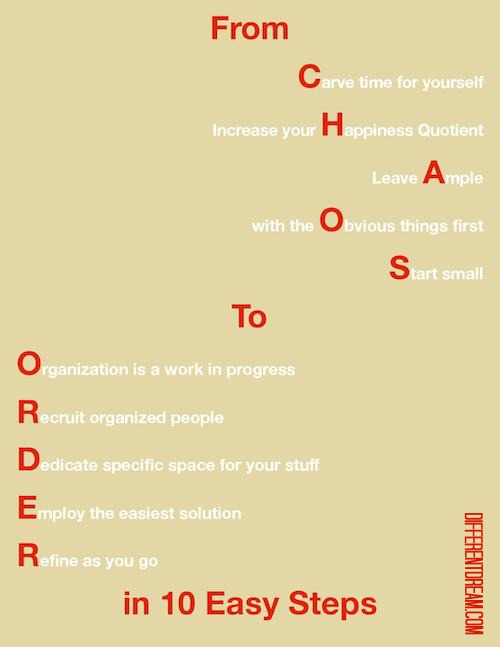
Moving from chaos to order is no easy feat for parents raising kids with special needs. I know that from experience. That experience is what I drew upon for the first post in the series that shared five tips to implement in to move from chaos to order. Today’s post completes the series with 5 more steps I’ve learned about taming chaos over the years. recently when asked to speak to special needs parents about how to bring order from chaos.

From Chaos to Order in Ten Easy Steps, Part 2

The 5 steps explained in Part 1 of this series can go a long way in controlling chaos. But they aren’t enough. To maintain control, a mindset of order must replace the chaos. The next 5 steps can equip you do this.

From Chaos to Order: Step 6

The sixth step is remember that organization is a work in progress. Accept the fact that organization is not an end point but a lifelong journey, especially with kids in the house. My mom gave me a plaque when my kids were young. It said, “Cleaning with children in the house is like shoveling snow in a blizzard.” I put it on a shelf in my kitchen, and it encouraged me when my children’s messes were a source of frustration. It also reminded me to delight in their presence and their messes because one day they would no longer be at home.

From Chaos to Order: Step 7

Step 7 is to recruit organized people to help you because staying organized is much easier when you’re surrounded by people who value what you do. During my teaching years, I learned to find the teachers who were always on top of things. I asked them how they set up their grade books, handled correcting papers, and filling out report cards. It’s a win-win situation. You validate them by seeking their expertise, and you don’t have to reinvent the wheel. So look for parents of kids with special needs who seem to be on top of things and ask them how they do it.

From Chaos to Order: Step 8

The next thing to do is to dedicate specific spaces for important stuff. Put your purse, wallet, and car keys in the same place each day. The same with your kids’ meds, your phone, your tablet, planner, calendar, grocery list–anything crucial to organization. Have a place for it and always put it in that place.

From Chaos to Order: Step 9

Step 9 is to employ the easiest solution possible in every situation. What’s easier than making a bed in the morning? Or getting rid of extra doo-dads on the dresser? The easiest solution could be to fix the same breakfast every morning or assign each person in the house a certain color of socks to facilitate laundry sorting. Stick with easy solutions because they are, well, easy.

From Chaos to Order: Step 10

The final step in moving from chaos to order is to refine as you go. Look for little ways to tweak the systems you put in place so they become more streamlined, simpler, and easier to maintain. And when circumstances change in either big or small ways–a new therapy is added, a new child arrives, you move to a new house–keep refining and tweaking so order is maintained.

Very early in my parenting career I learned a very important key to implementing these 10 steps. I learned to select just one thing at a time–to shine the sink, make the bed, color code the socks, clean off the dresser–and wait until it’s a habit I moved on to the next thing. That was manageable. I could develop one organized habit at a time. I could do it. And you can too.

What are your tips for moving from chaos to order? Leave them in the comment box if you like!

Part 1

Do you like what you see at DifferentDream.com? You can receive more great content by subscribing to the quarterly Different Dream newsletter and signing up for the daily RSS feed delivered to your email inbox. You can sign up for the first in the pop up box and the second at the bottom of this page.

By

Jolene Philo is the author of the Different Dream series for parents of kids with special needs. She speaks at parenting and special needs conferences around the country. She’s also the creator and host of the Different Dream website. Sharing Love Abundantly With Special Needs Families: The 5 Love Languages® for Parents Raising Children with Disabilities, which she co-authored with Dr. Gary Chapman, was released in August of 2019 and is available at local bookstores, their bookstore website, and at Amazon.

Author Jolene Philo

Archives

Categories

Subscribe for Updates from Jolene

Related Posts