Happy 25th, Americans with Disabilities Act

Happy 25th, Americans with Disabilities Act

Happy 25th, Americans with Disabilities Act

The Americans with Disabilities Act (ADA) turns 25 tomorrow. Government and civil rights organizations around the country will be celebrating the passage of legislation that did much to guarantee the rights and opportunities of the disabled.

What Is the Americans with Disabilities Act?

According to the government’s ADA website, “The Americans with Disabilities Act (ADA) was signed into law on July 26, 1990, by President George H.W. Bush. The ADA is one of America’s most comprehensive pieces of civil rights legislation that prohibits discrimination and guarantees that people with disabilities have the same opportunities as everyone else to participate in the mainstream of American life — to enjoy employment opportunities, to purchase goods and services, and to participate in State and local government programs and services. Modeled after the Civil Rights Act of 1964, which prohibits discrimination on the basis of race, color, religion, sex, or national origin – and Section 504 of the Rehabilitation Act of 1973 — the ADA is an “equal opportunity” law for people with disabilities.”

How the Americans with Disabilities Act Changed Life for Families

The Americans with Disabilities Act wasn’t around when multiple sclerosis landed my dad in a wheelchair around 1960. Most of the stores in our town were off limits to him. He couldn’t maneuver his wheelchair into the post office, the library, our church, his children’s schools, the doctor’s office, or the hospital. Because the sidewalks on our block ended with curbs, he had to use driveways to cross the street.

By the time the ADA was passed in 1990, Dad was bed-ridden in a nursing home. But whenever I saw–and still see today–public venues that are accessible to people with disabilities, I think of how wonderful the ADA is and how much Dad would have gloried in it. Every cutaway curb most people take for granted, he would have considered a miracle. A gift. A small delight to savor. A reason to be grateful.

Celebrating the Americans with Disabilities Act

ADA celebrations will be going strong tomorrow. You can check out the ADA Legacy Project website to find a celebration near where you live and join the fun if you like. Or, if you can’t make it, take a walk outside with someone who has a disability. Do a happy dance each time you see an accessible building, a cutaway curb, or a person with disabilities employed and doing meaningful work. At the same time, make a list of physical and attitudinal barriers that deny equal rights and opportunities to people with disabilities. Come Monday, get to work using the ADA to break down those remaining barriers one at a time. So much remains to be done!

How Has the ADA Changed Life for Your Family?

Has the ADA made a difference for your family? Leave a comment about it in the box below!

Do you like what you see at DifferentDream.com? You can receive more great content by subscribing to the quarterly Different Dream newsletter and signing up for the daily RSS feed delivered to your email inbox. You can sign up for the first in the pop up box and the second at the bottom of this page.

By

Jolene Philo is the author of the Different Dream series for parents of kids with special needs. She speaks at parenting and special needs conferences around the country. She’s also the creator and host of the Different Dream website. Sharing Love Abundantly With Special Needs Families: The 5 Love Languages® for Parents Raising Children with Disabilities, which she co-authored with Dr. Gary Chapman, was released in August of 2019 and is available at local bookstores, their bookstore website, and at Amazon.

Author Jolene Philo

Archives

Categories

Subscribe for Updates from Jolene

Related Posts

Father’s Day, Puberty and Special Needs

Father’s Day, Puberty and Special Needs

Father’s Day, Puberty and Special Needs

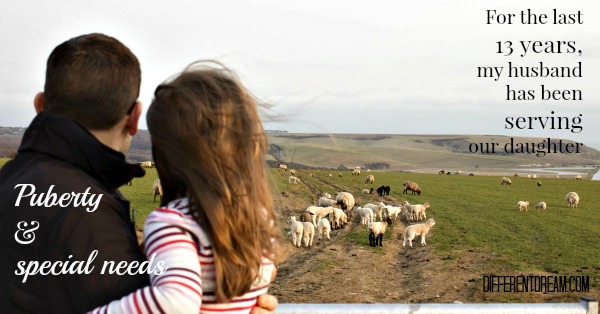
The note guest blogger Kimberly Drew sent with this post said she had written about puberty and special needs. She is undeniably right, but reading her words, it became clear that the post is also a wonderful Father’s Day tribute to her husband as he defines his role in caring for their daughter as she goes through puberty.

Father’s Day, Puberty, and Special Needs

We celebrated Abbey’s thirteenth birthday in April, and I can no longer ignore the fact that I have a teenager. I cannot believe how fast these years have gone. Many of my friends are still announcing pregnancies and posting baby photos, and here I am with this teenage daughter. For most people, that phrase comes with a little fear and trepidation. For us it has definitely brought some unwelcome changes. Being a woman myself makes Abbey’s changing body not that big of a deal for me. But, my husband has had a really difficult time with this.

Can you blame him?

Taking care of the physical needs of a cute little four-year-old with ringlets is nothing at all like putting a bra on your teenage daughter. Some people have assumed that from now on I alone will be caring for her physical needs. This is ridiculous. Male doctors, nurses, and therapists all over the world care for adult patients of the opposite sex.

Trust me when I say that no one on this earth has more compassion for our daughter than her own two parents.

My husband doesn’t love changing diapers or giving baths, but we are in this for the long haul together. You should not assume that just because he is a male, it’s not appropriate for him to care for our daughter. No matter how her body changes, she will always be our little girl…and I need his help.

I can’t do this alone!

We recently read an article written by the father of an adult disabled daughter. Ryan connected with that article and began to understand that while it’s completely normal to be uncomfortable at first, a child’s physical needs can become just medical care. You can look at it from a medical perspective and get over the uncomfortable nature of a changing body. Before we know it, Abbey will become an adult. We plan on having her live with us for as long as possible.

Abbey will need a team of the two of us to continue to take care of her physical needs.

When we graduated from Taylor University, we received our diploma and a towel that symbolized the calling to go out with the heart of Jesus to serve other people. My husband has his towel framed along with his diploma. Here we are fifteen years after graduation, and I can tell you that for the last thirteen years my husband has been serving our daughter. We have come to a crossroad where a lot of men might want to walk away and refuse to help.

Not my Ryan.

With some encouragement, and the humble heart of a man who wants to serve like Jesus, he literally rolls up his sleeves to change a diaper, take a turn giving Abbey a bath, or get her dressed. She is so blessed to have a dad like that.

How Has Your Family Handled Puberty and Special Needs?

Is puberty and special needs creating changes at your house? How are you handling or did you handle caring for your child during the physical transition to adulthood? Leave your comments!

Do you like what you see at DifferentDream.com? You can receive more great content by subscribing to the quarterly Different Dream newsletter and signing up for the daily RSS feed delivered to your email inbox. You can sign up for the first in the pop up box and the second at the bottom of this page.

By

Kimberly grew up and went to college in the small town of Upland, IN. She graduated from Taylor University with a degree in Elementary Education in 2002. While at TU, she married her college sweetheart and so began their adventure! Ryan and Kimberly have four amazing kids on earth (Abigail, Jayden, Ellie, and Cooper), and a baby boy waiting for them in heaven. Their daughter Abigail (Abbey) has multiple disabilities including cerebral palsy, a seizure disorder, hearing loss, microcephaly, and oral dysphagia. She is the inspiration behind Kimberly’s  desire to write. In addition to being a stay at home mom, Kimberly has been serving alongside her husband in full time youth ministry for almost fourteen years. She enjoys working with the senior high girls, scrapbooking, reading, and music. You can visit Kimberly at her website, Promises and Perspective.

Author Jolene Philo

Archives

Categories

Subscribe for Updates from Jolene

Related Posts

A Father’s Day Tribute to a Father’s Eyes

A Father’s Day Tribute to a Father’s Eyes

A Father’s Day Tribute to a Father’s Eyes

Father’s Day will be here soon. So Different Dream is taking a break from PTSD Awareness Month for a few days to focus on the roles fathers play in the lives of children with special needs. Guest blogger Kathy Guzzo begins the line up with this Father’s Day post about what she saw in the eyes of the fathers she observed at a special needs prom.

Their Fathers’ Eyes

Recently I had the privilege of being part of the paparazzi crowd for a prom given for special needs students and young adults. The anticipation and excitement in the hallway with more than 100 people was contagious as we awaited the arrival of guests by limousines. I joined in the cheers, whistles, and applause as they walked the red carpet.

I was there to take photos of the special guests. However to truly capture the full emotions of the evening, I wished I could have photographed individuals in the crowd, especially as their children were escorted onto the red carpet. I didn’t know any of the families or guests, but if could have watched both the crowd and the guests I’m sure I would’ve been able to identify whose children belonged to whom. Physical traits didn’t give it away. The love expressed in the eyes of parents, grandparents, siblings, and friends did. What touched me the most though were the fathers’ eyes.

What I Saw in their Fathers’ Eyes

Fathers are often given a bad rap as the stereotypical guys who sit back, write a few checks, relax and observe events like graduations, weddings, and proms without really participating. Yet that evening fathers clapped, cheered, took photos, and smiled from ear to ear. Even the fathers who weren’t as animated said so much with their eyes. They were celebrating because their children were treated with respect, as people who matter, as beautiful the way God made them, not looked down upon for their differences and disabilities.

Their fathers’ eyes sparkled with joy, beamed with pride, overflowed with an abundance of love, and a few glistened with tears. The dads weren’t seeing people with physical or mental disabilities. They saw their precious daughters looking like princesses walking the red carpet. Or their handsome sons, their buddies with their heads held high, distinguished in their tuxedos. They saw the children they had dreamed of loving, supporting, and protecting. The unconditional love of the fathers was inspiring.

What I Saw in their Fathers’ Hearts

These dads may have struggled with the changes in their roles when told of their children’s special needs. They’ve probably asked a lot of what if, how, and why questions. They may have been overwhelmed with the responsibility of meeting their needs. Yet their commitment, love, and devotion to their children are evident in their eyes.

Fathers aren’t usually asked how they feel or how how special needs challenges are affecting them. But on that special evening, the pride, gentleness, and love I witnessed in the eyes of the fathers made me want to stand up and applaud them, to thank them for being exactly what their child needs. Not necessarily super dads, but fathers who were present, compassionate, available, and willing to share in the exciting moments of their unique children’s lives.

Your Father’s Day Tribute?

Would you like to recognize the father who’s making a difference in the life of your child with special needs this Father’s Day? The comment box below is waiting for your Father’s Day shout out!

Do you like what you see at DifferentDream.com? You can receive more great content by subscribing to the quarterly Different Dream newsletter and signing up for the daily RSS feed delivered to your email inbox. You can sign up for the first in the pop up box and the second at the bottom of this page.

By

Kathy Guzzo and her husband live in Northern Illinois and have 4 adult children. One of her daughters was diagnosed with lupus and Epstein Barr Replication as a young adult. Another began struggling with depression and OCD in her mid-twenties. She understands the need for her daughters to be able to make their own decisions regarding their health, but the nurturer in her sometimes has a hard time letting go. She desires to direct others to the peace and hope that God has abundantly available for them.

Author Jolene Philo

Archives

Categories

Subscribe for Updates from Jolene

Related Posts

To Grandma from your Grandchild with Special Needs

To Grandma from your Grandchild with Special Needs

To Grandma from your Grandchild with Special Needs

Much of Mother’s Day week at Different Dream is devoted to moms of kids with special needs and rightly so. But today’s post is devoted to the grandmas who embrace their grandchildren with special needs and offer invaluable support to mommies. To honor grandmas, whose grandchildren can’t say how they feel, grandma and guest blogger Kathy Guzzo wrote this letter to grandma from a child with special needs for them. Grandmas, this one’s for you.

To Grandma from your Grandchild with Special Needs

Hi Grandma,

It’s hard for me to find the right words, so I decided to write you a letter. Well, Mommy is writing what I say, since it takes a long time for me to write letters that mean words.

I like you, Grandma, because you make Mommy and me feel special. You don’t make me feel like I’m bad, or make fun of me, or yell at me. Instead of making me play games I don’t want to play, you’ll join me in what I’m doing. You don’t ask me a lot of questions and are okay when I answer yes or no. Somehow you know whether or not I want to talk. Talking is so noisy, but I feel safe having someone just sit in the room with me. Sometimes it calms me down.

I like what you do for Mommy too. When you hug and laugh with her, she smiles on her face. Mommy doesn’t show her smile very often. It’s pretty. I like when you bring different foods over, even when I don’t like them. I’m a picky eater, but you bring Mommy’s favorite. Mommy likes when you talk about when she was little or ask her about the books she’s reading instead of talking about me. And boy does she love white daisies. That’s probably why you bring them to her sometimes. You’re nice to help Mommy with all her jobs around the house. When you help, she gets done faster and doesn’t seem so tired.

I like it when you come over and then Mommy leaves, too. Because sometimes Mommy and I just need to be apart for awhile. Besides, when it’s just you and me at home, we have fun. When mommy comes back it’s like she took a nap. I don’t want mommy to be tired all the time.

Mommy told me that you are her mommy. Mommy doesn’t lie so I know it’s true. Thank you for being her mommy.

I’m out of words and Mommy’s crying a little. Even though she’s smiling, too.

I love you, Grandma!
Your Special Grandchild

Have You Written to Grandma from your Grandchild with Special Needs Yet?

If you haven’t yet, you should. Because I’ve been a grandma for 2 1/2 years now and know much grandmothers love to hear from their grandkids. Whether it’s a card, a letter, an email, Skype or Facetime, or in person, remember your kids’ grandma this Mother’s Day. Or leave a shout out in the comment box for a grandparent who’s making a difference in the life of your child with special needs.

Do you like what you see at DifferentDream.com? You can receive more great content by subscribing to the quarterly Different Dream newsletter and signing up for the daily RSS feed delivered to your email inbox. You can sign up for the first in the pop up box and the second at the bottom of this page.

By

Kathy Guzzo and her husband live in Northern Illinois and have 4 adult children. One of her daughters was diagnosed with lupus and Epstein Barr Replication as a young adult. Another began struggling with depression and OCD in her mid-twenties. She understands the need for her daughters to be able to make their own decisions regarding their health, but the nurturer in her sometimes has a hard time letting go. She desires to direct others to the peace and hope that God has abundantly available for them.

Author Jolene Philo

Archives

Categories

Subscribe for Updates from Jolene

Related Posts

A Special Needs Mother’s Day Poem

A Special Needs Mother’s Day Poem

A Special Needs Mother’s Day Poem

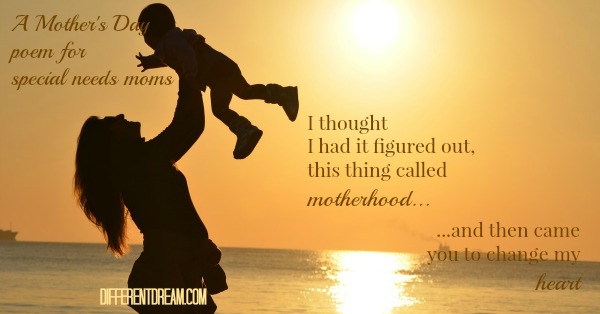
Mother’s Day is a lovely holiday, but it can sometimes be bittersweet for moms raising kids with special needs. Guest blogger, Steph Ballard, who understand bittersweet very well as mom to a son with heart issues. She’s back again this year with another special needs Mother’s Day poem just for you.

And Then Came You

I thought I had it figured out
This thing called motherhood.
With all of my what-to-expect books on hand
I just knew I’d do all that I should.
I’d learn to rock a cranky child
Into sweet and endearing compliance.
I’d know my child’s every cry–
Hey it’s not rocket science.
You’d take your bottle eagerly
While snoozing in delight.
I’d have the Gerber baby,
Of course he’d sleep all night

And then came you…
And all my plans unraveled
As we took our first steps
Down a road much less traveled.
A life of not knowing
What each new day brings
A constant reminder
To cherish all things.
I thought I possessed all I’d need
To see me through this life–
Laughter, love, joy, and faith–
Does anyone need strife?
Of course I’d face some obstacles
Along the weary road
But surely I was strong enough
To carry any load.

And then came you…
Leaving me so unsure
As I watched all the trials
That you had to endure.
I realized the things
That I’d hoped to achieve
Were all put aside
As I learned to believe.
I knew it would be difficult
To wonder everyday–
Will my child grow up?
Will he be okay?
Will I make the right choices…
Will I make mistakes?
Lord, I know you chose me but…
Do I have what it takes?

And then came you…
With a gentle reminder
That life can be tough,
And I need to be kinder.
That every life matters
And just one small deed
Can change many lives
By just planting one seed.
And yes, I struggle often
And yes, I question still
At times I want what I want
And wonder what’s God’s will?
And then we brought you home at last.
Now life would be complete–
Imagine my surprise to find
My child would not eat.
Each milestone that you would reach
Would come at your own pace
I was learning patience
As life…is not a race.
I thought I knew myself so well
I guess that I was wrong
For in my time of weakness
I found out I was strong.

And then you come…
Running toward me with joy
Your laughing at something,
My mischievous boy.
You reach for my face,
As you so often do…
“Why you smiling Mama?”
“I’m smiling at you”.
I thought I had it figured out
This thing called…Motherhood
And then came you…to change my heart
Surely God is good.

~Stephanie Ballard

Do you like what you see at DifferentDream.com? You can receive more great content by subscribing to the quarterly Different Dream newsletter and signing up for the daily RSS feed delivered to your email inbox. You can sign up for the first in the pop up box and the second at the bottom of this page.

By

Stephanie Ballard is the mother of two sons, her youngest son, Braeden, was born with Kabuki Syndrome and congenital heart defects. Her oldest son, Colin is in the military. She enjoys writing poetry and life lessons about her journey in life.

Author Jolene Philo

Archives

Categories

Subscribe for Updates from Jolene

Related Posts

Love, Marriage, and Special Needs

Love, Marriage, and Special Needs

Love, Marriage, and Special Needs

Tomorrow is Valentine’s Day, a holiday devoted to the symbols of love…chocolates and flowers and diamonds. Maggi Gale goes beyond symbols to the very heart of love in this guest post in her look at how to love when you and your spouse respond differently to a child’s  special needs.

Love is patient, love is kind.
It does not envy, it does not boast, it is not proud…

Beautiful poetry for Valentines Day? Yes, but much more, too. It’s a demanding definition of practical love.

But how can anyone live this way
in the home,
in marriage,
with the extra stress of special needs parenting thrown in on top?

A few general differences in dealing with stress between men and women are worth taking into account. Of course we are all unique, and we don’t always fall into neat categories, but as Psychology Today points out, under stress men and women tend to react differently. Men tend to operate in the fight or flight mode, whilst women normally tend and befriend.

Marriage and Special Needs Stress Responses

I don’t know how true this for other people, but it was certainly true for us when we first heard the news that our daughter was EA/TEF. For my husband, fight took the form of frenetic activity. He was arranging this and organizing that, as if he was fighting the very very diagnosis itself. And his flight was … walking. This same man, who has had a lifelong dislike of walking anywhere, suddenly couldn’t keep still. He walked everywhere, until his trousers began to hang off him, as he processed the stress and shock of preceding weeks.

Meanwhile, I was left, of course, holding the baby. Just as well tend and befriend kicked in for me.

It does not envy, it does not boast, it keeps no record of wrongs…

Psychology Today goes on to state that the classic, contrasting responses may boil down to a single gene. Men have the SRY gene on their chromosome causes this fight or flight response. Women, on the other hand, don’t have this gene. The physiological changes happening in us women under stress involve several hormones: estrogen, oxytocin and endorphins. Together, these hormones alleviate pain, motivate us to befriend and make us feel good about social interactions. Just as well, in my case, because that’s just what I needed after our daughter’s special needs diagnosis.

Marriage and Special Needs on Valentine’s Day

Valentine’s Day is a great day for reflecting on love–real love–and how we can live in it. One important lesson for me has been to understand that my husband and I are different. We process many things differently, including the stress of bringing up a child with special needs.

This calls for generosity,
in giving each other a lot of space;
this calls for true love.
Maybe not the red roses and box of chocolates type of love,
but something deeper,
more demanding, yes,
but also more enduring.

…And now these three remain: faith, hope and love. But the greatest of these is love.

This Valentine’s Day, as parents of kids with special needs, let’s try to give each other the space we need to be different. Let’s put that love into practice today and all year long.

And when all else fails, remind yourself that the differences between you and your spouse are all in the genes.

What Do You Think?

What do you think of Maggi’s explanation of the differences between the responses of husbands and wives to a special needs diagnosis? What are your thoughts about love, marriage and special needs parenting? You’re invited to share them in the comment box. Happy Valentine’s Day!

Do you like what you see at DifferentDream.com? You can receive more great content by subscribing to the quarterly Different Dream newsletter and signing up for the daily RSS feed delivered to your email inbox. You can sign up for the first in the pop up box and the second at the bottom of this page.

By

Maggi is a wife and mother of two daughters. She is a primary school teacher, having worked in Africa for 14 years before moving to the Middle East. Her passions are her animals and art. Her youngest daughter was born with tracheoesophageal fistula (TEF). This birth condition was to be the start of an arduous journey, impacting the whole family for several years. Through writing, she hopes to turn her experiences into encouragement for others on similar paths.

Author Jolene Philo

Archives

Categories

Subscribe for Updates from Jolene

Related Posts