Unto Us a Child Is Born

Unto Us a Child Is Born

Unto Us a Child Is Born

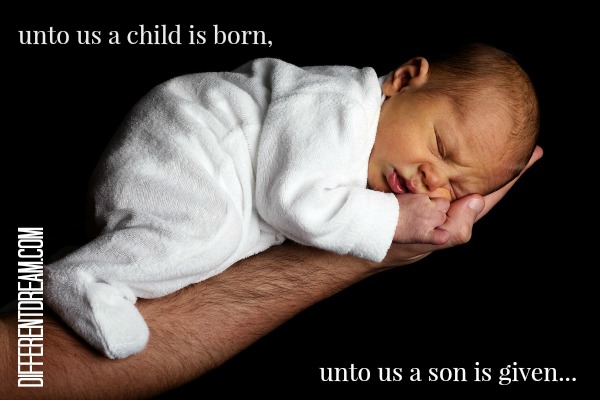
For the first time in many years, my husband and I are greeting the coming of the Christ Child in the presence of a baby. Our sweet grandson is almost 10 months old, and we are oohing and aahing over every new task he masters.

Hand-clapping.
Feeding himself and making a mess.
Drinking from a sippy cup.
Creeping and crawling across the carpet for the first time.

The wonder of Christmas becomes reality as we watch and celebrate every accomplishment of this grandchild we love so much.

The wonder of Christmas also raises many questions in my mother’s heart.

Did Mary’s heart swell the first time Jesus clapped and crowed for joy?
Did the infant Prince of Peace smear food in his downy hair?
Did his father carve a wooden cup that fit inside his Son’s baby hands?
Did the dirt scrape Jesus’ chubby knees when he first crept across the floor?

To read the rest of this post, visit the Not Alone website at specialneedsparenting.net.

Do you like what you see at DifferentDream.com? You can receive more great content by subscribing to the quarterly Different Dream newsletter and signing up for the daily RSS feed delivered to your email inbox. You can sign up for the first in the pop up box and the second at the bottom of this page.
By

Jolene Philo is the author of the Different Dream series for parents of kids with special needs. She speaks at parenting and special needs conferences around the country. She’s also the creator and host of the Different Dream website. Sharing Love Abundantly With Special Needs Families: The 5 Love Languages® for Parents Raising Children with Disabilities, which she co-authored with Dr. Gary Chapman, was released in August of 2019 and is available at local bookstores, their bookstore website, and at Amazon.

Author Jolene Philo

Archives

Categories

Subscribe for Updates from Jolene

Related Posts

Celebrating the Holidays Special Needs Style

Celebrating the Holidays Special Needs Style

Celebrating the Holidays Special Needs Style

Merry Christmas and Happy New Year to special needs families everywhere. With the biggest holiday week of the year upon us, guest blogger Karen Jackson is here with some tips about celebrating the holidays special needs style.

Celebrating the Holidays–Special Needs Style

As the parent of an 18-year-old daughter who has autism, I have some experience getting through the hectic holiday season. In the early years, I tried to cling to what was expected and traditional; often traveling great distances to visit with family. As you might imagine, these efforts left me and the whole family exhausted. Our celebration of Christmas has definitely become more special needs-friendly and less stressful. Here are a few questions to consider as you prepare to celebrate your own faith tradition.

  1. Is traveling really worth it? Our December 2003 flight to California with three children in tow proved to be our last flight as Samantha, our daughter with autism, screamed and cried for much of two full flights across the country. After this disastrous experience, we encouraged our parents and anyone else to visit us in Virginia at Christmas. Our daughter is happier at home in her familiar environment. We have developed a wonderful tradition of hosting Christmas Eve dinner for some of our extended family at our house.
  2. Should we try to entertain friends? I am a pretty social person and absolutely love to host parties, but Samantha has not always been fond of having a lot of people around her. In an effort to compromise, I learned how to make parties more special needs-friendly for her. Every December my husband and I invite all of our neighbors and friends to our home for a come and go holiday open house. I always make sure our daughter has a caregiver or buddy assigned for the evening. This frees me up to enjoy my guests and gives peace of mind that Samantha is cared for and part of the party. We also designate an area of the house as a “no guest zone” so Samantha has a space to retreat to for a sensory Samantha actually has increased her tolerance for being at parties and now looks forward to it, spending more and more time in the midst of the party every year.
  3. What about a visit to see Santa? If your child is like mine, however, you won’t go anywhere near the malls or other busy places for a picture with Santa. But we found some great alternatives. When our children were very young, my neighbors asked if their friends could come visit Samantha at our house in their Santa and Mrs. Claus outfits. The first few years, Samantha would literally run from the room, she was so scared. But eventually, she warmed up to the sight of them. About five years in, Samantha cautiously stayed in the living room. After about 10 minutes, she walked over, reached out and touched his white-gloved hand. It took a mighty effort to make progress and give our kids a typical experience, but it was definitely worth it. Although Samantha is now 18, Mr. and Mrs. Santa Claus still make a visit to say hello to her. Other options include finding sensory friendly Santa visits that are often offered through special needs organizations. You could even renting a suit and enlist a friend to play the part.
  4. Should we try to attend religious services? Houses of worship swell at this time of year. As Catholics, we try to attend the less crowded early Christmas Eve Mass, getting there very early, before anyone can take Samantha’s favorite seat. The ushers ensure we are seated so that we can see the pastor and that we are in the correct line for communion with the father she likes. Even if you do not attend a place of worship regularly, you can still enjoy attending a service at Christmas. Do some research ahead of time. Find a faith community that accommodates for special needs. Many congregations now have disability programs or ministries or even a contact person to help with accommodations. Stock a bag of your child’s favorite (quiet) sensory toys and a few snacks. Schedule in some sensory breaks also.
  5. How do I take care of myself? As the parent of a child with special needs, you may already be overwhelmed. My best advice is to accept your limitations and your child’s. Give yourself some scheduled breaks. The next time friends ask, “What can I do?” or “What gift would you like?” suggest they provide child care so you can have an evening of respite. Remember, you do not need to do it all during the holiday season. Try to find a bit of time for self-care. Keep exercising. Spend some time with friends. An evening out by yourself can be invigorating. Do whatever it takes to renew and strengthen yourself for the holidays.

Don’t be afraid to think outside the box as you plan for Christmas this year. Decide what you might like to try, rework it to accommodate your child and your family and enjoy celebrating the holidays–special needs style.

Your Tips for Celebrating the Holidays?

Do you have some tried and true tips for celebrating the holidays? Please feel free to share them in the comment box.

Do you like what you see at DifferentDream.com? You can receive more great content by subscribing to the quarterly Different Dream newsletter and signing up for the daily RSS feed delivered to your email inbox. You can sign up for the first in the pop up box and the second at the bottom of this page.

By

Karen Jackson is the Executive Director of Faith Inclusion Network of Hampton Roads where she lives with her husband and three children in Norfolk, VA. She is also the author of the recently published book, Loving Samantha.

Author Jolene Philo

Archives

Categories

Subscribe for Updates from Jolene

Related Posts

7 Holiday Survival Tips for Special Needs Families

7 Holiday Survival Tips for Special Needs Families

7 Holiday Survival Tips for Special Needs Families

Christmas. The most wonderful time of year. Unless it isn’t. Which is often the case for special needs families. So guest blogger Sheri Dacon is here with her tried and true list of 7 holiday survival tips for special needs families.

The Most Wonderful Time of the Year:
7 Holiday Survival Tips for Special Needs Families

It’s called the most wonderful time of the year, but it can also be the most stressful. As special needs parents, we often feel like wounded warriors as we limp our way into January.

Here are seven holiday survival tips for special needs families to get you through the season with minimal wear and tear.

1. Take care of yourself.

It bears repeating: put your own oxygen mask on first. Take the necessary steps to keep yourself healthy and as stress-free as possible. When you’re stressed and exhausted, you’re putting your family at risk for a chaotic and overwhelming holiday. It’s vital to tend to your physical, emotional, and spiritual needs. Sleep, diet, exercise, and spiritual fulfillment are crucial all year round, but especially during the Christmas season, when tensions run high. Make self-care your #1 priority during the holidays.

2. Keep it simple.

There is no such thing as a perfect holiday. Our media-saturated world somehow convinces us that we can craft, bake, or buy our way to the best Christmas ever. It’s simply not true. Avoid Pinterest and keep your decorations, gifts, and food preparation simple.

3. Emphasize the true meaning of the holidays.

Our kids — especially those with special needs — tend to obsess over the material aspect of the holidays. They associate Christmas with presents, and can become overly agitated if they don’t get what’s expected. Talk to them about expectations during times when they are calm. Gently remind them of the true meaning of Christmas. Spend quiet family times reading special books or telling stories. Consider having family devotionals that point to the true reason for the season.

4. Stick to a regular routine.

It’s important for the whole family, but especially for special needs kids: keep your schedule as close to normal as you can. Even though kids are out of school, insist on a regular bedtime and limit screen time. Have the family continue with everyday chores. Adhering to a routine helps lessen the stress of the holidays, and it will help your special needs child (and you) feel more grounded when tinsel and wrapping paper are everywhere.

5. Plan for down time.

With parties and festivities galore, the holidays can be overwhelming. Plan ahead for quiet family evenings at home. Too many social outings can be challenging for special needs kids, who need time and space at home to decompress and recharge.

6. Do what’s best for your family.

Put your family first when it comes to holiday planning. It may seem selfish, but it’s actually healthy. It’s crucial to consider your family’s unique challenges when planning celebrations. You may end up disappointing friends or family members, but it is okay. If you need to stay home or come late to a celebration in order to accommodate your family’s special needs, make that decision and stick to it.

7. Don’t be afraid to say no.

You don’t have to do everything. It’s okay to say no to baking cookies, caroling, or buying a white elephant gift this year. If an activity or event is too much for your child (or you), or if it causes undue stress, politely say no and move on.

The Christmas season truly can be a wonderful time, but it requires planning. Be proactive and decide now to implement these strategies so your season will be one of peace, not chaos. And from my special needs family to yours, Merry Christmas!

How Do You Survive the Holidays?

Do you have tried and true holiday survival tips? Leave them in the comment box.

Do you like what you see at DifferentDream.com? You can receive more great content by subscribing to the quarterly Different Dream newsletter and signing up for the daily RSS feed delivered to your email inbox. You can sign up for the first in the pop up box and the second at the bottom of this page.

By

You can learn more about Sheri by visiting her website at sheridacon.com.

Author Jolene Philo

Archives

Categories

Subscribe for Updates from Jolene

Related Posts

Happy 25th, Americans with Disabilities Act

Happy 25th, Americans with Disabilities Act

Happy 25th, Americans with Disabilities Act

The Americans with Disabilities Act (ADA) turns 25 tomorrow. Government and civil rights organizations around the country will be celebrating the passage of legislation that did much to guarantee the rights and opportunities of the disabled.

What Is the Americans with Disabilities Act?

According to the government’s ADA website, “The Americans with Disabilities Act (ADA) was signed into law on July 26, 1990, by President George H.W. Bush. The ADA is one of America’s most comprehensive pieces of civil rights legislation that prohibits discrimination and guarantees that people with disabilities have the same opportunities as everyone else to participate in the mainstream of American life — to enjoy employment opportunities, to purchase goods and services, and to participate in State and local government programs and services. Modeled after the Civil Rights Act of 1964, which prohibits discrimination on the basis of race, color, religion, sex, or national origin – and Section 504 of the Rehabilitation Act of 1973 — the ADA is an “equal opportunity” law for people with disabilities.”

How the Americans with Disabilities Act Changed Life for Families

The Americans with Disabilities Act wasn’t around when multiple sclerosis landed my dad in a wheelchair around 1960. Most of the stores in our town were off limits to him. He couldn’t maneuver his wheelchair into the post office, the library, our church, his children’s schools, the doctor’s office, or the hospital. Because the sidewalks on our block ended with curbs, he had to use driveways to cross the street.

By the time the ADA was passed in 1990, Dad was bed-ridden in a nursing home. But whenever I saw–and still see today–public venues that are accessible to people with disabilities, I think of how wonderful the ADA is and how much Dad would have gloried in it. Every cutaway curb most people take for granted, he would have considered a miracle. A gift. A small delight to savor. A reason to be grateful.

Celebrating the Americans with Disabilities Act

ADA celebrations will be going strong tomorrow. You can check out the ADA Legacy Project website to find a celebration near where you live and join the fun if you like. Or, if you can’t make it, take a walk outside with someone who has a disability. Do a happy dance each time you see an accessible building, a cutaway curb, or a person with disabilities employed and doing meaningful work. At the same time, make a list of physical and attitudinal barriers that deny equal rights and opportunities to people with disabilities. Come Monday, get to work using the ADA to break down those remaining barriers one at a time. So much remains to be done!

How Has the ADA Changed Life for Your Family?

Has the ADA made a difference for your family? Leave a comment about it in the box below!

Do you like what you see at DifferentDream.com? You can receive more great content by subscribing to the quarterly Different Dream newsletter and signing up for the daily RSS feed delivered to your email inbox. You can sign up for the first in the pop up box and the second at the bottom of this page.

By

Jolene Philo is the author of the Different Dream series for parents of kids with special needs. She speaks at parenting and special needs conferences around the country. She’s also the creator and host of the Different Dream website. Sharing Love Abundantly With Special Needs Families: The 5 Love Languages® for Parents Raising Children with Disabilities, which she co-authored with Dr. Gary Chapman, was released in August of 2019 and is available at local bookstores, their bookstore website, and at Amazon.

Author Jolene Philo

Archives

Categories

Subscribe for Updates from Jolene

Related Posts

Father’s Day, Puberty and Special Needs

Father’s Day, Puberty and Special Needs

Father’s Day, Puberty and Special Needs

The note guest blogger Kimberly Drew sent with this post said she had written about puberty and special needs. She is undeniably right, but reading her words, it became clear that the post is also a wonderful Father’s Day tribute to her husband as he defines his role in caring for their daughter as she goes through puberty.

Father’s Day, Puberty, and Special Needs

We celebrated Abbey’s thirteenth birthday in April, and I can no longer ignore the fact that I have a teenager. I cannot believe how fast these years have gone. Many of my friends are still announcing pregnancies and posting baby photos, and here I am with this teenage daughter. For most people, that phrase comes with a little fear and trepidation. For us it has definitely brought some unwelcome changes. Being a woman myself makes Abbey’s changing body not that big of a deal for me. But, my husband has had a really difficult time with this.

Can you blame him?

Taking care of the physical needs of a cute little four-year-old with ringlets is nothing at all like putting a bra on your teenage daughter. Some people have assumed that from now on I alone will be caring for her physical needs. This is ridiculous. Male doctors, nurses, and therapists all over the world care for adult patients of the opposite sex.

Trust me when I say that no one on this earth has more compassion for our daughter than her own two parents.

My husband doesn’t love changing diapers or giving baths, but we are in this for the long haul together. You should not assume that just because he is a male, it’s not appropriate for him to care for our daughter. No matter how her body changes, she will always be our little girl…and I need his help.

I can’t do this alone!

We recently read an article written by the father of an adult disabled daughter. Ryan connected with that article and began to understand that while it’s completely normal to be uncomfortable at first, a child’s physical needs can become just medical care. You can look at it from a medical perspective and get over the uncomfortable nature of a changing body. Before we know it, Abbey will become an adult. We plan on having her live with us for as long as possible.

Abbey will need a team of the two of us to continue to take care of her physical needs.

When we graduated from Taylor University, we received our diploma and a towel that symbolized the calling to go out with the heart of Jesus to serve other people. My husband has his towel framed along with his diploma. Here we are fifteen years after graduation, and I can tell you that for the last thirteen years my husband has been serving our daughter. We have come to a crossroad where a lot of men might want to walk away and refuse to help.

Not my Ryan.

With some encouragement, and the humble heart of a man who wants to serve like Jesus, he literally rolls up his sleeves to change a diaper, take a turn giving Abbey a bath, or get her dressed. She is so blessed to have a dad like that.

How Has Your Family Handled Puberty and Special Needs?

Is puberty and special needs creating changes at your house? How are you handling or did you handle caring for your child during the physical transition to adulthood? Leave your comments!

Do you like what you see at DifferentDream.com? You can receive more great content by subscribing to the quarterly Different Dream newsletter and signing up for the daily RSS feed delivered to your email inbox. You can sign up for the first in the pop up box and the second at the bottom of this page.

By

Kimberly grew up and went to college in the small town of Upland, IN. She graduated from Taylor University with a degree in Elementary Education in 2002. While at TU, she married her college sweetheart and so began their adventure! Ryan and Kimberly have four amazing kids on earth (Abigail, Jayden, Ellie, and Cooper), and a baby boy waiting for them in heaven. Their daughter Abigail (Abbey) has multiple disabilities including cerebral palsy, a seizure disorder, hearing loss, microcephaly, and oral dysphagia. She is the inspiration behind Kimberly’s  desire to write. In addition to being a stay at home mom, Kimberly has been serving alongside her husband in full time youth ministry for almost fourteen years. She enjoys working with the senior high girls, scrapbooking, reading, and music. You can visit Kimberly at her website, Promises and Perspective.

Author Jolene Philo

Archives

Categories

Subscribe for Updates from Jolene

Related Posts

A Father’s Day Tribute to a Father’s Eyes

A Father’s Day Tribute to a Father’s Eyes

A Father’s Day Tribute to a Father’s Eyes

Father’s Day will be here soon. So Different Dream is taking a break from PTSD Awareness Month for a few days to focus on the roles fathers play in the lives of children with special needs. Guest blogger Kathy Guzzo begins the line up with this Father’s Day post about what she saw in the eyes of the fathers she observed at a special needs prom.

Their Fathers’ Eyes

Recently I had the privilege of being part of the paparazzi crowd for a prom given for special needs students and young adults. The anticipation and excitement in the hallway with more than 100 people was contagious as we awaited the arrival of guests by limousines. I joined in the cheers, whistles, and applause as they walked the red carpet.

I was there to take photos of the special guests. However to truly capture the full emotions of the evening, I wished I could have photographed individuals in the crowd, especially as their children were escorted onto the red carpet. I didn’t know any of the families or guests, but if could have watched both the crowd and the guests I’m sure I would’ve been able to identify whose children belonged to whom. Physical traits didn’t give it away. The love expressed in the eyes of parents, grandparents, siblings, and friends did. What touched me the most though were the fathers’ eyes.

What I Saw in their Fathers’ Eyes

Fathers are often given a bad rap as the stereotypical guys who sit back, write a few checks, relax and observe events like graduations, weddings, and proms without really participating. Yet that evening fathers clapped, cheered, took photos, and smiled from ear to ear. Even the fathers who weren’t as animated said so much with their eyes. They were celebrating because their children were treated with respect, as people who matter, as beautiful the way God made them, not looked down upon for their differences and disabilities.

Their fathers’ eyes sparkled with joy, beamed with pride, overflowed with an abundance of love, and a few glistened with tears. The dads weren’t seeing people with physical or mental disabilities. They saw their precious daughters looking like princesses walking the red carpet. Or their handsome sons, their buddies with their heads held high, distinguished in their tuxedos. They saw the children they had dreamed of loving, supporting, and protecting. The unconditional love of the fathers was inspiring.

What I Saw in their Fathers’ Hearts

These dads may have struggled with the changes in their roles when told of their children’s special needs. They’ve probably asked a lot of what if, how, and why questions. They may have been overwhelmed with the responsibility of meeting their needs. Yet their commitment, love, and devotion to their children are evident in their eyes.

Fathers aren’t usually asked how they feel or how how special needs challenges are affecting them. But on that special evening, the pride, gentleness, and love I witnessed in the eyes of the fathers made me want to stand up and applaud them, to thank them for being exactly what their child needs. Not necessarily super dads, but fathers who were present, compassionate, available, and willing to share in the exciting moments of their unique children’s lives.

Your Father’s Day Tribute?

Would you like to recognize the father who’s making a difference in the life of your child with special needs this Father’s Day? The comment box below is waiting for your Father’s Day shout out!

Do you like what you see at DifferentDream.com? You can receive more great content by subscribing to the quarterly Different Dream newsletter and signing up for the daily RSS feed delivered to your email inbox. You can sign up for the first in the pop up box and the second at the bottom of this page.

By

Kathy Guzzo and her husband live in Northern Illinois and have 4 adult children. One of her daughters was diagnosed with lupus and Epstein Barr Replication as a young adult. Another began struggling with depression and OCD in her mid-twenties. She understands the need for her daughters to be able to make their own decisions regarding their health, but the nurturer in her sometimes has a hard time letting go. She desires to direct others to the peace and hope that God has abundantly available for them.

Author Jolene Philo

Archives

Categories

Subscribe for Updates from Jolene

Related Posts