by jphilo | May 23, 2011 | Advocacy, Different Dream, Special Needs Parenting
Maybe you remember Kristi Yamaguchi as America’s sweetheart and winner of the 1992 Olympic Gold Medal in women’s figure skating. Or maybe you saw her become a champion on Dancing with the Stars. Or maybe you’re read her new children’s book, Dream Big, Little Pig, to your kids. Those are all wonderful accomplishments, but they don’t hold to candle to what Yamaguchi does for kids with special needs.
Always Dream Foundation
According to an article at www.mercurynews.com, Yamaguchi’s Always Dream Foundation co-sponsored camps for kids with special needs. “Disabled children were paired with able-bodied buddies for a week. Kids with spinal bifida or muscular dystrophy or other challenges mingled with others. By the end of the week, each side saw the world in a different light.”
Her interest with special needs began early. The article states that “Yamaguchi was born in 1971… with two club feet, which required a series of manipulations and castings. By the time Yamaguchi started skating, at age 6, she was hardly a natural. ‘I wasn’t always the strongest physically, and I wasn’t always the most coordinated,’ she said. ‘But I was always willing to work a little harder.'”
The Children’s Discovery Museum of San Jose’s Legacy Award
Recently, Yamaguchi received the Children’s Discovery Museum of San Jose’s Legacy Award. Why? Because she and her Always Dream Foundation were the driving forces behind the creation of The Always Dream Play Park, located in the Central Park of Fremont, California, Yamaguchi’s home town. Here’s how the Mercury.com article describes the playground. It “features a slide that’s wheelchair-accessible and swings with extra safety precautions. But it’s not advertised as a park for special-needs kids. It’s advertised as a park. And it’s always packed.”
Yamaguchi Still Gets the Gold
That’s why Kristi Yamaguchi still gets the gold in my book. She’s taking the grief and the grace of her lifetime and using it to show compassion to those in need. She’s the champion of a worthy cause. She’s a champion. Period.
Do you like what you see at DifferentDream.com? You can receive more great content by subscribing to the quarterly Different Dream newsletter and signing up for the daily RSS feed delivered to your email inbox. You can sign up for the first in the pop up box and the second at the bottom of this page.
by jphilo | Jan 12, 2011 | Advocacy, Different Dream, Special Needs Parenting
With the arrival of January 2011, the first ever EA TEF Awareness Month began. (To get the scoop on that alphabet soup, check out last week’s post.) In today’s post Lori McGahan, the founder of EA TEF Awareness Month explains how it came into being.
Meet Lori and Brandon McGahan
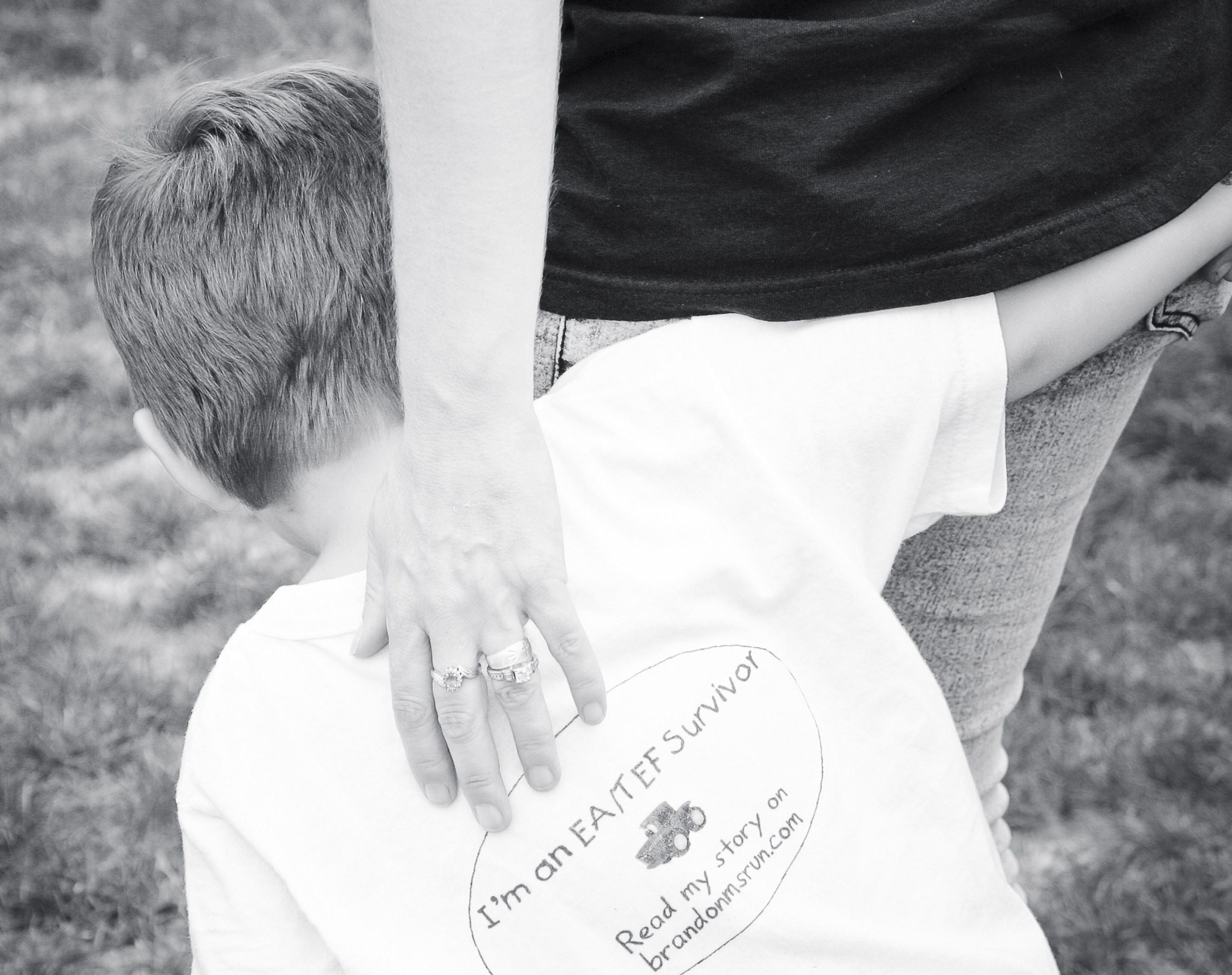
My name is Lori and I am a mom of an EA/TEF child. My son, Brandon, was born in 2007 and diagnosed day 2 of his life with Type C long gap EA/TEF with a distal fistula, severe tracheomalacia, heart defect, kidney reflux, as well as complications which occurred during treatment of this birth defect.
During our journey, we found it to be a very lonely journey as well as felt there was such a lack of information. We were always compelled to ask the following questions with no definitive answers:
- Why is there not more information and/or resources pertaining to EA/TEF?
- Where are the support groups for us and where are the other EA families we can be connected with?
Why It’s Hard to Connect EA TEF Families
We learned during our journey that there is not a lot of information regarding EA/TEF as it is a rare birth defect and can come in many different variations. We also learned, that it was extremely hard to be connected with other families via the hospital and or other facilities as they are grounded by HIPAA guidelines. HIPAA essentially means that hospitals are NOT allowed to give out family names and/or diagnosis, therefore, their ability to connect EA families together is impossible.
Brandon’s Run
In October of 2007, we started Brandon’s Run to raise awareness and to raise funds for research pertaining to this birth defect. Our hope was that we would also find a way to connect with other EA Families. While our efforts to raise funds were good, by 2009 we still had not met any other families with an EA diagnosis. Due to this aspect, I spent a lot of time researching on the internet, found a wonderful EA support group on Facebook to connect with.
Bridging the Gap of EA TEF
In collaboration with other EA families, results from my surveys and with help from the EA Treatment Program at Children’s Hospital Boston, the Bridging the Gap of EA/TEF Facebook page was born. It is also due to this that when we held our 4th Annual Brandon s Run in September of 2010, we were able to connect with other EA families and meet these families face to face. This was an overwhelming joy for us, as prior to that we had never met and/or spoken to another EA family.
What We Have in Common
It amazes me how in the past year, BTG has grown so much and with the help of other EA families we have been able to initiate the first annual Worldwide Esophageal Atresia and Tracheoesophageal Fistula Awareness Month currently being held. It is my sincere hope, that Bridging the Gap of EA/TEF will help better connect EA families with resources and face-to-face support within their states that we all so much need. While all of our journey’s vary just a bit, we all have one common theme, a child born with EA/TEF.
Leave a Comment
If you’re the parent of a child with EA/TEF or an adult who had EA/TEF repair, please leave a comment. Lori would love to hear your story, and so would I.
Do you like what you see at DifferentDream.com? You can receive more great content by subscribing to the quarterly Different Dream newsletter and signing up for the daily RSS feed delivered to your email inbox. You can sign up for the first in the pop up box and the second at the bottom of this page.
Save
by jphilo | Jan 4, 2011 | Advocacy, Different Dream, Special Needs Parenting
January is an important month, not only because it’s the start of a new year. But also, because it is EA/TEF Awareness Month. If you’re not familiar with that jumble of alphabet soup, this article by the folks at www.bridgingthegapofea-tef.com will satisfy your curiosity.
Why is EA/TEF Awareness Month important to me? Our son was born with the condition almost 28 years ago, and it changed our lives!
Facts about EA/TEF (OA/TOF)
- In long form is called Esophageal Atresia and Tracheoesophageal Fistula.
- Is an abnormal or non-existent connection between the esophagus and the stomach.
- About 1 in every 3,000 to 5,000 infants is born with one or both of these conditions in the United States each year. WORLDWIDE: It is suspected the occurrence is roughly 1/4,000 live births since there has not yet been any genetic or environmental factor found to date.
Diagnosing EA/TEF
In most case EA/TEF is not prenatally diagnosed. OB/GYNS can determine diagnosis by the following:
- No or small stomach/no stomach bubble
- High levels of amniotic fluid
- Linked to vessel cords (2 vessel cords)
Links to Other Birth Defects
Up to one-half of all babies with TE fistula or Esophageal Atresia (TOF) have another birth defect.
- Trisomy 13, 18, or 21
- other digestive tract problems (such as diaphragmatic hernia, duodenal atresia, or imperforate anus)
- heart problems (such as ventricular septal defect, tetralogy of Fallot, or patent ductus arteriosus)
- kidney and urinary tract problems (such as horseshoe or polycystic kidney, absent kidney, or hypospadias)
- muscular or skeletal problems
- VACTERL syndrome (which involves Vertebral, Anal, Cardiac, TE fistula, Renal, and Limb abnormalities)
About one-half of children who had esophageal atresia (TOF) repaired will have problems with GERD.
*Statistics Source: Children’s Hospital Boston
We Need your Help!
Help us to raise awareness regarding this rare birth defect. To learn how you can help visit the Bridging the Gap website.
Brief background of the Periwinkle Ribbon
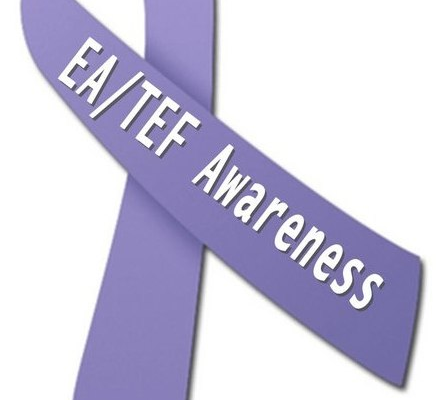
The Periwinkle Awareness Ribbon is used to represent a number of health conditions and social issues. Why Periwinkle? Periwinkle signifies esophageal cancer and GERD, two items our children are at risk for; the white signifies the innocence of our children and young adults.
What’s Your Experience with EA/TEF?
If your family or someone you know has been affected by EA/TEF, share the story in the comment box. And be watching for more information about EA/TEF throughout the month of January.
Do you like what you see at DifferentDream.com? You can receive more great content by subscribing to the quarterly Different Dream newsletter and signing up for the daily RSS feed delivered to your email inbox. You can sign up for the first in the pop up box and the second at the bottom of this page.
Save
by jphilo | Nov 8, 2010 | Advocacy, Different Dream, Special Needs Parenting
For a month and a half, I’ve been conducting almost daily interviews for my work in progress, Different Dream Parenting: Raising a Child with Special Needs. All the interviews have been with experts in the special needs community: half of them being professionals and half being parents of kids with special needs.
Meet Nancy Woleslagle
Nancy Woleslagle is one of the parents interviewed. Even though she’s a very busy mother of five (with one more on the way), two of whom have special needs, she offered to share her expertise. And I’m so glad she did. She had excellent advice about dealing with insurance companies and brought several support organizations and websites to my attention. Different Dream Parenting will be a better book because of her contribution.
Meet Lillian and Phillip
Nancy’s daughter Lillian, age 9, and her twin, Phillip, were born prematurely. Both have special needs related to their early arrivals, but Lillian’s are more severe. Because she has a trach, she qualifies for in home health care which is a great help to the family. But finding home health care agencies whose philosophy and workers meshed well with their family required careful screening. In the process, Nancy developed a list of questions that she agreed to share.
Questions for Home Health Care Agencies
Thanks to Nancy’s generosity, you can benefit from her family’s experience. Just click on In Home Nursing Care Questions to download her questions. If you have questions to add to Nancy’s list, please share them by leaving a comment. I will continue to compile questions while researching Different Dream Parenting and would love to include your ideas in the book.
Do you like what you see at DifferentDream.com? You can receive more great content by subscribing to the quarterly Different Dream newsletter and signing up for the daily RSS feed delivered to your email inbox. You can sign up for the first in the pop up box and the second at the bottom of this page.
Save

by jphilo | Sep 24, 2010 | Advocacy, Different Dream, Special Needs Parenting
Today, I’m pleased to introduce you to a new www.DifferentDream.com guest blogger, Scott Newport. Some of Scott’s family’s story has been shared here before. (Good-Bye Evan Newport, Evan Newport All Around Me, The Evan Newport HOPE Awards, and The Longevity of Grief) You can read more about him at Different Dream Guest Bloggers. In this post, Scott addresses an topic about which he’s passionate–effective and graceful parent advocacy. See what you think.
Brick Throwing Stops Today!
Getting struck by a tumbling brick thrown from a towering institution window was the way I felt when I first looked up at the sterile counter and asked the woman peering down at me if she could help. “Yes, we do some of that,” she replied. “But not the way your family wants it.”
The grueling question I was asking was whether they could help us care for our dying son. I was envisioning that every time we were in a crisis we wouldn’t have to travel to a hospital. I had heard that some hospitals in the country were trying to embrace not only the child but also the family in a home setting. Living in a large metropolitan area allows for many institutions but, so far, I had found no one up-to-speed with our needs.
Our needs revolved around our son Evan, who was born with a terminal heart condition and other serious medical conditions associated with Noonan Syndrome. Our family has struggled over the last seven years knowing our son would die young. With a breathing tube, a feeding tube and full-time nursing staff, our life with Evan is complicated at times. As a father, I often feel I can’t hold our family together by myself. As I stood alone at the “help desk” that day, I was asking for permission to let Evan die at home. The catch: In order to receive palliative services, Evan had to be an in-patient at the hospital.
A while back, Evan had a so-called “simple surgery” that went bad. What should have been a three-day stay at the hospital turned into an eleven-day end-of-life event. We weren’t able to feed Evan after the surgery; his body was shutting down. Eventually, he was sent home from the PICU with these words: “There’s nothing more we can do, Scott. If he stays here, he will surely die,” the caring doctor explained. “We may be the ones killing Evan.” That was the week I first found myself the target of brick throwing.
Desperate for help, I went to visit the closest of our local hospitals to talk to a nurse manager I had come to trust over the years. She knew Evan well from previous ICU visits. Words she’d spoken years earlier rang in my head: “If you ever think Evan is dying, please bring him in for an assessment. If it seems like it’s the end, I will help you get him home.” This was our wish; it was a choice my wife, Penni, and I had made shortly after Evan was born. Before I left, my nurse-friend hugged me, handed me a glossy brochure, and told me to call the number.
Before I even left the parking lot, I dialed the number. In my mind I was ducking as I imagined another brick poised and ready to be hurled my way. As soon as the voice on the phone said, “Yes, Scott, that is what we do and we can come to your home tomorrow,” I looked up to the sky and thanked our God.
When I got home, I showed Penni the brochure and told her that a nurse and doctor would be coming out from a pediatric service called Walk with Me the following day to speak with us. I was so amazed these people were coming so quickly to see our family. I knew we had connected with some very special people. It was obvious to me that they “got it” and that setting up an appointment in a week or so was not an option.
Over the next few weeks and then months, we came to find out how much the Walk with Me team would embrace our family and make our complicated life a little simpler. Even though we have a home ICU and nursing staff of our own, the team was able to help in ways we’d never thought of before. For instance, now we could have blood draws done at home. Instead of Evan having to make a trip to the hospital to be poked by a stranger, he now has loving arms embracing him and familiar surroundings comforting him. We are never even asked to step outside the room.
I think the greatest thing about the team is that they know that kids like Evan are very complex. These kids can experience a near-death illness one month and, the next month, be smiling and wanting to play outside. Not only is Evan complicated, our family dynamics are such that we could never survive without the Walk with Me team.
I could go on and on about Kim and Dave or about Matique and Dr. Jeanne. I could talk for an hour about how each time someone from the team comes to our home, they brighten our often-dark journey with a smile. But I guess the best way to explain what these folks mean to us is for me to share an article I wrote recently about Linda, one of the fine people at Walk with Me.
I hope you can see, through the story and poem I wrote, that no bricks will ever be thrown at our family again thanks to Walk with Me.
Share Your Experience
Have you ever had a brick throwing experience similar to Scott’s? How did you advocate for your child? What hospital resources or personnel helped you? If you have answers to any of those questions or want to ask a question, please leave a comment below. Maybe together we can put an end to brick trowing all together. Wouldn’t that be grand?
Do you like what you see at DifferentDream.com? You can receive more great content by subscribing to the quarterly Different Dream newsletter and signing up for the daily RSS feed delivered to your email inbox. You can sign up for the first in the pop up box and the second at the bottom of this page.
by jphilo | Sep 3, 2010 | Advocacy, Different Dream, Special Needs Parenting
In July, countless groups in the special needs community observed the twentieth anniversary of the Americans with Disabilities Act. The many commemorations made me think about my dad. By the time the act was passed, he’d been in a wheelchair 31 years. He’d spent many of those years unable to cross the street because of sidewalk curbs, unable to work because jobs weren’t modified for people like him back then, unable to enter the library or city hall because of steps. Though he lived for 6 years after the law’s passage, by then he was confined to a nursing home and rarely benefited from it.
Ben Mattlin and the Americans with Disabilities Act
Dad’s life could have been very different if the act had been in place when he was diagnosed with multiple sclerosis in 1959. But it wasn’t and there’s no sense wishing for what could have been. Besides many stories of lives changed because of the act do exist. Ben Mattlin’s is one of them.
Ben was born with spinal muscular atrophy, a condition which leaves him too weak to scratch an itch. In a recent NPR commentary, he told how the Americans with Disabilities Act did to change his life, and also what it didn’t do. You can read the article, print out a transcript, and listen to the audio version at Looking Back at 20 Years of Disability Rights.
Visit Ben’s Blog
To learn more about Ben, visit benmattlin.blogspot.com. These days, he’s running a series from his memoirs called Miracle Boy. In the August 7 installment, he describes how his mom and the school arrange to handle his bathroom needs as a seven-year-old. Not an easy task in the days before 504b plans. The story reminded me of Dad’s urinal, discreetly hidden in an old leather shaving bag, which we kids carried around for him when he could still get out and about.
Ahh, the good old days weren’t all that good after all. These days, the Americans with Disabilities Act days, are better. Though as Ben said, much remains to be done. And we’re the ones who have to do it.
Do you like what you see at DifferentDream.com? You can receive more great content by subscribing to the quarterly Different Dream newsletter and signing up for the daily RSS feed delivered to your email inbox. You can sign up for the first in the pop up box and the second at the bottom of this page.