by jphilo | Aug 8, 2019 | Different Dream, Encouragement, Spiritual Support
Even the Experts Don’t Know What A Child with Disabilities Will Achieve
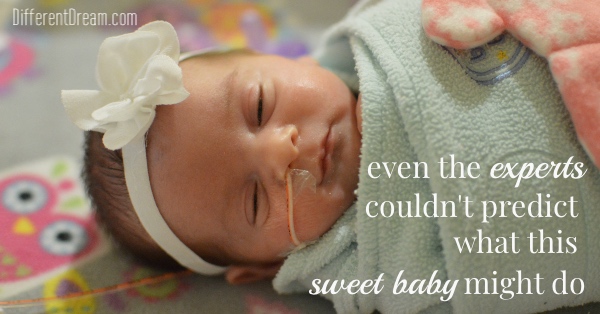
Even the experts don’t know what a child with disabilities will achieve. Guest blogger Kimberly Drew and her husband Ryan continue to watch their youngest daughter with special needs surpass the predictions of wise and well-meaning professionals. Today, Kimberly tells the story of one such event.
Even the Experts…
When Ryan and I were at the beginning stage of adopting our baby with special needs, we were told a lot of different things. Every scan showed something unusual, and we were told “normal” was out of the question for her. We were careful to listen to each doctor and specialist, but we also believed prayer and love can make a difference.
One of our first shocking experiences came from a resident at the children’s hospital while Ellie, the baby we were adopting, was still in the NICU. Because this was not a planned adoption, we traveled across the country every weekend to see our baby. During the week, her birth grandmother and my parents checked in on her regularly.
Like any newborn, Ellie slept most of the day. However, she was also heavily medicated because she was going through drug withdrawal. The result was a rarely awake baby who was tube fed. We worked with the pacifier every chance we got, and we kangarooed every minute possible. But there was very little chance to work with her on oral feeding in the NICU, so she came home with a feeding tube that went through the nose.
During the final weeks of Ellie’s NICU stay, a resident popped in the room to discuss the feeding tube with us. She worked in a clinic with children who have special needs. She was an expert in this area and told us we should consider having a g-tube placed in before Ellie left the hospital. The expert clearly said that “these kids will never….” I was in shock! Why would we do this when we had rarely had a chance to work with her on oral feedings?
I went to the chapel and sobbed hysterically. Then I came back mad and determined. Even the experts couldn’t stop me from trying.
Ellie was discharged to the care of my parents and her birth grandmother. Thankfully my mother was as mad and determined as I was while we waited for legal approval take our daughter across state lines. Mom’s determination meant that Ellie was off of the nasal tube before we ever took her home!
Ellie’s 3 1/2 now. I will tell you that feeding has been a major issue since day one. With her diagnosis of cerebral palsy, feeding will most likely always be an issue. But, we are determined parents! We continue to consult with several specialist to address her nutritional needs, to try and get her off of the bottle and formula, and onto regular food.
Our most recent success, which even the experts couldn’t have imagined, came at a pancake house in Cape May, New Jersey. Ellie was fussing for a fork. When I was distracted, she slipped the fork off the table and stabbed a piece of pancake. I turned around in time to see her putting pancake into her mouth!
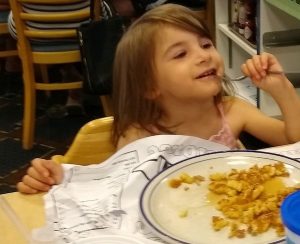
I had to stifle a scream so I didn’t scare her. We ignored her, watching furtively as she went back for another bite. I burst into tears of happiness. In the back of my mind, I heard that resident with her “probably nevers” and I laughed to myself. Even the experts don’t know it all.
Do you like what you see at DifferentDream.com? You can receive more great content by subscribing to the monthly Different Dream newsletter and signing up for the daily RSS feed delivered to your email inbox. You can sign up for the first in the pop up box and the second at the bottom of this page.
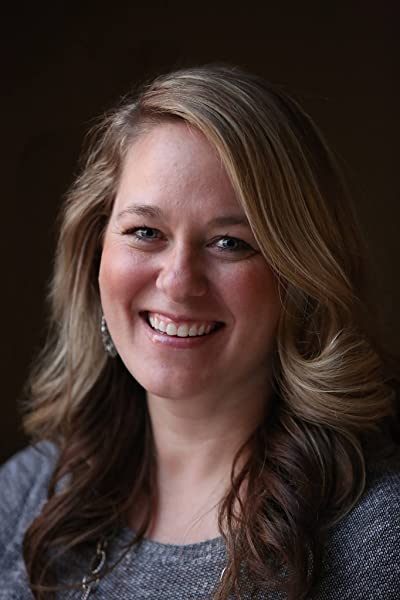
Kimberly and her college sweetheart Ryan have four amazing kids on earth (Abigail, Jayden, Cooper, and Ellie), and a baby boy waiting for them in heaven. Their daughters have special needs and are the inspiration behind Kimberly’s desire to write. Kimberly enjoys working with senior high girls in their church’s youth program, scrapbooking, reading, and music. You can visit Kimberly at her website, Promises and Perspective.
Subscribe for Updates from Jolene
by jphilo | Mar 12, 2012 | Current Events
We did some mighty fine eating during our Savannah vacation. So fine that I’ve been fighting an unsuccessful battle of the bulge since arriving home last Tuesday. For days, my inner dialogue has been a free-for-all of complaints.
Why did I indulge in so many afternoon snacks, and evening ice cream runs?
Why did the food down south have to be so tempting?
Why didn’t I walk more while we were there?
I was complaining last Thursday when our church secretary sent the following prayer from a dad requesting prayer for his son:
“Jaxson and his mom will be in Omaha for eight weeks, starting Monday, where they will be working on issues with his food aversion. Since coming home last year, his only real source of food has been through his feeding tube and an occasional (when he is in the mood) bottle or a little bit of something solid. When eating, he has constantly gagged. He is on at least four different medications at any one time and taking those at least three times per day. He is on constant oxygen all day, and we have been visited at least three times a week by medical and AEA staff who have been working with Jax on his development. We are definitely praying for success out of this because, to be honest, it is our best and last shot (this is only one of three food aversion clinics nationwide) to get help in getting him off the food pump, g tube, and oxygen and eating right!”
My heart broke for them as I remembered our son’s food aversion as an infant. It hadn’t lasted as long as Jaxson’s, but it had been traumatic. More than that, I knew this family. I interviewed them and told their story in Different Dream Parenting. I sensed God calling me to pray for them for the next eight weeks. And I sensed His gentle chastening, too. Instead of complaining about my battle of the bulge, he called me to thank Him for blessings too often taken for granted.
Thank you, God, that I can chew. Thank you for the ability to swallow, for being able to eat and enjoy food. Lord, make these blessings I take for granted part of Jaxson’s life, too. Amen.

by jphilo | Jan 10, 2012 | Advocacy, Different Dream, Special Needs Parenting
January is EA/TEF Awareness Month.Therefore, each Tuesday post at DifferentDream.com in January is dedicated to raising awareness of the birth anomaly that affects our first child and approximately 1 in every 4000 babies born.
10 Reasons to Mark EA/TEF Awareness Month in January
Last week’s Tuesday post listed 10 reasons to mark EA/TEF Awareness Month. Many of you listed your children (and some EA/TEF survivors listed themselves) as more reasons to mark the month. Thank you so much for sharing your stories and reminding all of us that the EA/TEF family is wide and deep.
EA TEF Awareness Is Why I Write
This week’s post gets up close and personal. (Anybody else out there old enough to remember that slogan from the news coverage from the Winter Olympics way back when?) It’s a piece I wrote in December for a guest post for an author friend of mine, Melissa Tagg, an up and coming fiction writer who is on the verge of publication. (When you read her first book, remember you heard about her at DifferentDream.com first!) She asked me to blog about how my past experiences influence my writing. The resulting post, altered slightly, is a perfect fit for EA TEF Awareness Month. See what you think.
Helping Faith Take Root
My husband came home from work a few weeks before Christmas with good news and bad news. The good news was that a co-worker had just become a grandfather. The bad news was that the newborn boy had a heart anomaly and wasn’t doing well.
“Can I give the family copies of your books?” my husband asked.
Now, you would think my answer must have been an immediate yes. But it wasn’t. I didn’t say a thing because I was busy thinking, “I have given so many books away already. Will anybody ever buy them? Will my writing income ever be greater than the expenses?”
A shocking internal reaction, don’t you think?
Thankfully, dollar signs didn’t hold my thoughts hostage for long. I remembered our son’s first December. Allen was seven months old by then and had endured two Lifeflight helicopter rides, two major surgeries, three hospitalizations, and dozens of medical tests and treatments to correct a type C EA/TEF. He’d recently transitioned from tube feeding to using a bottle to take in the breast milk I pumped for him four times a day. My husband and I were exhausted by lack of sleep, constant worry, and frequent trips to the hospital, a 240 mile round trip from the remote South Dakota town where we lived.
What kept us going?
The encouragement of friends and neighbors in the tiny town where we lived. While Allen was hospitalized for three weeks after his birth, they cleaned our house, cared for our garden, and sent notes. Once we brought Allen home, a pastor and his wife came every week to do a Bible study with us and answer our questions about why a loving God would allow a little baby to endure so much. A local fundraiser in November netted over $1500.
For a town with a population of 92 in a county of about 1500, it was big money!
As Christmas drew closer, the familiar story of a baby in a manger held new meaning to me. For the first time, as the parent of a precious child who had experienced great pain, I understood the magnitude of God’s gift to mankind. He sent his Son to a world stained by sin and evil, even though he knew the pain Jesus our Savior would bear. What joy to be loved by a God willing to sacrifice so much to save us from our sin.
My faith and gratitude grew deep roots that Christmas.
Roots that waited more than two decades to bear fruit. The fruit took the form of two books full of resources and encouragement and answers for parents facing the same exhaustion and doubts we once did. Two books for families like the man who works with my husband.
“Of course,” I said. “Take both books to them.”
The little baby had surgery a few days after that. Today we received word that he’s not getting better. The family is stricken, not up to reading anything. But one day they will start looking for encouragement. One day they will ask hard questions. Depending on the answers they find, their faith will either shrivel and die or take root and grow.
I’m praying that these books will help their roots to grow.
Do you like what you see at DifferentDream.com? You can receive more great content by subscribing to the quarterly Different Dream newsletter and signing up for the daily RSS feed delivered to your email inbox. You can sign up for the first in the pop up box and the second at the bottom of this page.

Save
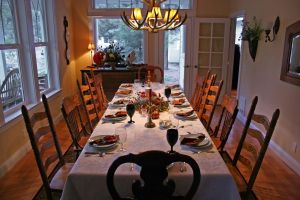
by jphilo | Nov 10, 2011 | Different Dream, Holidays, Special Needs Parenting
Nancy Flanders knows Thanksgiving will be here in a few short weeks. So she’s back today with 6 Thanksgiving survival tips about how to make the day a success for kids with a variety of special needs. Once again her ideas are practical and simple things you can implement before the big day arrives on November 24.
6 Thanksgiving Survival Tips for Special Needs Families
Thanksgiving dinner is perhaps the biggest meal of the year in the United States. We spend most of the day eating, and then we continue to eat the leftovers for weeks. For families of children with special needs, big concerns come to the surface on Thanksgiving. It isn’t just about making the best turkey or pumpkin pie, but keeping our children comfortable, healthy and safe.
Over-Stimulation
For children who are easily over-stimulated, having a plan is the best way to keep the situation from getting out of control. Plan ahead with your child. If you are going to a home he hasn’t been to very often, show him pictures of the home and of the people that will be there. Talk about what the party will be like and what he can expect. Include in your plan, a way for you and your child to escape if a meltdown occurs. Talk to your host about a space in the home where your child can go if he feels overwhelmed. Bring a bag of his favorite things to have on hand during this downtime.
The Child Who Can’t Eat
For people with Prader-Willi Syndrome, overeating can be deadly and Thanksgiving is traditionally a day of overeating. If you are the parent of a child with PWS, you may feel isolated, especially around the holidays. You can go to the family get-together, but you have to have a plan and be vigilant. Make sure your child plays in a different room than where the food is, but try to position yourself so that the food is in your line of sight. Make sure you are the one who makes a plate of food for your child, and have her sit at a table where there isn’t any other food. You can find more tips for your child, your host, or your guest with PWS at the association website.
The Child Who Must Eat
Children with cystic fibrosis must eat up to 150% more calories than their peers every day. So Thanksgiving is a great day for these families, unless of course, your child with CF is too distracted to eat. There’s so much going on that your child may not be able to focus on her food and may just want to get down from the table to play. Try to entice her with her favorite foods. One trick that has worked for my daughter with CF is to put whipped cream on everything. She seems to dive right in. You can also remove her from the distractions to a quieter area of the home where the two of you can sit and eat together.
The Child with a Feeding Tube
For the child who is fed exclusively by feeding tube, a big family dinner can be tough. If relatives are comfortable having your child tube fed at the table while everyone else eats, there are some Thanksgiving tube feeding recipes you can try. You can also feed your child ahead of time, or if your child is uncomfortable with these options, you can wait to attend the party until after dinner has been served.
The Child with Tics or Outbursts
For children with Tourette Syndrome or non-verbal children who make sudden load noises, Thanksgiving dinner can make some relatives uncomfortable. And when they stare at your child or make comments, it hurts your child. Talk to the host and other party guests ahead of time to explain the situation and remind them that your child faces stares and rude comments every day, and you and she are both excited to be at dinner with understanding family members. Offer them your best advice for having patience with stuttering and not reacting when a child has an outburst. Give them the knowledge you have gained so that they can handle the situation and your child can feel comfortable.
The Child Who Can’t Get Sick
My family’s biggest issue during Thanksgiving is germs. It’s cold and flu season and people with cystic fibrosis need to avoid respiratory germs. This is a tough topic to bring up when planning a Thanksgiving dinner. Whether the party is at your house, or a relative’s house, you need to make sure everyone understands that they should stay home if they are sick. Inevitably, someone will show up saying he just has a cold. When this happens, you have two choices. You can turn around and leave, which will probably upset your child, or you can stay. If you stay, there are rules you can follow to reduce your child’s chances of getting ill. Keep at least 3 feet away from the person who is sick and the rest of their immediate family. Wash your hands or use hand-sanitizing wipes like Sani-Wipes often. If it is a child who is sick, this makes life a bit tougher. When my daughter was younger, we simply put up a baby gate and kept her in it with a bunch of clean toys. Now that she’s a bit older, we are extra careful to wash her hands and keep certain toys away from the sick child.
Thanksgiving is a holiday that should be celebrated, no matter what special need your child has. Don’t deprive her of family time if you don’t have to. With a little planning and a lot of attention to detail, you and your child can enjoy a traditional Thanksgiving.
Share Your Thanksgiving Survival Tips
Nancy had some great tips. Maybe you have some other tips about specials need not mentioned in this post or simple things that have made a positive difference in the past. Please, we’d love to hear them, so share them in the comment box if you like.
Nancy Flanders is a wife and mother of two girls, one with cystic fibrosis. After her daughter’s diagnosis at just 6 days old, she altered her career path to focus on writing about raising a child with a special health need. She spends any free moment she can find fundraising for a cure for her daughter and volunteering for her hospital’s cystic fibrosis advisory group. Visit Nancy at www.chronicadmissions.blogspot.com and www.parentingsquad.com.
Do you like what you see at DifferentDream.com? You can receive more great content by subscribing to the quarterly Different Dream newsletter and signing up for the daily RSS feed delivered to your email inbox. You can sign up for the first in the pop up box and the second at the bottom of this page.