by jphilo | Mar 23, 2011 | Different Dream, In Children, PTSD
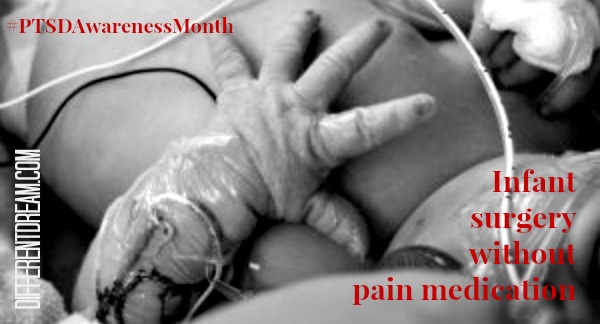
Can You Imagine Infant Surgery Without Anesthesia?
Warning! This post is not for the faint at heart!
At best, it will show you how far pediatric surgery has advanced since the 1950s. At worst, it will make you sick to think of the trauma endured by tens of thousands of babies before 1986.
What Happened in 1986?
1986 was the year the Academy of Pediatric Surgeons changed their infant surgery protocol. Finally, they added pain medication to the paralytic drugs administered to infants going into surgery.
Yes, you read that correctly. Before 1986, babies going into surgery were given a paralytic drug so they would hold still. But they weren’t given pain medication.
Why Not?
Before 1986, the standard belief was that babies didn’t feel pain like adults do. My husband and I know this was their belief because we heard it often from the neonatal intensive care doctors and nurses in 1982. During Allen’s recovery, we knew he received no pain meds. Still, we assumed they’d been administered during surgery. That assumption was wrong.
How About Now?
These days, if your infant or child has surgery, pain medication is in the mix. But there are three decades worth of babies born in the 1950s through 1986 who were deeply traumatized during surgery. Many of them suffer from post-traumatic stress disorder (PTSD), and their lives are in shambles. Our son avoided a ruined life, thanks to the treatment he received at Intensive Trauma Therapy Institute in Morgantown, WV. One of the therapists at the clinic, Dr. Louis Tinnin, recently started a blog about Infant Surgery Without Anesthesia. You can read what he has to say at this link.
What About Those Babies?
If you or someone you know went through infant surgery during the decades of the 50s, 60s, 70s, and early 80s, please pass this information on to them. A life that began with searing pain doesn’t need to be consumed by it. Help is available. I’d be glad to talk to you more about it, so leave a comment if you have questions.
Do you like what you see at DifferentDream.com? You can receive more great content by subscribing to the quarterly Different Dream newsletter and signing up for the daily RSS feed delivered to your email inbox. You can sign up for the first in the pop-up box and the second at the bottom of this page.
Subscribe for Updates from Jolene

by jphilo | May 7, 2010 | Different Dream, Prevention/Treatment, PTSD
For 26 years, my son lived with PTSD caused by early medical surgeries and invasive procedures. Since was successfully treated at the Intensive Trauma Therapy Institute in December of 2008, I’ve been researching the topic. There’s good news and bad news concerning the topic.
Bad News, Good News about How to Trauma Proof Your Child
When our son was born in 1982, we asked doctors and nurses about how the separation from family, surgery, post-op pain, and countless medical procedures would affect him. Over and over, we were told, “He’s so young, he won’t remember.” Research has proven those words to be untrue, but here’s the bad news. Parents of newborns are still being told their children won’t remember early medical treatment. Medical professionals who say that are wrong. What they should be saying is the good news.
Enter, Peter A. Levine and Maggie Kline
The good news is that much medical trauma can be prevented and the rest can be treated early, and in most cases, easily. Two good resources for parents are Trauma-Proofing Your Kids and Trauma Through a Child’s Eyes, both by Peter A. Levine and Maggie Kline. They not only help parents view trauma from a child’s point of view, but also provide ideas about how to prevent trauma and remediation exercises to do with kids when trauma occurs. The second book provides a wealth of information about avoiding trauma at birth, at school, during natural disasters and during medical procedures. They also advise parents about when trauma is serious enough to require professional treatment.
However, neither book deals with the cutting edge theory and treatment coming out of the Intensive Trauma Therapy Institute. If your child is dealing with long-standing trauma issues, visit their website for more information. The healing they do in one week can be miraculous.
If you know of other good trauma therapy resources, please tell us about them.
Do you like what you see at DifferentDream.com? You can receive more great content by subscribing to the quarterly Different Dream newsletter and signing up for the daily RSS feed delivered to your email inbox. You can sign up for the first in the pop up box and the second at the bottom of this page.
by jphilo | Mar 12, 2010 | Different Dream, In Children, PTSD
A recent radio interview with Dr. John Rich caught my ear the other day. He was explaining why he wrote the book, Wrong Place, Wrong Time. After watching young black men stream through Boston City Hospital’s ER with gunshot and knife wounds, he started listening to their stories.
Wrong Place, Wrong Time
He learned that many of the young men were just in the wrong place at the wrong time–maybe at a bus stop or a party and ended up in the line of fire when violence broke out. And it didn’t take much for violence to break out in the highly charged atmosphere where many of the young men lived.
Rich says he ” came to realize that many of the men who had been injured also suffered emotional wounds, similar to those of combat veterans. Symptoms like nightmares and flashbacks contributed to a feeling of jumpiness and unease — and often put these young men at risk for even more violence. When you are hyper-vigilant or jumpy, or always on guard, you can go from 0 to 60 in a very short time. So a young person who is on the bus, somebody steps on his foot and suddenly somebody gets stabbed or shot.”
Post-Traumatic Stress Disorder
My ears perked up at that description. Dr. Rich was describing Post-Traumatic Stress Disorder (PTSD), the condition our son developed after undergoing seven surgeries and hundreds of procedures before he was five years old. His hyper-vigilance and unstable behaviors escalated throughout adolescence. A little over a year ago, he went through a week of intense, one-on-one treatment at the Intensive Trauma Therapy Institute and is now emotionally healthy and stable.
Trauma in the ER
Because of our son’s experience, I found a paragraph in the excerpt of Rich’s book about what the young, black men experienced when in the ER fascinating. He first described ER protocol. “The treatment of trauma is arguably the most highly standardized and choreographed treatment in medicine. There is little room for variation or creativity in the process. As a result, every trauma patient gets the same assessment, the same tests.”
Then, after describing the terrifying ER procedures endured by one young man, he wrote, “Several impressions struck me as I walked out of the emergency department to my car. The first was that in the rush to save this young man’s life, very few words were spoken to him, and he said very few words in return. “I’m cold” were the only intelligible words that I could remember hearing the patient speak.”
What About Little Kids?
After hearing the report, all I could thing was that my son had experiences like that as a baby and toddler. If it’s scary for big, tough guys who already had PTSD from living in a violent world, no doubt repeated trips to the hospital caused and then exacerbated my son’s condition.
If you have a child who endures frequent, invasive medical treatment be aware of the signs of PTSD. Ask to speak to the child life specialist at the hospital about how to avoid and treat it. If you suspect your child has PTSD, visit Intensive Trauma Therapy website for more information about treatment options. Our child was twenty-six before he went through the treatment that changed his life. He wants your child to receive healing much sooner.
To listen to the entire radio interview or read the transcript, the complete story is available at www.npr.org.
Do you like what you see at DifferentDream.com? You can receive more great content by subscribing to the quarterly Different Dream newsletter and signing up for the daily RSS feed delivered to your email inbox. You can sign up for the first in the pop up box and the second at the bottom of this page.
by jphilo | Nov 25, 2009 | Books and Resources, Different Dream, PTSD
For the past few weeks, National Public Radio (NPR) has been airing a series called The Impact of War. While listening to several episodes that described the symptoms of PTSD in returning vets, the similarities to our son Allen’s PTSD symptoms (caused by early, repeated medical traumas from 1982 – 1986) were striking.
An Interview with General Eric Shinseki
In a November 13 interview with retired General Eric Shinseki, who is head of the Department of Veterans Affairs, he talked about an encounter with veterans during a recent speaking engagement. When he asked if any of them suffered from PTSD, no one said anything. So he asked the following questions:
- How many of you have a little trouble sleeping at night?
- Are you overly vigilant for threats in your own homes?
- Have you been having anger management problems?
Then, Shinseki said, “And then hands go up.”
The Sand Storm: Stories from the Front
In a November 14 episode, a clinical psychiatrist named Judith Broder describes her reaction to The Sand Storm: Stories from the Front, which was written by a Marine and featured monologues of those who served in Iraq and Afghanistan.
“The most horrifying aspect of it was the sense that I got that these were really just ordinary everyday guys, and they had seen things and done things that just shattered their whole sense of themselves,” says Broder. “And that they would all need help.” Broder has since started a program to help veterans recover from PTSD.
PTSD in Medically Traumatized Children
What General Shinseki and Broder said described Allen before he was treated for PTSD. For years, our son displayed the symptoms Shinseki mentioned. And as Broder said, he needed help. Thankfully he found help last December at Intensive Trauma Therapy, Inc., an outpatient clinic in Morganstown, West Virginia.
But Allen isn’t the only person struggling with PTSD caused by medical trauma at a young age. If you have a child exhibiting the symptoms above, and you suspect they are related to some sort of trauma (which can include the death of a loved one, divorce, a difficult move, sexual abuse, physical abuse, medical trauma or adoption) go to their website to learn more. Your child doesn’t need to suffer any more. Life-changing treatment is available that doesn’t require drugs or hospitalization in most cases.
After treatment, Allen turned to me and said, “Mom, I have my life back.”
Those were the sweetest words he’d ever spoken. I hope that one day, your child who is suffering from PTSD will say the same words to you.
Do you like what you see at DifferentDream.com? You can receive more great content by subscribing to the quarterly Different Dream newsletter and signing up for the daily RSS feed delivered to your email inbox. You can sign up for the first in the pop up box and the second at the bottom of this page.
by jphilo | Oct 9, 2009 | Different Dream, Prevention/Treatment, PTSD
A few weeks ago Claire Shackelford interviewed me about A Different Dream for My Child. While we talked, I thought about the double whammy military wives with special needs children deal with every day. My only desire was to encourage the moms as they care for their kids.
But as Claire listened to our son’s story, she recognized a second link between my son’s story and the families of combat vets: post-traumatic stress disorder. Claire hopes that the interview, which you can hear at this link, will minister to struggling veterans, their spouses, and children.
Intensive Trauma Therapy, Inc.
If you suspect your special needs child or returning war vet has PTSD, I urge you to visit Intensive Trauma Therapy, Inc’s website and see what they have to offer. Read their literature. Check out their statistics. Call them and see if your loved one can take the diagnostic test and perhaps qualify for treatment.
Our son’s life was changed after a week of outpatient treatment. Maybe your vet’s life can be changed, too.
Do you like what you see at DifferentDream.com? You can receive more great content by subscribing to the quarterly Different Dream newsletter and signing up for the daily RSS feed delivered to your email inbox. You can sign up for the first in the pop up box and the second at the bottom of this page.
Save
Save