Friendship Dance for Parents in a Special Needs World

Friendship Dance for Parents in a Special Needs World

Friendship Dance for Parents in a Special Needs World

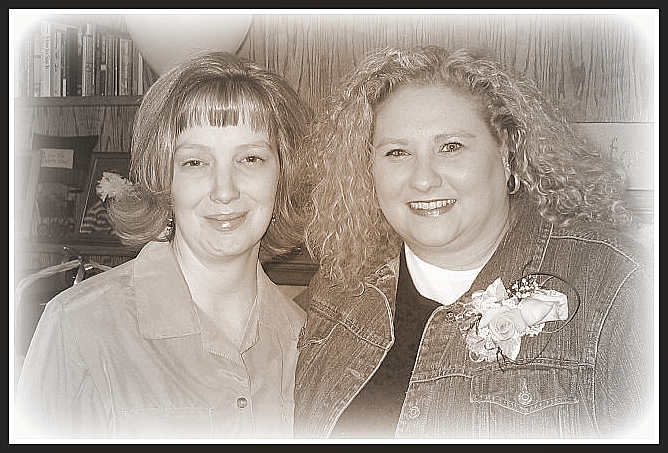
Friendship is a precious gift, something friendship maven and guest blogger Amy Stout knows is truth. Today she reflects upon a friendship that gave her strength as the parent of a child with special needs. Read and enjoy!

Friendship Dance for Parents in a Special Needs World

by Amy Stout

As a woman who has experienced many facets of life that are vastly different from the typical, I learned early on about the beautiful dance of friendship. The dance was not always beautiful.  Sometimes it was awkward, and the music didn’t sound right.  Sometimes, I didn’t have a partner who knew the same dance steps I did. Many times, I was too embarrassed to dance in public—to be “out there” for everyone to see.  I often stood alone just watching others dance.  It was incredibly painful when people would bump into me or step on my feet.

Then one day, I had an extra measure of courage and slowly began to sway to the music.  A fellow dancer approached me and offered: “I don’t know this particular dance, but if you teach me, I’d really like to dance with you”

I began to teach her the steps, how to listen to the music and respond accordingly, and she became sensitive to my methods and technique. We soon were twirling and dancing in rhythm. We felt free and the laughter bubbled forth. Something beautiful emerged from our awkwardness and we found we were able to express ourselves in ways we had never tried before.  The more we rehearsed and danced the more we communed. We learned to speak through the dance and we became kindred spirits.

***

Friendship Resume

The above is a true story. In my short life I have been an oldest child, preacher’s daughter, military wife, and I have experienced infertility, adoption, and parenting a child who experiences special needs. That resume isn’t a very popular one in my circle of influence. There just aren’t many people that can relate to my same life experiences.

More often than not, I was one of those people who, even in a room full of people, felt very alone.

I had a difficult time relating to women that complained about their scads of children when I would have given anything for just one! Yet, I really needed a friend.  Even though I knew the Lord was with me always and my husband loved me fiercely, I desired a female presence in my life.  Arms that could embrace me (other than my husband), a girlfriend that I could really open up and share with honestly.

I prayed for a certain kind of friend.  One whose resume matched mine.

Friendship Provided

But God, in His wisdom, answered my prayer very differently.  He sent someone to me that could not have been any more opposite. She had a houseful of children (I had none), She prefers talking on the phone (I hate the phone), She is amazing at remembering birthdays (and I am not), and the list goes on and on and on…

I received a letter in the mail (and she hates writing).  She began by saying that she had no idea what it was like to experience what I had and was experiencing, but that she would love for me to share it with her (if I felt comfortable).  She promised me a “safe place” to vent all I was feeling and to be completely honest. She was interested in knowing what my struggles and joys were and most of all she wanted to be there for me and uphold me in prayer before our King.

She asked a girl, who had stood on the sidelines of friendship for a LONG time, to dance.  She became my friend.

Our friendship dance is not always perfect or pretty.  Like a ship, the waves of life sometimes bring us close together and sometimes we float apart.  But, I always know she is there.

Friendship Dance for My Daughter

When I struggle with the challenge of teaching my Kylie social skills and how to be a friend.  I think back to the most precious friendship of my lifetime and how it all began:

  • Reaching out selflessly
  • Being willing to learn something new
  • Experience something unfamiliar
  • Being trustworthy
  • Looking for the beauty within and cherishing it

Are You Dancing with a Friends?

Now’s your chance to tell about the friends who dance with you. Leave a comment to brag about the people who support you.

Do you like what you see at DifferentDream.com? You can receive more great content by subscribing to the quarterly Different Dream newsletter and signing up for the daily RSS feed delivered to your email inbox. You can sign up for the first in the pop-up box and the second at the bottom of this page.
By

Amy Stout is a wife, mother, and free-lance writer. You can visit her website at His Treasured Princess.

Author Jolene Philo
Archives

Categories

Subscribe for Updates from Jolene

Related Posts

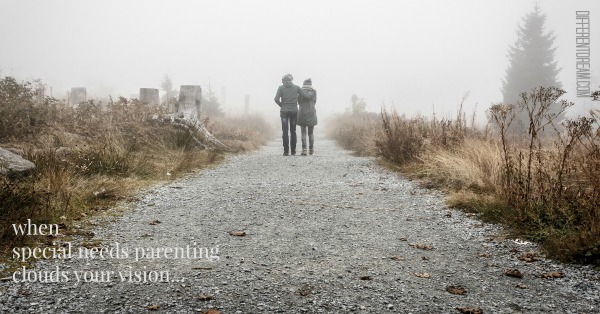
A Faith Lens When Special Needs Parenting Clouds Your Vision

A Faith Lens When Special Needs Parenting Clouds Your Vision

A Faith Lens When Special Needs Parenting Clouds Your Vision

Faith can be a hard thing to hang onto when raising kids with special needs. Today, new guest blogger Michelle Selent writes about recent adventures parenting two daughters with fetal alcohol syndrome that are making it hard for her to keep faith.

Finding My Faith Lens

This post I am about to write is my least favorite kind of post. The kind where I don’t have clear vision. Where a haze is all that is visible in every direction. I wrestle during these times if I should even write, but I am compelled to because someone is out there, maybe not at this moment but maybe coming behind me, that will be where I am at and they will need to know they are not alone. They will need to feel some sense of comradeship.

Finding My Faith Lens in the Midst of School Troubles

I am having a hard time finding my faith lenses. The struggles with the girls have been hard and many lately. To begin, we had to make a school decision that was very hard to make. The Christian preschool we put them in, well… reality set in. Jubilee’s behaviors were described as overwhelming. Our hearts completely sank as once again we were sitting in a meeting about our daughter and hearing the same things once again. Eric wasn’t shocked. I think he prepared himself for reality better than my hopeful Mama’s heart. We felt it was best to decide to go back to public school just for the safety. At the public school, they can’t decide her behaviors are too much. They have to educate her. Everywhere she goes her cuteness fades, reality sets in, and she becomes “that” kid. You know—the one who is exhausting and frustrating and always has issues. Medications have brought no help at this point either. In fact, the side effects are ones I am not willing to inflict upon my child.

Finding My Faith Lens While Potty Training

Potty training remains a complete mystery. I do know how to potty train a child. I mean, I have successfully trained 4 boys in the past, but I am completely stumped with these girls.  A little over a week ago after she had peed on the sidewalk, Jubilee proudly took my hand to show me the puddle then grinned ear to ear and said, “Look, Mommy! I pee pee in the potty.” The dots just don’t connect even if they say and do things that make you think they are connecting, because the next day it will be like starting completely from scratch.

We just came back from a four-day getaway as a family, and I feel like I was beat and left for dead. I cannot even number the times we looked back to see the girls had once again unbuckled from their car seats and were loose as we were driving. The tantrums were also countless. I just kept my eyes to the ground and would not look anyone in the eyes who I knew were starring at this “inept parent” in front of them.

Finding My Faith Lens Despite Fetal Alcohol Syndrome

The big discouragement came when Jubilee decided to pull her not-a-bit-loose tooth out of her head. I had read about F.A.S. children doing this before, and now we are another statistic. These are just some of the numerous three- and four-year-old challenges we daily face, and I cannot even let my mind think about what teenage challenges might be. The ones I have read about are terrifying.

Hidden disabilities are the worst. Your child looks “normal” and can even say the right things, but the actions don’t line up or follow suit. Sometimes we feel like physical presentations of their disabilities would be easier. Maybe others would be more tolerant and understanding.

Praying for Renewed Faith

My lenses right now are experiential. They are caked with the challenges and the behaviors. I am asking God to clear the debris. For light to shine in the darkness. For a renewed faith perspective and hope.

I once again pray these words over my girls:

For I know the plans I have for you, Jubilee and Mercy, plans to prosper you and not to harm you, plans to give you a hope and a future. Jeremiah 29:11

So even in my hardest struggles, in the deep pits, in the dark…God is here.

Finding Your Faith Lens

Do you understand how Michelle feels? Have you ever felt like she does? Do you feel like she does now? What do you do to renew your faith when all seems dark? Leave a comment.

Do you like what you see at DifferentDream.com? You can receive more great content by subscribing to the quarterly Different Dream newsletter and signing up for the daily RSS feed delivered to your email inbox. You can sign up for the first in the pop-up box and the second at the bottom of this page.

By

Michelle is the mother of two adopted daughters with fetal alcohol syndrome. You can connect with her on Instagram.

Author Jolene Philo

Archives

Categories

Subscribe for Updates from Jolene

Related Posts

Redwood Love Notes at Summer Camp

Redwood Love Notes at Summer Camp

Redwood Love Notes at Summer Camp

Redwood, summer camp, and love notes don’t have anything in common. Unless you’re guest blogger and carpenter Scott Newport. Today, he shares the story of how he used salvaged redwood to stay close to his son Noah, who was at summer camp, and how he’s expanding the idea to help families dealing with hospitalized children or the death of a child.

Summer Camp

I guess Penni must have picked up on some wisdom from other camp moms when she announced her idea of hiding a little love note between Noah’s underwear and his new swim trunks. Noah was nine years old, and this would be his first, week-long camp experience. Not wanting to be out-parented, I also put an envelope in Noah’s suitcase. I just jammed my envelope toward the bottom.

The Envelope

All week I worried if Noah would be homesick and waited for the phone to ring. Friday was here before I knew it. Noah walked into the house, and you could tell he had a good time. Story after story broke from his lips and then I interrupted. “Did you open the envelope?”

“Yea dad,” he replied.

Wondering, I asked, “Well, what did you think?”

“I held it every night before I went to sleep.”

This past week Linda the social worker from Walk With Me called. She asked if I could stop by and see a family at our local hospital. You see, Walk With Me is a pediatric hospice and palliative program, and I am a graduate. Our son, Evan died a couple of years back; I now have a strong passion to help other families on their journey.

The Redwood

Before I went to see them, I wondered what I would say. While working in my wood shop, I remembered the story about Noah and the envelope. I soon found myself taking some old redwood I reclaimed from a deck on Lake Michigan and cutting it up into small pieces about the size of a harmonica. I then split each of those pieces in half, creating a mirror image of the other. In woodworking we call that “book matched,” a technique often used when making fine violins or the interiors of a Rolls Royce.

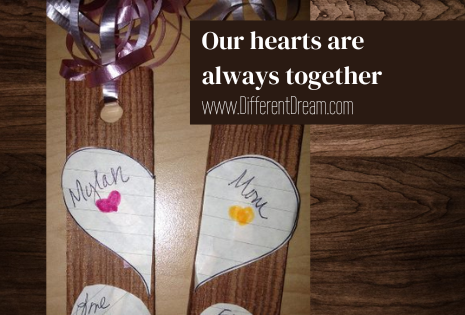
So when Noah opened his envelope, there was no note but a small piece of redwood with all of the names of the other members of our family engraved there: mom, dad, Chelsea, and Evan. On the mirrored piece I kept, I had the name Noah written on it.

You see, I hoped when Noah opened his note from me, he would be reminded of his family. My plan worked. While he was holding onto his each night, I was holding on to mine and then laying it on my bed stand while I slept.

Redwood Transformed

During my visit with the family, I told them about the wood and gave them a sample, asking if they had any ideas how this could help families, especially if a parent had to leave their child. While the dad and I talked, the mom was standing at the nurses’ work desk. Within about fifteen minutes, she had asked for ribbon, a pair of scissors, and some markers. Luckily I had come prepared.

When she was done, she showed me. When she put both pieces together like pages from a book her creation was an assembled heart. Each stick had its own inscription. One side said, “Love ties us together,” and the other “Even when we’re apart.”

I just loved what she had done. I told her to keep it and to send me a picture. I’m hoping this may be a new way to help families who are on the journey of having a child with a life-limiting disease.

Redwood Remembrance

And if you’re wondering, Evan had a piece of redwood too with all our family names on it. My half is still on my bed stand and Evan’s was buried, neatly nestled in his folded hands.

What Do You Think?

Scott’s story gives me goosebumps. I keep thinking of how his redwood idea could minister to so many parents of kids with special needs. How about you? What’s your reaction to his story? How would you like to see the idea used? Leave a comment.

Do you like what you see at DifferentDream.com? You can receive more great content by subscribing to the quarterly Different Dream newsletter and signing up for the daily RSS feed delivered to your email inbox. You can sign up for the first in the pop-up box and the second at the bottom of this page.

By

Scott Newport is a carpenter who has a vision for unwanted, damaged wood. His finds are treasures to his soul. Each discovery he makes unfolds into a beautiful piece of furniture for which he finds a home, usually with a child or caregiver of a child with special needs. He writes about the life lessons he learns from his 3 children, especially from Evan who died in November of 2009 after 7 years of joyful life. To access all of Scott’s guest posts, click on the magnifying glass at the top of the page and type “Scott Newport” in the search box.

Author Jolene Philo

Archives

Categories

Subscribe for Updates from Jolene

Related Posts

Adopting Terminally Ill Children: One Family’s Story, Pt. 3

Adopting Terminally Ill Children: One Family’s Story, Pt. 3

Adopting Terminally Ill Children: One Family’s Story, Pt. 3

Adoption changes families in a myriad of ways. For the past two days, Sue Badeau has been sharing the story of how adopting 20 children. 3 of those children had terminal diagnoses, changed their family. In Part 1, you met Sue and her husband Hector and heard their adoption story. In Part 2, she focused on the experience of adopting children with special needs. Today, in Part 3, Sue shares lessons they learned as they grieved for their sons.

Adopting Terminally Ill Children: One Family’s Story, Pt. 3

Three Lessons Learned

  1. Everyone can heal and grow. Healing and growth may look different for each individual. We may never see the wholeness we are hoping for, but we can continue to work towards it. I learned this lesson at an early age from my grandfather as he showed me how he cared differently for the various plants in his vegetable garden so that each would have the best chance of growing and bearing fruit.  I have come to understand that this analogy also applies to children—they are not all easy to grow, like zucchini, but then, what a boring garden it would be if we grew nothing but zucchini!
  2. There is as much value in the journey as in the destination. I know, I know, it sounds like a worn cliché, but we have found it to be true.  Years ago, we went on a family hike and this message came home to me in a powerful way as I saw my small son Raj, who had been diagnosed with cerebral palsy and told that he would never walk, clambering along the hiking trail with his brothers and sisters.  Years later as we experienced everything from teen pregnancy to a son in prison, I have had to remind myself again and again of this important lesson.
  3. While God does not “fix” everything in the sense of removing all obstacles, curing all diseases, or unlocking all disabling conditions, He does, indeed, make all things new. I learned this after experiencing a car wreck—I still have some scars and there are things I cannot do, yet I was changed by the experience and “made new” in important ways.   And as I think about some my children viewed as most “damaged” by the world—whether physically or emotionally “damaged” by all kinds of brutal early life experiences, turning to drugs, early pregnancies or other outlets for their pain—I know that some people look at them and only see the wreck. But I like to look at them and see them as survivors.  And I am always amazed how, in spite of the “damage” they have sustained, they, through God’s grace and healing power, are able to find amazing new ways to do old things that many of us take for granted—communication, relationships, eating, moving, getting through the day.

Toolkit for Parents Caring for Terminally Ill Children

If I were to try to offer words of encouragement to parents caring for children with severe special needs and terminal illnesses, I would urge them to create a toolkit for themselves to help them make it through the dark times.  Into the toolkit would go at least the following tools:

  • Knowledge – Get as much information about your child’s condition, current state-of-the-art research, and treatment options as you can.
  • Self-care – When on an airplane, the safety instructions include these critical words, “When traveling with a child, put your own oxygen mask on first.”  While this initially seems counterintuitive to parents, it is essential.  You cannot care for anyone if you are out of oxygen yourself.  Feed your soul—make a personal self-care plan and follow it.
  • Intimacy and affection – Nurture your relationships with your spouse and other people in your life that are important to you.  They need you, you need them, and together you will create a strong team (the cord of 3 strands in Ecclesiastes 4:12) to meet the needs of your special child(ren).
  • Anger management techniques – Don’t deny anger when it comes—and it WILL come. Whether you become angry at the disease itself that plagues your child, the health care system, the schools, strangers on the street, yourself, or God, there will be times of anger.  Learning to manage it in ways that are safe and healthy is key to coping with both the life and the grief you will experience on this journey.
  • Play – I can’t say enough about the importance of laughter, silliness, and play with your children, the one who is dying as well as the others.  “Laughter is the best medicine” may sound trite, but it is the gem of a significant truth.
  • Pray – God the Father had to bury his only begotten son.  Surely, he understands and knows our grief.  Talk to him.  And listen to him.

Your Thoughts about Adopting Terminally Ill Children

Now that you’ve read the final installment in this series about adopting terminally ill children, what thoughts do you have? Leave your insights and comments below. To keep up with the Badeau’s future adventures, visit their website at www.badeaufamily.com.

Adopting Terminally Ill Children: One Family’s Story, Part 1
Adopting Terminally Ill Children: One Family’s Story, Part 2

Do you like what you see at DifferentDream.com? You can receive more great content by subscribing to the quarterly Different Dream newsletter and signing up for the daily RSS feed delivered to your email inbox. You can sign up for the first in the pop-up box and the second at the bottom of this page.

By

Author Jolene Philo

Archives

Categories

Subscribe for Updates from Jolene

Related Posts

Adopting Terminally Ill Children: One Family’s Story, Pt. 2

Adopting Terminally Ill Children: One Family’s Story, Pt. 2

Adopting Terminally Ill Children: One Family’s Story, Pt. 2

Adoption is a life-changing decision for every member of the family. Yesterday, in Part 1 of a series about adopting children with terminal illnesses, you met Hector and Sue Badeau. They have 2 birth children, 20 adopted children (that is not a typo), and 3 of those children had terminal diagnoses before adoption. One of those children, Wayne, is pictured above.

Today, Sue focuses on the adoption of their three children with terminal special needs. Tomorrow in Part 3, the final installment in the series, she shares lessons learned during their grief journey.

Adopting Terminally Ill Children: One Family’s Story, Pt. 2

We already had 16 children and a very active, full life when a friend in adoption called one day to tell us about a 3 year old Chinese little boy with a rare terminal illness called Sanfilippo syndrome that needed an adoptive home.  Of course we had never heard of this condition, and so we began to learn about it so we could maybe help find a family for him. We learned that the life expectancy was from 8 to 13 years.   The more we learned, the more we realized how challenging children with this syndrome can be for many families. And, as our friend quickly pointed out, “Wouldn’t he do great in a large family?”

Breaking our Rule to Not Adopt Terminally Ill Children

It didn’t take a lot of phone calls to convince us—Wayne was our son.  He was, in some very real, preordained way, already our son, so now all we had to do was bring him home. Wayne was such a delightful child and we were so glad that we broke our rule about not adopting a child with a terminal illness that within the next 3 years, we added two more terminally ill children to our family—Adam, who had the same disease as Wayne but was also plagued with fetal alcohol syndrome, lead poisoning, and an early life history involving trauma, and Dylan, a shaken baby.

Terminally Ill but Living with Gusto

Wayne lived every day with sheer joy and gusto.  When he was still able to walk, he didn’t.  Walk, that is.  He ran—everywhere.  He was the hardest of the little kids to keep track of, always on the go.  As we looked through pictures, there were several of one of the kids or another—George in one, Jose in another, SueAnn here, Chelsea there—all holding him tightly for a photo; if you didn’t corral him, he’d escape.  Even in the photos where he is just sitting in a chair, you can see the glint in his eye that says, “just you wait” and you can hear his little laugh, as he prepares to break out.  Once, when we lived in Vermont, he escaped in the middle of the night and the milkman came knocking at our door to bring him home at 4 in the morning!

Our Terminally Ill Sons Taught Us True Joy

Adam was the first to die, in 1999, followed by Dylan in 2010.  In April of this year, Wayne, the last of our “3 Musketeers” completed his earthly journey.  Each of our children is unique and enriches our life in their own ways with their individual strengths, gifts, personality quirks, talents, and spirit.  Wayne, more than any other, taught us the true meaning of joy.  As we reminisced about Wayne in the days following his death, the most common words used were smiles, clapping his hands, that laugh, mischievous, wild, always on the go, and always up to something.

Losing a child is an unspeakably devastating experience.  No matter how prepared you think you are, and no matter how deep the roots of your faith, when the moment of death arrives, and the days and weeks of grieving that follow, the pain seems almost bottomless.  No one should ever have to bury a child.  It never feels right.  I know Jesus understood this, which is why he showed such compassion toward parents of children with illnesses or special needs, and one of his early-recorded miracles is restoring the daughter of Jairus’ to life and health.

Life Lessons Learned through Adopting Terminally Ill Children

My husband and I grieved individually and together as a couple.  We grieved as a family, and each of our children also grieved in their own way.  Since most of them had also experienced many losses and traumatic experiences in their younger years, the grief of losing these 3 brothers also triggered painful memories of past losses. This grief, along with the joy and challenges we have experienced raising our children with special needs, has profoundly changed us.  We have learned many important life lessons along the way.  Tomorrow, I’ll summarize a few of them.

What Have You Learned from Your Children?

In today’s post, Sue mentioned lessons her family learned from their sons with terminal diagnoses. But we all learn lessons from our children, be they typical, special needs, or terminally ill. If you like, leave a comment about lessons your children have taught you. Or tell about something you’ve learned from Sue’s story thus far. Come back tomorrow for the final installment in this series about adopting children with terminal illnesses.

Adopting Terminally Ill Children: One Family’s Story, Part 1
Adoption Terminally Ill Children: One Family’s Story, Part 3

Do you like what you see at DifferentDream.com? You can receive more great content by subscribing to the quarterly Different Dream newsletter and signing up for the daily RSS feed delivered to your email inbox. You can sign up for the first in the pop-up box and the second at the bottom of this page.

By

Author Jolene Philo

Archives

Categories

Subscribe for Updates from Jolene

Related Posts

Adopting Terminally Ill Children: One Family’s Story, Pt. 1

Adopting Terminally Ill Children: One Family’s Story, Pt. 1

Adopting Terminally Ill Children: One Family’s Story, Pt. 1

Badeau family at daughter SueAnn’s wedding.

Adoption is a life-changing decision for families, one that required deep thought, discussion, and research. Families that want to adopt children with special needs or terminal diagnoses have even more to think about. Today, Different Dream welcomes Hector and Sue Badeau, parents of 22 children (yup, that’s them in the picture), twenty of them adopted, three of whom had terminal special needs. Over the next three days, Sue tells their family’s story. In Part 1, she leads us through the growth of their family. Part 2 focuses on the adoption of their three children with terminal special needs. In Part 3, she shares lessons learned during their grief journey.

Adopting Terminally Ill Children: One Family’s Story, Pt. 1

My name is Sue Badeau and I am the mother of 22 children.  (It almost sounds like the opening of a joke, with a punch line to come, but trust me, it is very real!)

The Journey of a Lifetime

In 1979 I married my high school sweetheart, Hector, and we began the journey of a lifetime.  He grew up in a blue-collar French-Canadian Catholic family, the 12th of 16 children born to his parents.  Hockey was the center of his life, and because he excelled, hockey provided the ticket out of our small town by way of a college scholarship.  Throughout our dating years we had talked about working together and when we eventually had children, raising them together with equal involvement and participation by both parents.  So, the logical thing to do, of course, was to buy a business less than a month after our college graduations (and a month before our wedding!) The Christian bookstore, Logos, was a wonderful place for us to begin our marriage, grow in our faith, and explore ideas about what we wanted to do in our life.  While still managing the bookstore, we became parents, first to our birth daughter Chelsea, then by adoption when we added our son Jose from El Salvador, and also by foster care when we welcomed a teenage girl into our home.

Life Changing Adoption Choices

Those early career and parenting decisions profoundly shaped our lives.  Guiding scriptural passages during those years included Luke 9:48. “Whoever welcomes this little child in my name welcomes me; and whoever welcomes me welcomes the one who sent me. For whoever is least among you all is the greatest.” And Romans 8:15-16: “ . . . the Spirit you received brought about your adoption to sonship. And by him we cry, ‘Abba, Father.’ The Spirit himself testifies with our spirit that we are God’s children.”  And of course, I Corinthians 4:10: “We are fools for Christ!”

As we adopted and fostered more children, we sold the bookstore, and Hector became the full-time at-home parent while I worked outside of the home in the field of social services.  The last of our children needing full-time round-the-clock care passed away in April, and Hector recently ventured back into the workforce with two jobs, one as the youth program director at our church and the other as an overnight counselor at a local homeless shelter.

From 1980 when our first daughter was born, to 1997 when the last of our adopted children joined our family, we brought home a total of 22 children to form our “forever family” (2 by birth, 20 adopted) and cared for 50 foster children (half special needs infants and half teenagers).  Since that time, we also served as a host family to refugees from Guatemala, Kosovo, and Sudan and our children have blessed us with 35 grandchildren and 5 great grandchildren!

God’s Guidance on the Adoption Journey

God has led us, at times gently and at times quite firmly, along this journey over the years. God planted this motto into our hearts, “Our family would adopt the child most in need of a home, but least likely to get one.”  Initially, we thought that simply meant a child who was no longer an infant (so our first adoption was of a 2 year old boy) but over time, He showed us that this motto included children who had siblings that needed to stay together, children who had experienced significant trauma in their young lives, children with serious health, mental health, and cognitive challenges, children who were already teenagers but still in need of a family.  Through my work, we also helped many children be adopted by other families and part of my work was during the HIV boarder babies crisis in the late 80s and early 90s.  As I placed these terminally ill children into their adoptive homes, I admired these parents deeply but believed in my heart that I could never bear to adopt a child who I would have to later watch die.

Not until a precious little boy named Wayne came along.

What Do You Think of the Journey So Far?

While reading Sue’s story, I have to strong responses. The first is a deep respect for the Christian generosity and compassion Sue and Hector displayed in welcoming these children into their home. The second is a certain knowledge that not all of us—including me—are called or equipped to serve in such a way. But whatever you sense God calling your family to do, please leave a comment about Sue’s story so far. What questions do you have? What encouragement can you offer? What’s been your adoption experience?

If you’d like to read more about the Badeau family, come back tomorrow to meet Hector and Sue’s three very special sons Wayne, Adam, and Dylan.

Adopting Terminally Ill Children: One Family’s Story, Part 2
Adopting Terminally Ill Children: One Family’s Story, Part 3

Do you like what you see at DifferentDream.com? You can receive more great content by subscribing to the quarterly Different Dream newsletter and signing up for the daily RSS feed delivered to your email inbox. You can sign up for the first in the pop-up box and the second at the bottom of this page.

By

Author Jolene Philo

Archives

Categories

Subscribe for Updates from Jolene

Related Posts